
Cross Creeks NWR and the Diving-Duck Story Mid-South Marketing Forgot to Tell
Updated: Jun 12
By Jacob Mishalanie & Thomas Garner, Co-Founders
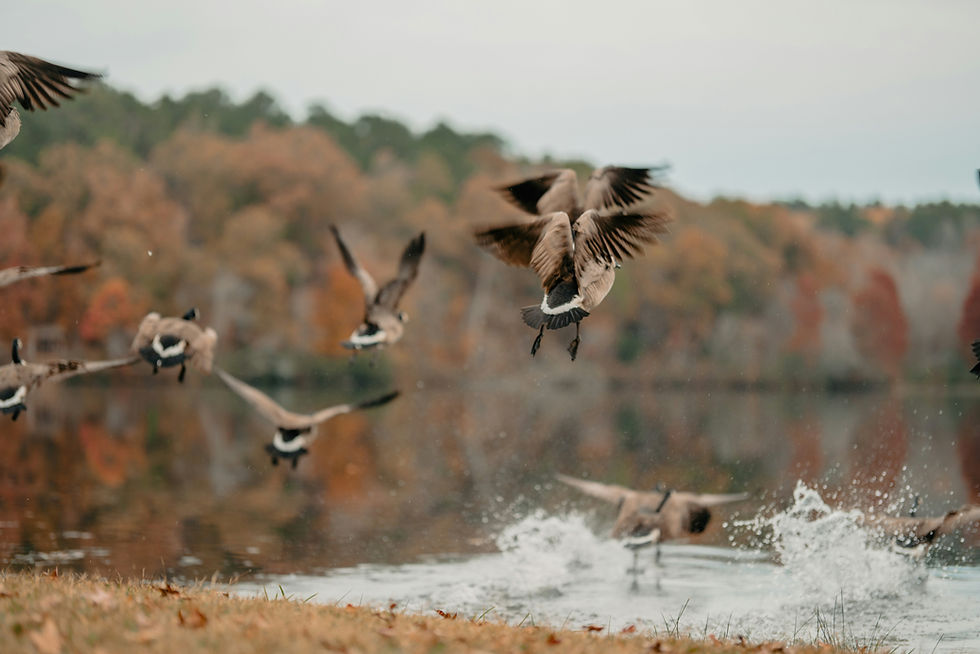
Stand on the Cross Creeks dike at first light in late December, and the silhouettes finishing into the impoundment are not the green-timber mallards Mid-South duck content has trained you to expect. They are canvasbacks coming hard off the Cumberland, fast, low, locked, with redheads and ringnecks behind them and a few buffleheads working the open water past the cattail line. The sanctuary structure built into this 8,862-acre USFWS refuge in Stewart County, Tennessee, established in 1962 as mitigation for Lake Barkley, concentrates a diving-duck flight that the Arkansas Grand Prairie canon does not actually contain. And the operators on the Cumberland-and-Barkley corridor are missing the editorial moment.
That is the marketing position our 09-series Tennessee field briefs and our Aggregator Interception Index converge on. Cross Creeks does not have a dense commercial-operator class. It has a refuge whose sanctuary design caps internal hunting and pushes the action to adjacent private leases and surrounding TWRA-managed waters, and a diving-duck cultural moment driven by Project Upland, Strung, and Modern Huntsman happening without an operator at the center. Operators who position their work as the diving-duck specialist on this corridor, with Cross Creeks as the anchor flyway story rather than the literal hunt water, claim a category that has no current owner.
What the Refuge Is and Why It Exists
The 1962 Barkley Mitigation Origin
Cross Creeks NWR sits in Stewart County, Tennessee, at the confluence where the Cumberland River is impounded into Lake Barkley. USFWS established the refuge in 1962 as mitigation for habitat lost to the Barkley impoundment, which means the refuge's existence is directly tied to the dam-and-reservoir history of the Cumberland system. The refuge wetland units are fed and dewatered on a managed cycle from the Cumberland regulated pool: managed water, managed forage, managed sanctuary structure. This is not a wild river. It is an engineered habitat, and the engineering is the point.
That mitigation origin distinguishes Cross Creeks from most federal refuges in the Southeast. The refuge was not carved from surplus federal land or donated by a conservation trust. It was built because the Army Corps of Engineers flooded thousands of acres of bottomland hardwood and moist-soil habitat when it impounded the Cumberland. The compensatory logic baked into its founding charter means the refuge has always been managed intensively: drawdown schedules timed to shorebird and waterfowl migration, agricultural food plots on a corn-milo-millet rotation, and green tree reservoirs flooded on a calendar that prioritizes wintering waterfowl over any other use.
Habitat Composition and Climate Windows
Habitat composition across the 8,862-acre footprint reads as a managed-cycle layered map. Greentree reservoirs are flooded-hardwood compartments where standing timber is inundated on a controlled schedule to attract dabbling and diving ducks. Moist-soil units alternate between drawdown and flood to support the growth of natural seed-producing plants. Croplands managed for waterfowl forage run on a corn-milo-millet rotation. Bottomland hardwood and upland edge frame the refuge boundary, and Land Between the Lakes National Recreation Area sits immediately to the west.
Climate windows follow a Mississippi Flyway-edge-tier pattern. Waterfowl season runs from November through January, with a December peak that concentrates the diving-duck numbers. Bald eagle wintering runs through the broader Cumberland and LBL corridor from December through February. Spring shorebird migration activates the moist-soil units from March through May. The downstream Cumberland reaches, Cheatham to Cordell Hull, extend the flyway corridor and feed the same migratory pipeline that stages at Cross Creeks.
The Diving-Duck Signature as Competitive Moat
The diving-duck signature is the moat. Canvasback, redhead, and scaup use Cross Creeks in numbers that exceed the inland-Mid-South norm. Canvasback use is particularly notable because the species is selective in its wintering choices: canvasbacks need open water with submerged aquatic vegetation, specifically wild celery and sago pondweed, plus enough depth to dive for tubers. The presence of canvasback in Cross Creek's census records signals habitat quality that the region's marketing language rarely names.
Ring-necked ducks round out the diving-duck cohort and are often the highest-count diver on the refuge, though they receive almost no marketing attention because they lack the canvasback visual drama. Buffleheads work the open water past the cattail line. Lesser scaup stage in rafts on larger open-water impoundments. Together, these species constitute a diving-duck portfolio that most Mid-South waterfowl marketing ignores entirely, because the regional narrative has been built around flooded-timber mallard hunting in the Arkansas Grand Prairie and the Mississippi Delta.
The Sporting Profile: Vertical by Vertical
Diving-Duck Specialty Hunts
Waterfowl is the primary vertical. The refuge runs a limited public-hunting program on designated open units, and the surrounding private and TWRA-managed waters benefit from what we call the refuge flyway-anchor effect: the sanctuary loads birds onto protected waters, and those birds move back and forth to adjacent private leases and public management areas on a daily feeding cycle. The diving-duck specialty, canvasback, redhead, ring-necked duck, and scaup, plus mallard, gadwall, and wood duck on the puddle-duck side, constitute a destination-tier opportunity on the diving-duck identity alone.
The distinction between hunting divers and hunting puddlers matters operationally and editorially. Diver decoy spreads are larger, more open-water-oriented, and use different motion systems than timber-hole mallard sets. Calling is minimal to nonexistent for most diving species. Boat requirements shift from shallow-draft mud boats to layout boats or open-water blinds. The operator who explains these differences credibly on a website, rather than defaulting to generic duck-hunting language, earns a specificity advantage that compounds across every search query.
Birding and Eco-Tourism: The Expanding Cohort
Birding and eco-tourism are co-equal primary verticals. The refuge auto tour, observation platforms, and the regional eagle-and-waterfowl winter draw attract low-six-figure annual visitation dominated by non-consumptive users. The operator class on the eco side is volunteer and Friends-of-Refuge tier, not a commercial outfitter market like the sporting market. But the eco-traveler segment is expanding faster than the hunting segment nationally, and the Cross Creeks corridor has a structural advantage: the LBL adjacency means a birder visiting Cross Creeks in January can add elk viewing at the LBL nature station, bald-eagle watching on Lake Barkley, and dark-sky programming at the LBL planetarium to the same trip.
Whitetail, Fishing, and Turkey
Whitetail is secondary on the refuge itself, limited to an archery program, but the surrounding Stewart County farm-and-timber is destination-class West-Tennessee deer hunting. Multi-species fishing is secondary: refuge open-water reaches feed Lake Barkley, and fishing and outfitters work from the LBL and Barkley side. Turkey is secondary in the surrounding Stewart County. None of these verticals has the editorial-arbitrage potential of the diving-duck identity, but they matter to operators building multi-vertical itineraries.
The Operator Market: Small, Edge-Positioned, and Editorially Under-Claimed
We estimate roughly three to eight small commercial waterfowl operators working private leases adjacent to the refuge boundary, plus a handful of guides who bundle Cross-Creek-edge hunts with LBL or Barkley packages. The refuge sanctuary structure caps visible commercial activity inside it. Private-lease operators, upstream and downstream, absorb most of the demand, and the digital footprint of these operators is, to be direct, functionally near zero in AI search.
The Aggregator Picture
Aggregator dominance reads simply here: USFWS Refuge System pages capture nearly all top-of-funnel for Cross Creeks NWR queries. Friends of Cross Creeks NWR carries the volunteer and outreach tier. Commercial operator visibility at the refuge level is near zero in AI search. There is no FishingBooker layer, no Visit-Stewart-County lodging-and-events crowding. The aggregator-interception risk is mostly USFWS itself, which is structural and not addressable by conventional SEO.
The implication is that an operator who builds the diving-duck-specialist editorial position with Cross Creeks as the flyway anchor, a body of content covering canvasback identification, decoy strategy specific to diving species, the calling differences from mallard, the refuge-and-private-lease integrated calendar of when sanctuary loads birds and when adjacent private waters peak, owns a category that is currently uncontested. There is no incumbent to displace. The category simply does not exist yet in the search layer.
Digital Health and AI Visibility Benchmarks
Across the 2,206 outfitters Pine and Marsh have audited in the Southeast, the mean digital-health score is 5.57 out of 10. Tennessee sits at 5.78 with 22.4 percent AI high-visibility, the mid-to-high digital, low-AI quadrant where structured content compounds fastest. Roughly 80 percent of operators run no schema beyond CMS defaults. 85 percent have no FAQ page. Newsletters have an adoption rate of under 40 percent. The Cross Creeks operator cohort skews lower than the Tennessee mean across all metrics.
Demand Signals and the Trajectory We See
USFWS publishes annual visitation by refuge. Cross Creeks runs in the low-six-figures-of-visits range, dominated by the auto tour and birding traffic. Hunt-program participation is small and quota-controlled. Five-year trajectory: flat for hunting (sanctuary-driven by design, the cap is structural), modestly expanding for birding and eco-tourism, and expanding for diving-duck-specific content demand nationally.
The Diving-Duck Content Boom
The diving-duck content boom is the variable to watch. National waterfowl culture is having a diversification moment. The Project Upland, Strung, and Modern Huntsman aesthetic is pushing past the green-timber mallard canon into more specific stories: sea ducks on the Atlantic, divers on inland refuges, late-season puddlers on flooded grain. Cross Creeks fits that editorial direction precisely. The first operator to publish substantively on Mid-South divers will rank for the search demand the cultural shift generates.
The search-demand signal is split between informational and transactional. Informational queries, things like what diving ducks winter in Tennessee, canvasback habitat requirements, and Cross Creeks NWR bird list, are currently answered by USFWS pages and birding databases. Transactional queries, things like guided diving-duck hunts, Tennessee, and canvasback hunting outfitter near me, return almost no results because no operator has built the content to rank for them. That gap is the opportunity.
AI Search and the Emerging Answer-Engine Layer
AI search engines like ChatGPT, Perplexity, and Google AI Overviews are increasingly the first layer travelers and hunters consult when planning a trip. The current AI answer for Mid-South diving-duck questions defaults to the Chesapeake Bay, the Great Lakes, and occasionally the Mississippi River pool system. Cross Creeks does not appear in AI answers because no operator has published the structured, schema-marked content that AI systems index and cite. The operator who fills this gap earns citations that compound across every AI platform simultaneously.
Regulatory and Conservation Layer
USFWS sets refuge regulations, including the structure of the hunt program. TWRA sets statewide bag limits and seasons that apply to adjacent waters. The regulatory environment is stable, but operators must track both federal refuge-specific rules and state season frameworks, which do not always align on dates.
Conservation organizations on this corridor include Ducks Unlimited, which has substantial CCNWR project history, including wetland restoration and moist-soil-unit enhancement; Friends of Cross Creeks NWR, the volunteer backbone; The Nature Conservancy, working on broader Cumberland watershed issues; and the Tennessee Ornithological Society, which conducts survey work that feeds the birding-database layer.
Pending threats include federal budget pressure on the USFWS national wildlife refuge system maintenance, Asian carp pressure on the Barkley system forage base (a direct threat to the submerged aquatic vegetation that diving ducks depend on), and agricultural runoff loading from the surrounding watershed. The refuge mitigation for Barkley's origin story is a unique editorial territory. Most refuges have origin narratives, but few have the refuge-exists-because-of-the-dam clarity that Cross Creeks has. Operators who explain that history credibly earn depth that pure marketing pages cannot match.
Where the Editorial Whitespace Sits
What an outfitter on the Cross Creeks corridor likely does not have on their website: a diving-duck-as-Mid-South-signature explainer with canvasback and redhead identification, decoy strategy specific to divers, calling differences from mallard, and why this refuge in particular supports the population. A refuge-and-private-lease integrated calendar showing when the sanctuary loads birds and when the adjacent waters peak. A Cross-Creeks-as-LBL-extension positioning piece tying the diving-duck story to the LBL multi-vertical week itinerary.
The Highest-ROI Content Asset
The single highest-ROI content asset is what we have started calling The Diving-Duck Signature of Stewart County: a refuge-history-meets-flyway-ecology piece that no commercial operator currently owns. The piece writes once, ranks for years, and earns AI citations from answer engines that currently default to mallard-centric Mid-South duck framing. It bundles canvasback identification, decoy strategy for open-water diving-duck sets, the 1962 Lake Barkley mitigation origin, and the managed-water ecology that supports the diving-duck population into a single canonical asset.
The Multi-Vertical Itinerary Play
A hunter who came for divers can stay for an LBL bison-and-dark-sky weekend with the family. The refuge sits immediately east of Land Between the Lakes on the Cumberland-Barkley corridor, and the multi-vertical itinerary writes itself: December diving-duck hunt on a private lease adjacent to the refuge, afternoon elk viewing at the LBL Elk and Bison Prairie, evening dark-sky programming at the Golden Pond Planetarium, next-day crappie fishing on Kentucky Lake. No operator currently publishes an integrated itinerary with the duck-hunting duck as the anchor.
What We Would Do Tomorrow If We Worked the Cross Creeks Corridor
Audit and complete the Google Business Profile. Add LocalBusiness, FAQPage, and TouristTrip schema with areaServed properties tied to Stewart County and the Cumberland-Barkley corridor. Build the FAQ around the diving duck-specific question: What is the difference between hunting divers and puddlers? What decoys work for canvasback and redhead at Cross Creeks? When does the refuge sanctuary cycle peak? The bird counts on the adjacent water.
Then publish the diving-duck signature piece as the canonical content asset, with photographs of canvasback bulls in late-December light, decoy spreads built for divers rather than puddlers, and the historical context of the refuge's 1962 mitigation origin. Tie it editorially to the broader Cumberland-and-LBL story, and the multi-vertical itinerary writes itself.
Build a five- to ten-piece pillar-cluster content architecture around the diving-duck identity. The pillar is the Stewart County diving-duck signature piece. Cluster pages cover canvasback identification and behavior, redhead versus canvasback field marks, ring-necked duck as the overlooked diver, decoy-spread design for open-water diving-duck sets, layout-boat versus permanent-blind logistics on the Cumberland corridor, the refuge sanctuary-cycle calendar and its effect on adjacent private water, and the LBL multi-vertical itinerary for families. Each cluster page links back to the pillar. Each earns its own long-tail search traffic.
Secure ten to fifteen authoritative inbound links from Ducks Unlimited chapter pages, Tennessee Wildlife Federation, Stewart County tourism, LBL Association, and regional outdoor media. Eighteen months of maintenance make the category AI-cited and durable against federal-page capture.
The Cultural Moment Is Here
The cultural moment is here. The category is open. The refuge is on the map, and the operators are not. National waterfowl media has moved past the green-timber mallard default and is actively seeking the next specific, place-based story. Cross Creeks NWR, with its canvasback-and-redhead census signature, its 1962 Lake Barkley mitigation origin, and its LBL adjacency, is that story. The first operator to claim it editorially will own a Mid-South diving-duck category with no incumbent.
We will see you on the divers.
Work with Pine and Marsh
Pine and Marsh is a small, owner-operated marketing agency built specifically for the Southeastern outdoor industry, and Cross Creeks NWR is one of the cleanest editorial-arbitrage opportunities in our 2,206-outfitter Southeast audit. The diving-duck cultural moment, driven by Project Upland, Strung, and Modern Huntsman, is happening without a commercial operator at its center along the Cumberland-and-Barkley corridor. The refuge mitigation-for-Barkley origin, the canvasback-and-redhead census signature, and the LBL adjacency together compose a content moat almost no operator currently claims.
The work we do with operators on the Cross Creeks corridor usually starts with a digital audit anchored to our Southeast baseline and a clear-eyed reading of where USFWS Refuge System pages and Friends-of-Refuge volunteer content currently sit on the search layer. From there, we build the technical foundation: schema markup applied specifically (LocalBusiness, FAQPage, TouristTrip) with areaServed properties tied to Stewart County and the Cumberland-Barkley corridor; an FAQ structured around diver-versus-puddler differences, decoy strategy for canvasback and redhead, and the refuge sanctuary-cycle effect on adjacent private water; a Google Business Profile completed past the obvious; and a content body that translates the refuge flyway-anchor effect into pages that rank.
The foundation cluster Pine and Marsh runs for Cross Creeks operators mirrors the Black Camp and Jocassee Lake Tours single-operator-AI-monopoly playbook: GBP optimization, Organization and LocalBusiness and Service schema, an FAQ that answers what diving-duck travelers ask ChatGPT, and five to ten schema-marked pillar pieces. Ten to fifteen authoritative inbound links plus eighteen months of maintenance make the category AI-cited and durable against federal-page capture.
If you operate a private-lease waterfowl program adjacent to Cross Creeks, an LBL-based bundling guide service, or an eco-and-photography operation on the Cumberland-Barkley corridor, that conversation is one we are usually willing to have.
Frequently Asked Questions
Why was Cross Creek NWR established?
USFWS established the refuge in 1962 as mitigation for habitat lost to the Lake Barkley impoundment on the Cumberland River. Its wetland units are fed and dewatered on a managed cycle from the Cumberland regulated pool. It is an engineered habitat by design, and the engineering is what makes the diving-duck signature possible.
What makes Cross Creeks a diving-duck destination?
Sanctuary structure plus managed wetland units concentrate canvasback, redhead, ring-necked duck, and scaup at numbers exceeding the inland-Mid-South norm. Canvasback use in particular signals habitat quality because the species is highly selective about wintering sites, requiring open water with submerged aquatic vegetation.
Can hunters access Cross Creeks directly?
The refuge runs a limited public-hunt program on designated open units. The sanctuary design caps internal hunting and pushes most commercial activity to adjacent private leases and surrounding TWRA-managed waters. This sanctuary-and-overflow dynamic is actually what makes the corridor attractive to operators: the refuge loads birds, and adjacent waters benefit.
How does Cross Creeks fit with Land Between the Lakes?
The refuge is immediately east of LBL on the Cumberland-Barkley corridor. Operators who pitch Cross Creeks divers next to an LBL bison-and-dark-sky family weekend access a multi-vertical itinerary; the LBL-only narrative does not. The integrated positioning is unowned.
What is the diving-duck cultural moment, and why does it matter for marketing?
National waterfowl culture is diversifying past the green-timber mallard canon. Project Upland, Strung, and Modern Huntsman are pushing diver-specific content. Cross Creeks fits the editorial direction and currently has no operator owning the search. The first operator to publish substantively on Mid-South divers claims a category with no incumbent.
What conservation organizations are most active at Cross Creeks?
Ducks Unlimited has a substantial history of CCNWR projects, including wetland restoration. Friends of Cross Creeks NWR carries the volunteer backbone. The Nature Conservancy works on broader Cumberland watershed issues. The Tennessee Ornithological Society conducts survey work feeding the birding-database layer.
What is the highest-ROI content asset for a Cross Creeks corridor operator?
The Diving-Duck Signature of Stewart County: a refuge-history-meets-flyway-ecology piece tying canvasback identification, decoy strategy, and the 1962 Barkley-mitigation origin into one canonical asset. It writes once, ranks for years, and earns AI citations from answer engines that currently default to mallard-centric Mid-South framing.
About the Authors
Jacob Mishalanie is co-founder of Pine and Marsh and a lifelong outdoorsman, gun enthusiast, and nationally-traveled hunter and angler. His career covers large-scale live production and on-property creative direction across the United States.
Thomas Garner is co-founder of Pine and Marsh and a Southeastern digital marketing operator with nearly a decade of analytics, SEO, and AI search work for outdoor and tourism businesses across the 11 states the agency serves.
Pine and Marsh is a small, owner-operated marketing agency built for the Southeastern outdoor industry: 11 states, 10 verticals, 2 co-founders on every engagement. Our research baseline is a 2,206-outfitter Southeast audit and a 09-series field-brief library covering operator-level digital health across every region we work.
Sources: Pine and Marsh Tennessee Cross Creeks NWR brief; USFWS Cross Creeks NWR Comprehensive Conservation Plan and refuge pages; USFWS National Wildlife Refuge System annual visitation summaries; TWRA Region 1 waterfowl regulations and harvest data; Ducks Unlimited project records; Tennessee Ornithological Society survey records; LBL adjacency materials.


Comments