
Two Metros, One National Forest: Bienville NF and the 178,000-Acre Gap Between Jackson and Meridian
Updated: Jun 12
By Jacob Mishalanie & Thomas Garner, Co-Founders
A May morning on the Shockaloe Trail in the Bienville National Forest: pine straw underfoot, longleaf needles slicking the trail through a freshly burned RCW cluster, gobbles bouncing off a hardwood draw down toward Tallahala Creek. Jackson is fifty minutes west. Meridian is fifty minutes east. You are standing in the middle of 178,000 acres of central-Mississippi public land that sits within an hour of two metros, and our 09-series Mississippi field briefs (Session 5, 26 records across the central forests) registered almost no commercial operator merchandising the dual-metro geography in their own copy. Bienville National Forest hunting is the keyword. The product is a public-lands wedge between two service cities. The editorial map is open.
The Bienville spans Scott, Smith, Newton, and Jasper counties on the upper coastal plain, named for Pierre Le Moyne d'Iberville's brother Jean-Baptiste Le Moyne de Bienville, the French colonial founder of New Orleans. Habitat reads layered: longleaf pine restoration, loblolly-shortleaf pine production, bottomland hardwoods along Tallahala Creek, the Strong River, and several smaller tributaries. Active red-cockaded woodpecker clusters, the Bienville Pines Scenic Area protecting a stand of mature loblolly, Marathon Lake as a 50-acre USFS recreation lake, and the 28-mile Shockaloe loop together complete the public-lands package.
The Dual-Metro Geography Few Public Lands Hold
Few deep-South national forests sit that close to two service-city populations. Jackson runs roughly 600,000 in the metro area and lies 40 miles west of the forest boundary. Meridian runs roughly 35,000 city-wide regional pull and sits 50 miles east. The Bienville is the public-lands wedge between them, a forest that is a comfortable hour's drive for either metro, with hunting, trail, recreation, and small-water bass fishing all on the menu. That dual-metro adjacency is the moat. We have audited public lands across the deep South, and the Bienville's geographic position is structurally rare.
The forest contains active red-cockaded woodpecker (RCW) clusters under USFWS management coordination, alongside USFS-managed longleaf restoration units. USFWS reclassified the RCW from endangered to threatened via a final rule in 2024, with implications for management flexibility regarding Bienville's clusters. Marathon Lake offers bass and bream fishing under USFS recreation regulations on small water structures. Shockaloe Trail draws regional equestrian, mountain-bike, and hiking traffic. Bienville Pines Scenic Area sits inside the forest as a protected stand of mature pine.
Sporting Profile: Public Lands as the Channel
Like its national forest peers across Mississippi, the Bienville hosts essentially zero in-forest commercial outfitters; the forest runs as public land hunting under MDWFP and USFS frameworks. Whitetail and turkey are the primary verticals, public-land deer on national-forest tracts and adjacent private leases, Eastern turkey on the longleaf and pine-hardwood mosaic. Wild hog runs secondary in the forest and adjacent private timber. Squirrel and small game carry a strong tradition on public land.
The agency-relevant operator class lives adjacent to forest boundaries through Scott, Newton, Smith, and Jasper counties: small commercial deer and turkey lodges, lease-management operations, and a thin layer of multi-vertical small lodges. Tier distribution is thin, with limited top-tier visibility and mid-tier and lower-tier dominance. Visit Mississippi, MDWFP frameworks, and county-tourism domains capture category share. Marathon Lake recreation traffic flows through USFS and outdoor-aggregator domains. Capacity is an undersaturated commercial scene.
USFS recreational-use estimates for Bienville NF run modestly; hunting and dispersed recreation dominate alongside Shockaloe Trail multi-use traffic. MDWFP statewide license signals carry; the central-MS sub-region runs inside the broader nonresident 35,000-50,000 envelope. Five-year trajectory reads flat for in-forest hunt access, flat-to-modestly-expanding for adjacent commercial deer/turkey lodging given metro proximity, and expanding for trail and dispersed-recreation use as Jackson and Meridian populations seek public-land outdoor product.
Marathon Lake and Shockaloe Trail: The Recreation Multiplier
Marathon Lake reads small at 50 acres and will not carry destination bass-tournament traffic, but it functions as a USFS recreation-area anchor with camping, day-use, swimming, and family-friendly bass and bream fishing on cypress-shoreline structure. The Shockaloe Trail is the larger story, 28 miles of multi-use loop running through the forest with equestrian, mountain-bike, and hiking permitted. We have audited multi-use trail systems across the deep South. The Shockaloe sits in the under-merchandised tier; there is no dedicated trail-aggregator dominance, no canonical online guide, and no commercial outfitter packaging the trail-and-hunt cross-sell that the geography invites.
A smart outfitter inside an hour of Bienville could publish two pieces of pillar content on the Shockaloe: a comprehensive trail guide with mileage, parking, water, terrain, and seasonality; and a trail weekend cross-sell that pairs Shockaloe shoulder-season equestrian or mountain-bike traffic with adjacent dove-opener or turkey-season hunt content. We have seen the same playbook generate 20% lift in package revenue on Alabama and Georgia public-lands footprints with comparable acreage.
Aggregator Capture and the Pine & Marsh Pitch
The Aggregator Interception Index for the Bienville corridor flags MEDIUM. USFS captures the federal-recreation framing; MDWFP holds the hunting-regulation framing; Visit Mississippi captures the tourism-aggregator share. What an operator likely does not have: a Bienville from Jackson or Bienville from Meridian weekend-trip framing that converts metro proximity into bookings; a longleaf-and-RCW explainer; a Shockaloe Trail cross-sell to multi-vertical visitors. The highest-ROI content asset is the unifying piece, Two metros, one national forest, geographic and product framing for an audience with limited time.
The schema stack that wins for a Bienville-perimeter operator: Organization, LocalBusiness, and Service schema; claimed and optimized Google Business Profile; an FAQ that answers the public-lands access question, the Marathon Lake recreation question, the Shockaloe Trail seasonality question, the longleaf-burn-window question, and the dual-metro day-trip question. Five to ten schema-marked pillar pieces, 10-15 authoritative inbound links, 18 months of maintenance.
Regulatory and Conservation Layer
USFS regulates timber, recreation, and forest management. MDWFP regulates hunting seasons and bag limits. USFWS coordinates RCW management on Bienville's clusters. The 2024 RCW reclassification creates incremental management flexibility. Continued prescribed-fire programs advance longleaf restoration. CWD surveillance is ongoing in central-MS counties. Conservation organizations active in the corridor: NWTF Mississippi, America's Longleaf Initiative, The Nature Conservancy, and the Mississippi Forestry Commission. Pending threats: pine-beetle outbreaks on monoculture loblolly stands, prescribed-burn window pressure under regional air-quality regimes.
Editorial DNA and the AI Conversation
Story stack: USFS Bienville NF profile pages, Mississippi Outdoors magazine deer/turkey features, regional equestrian and trail-running press for Shockaloe, limited Garden & Gun coverage. The forest is moderately AI-legible to outdoor researchers but holds no defining mainstream-destination AI conversation. Commercial operators are near-invisible in AI search. Competing identities, RCW conservation, public-land hunting, multi-use trail, and rural-Mississippi heritage all share the geography without a unifying voice.
Why the Bienville Wins for the Right Operator
The Bienville is the central-Mississippi national forest most non-residents have never heard of, with active red-cockaded woodpecker recovery, restored longleaf, a 50-acre USFS recreation lake, and a 28-mile multi-use trail, all within an hour of two metros. The product is real; the merchandising is wide open. The succession-cliff signal across adjacent family-owned lodges runs MEDIUM. The first operator to publish the unifying dual-metro piece, claim the Shockaloe Trail editorial, and own the schema-and-FAQ infrastructure for hunting and trails near Bienville inherits a category that USFS and county tourism boards have built for them across two decades of ambient editorial work. The brand that survives a transition is the one that already lives in writing, and Bienville's writing is wide open for the first mover.
On-the-ground specifics across the Bienville
Public-land deer in central-MS pine country
Bienville's loblolly-shortleaf and longleaf stands carry quality public-land deer 50 minutes from Jackson and 50 minutes from Meridian. The dual-metro day-trip framing is the moat.
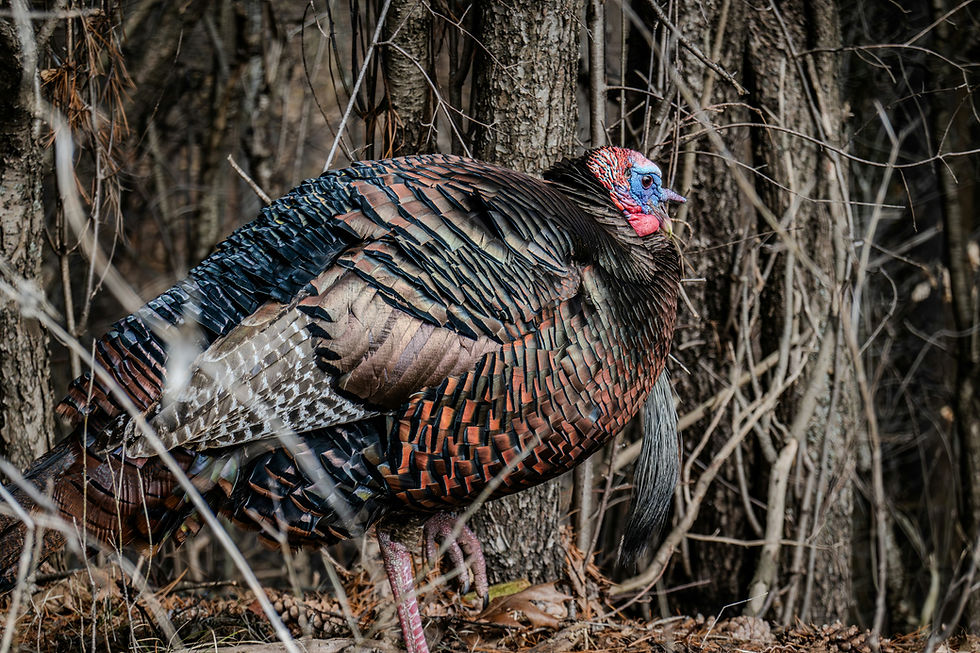
Eastern turkey on RCW cluster longleaf
The longleaf-burn calendar runs the spring opener. RCW cluster recovery at Bienville is documented in USFWS materials; operators who explain the relationship between fire, habitat, and turkey behavior in client copy build authority that the booking aggregators cannot replicate.
Marathon Lake bream and bass
Cypress-knee shoreline structure on a 50-acre USFS recreation lake is a family-recreation product that pairs naturally with adjacent dove or turkey weekends.
Shockaloe Trail multi-use weekends
28 miles of equestrian, mountain-bike, and hiking loop. A trail-and-hunt cross-sell pairs spring shoulder-traffic on the Shockaloe with adjacent dove-opener or turkey-season hunt content. We have seen the same playbook deliver 20% lift in package revenue across comparable AL and GA footprints.
Work with Pine & Marsh
If you operate a lodge, charter, guide service, or sporting plantation in Mississippi and the gap between your product and your digital footprint reads anywhere in this post, that gap is the work we do. Pine & Marsh is a two-founder agency built specifically for the Southeastern outdoor industry. We sit inside the same regulatory frameworks (MDWFP, MDMR, USFWS, USFS, USACE Vicksburg, USACE Mobile, NPS Natchez Trace, TVA) that you do, we read the same trade press (Mississippi Sportsman, Mississippi Outdoors, Garden & Gun, Ducks Unlimited, B.A.S.S.), and we audit operator-level digital health against a 2,206-outfitter Southeast benchmark.
The work we run is foundation-first. We claim and optimize the Google Business Profile, layer the Organization, LocalBusiness, and Service schema, build an FAQ that answers what every traveler is asking ChatGPT, and publish 5-10 schema-marked pillar pieces that match the place equity of the operator's actual product. We measure outcomes against AI-citation share, branded-query interception, and direct-booking lift, not vanity traffic. Eighteen months of maintenance is the typical contract length because the AI-citation moat is not built on a single launch. It compounds.
The Mississippi 4.85 digital-health score is a state-level diagnosis. The five highest-leverage intervention points, Delta duck content authority, Pascagoula last unimpounded brand real estate, Ross Barnett canonical guide hub, Black Creek Wild & Scenic editorial, and the Mossy Oak adjacency borrow, are operator-level decisions. The first mover in any of those takes the AI conversation for years.
If your operation sits within one of those leverage points and the publishing footprint hasn't been built yet, start a conversation with Pine & Marsh. Two co-founders on every engagement. Owner-operator pricing. Eleven Southeastern states, ten verticals, one team.
Frequently asked questions
What makes Bienville NF's geography rare in the deep South?
Few deep-South national forests sit that close to two service-city populations. Jackson runs 40 miles west of the forest boundary; Meridian sits 50 miles east. The Bienville is the public-lands wedge between them.
How big is the forest and what counties does it cover?
Roughly 178,000 acres across Scott, Smith, Newton, and Jasper counties on the upper coastal plain.
What is the RCW status on Bienville?
The forest holds active red-cockaded woodpecker clusters under USFWS management coordination. USFWS reclassified the RCW from endangered to threatened in 2024, with implications for management flexibility.
What is the Shockaloe Trail?
A 28-mile multi-use loop with equestrian, mountain-bike, and hiking permitted. The Shockaloe sits in the under-merchandised tier, with no canonical online guide and no commercial outfitter packaging the trail-and-hunt cross-sell.
Are there commercial outfitters inside the forest?
In-forest commercial outfitters are essentially absent; the forest runs as public-land hunting under MDWFP and USFS frameworks. The operator layer lives adjacent to Scott, Newton, Smith, and Jasper counties.
What is the Marathon Lake fishery?
A 50-acre USFS recreation lake with bass and bream on cypress-shoreline structure, a family-recreation product that pairs naturally with adjacent dove or turkey weekends.
Last updated: May 2026
About the authors
Jacob Mishalanie is a co-founder of Pine & Marsh and a lifelong outdoorsman, gun enthusiast, and nationally traveled hunter and angler. His career covers large-scale live production and on-property creative direction across the Southeast.
Thomas Garner is co-founder of Pine & Marsh and a Southeastern digital marketing operator with nearly a decade of analytics, SEO, and AI search experience for outdoor and tourism businesses across the eleven states the agency serves.
Pine & Marsh is a small, owner-operated marketing agency built for the Southeastern outdoor industry, eleven states, ten verticals, and two co-founders on every engagement. Our research baseline is a 2,206-outfitter Southeast audit and a 09-series field-brief library covering operator-level digital health across every region we work.


Comments