
Marketing a Sporting Operation in Mississippi: The Full State Guide
Updated: Oct 21

Mississippi has a large and engaged hunting community, including a strong tradition of women and families in the field. That matters to operators because it means the Mississippi sporting market is not the narrow, male-dominated demographic many outfitters assume they are marketing to. It is broader and more inclusive, and operators who reflect that in their messaging, imagery and mentored-hunt programming can reach more of the people who already hunt.
That is one example of a broader pattern. Mississippi has outstanding duck hunting in the Delta -- arguably the most important waterfowl migration corridor in North America, running directly through the state's flat agricultural western third. It has a whitetail deer population that produces Boone & Crockett-class bucks. It has a productive Gulf Coast inshore fishery. It has the Ross Barnett Reservoir's well-known bass fishery, Pickwick Lake's year-round striper and smallmouth, and a catfish culture -- centered on Belzoni, the self-proclaimed Catfish Capital of the World -- that is unique to this state.
And yet: in our 2026-27 audit of 88 Mississippi operators, the mean digital health score was 4.39 out of 10, the lowest of the 11 states and about 0.7 points below the 5.09 mean across all 1,546 verified operators. Roughly 49 percent of the Mississippi operators we audited scored 4 or below. That is not a fixed condition. It is an opportunity. An operator building real digital infrastructure in Mississippi right now is working in a state where many audited peers have a lighter online footprint.
Pine & Marsh works across the Southeast, and we have spent time on the ground in Mississippi -- in the Delta, on the Gulf Coast, on the Bass-haunted reservoirs of the central state. We write about marketing the way we talk about it in the field: as practitioners, not theorists. This guide covers Mississippi the same way we would cover it in person: region by region, honestly, with enough specificity to be useful.
The Mississippi Delta: The Heart of American Waterfowl Country
The Mississippi Delta is not what most people think it is when they hear the word "delta." It is not the delta of the Mississippi River -- that is several hundred miles to the south, in Louisiana. The Mississippi Delta is a flat, alluvial plain between the Yazoo and Mississippi rivers, stretching roughly from Vicksburg in the south to Memphis in the north, and it is one of the most remarkable agricultural landscapes in North America. It was built by thousands of years of Mississippi River flooding, depositing deep, fertile topsoil. That soil grows cotton, soybeans, and corn in enormous quantities, and those crops -- harvested and left in the field, flooded by winter rains and intentional water management -- create the waterfowl hunting conditions that have made the Delta famous.
Named Towns and the Delta Sporting Geography
Greenville is one of the largest cities in the Delta and a cultural center for the region. Greenwood, on the Yazoo River, was a major cotton market at the same time the Delta was the center of American waterfowl-hunting mythology. Cleveland, in the central Delta, is home to Delta State University and a tight community of duck hunters who have worked the same fields and sloughs for generations. Clarksdale is the crossroads of American blues and the northern entry point to the Delta from Memphis. Tunica, in the northwestern corner, is home to casino hotels that attract visitors from across the Mid-South. Indianola is the hometown of B.B. King and home to the B.B. King Museum. Belzoni, on the Yazoo River in the heart of the Delta, is the center of Mississippi's catfish aquaculture industry -- the county seat of Humphreys County, which bills itself as the farm-raised catfish capital of the world. Yazoo City sits on the eastern edge of the Delta, where it begins to transition into the hill country.
Each of these towns has a distinct identity and a distinct relationship to the sporting culture. Belzoni's catfish identity - both farmed and wild-caught - is a marketing hook that a guide service on the Yazoo River system could use for positioning. The story of catfish in the Delta, the culture around noodling and trotlining, and catfish tournaments, is a legitimate editorial angle for a freshwater fishing guide operating there.
Named Waterways: The System That Drives the Duck Hunting
The named waterways of the Delta are the structure around which waterfowl hunting is organized. The Sunflower River runs south through the central Delta, passing Indianola, and takes in the Bogue Phalia before it reaches the Yazoo. The Bogue Phalia drains the west-central Delta through farm country where flooded fields can hold mallards from December through February. The Quiver River is another Sunflower River tributary in the central Delta. Deer Creek heads up in Bolivar County and runs south through productive duck country.
For operators working these waterways, the specificity of named creeks and rivers in content is a search-ranking signal and a credibility marker for experienced hunters who recognize those names. A guide who mentions hunting the Bogue Phalia or the Sunflower River backwater sloughs is communicating to potential clients that they know exactly where they are and what they are doing.
The National Wildlife Refuges
Several National Wildlife Refuges protect wintering waterfowl habitat in and around the Delta, including Yazoo, Hillside, Morgan Brake, and Dahomey NWRs. Hunting rules, permits, and any guided or commercial use are set by the U.S. Fish and Wildlife Service and differ by refuge, so check each refuge's official hunting page before writing about any hunt on refuge land.
These refuge boundaries matter for operators because they define the legal framework around which hunting is structured -- and they are also geographic anchors that give content writers named-location specificity. Content that names the Bogue Phalia drainage or a specific refuge is more useful to searchers than a page that says "we hunt the Delta."
Duck Species and the Migration Corridor
The Mississippi Delta sits directly in the Mississippi Flyway -- one of the most heavily trafficked waterfowl migration corridors in North America. During peak migration, the Delta holds large numbers of ducks. Mallards are the signature species -- the big greenheads that define the Delta hunting culture, the birds that fill pintail and gadwall flights as staging backup. Teal -- blue-winged and green-winged -- pass through in enormous numbers in September during the early teal season. Gadwall are abundant in the flooded rice fields and moist-soil impoundments. Pintails are a prized species for many Delta hunters. Wood ducks are year-round residents in the bottomland hardwoods and beaver pond systems throughout the region.
Green-Tree Reservoirs and Flooded Fields
The Delta's waterfowl hunting is organized around two primary habitat types: flooded agricultural fields and green-tree reservoirs. The flooded rice and corn fields of the western Delta produce the high-volume, decoying-bird hunts that draw hunters from across the country. The green-tree reservoirs - impoundments in bottomland hardwood timber that are flooded in fall and drawn down in spring - produce hunting in timber that is unlike any other duck hunting environment.
North-Central Mississippi: Transition Country
The transition zone between the flat Delta to the west and the hilly country to the east is a mixed agricultural and timber landscape. It produces quality deer and turkey hunting as well as a distinct waterfowl market. It is less well known outside the state than the Delta, but it offers hunting that is often more accessible for operators who want to build a business with a broader seasonal calendar -- more deer hunting, more turkey, and enough duck hunting to offer a genuine multi-species operation.
Grenada Lake, a USACE impoundment on the Yalobusha River, is a significant bass and crappie fishery that serves the north-central Mississippi market.
The Mississippi Hills: Northeast MS
Northeast Mississippi is hill country -- rolling timbered ridges and creek drainages that define the Appalachian foothills' influence on the northeastern corner of the state. Tupelo, the birthplace of Elvis Presley, is the regional center. Corinth, near the Tennessee and Alabama lines, is a Civil War battlefield town with significant deer and turkey hunting in the surrounding forests. Iuka, in Tishomingo County, sits near Pickwick Lake and the Alabama line. Oxford, the home of Ole Miss and William Faulkner, is a college town with growing outdoor recreational interests.
Named waterways in northeast Mississippi define both recreational fishing and hunting access: Bear Creek runs through Tishomingo State Park, one of the few places in Mississippi with exposed sandstone outcroppings, a geological anomaly in an otherwise flat state, and a distinct editorial angle for operators working the area. Bay Springs Lake, a USACE project on the Tennessee-Tombigbee Waterway, is a significant bass and crappie lake. Pickwick Lake -- shared between Mississippi, Alabama, and Tennessee -- is a productive year-round fishery, with smallmouth bass, largemouth bass, and striped bass fishing that draws tournament anglers from across the mid-South.
Deer and turkey hunting in northeast Mississippi is driven by mixed pine-hardwood forests and significant private landholdings in Lee, Prentiss, and Tishomingo counties, with public hunting on national forest and state-managed land under MDWFP rules. The proximity to Memphis (less than two hours from Tupelo) and Birmingham (less than three hours) gives operators in this region access to two major metro markets.
Central Mississippi and the Natchez Trace
Ross Barnett Reservoir
The Ross Barnett Reservoir -- a 33,000-acre impoundment of the Pearl River created in 1963 -- is the center of bass fishing culture in central Mississippi. The Jackson metropolitan market makes Ross Barnett a heavily fished bass lake, which in turn creates demand for guided trips that put clients on fish away from the pressure. The reservoir has hosted professional bass tournaments, and the bass fishing -- particularly in the flooded timber of the upper reservoir -- is well regarded.
For operators on Ross Barnett, tournament history serves as a content anchor that attracts search traffic from anglers researching the reservoir. Content that references the specific tournament history, the proven productive areas (the Pearl River channel, the timber points of the upper pool, the bridge structures), and the seasonal patterns provides the kind of expert-signal information that converts well from search to booking.
The Pearl River and Strong River
The Pearl River below the dam is a significant catfish and bass fishery that extends south through Rankin County and into the piney woods. The Strong River, a tributary of the Pearl in Simpson and Rankin counties, offers small-stream bass fishing that is almost entirely unmarketed as a guide product. These tributary systems represent potential differentiation for operators who want to build a product around access and solitude rather than competition with the Ross Barnett pressure.
Jackson: The Corporate Market
Jackson, Ridgeland, Madison, and Brandon form the Jackson metro cluster, the largest metro area in Mississippi. The corporate and healthcare market in Jackson is significant: the University of Mississippi Medical Center, Blue Cross Blue Shield of Mississippi, and dozens of regional corporate employers represent the group-booking and executive-trip market that well-positioned outfitters in the region should be pursuing. Many of the operators we audited in the Central Mississippi and Ross Barnett sub-region did not have a website of their own, so an operator with the kind of professional web and content presence that corporate event planners expect when evaluating vendors has room to stand out.
Southwest Mississippi and the Homochitto
Natchez is one of the oldest European settlements on the Mississippi River and is known for its antebellum architecture. The Homochitto National Forest, southwest of Natchez in Adams and Franklin counties, is public land with deer, turkey, and wild hog hunting under MDWFP and Forest Service rules. The Homochitto and Amite Rivers drain the southwestern corner of the state -- the Amite is a productive bass and catfish river that receives almost no guide-service attention.
Brookhaven and McComb, on the Illinois Central rail corridor in the southwest, are the access points to the Homochitto NF from the south. Wild hog hunting on private land around the Homochitto has genuine national demand - particularly from clients who want a multi-day camp experience in remote bottomland - but relatively few Mississippi operators market it. Guiding on the national forest itself needs a Forest Service special-use authorization.
The Gulf Coast: Mississippi's Undermarketed Saltwater Fishery
The Coastal Cities
Biloxi, Gulfport, Pascagoula, Ocean Springs, and Long Beach form the Mississippi Gulf Coast's urban corridor. Biloxi is the center of the coast's casino economy and attracts visitors from across the mid-South, representing an untapped charter-fishing demographic. Ocean Springs, across the Back Bay from Biloxi, is the cultural and arts center of the coast and has a more affluent, experience-oriented resident population that is a natural market for premium inshore fishing experiences. Pascagoula, on the eastern end of the coast, is an industrial city with a significant shipbuilding workforce and an adjacent river system, the Pascagoula, which is one of the cleanest and most ecologically intact in the Southeast.
Mississippi Sound and the Biloxi Marsh
The Mississippi Sound is a shallow, protected body of water enclosed by the barrier islands (Ship Island, Horn Island, Petit Bois, Cat Island) of Gulf Islands National Seashore. The combination of the Sound's protected waters and the estuary systems feeding it from the north creates exceptional habitat for inshore fish. Redfish and speckled trout are the primary targets -- the grass flats and oyster reefs of the Sound hold fish year-round. Flounder are seasonally abundant, particularly in the fall migration when they stage in the passes between the barrier islands.
The Biloxi Marsh, extending east from Biloxi into the Back Bay and the tidal drainages of Harrison and Jackson counties, is a significant redfish habitat area. The marsh is less well known than the Sound, but it offers consistent sight-fishing opportunities for red drum on shallow flats comparable to anything in Louisiana or coastal Mississippi's western neighbors.
The Pascagoula River estuary -- the mouth of one of the largest undammed river systems in the lower forty-eight states -- creates a massive freshwater-saltwater mixing zone that is genuinely exceptional inshore fishing habitat. The combination of clean freshwater from the Pascagoula watershed and Gulf tidal influence produces redfish, trout, flounder, and sheepshead fishing that has been barely touched by the guide-service industry.
Mississippi Canyon: Offshore World-Class Fishing
Deep-water structure in the northern Gulf of Mexico, from the rigs and wrecks closer in to the Mississippi Canyon well south of the river delta, concentrates pelagic species offshore of the Mississippi coast. Amberjack, red snapper, and grouper are the primary structure-oriented targets, and the seasonally present wahoo, mahi, and yellowfin tuna round out the offshore calendar. The offshore fleet from Biloxi and Gulfport has not developed the same kind of national editorial profile as the Destin or Venice fleets, which means there is a genuine positioning opportunity for operators who can tell the story of the offshore Gulf and the fishing it produces.
Red snapper fishing in the Gulf of Mexico federal waters is subject to the NOAA-managed season, which varies annually and has been a source of significant controversy between the federal management and Gulf Coast states. Mississippi's state-managed offshore red snapper season runs separately from the federal season, creating windows that operators can market when the federal season is closed. Understanding and communicating this regulatory structure clearly is a basic service that most Gulf Coast anglers expect from their guide, but that few operators explain well in their content.
The Piney Woods: South-Central Mississippi
Hattiesburg, Laurel, Collins, and Wiggins anchor the piney woods region of south-central Mississippi. DeSoto National Forest -- about 500,000 acres of longleaf and slash pine across multiple ranger districts -- is the dominant public land in this zone and provides deer, turkey, and wild hog hunting across a large area under MDWFP and Forest Service rules. Turkey hunting in the pine belt is a legitimate pursuit: the Eastern wild turkey subspecies in the piney woods produces birds that respond to aggressive calling and hold well in the open understory of mature pine forests.
The wild hog population in the DeSoto NF and on surrounding private land has grown over the past two decades, and the hog-hunting market has developed nationally. Operators who build a legitimate hog-hunting product with proper private-land access and professional lodging are entering a market with national demand. Rules for hunting hogs on national forest land and at night differ by location, so confirm current MDWFP and U.S. Forest Service rules before promoting any hunt.
Species Deep-Dives
Duck Hunting: The Delta Product
Mississippi Delta duck hunting is the state's most nationally recognized sporting product, and the audit suggests it is also an area where content can still stand out. The Delta sub-region's audited operators mostly had their own websites, but few offered online booking, and across Mississippi only 22 percent of the sites we read showed FAQ content. Deep, specific content around the Delta duck-hunting product is a clear way to separate one operation from another.
The Delta duck-hunting content strategy needs to be built around named waterways, specific habitat types (flooded rice, green-tree reservoirs, moist-soil impoundments), specific species, and specific timing. Content that describes hunting the Bogue Phalia drainage in December for mallards and pintails is more searchable, more credible, and more conversion-efficient than content that says "we hunt the Mississippi Delta."
Delta Waterfowl, one of the two primary waterfowl conservation organizations in North America, does significant research work in the Mississippi Delta and has a strong organizational presence in the region. Alignment with Delta Waterfowl -- co-branded content, event sponsorship, and chapter involvement -- gives Delta duck operators a credibility signal recognized by serious waterfowl hunters across the country.
Whitetail Deer: The Delta and Beyond
Mississippi produces Boone & Crockett-class whitetails, and the Delta is a leading trophy deer zone. The soil fertility of the Delta alluvial plain supports strong natural forage, and the combination of agricultural crops, mature bottomland timber, and managed private land creates the conditions for trophy-class bucks. That reputation drives out-of-state hunter interest.
For operators offering trophy deer hunts in the Delta, the B&C record context is a legitimate marketing anchor. Content that references specific record-class bucks from the region, the history of Delta deer management, and the habitat features that produce trophy bucks provides the kind of expert information that serious whitetail hunters are seeking when researching Mississippi deer hunting.
The deer hunting outside the Delta -- in the hills, the piney woods, and the river bottoms -- is similarly productive, and the hunting pressure per acre is often lower than in the Delta, which is a quality argument for operators working those regions.
Turkey Hunting: A Deep Spring Tradition
Mississippi has a deep spring turkey tradition. Turkey habitat across much of the state, a generous season structure and a cultural tradition of spring turkey hunting have produced strong participation. Yet the guide-service market for Mississippi turkey hunting is thin - most turkey hunting in the state is done by individual hunters on private land without guide involvement. That is a market structure opportunity for operators who can position a guided turkey experience as something distinct from the landowner-hunter model that dominates the market.
The Eastern wild turkey in Mississippi occurs at high densities in the Delta bottomlands, the central hills, the piney woods, and the river corridors. The spring season typically opens in late March, and the combination of mild spring weather and dense turkey populations makes Mississippi a legitimate destination for out-of-state turkey hunters who are willing to travel.
NWTF Mississippi chapters are active throughout the state. The state's strong tradition of women in the field is a resource for turkey operators who want to develop women's mentored hunt programming. The NWTF's Women in the Outdoors program has active involvement in Mississippi, and operators who align with it have access to a built-in audience development pipeline.
Bass Fishing: The Reservoir System
Mississippi's reservoir system is extensive. Grenada Lake, Sardis Lake, Enid Lake, and Arkabutla Lake form the North Mississippi lakes complex -- USACE impoundments on the Yalobusha, Little Tallahatchie, Yocona and Coldwater rivers, all originally built for flood control on the Yazoo-Mississippi Delta system. Each reservoir has a distinct character, and tournament history and coverage give operators search-term context for building content around productive areas.
Pickwick Lake -- the Tennessee River impoundment at the Alabama-Tennessee-Mississippi corners -- is a year-round fishing destination with largemouth, smallmouth, and spotted bass, plus striped bass and crappie. The Pickwick smallmouth fishery is a strong one, and it is shared with Alabama and Tennessee.
Ross Barnett's tournament history and the sustained production of quality largemouth make it one of the best-known bass lakes in the state. The content strategy for Ross Barnett guides should lean into the tournament history, seasonal patterns (pre-spawn flats in March and April, post-spawn timber in May, fall grass beds), and the reservoir's specific geographic character.
Catfish: Belzoni and the Yazoo System
Belzoni's identity as the Catfish Capital of the World is built on both the aquaculture industry -- Humphreys County bills itself as the farm-raised catfish capital of the world -- and on the wild-caught catfish culture of the Yazoo River system. The Yazoo and its tributaries produce blue catfish, channel catfish, and flathead catfish in substantial numbers, and the trotlining and big-water drift fishing culture around these fish is distinctly Mississippian.
For guide operators targeting catfish, the Belzoni connection is a brand anchor -- "we fish the waters that built the catfish capital" is a marketing narrative that connects the guide experience to a place identity that is nationally recognized within the catfish fishing community. The catfish fishing community -- particularly the big-water trotlining and drift-fishing community -- is a significant and underserved niche that most Southeast guide operations ignore entirely.
Inshore Saltwater: Redfish and Speckled Trout
The Mississippi Gulf Coast inshore fishery is undermarketed given its quality. Louisiana and Florida inshore fishing receive much of the Gulf Coast editorial coverage, and Alabama's Mobile Bay fishery has developed a national profile. Mississippi's inshore fishery is productive -- the Biloxi Marsh and Mississippi Sound hold redfish and trout -- but the guide-service marketing is comparatively light.
That underinvestment is an opportunity, just as it is in Delta digital marketing. A content-rich guide service on the Mississippi Sound has room to build search authority for "Mississippi redfish fishing," "Biloxi Bay fishing charter," and "Mississippi Sound inshore guide." Many of the operators we audited on the Mississippi Gulf Coast did not have a website of their own, which suggests that presence has not yet been built. In a more mature market, that window closes. In Mississippi's current digital environment, it is still open.
Wild Hog
Mississippi has a large wild hog population - a consequence of the state's varied habitat and mild climate. The wild hog market has developed nationally over the past decade as hunting outfitters in Texas, Oklahoma, and the Deep South built products around thermal-night hunts and guided hog eradication packages. Mississippi operators have participated less in this market despite having the raw material for an excellent product.
What the 2026-27 numbers say about Mississippi buyers
Outdoor recreation added $4.2 billion to Mississippi's economy in 2024, the lowest total of the eleven Southeastern states, yet it was 2.7% of state GDP, the fifth-highest share, against 2.4% nationally (BEA). It employed 36,605 people. Visit Mississippi counted 45.5 million visitors in 2025 and $12.4 billion of visitor spending, for a total economic impact of $18.9 billion. Those figures cover travel of every kind, so read them as the audience a trip is sold into, not as the size of the guiding market.
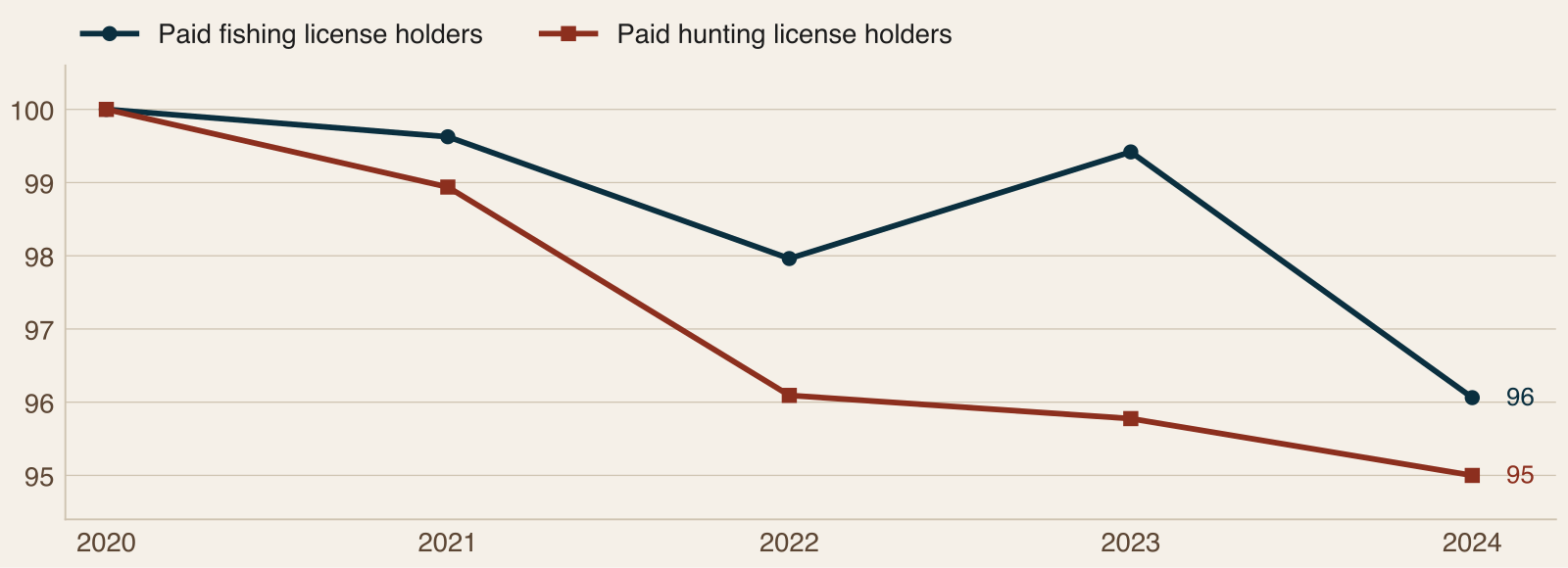
The license base is steady but drifting down. Mississippi had 313,710 paid fishing license holders in 2024, down 3.9% from 326,571 in 2020, and 271,751 paid hunting license holders, down 5.0% from 286,056. The money split is the useful part for an outfitter. Nonresidents bought 22% of hunting licenses, tags, permits and stamps but paid 69% of hunting license revenue, $10.8 million against $4.9 million from residents. In fishing, nonresidents bought 16% of items and paid 32% of revenue. A Delta duck lodge or a deer camp is therefore selling to a small out-of-state buyer who carries most of the license revenue, and that buyer needs travel, lodging and season information explained.
Gulf coast trips, charters and freshwater lakes
NOAA's recalibrated estimates count 3.09 million marine angler trips on the Mississippi Gulf coast in 2025, down 14% from 3.58 million in 2021 and below a 2024 peak of 3.81 million. Shore fishing was 68% of 2025 trips and private and rental boats 31%. Charter boats made only 13,460 trips, 0.4% of the total. NOAA recalibrated every estimate in August 2026, so these figures should not be compared with any published before then. Charter customers spend the most per day: NOAA's 2022 survey put for-hire spending at $169 per angler-day, against $9 for a shore angler and $31 for a private boat, and trip spending supported $73 million in sales impact and about 306 jobs.
Inland, the picture is bigger than the coast. The Corps of Engineers' five Mississippi lakes in the federal visitation report logged 3,320,736 visits in fiscal 2024, 515,960 of them (16%) for fishing. Sardis Lake drew 990,732 visits and Arkabutla Lake 704,455, and Arkabutla had the highest fishing share at 22%. For a bass or crappie guide, that is the audience already on the water.
The 2026-27 calendar to build content around
MDWFP divides the state into four deer management units, Delta, North Central, Hills and Southeast, each with its own antler rules and in places its own dates. Always state the unit when you quote a date.
Deer: archery opens October 1 in the Delta, North Central and Hills units and October 15 in the Southeast unit. Youth gun runs November 7 to 20, gun with dogs November 21 to December 1, primitive weapon December 2 to 15, and gun seasons run into late January, with extra buck-only periods to February 15 in the Southeast.
Spring turkey 2027: youth March 8 to 14, season March 15 to May 2. Nonresidents may not hunt public land before April 1 unless drawn, and are limited to two gobblers a season, only one before April 1.
Ducks: November 27 to 29, December 4 to 6 and December 9 to January 31, six ducks a day. Early teal runs September 19 to 27. Geese run November 13 to 29, December 4 to 6 and December 9 to January 31.
Dove: September 5 to October 4, October 24 to November 22 and December 26 to January 24, daily bag 15.
Wild hog: under state rule hogs are nuisance animals that landowners and leaseholders may hunt year-round on private land, so confirm details with MDWFP before building a hog package.
Harvest context helps with honest copy. The National Deer Association's 2026 report lists 271,289 deer harvested in Mississippi in 2024-25. USFWS estimated a duck harvest of about 274,400 birds in 2024-25, down 28% from 382,600 the season before, a preliminary survey figure with a wide margin, so single-season swings should not headline a marketing page.
Rules and credentials to publish on your site
On MDWFP wildlife management areas, paid guiding and outfitting is barred. The basic WMA rules say no person or group may act as a guide, outfitter or in any capacity for which they are paid or promised payment (40 Miss. Code R. 2-1.1, paragraph W). Describe hunts on private land you control, and do not sell guided WMA hunts.
Gulf charters: a vessel carrying a passenger for hire to fish is a charter vessel under MDMR's Title 22, and its decal is not valid without the proper Mississippi charter license. A captain and crew may not keep a recreational bag limit of spotted seatrout, red snapper or greater amberjack.
Gulf Islands National Seashore: NPS requires a Commercial Use Authorization for charter fishing, motorized boat tours and scuba and snorkeling in park waters.
Natchez Trace Parkway: bicycle tours and charter-bus road tours need a Commercial Use Authorization.
National wildlife refuges: soliciting business or any commercial enterprise needs a special permit.
National forests: selling goods or services, including guiding, needs a Forest Service special-use authorization.
Corps lakes: the report found no rule text to cite, so check with the Corps project office.
A worked example: a Gulf inshore guide should list the Mississippi charter license, the decal, insurance, and any NPS authorization for the seashore on the trip page, and link to MDMR's current catch limits instead of copying numbers, because a March 2026 notice of intent proposes an amendment.
Where audited Mississippi operators stand
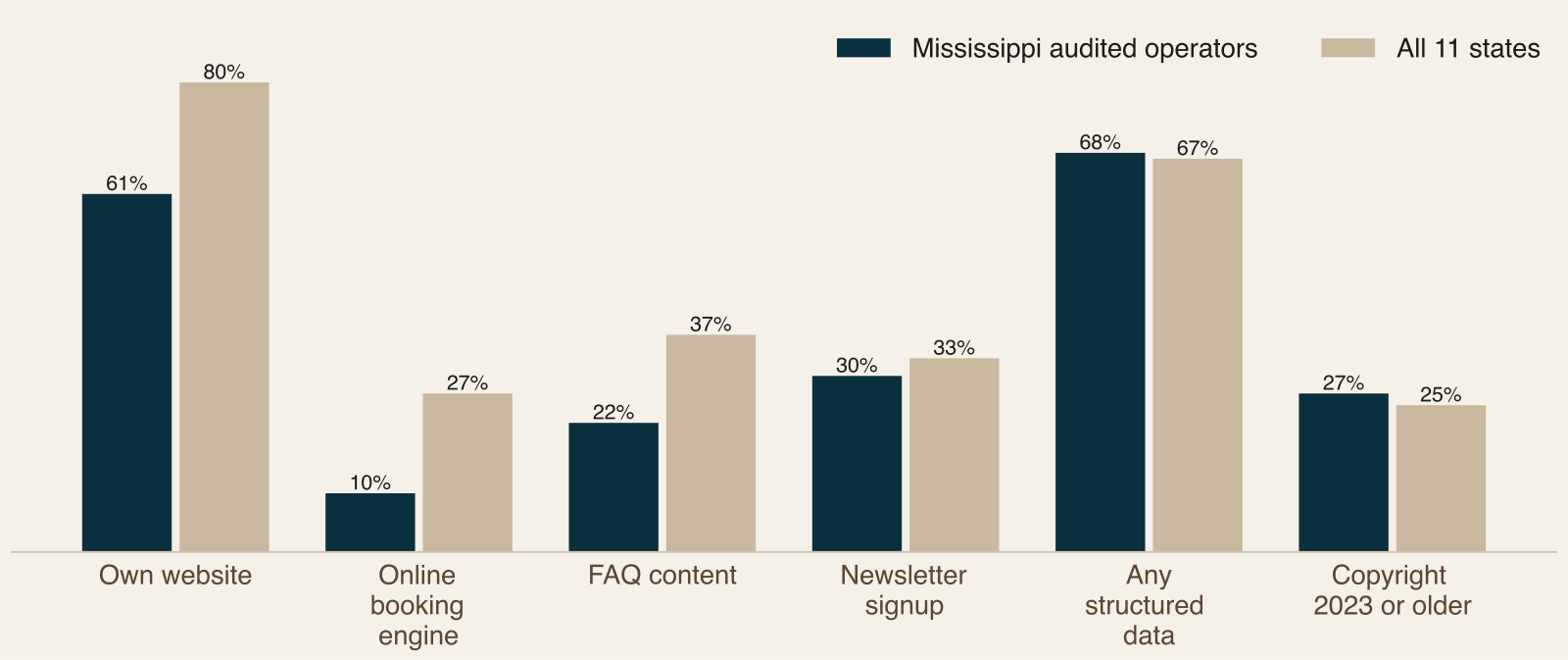
The 88 audited Mississippi operators averaged 4.39, the lowest of the eleven states. Part of the gap is the sample: 20% are top-tier against 32% region-wide, and re-weighting to the region's tier mix would lift the mean to 4.71. The rest holds within tiers, where Mississippi's top-tier operators average 6.50 against 7.06. Only 61% have their own website against 80%, and 49% score 4 or below against 40%.
No Mississippi sub-region has both 15 operators and 10 readable homepages, so none gets a score. The Gulf Coast has 19 operators with five readable homepages, Central Mississippi and Ross Barnett has 14 with four, Pascagoula and Southeast Mississippi has 12 with six, and the Tenn-Tom, Northeast Mississippi and Pickwick area has 10 with seven. The largest categories are inshore and flats fishing (14), bass, crappie and lake fishing (13) and lodging and campgrounds (10). The separate hunting audit counted 34 Mississippi hunting operators with a mean of 5.00 and 100% on their own website, yet only 3% of the 30 sites read showed online booking. By tag, waterfowl led with 14, lodge or multi-program 12, upland and quail 11 and whitetail 6.
The Digital Landscape
Mississippi operators averaged 4.39 out of 10 in our audit - the lowest state average of the 11 states - and 0.7 points below the 5.09 regional mean. About 49 percent of the Mississippi operators we audited scored 4 or below, and 61 percent had their own website. Mississippi's sub-regions are small samples, so we do not rank them, but the individual groups ran from well below the state average around Ross Barnett and Central Mississippi to above it in the Tenn-Tom, Northeast Mississippi and Pickwick area. That changes the competitive dynamic: in many Mississippi categories the audited operators have a light online footprint, so a new entrant who builds real infrastructure has a realistic path to a strong position.
The signals we could measure show where the common gaps are. Of the 40 Mississippi sites we could read, 22 percent showed FAQ content, none used FAQPage schema, 68 percent carried some structured data, and only 10 percent had an online booking engine. Another 27 percent showed a copyright year of 2023 or older. The audit did not measure Google Business Profiles or review solicitation, but those remain sensible parts of the fix. The fix is the same as everywhere: consistent investment in location-specific, practitioner-grounded content over 12 to 24 months.
AI Search in an Underbuilt Market
Mississippi's thin digital infrastructure makes the AI search opportunity particularly sharp. AI search systems surface entities - named businesses, named locations, named activities. The audit did not measure AI visibility, so we cannot say how often Mississippi operators are cited, but the signals AI systems lean on, such as FAQ content and FAQPage schema, were present on only a minority of the Mississippi sites we read. The operator who builds a content-rich, entity-structured web presence in Mississippi right now is writing themselves into the AI search landscape while it is still being constructed.
Content Priorities for Mississippi
Mississippi Delta duck guides and Ross Barnett bass guides work in categories where specific, location-based content can set an operator apart. A focused library of well-built pieces on named waterways, species and seasons, published steadily over a year, is a realistic way to build category authority.
For Mississippi Gulf Coast operators, the longer-term competitive picture will likely include well-resourced competitors from Louisiana and Alabama. Distinctive brand content, built now, gives coastal operators the search authority to hold a position when that competition develops.
Content Calendar: Mississippi
January-February: Late duck season (best of the year in the Delta). Big-water catfish on the Yazoo. Ross Barnett pre-spawn bass are moving. Content focus: late-season Delta ducks, winter catfish, pre-spawn bass pattern preview.
March: Turkey season opens statewide. Pre-spawn bass peak on Ross Barnett and the hill-country reservoirs. Content focus: spring turkey tactics, pre-spawn bass fishing, and booking season for fall deer.
April-May: Turkey season peak. Post-spawn bass. Gulf Coast inshore spring pattern (trout on the grass, redfish on the flats). Content focus: turkey hunting, bass fishing, and Gulf Coast spring guide trips.
June-July: Gulf Coast offshore season (snapper, amberjack). Inshore summer (trout and redfish in the early morning, catfish at night). Content focus: offshore fishing, summer catfish culture, night fishing.
August: Early teal season approaching. Gulf Coast summer peak. Content focus: teal season preview, booking deadline for Delta duck season, Gulf Coast late summer.
September: Early teal season. Deer archery season opens. Content focus: teal hunting, deer season preparation, early Gulf Coast fall fishing.
October-November: Duck season preview and opener. Deer season (gun season in November). Gulf Coast fall inshore peak. Content focus: Duck season opener, trophy buck narratives from Delta, Gulf Coast fall guide trips.
December: Duck season peak in the Delta. Best duck hunting of the year on flooded rice fields and green-tree reservoirs. Content focus: Delta duck hunting, green-tree reservoir guide trips, end-of-year booking for spring turkey.
Conservation Partnerships
Ducks Unlimited Mississippi has a substantial presence across the state, with particular concentration in the Delta. DU has invested significantly in restoring and enhancing wetland habitat in the Delta over the past four decades, and the conservation work is directly connected to the hunting quality that Delta duck operators sell. Delta operators who align with DU Mississippi through chapter involvement, conservation easement participation, or co-branded content have access to one of the most dedicated waterfowl-hunting audiences.
Delta Waterfowl has significant research and policy presence in the Delta and publishes content that reaches serious duck hunters across North America. Operators who contribute to Delta Waterfowl, participate in their nest-box programs, or collaborate on content have access to a national audience that is directly aligned with the Delta duck hunting product.
NWTF Mississippi has active chapters throughout the state. The combination of Mississippi's high turkey participation rate and the NWTF chapter network creates a natural partnership infrastructure for turkey operators.
Mississippi Wildlife Federation is the state's broad-based conservation advocacy organization. MWF membership and event participation build connections with the full spectrum of Mississippi sportsmen -- hunters, anglers, and conservation-minded landowners -- and provide editorial and promotional reach useful for operators working across multiple species verticals.
The Bottom Line
Mississippi is one of the clearest examples in our 2026-27 audit of a state where the quality of the sporting product and the quality of the digital marketing look far apart. The Delta duck hunting is outstanding. The deer hunting is legitimate trophy hunting. The bass fishing is tournament-grade. The Gulf Coast inshore fishery is productive. And the mean digital health score is 4.39 out of 10, the lowest of the 11 states we audited.
That is not a permanent condition. It is a window. The operators who build real digital infrastructure in Mississippi now - location-specific content, genuine Google presence, conservation partnerships, systematic review management - are going to be the operators who hold strong search positions when the market matures. They will have built their positions while many competitors were still relying on word of mouth and Facebook. That window is available to Mississippi operators right now.
We work with the operators who are serious about closing that gap. If that is you, we want to talk.
Pine & Marsh is a southeastern outdoor marketing agency. Jacob Mishalanie and Thomas Garner founded the agency after working in and around sporting operations across the region. Contact us at pineandmarsh.com.
Read the full 2026-27 Mississippi Outdoors report
Pine & Marsh's 2026-27 Mississippi Outdoors report sets public data on the state's outdoor economy, hunters, anglers and public land beside our operator audit. Headline findings:
$4.2 billion of value added in 2024, the lowest of eleven states, yet 2.7% of GDP, the fifth-highest share.
3.1 million Gulf coast angler trips in 2025, down 14% from 2021, with 13,460 on charter boats.
Audited operators trail the region, with a digital health mean of 4.39, the lowest of eleven.
Download the full 2026-27 Mississippi Outdoors report (free with your email).
Frequently Asked Questions
How do Mississippi sporting operators compare online?
The 88 audited Mississippi operators averaged 4.39 out of 10 on digital health, the lowest of the eleven states and 0.7 points below the 5.09 regional mean. Only 61% have their own website against 80%, 49% score 4 or below against 40%, and only 10% of the 40 sites read show an online booking engine against 27%. Part of the gap is sample mix, since 20% of Mississippi's operators are top-tier against 32% region-wide, but it persists within each tier.
Can I guide hunts on Mississippi WMAs?
No. MDWFP's basic WMA rules say no person or group may act as a guide, outfitter or in any other capacity for which they are paid or promised payment for services rendered (40 Miss. Code R. 2-1.1, paragraph W). Individual WMAs add their own rules. Describe guided hunts on private land you control, or on land whose manager authorizes guiding, and state plainly on your site that you do not sell guided hunts on MDWFP WMAs.
What does a Gulf Coast charter need in Mississippi?
Under MDMR's Title 22, a vessel carrying a passenger for hire to fish is a charter vessel, and its decal is not valid without the proper Mississippi charter license. A captain and crew may not keep a recreational bag limit of spotted seatrout, red snapper or greater amberjack. In Gulf Islands National Seashore park waters, NPS also requires a Commercial Use Authorization for charter fishing. Publish the credentials you hold, and link to MDMR's current limits rather than copying them.
How important are out-of-state hunters in Mississippi?
Very, by revenue. In 2024 nonresidents bought 22% of hunting licenses, tags, permits and stamps but paid 69% of hunting license revenue, $10.8 million against $4.9 million from residents. For fishing, they bought 16% of items and paid 32% of revenue. Duck and deer operators selling to travelers should explain lodging, tags, season windows and unit rules clearly, and nonresidents may not hunt public turkey land before April 1 unless drawn.
When do the main Mississippi seasons open?
Deer archery opens October 1 in the Delta, North Central and Hills units and October 15 in the Southeast unit. Early teal runs September 19 to 27, duck season opens November 27 with a split to January 31, and dove opens September 5. Spring turkey 2027 has a youth hunt March 8 to 14 and a season March 15 to May 2. Dates on WMAs, forests and refuges can differ, so confirm with the managing agency.
How big is Mississippi's saltwater fishing market?
Small and mostly shore-based. NOAA's recalibrated estimates count 3.09 million marine angler trips on the Gulf coast in 2025, down 14% from 2021, with shore fishing 68% and private and rental boats 31%. Charter boats made only 13,460 trips, 0.4% of the total, though for-hire spending was $169 per angler-day against $9 for shore anglers. Trip spending supported $73 million in sales impact in 2023. Freshwater is larger: five Corps lakes logged 3.3 million visits.
Why is Mississippi's digital score so low, and is that an opening?
The audit measures how a business presents itself online, not the quality of its trips. Mississippi's sample leans toward the lower tier, and 39% of audited operators have no website of their own, against 20% region-wide. For operators who do build a clear homepage, a booking path and dated FAQ answers, the report treats that as room to grow. Only 22% of sites read carried FAQ content and none used FAQ structured data.
What should a Mississippi operator publish first?
Start with the storefront: what you sell, where you meet, how to book and which permits you hold, working on a phone. The report's six moves then add a booking path, plain FAQ answers marked up for search, the rules you work under, and a dated page for each water, unit and season. Hunting operators should add a season calendar with open dates, because only 3% of audited hunting operators show online booking on the sites read.
Sources
U.S. Fish and Wildlife Service, certified hunting and fishing license data, license years 2020 to 2024
NOAA Fisheries, Marine Recreational Information Program estimate data, recalibrated series
Visit Mississippi (Tourism Economics), 2025 Tourism Economic Contribution Report (published July 2026)
Pine & Marsh Southeast audit, October 2026 (1,546 operators), and the Pine & Marsh hunting audit, October 2026 (493 operators)


Comments