
Inside the 2026-27 Mississippi Outdoors Report: A Small Economy and Room to Grow Online
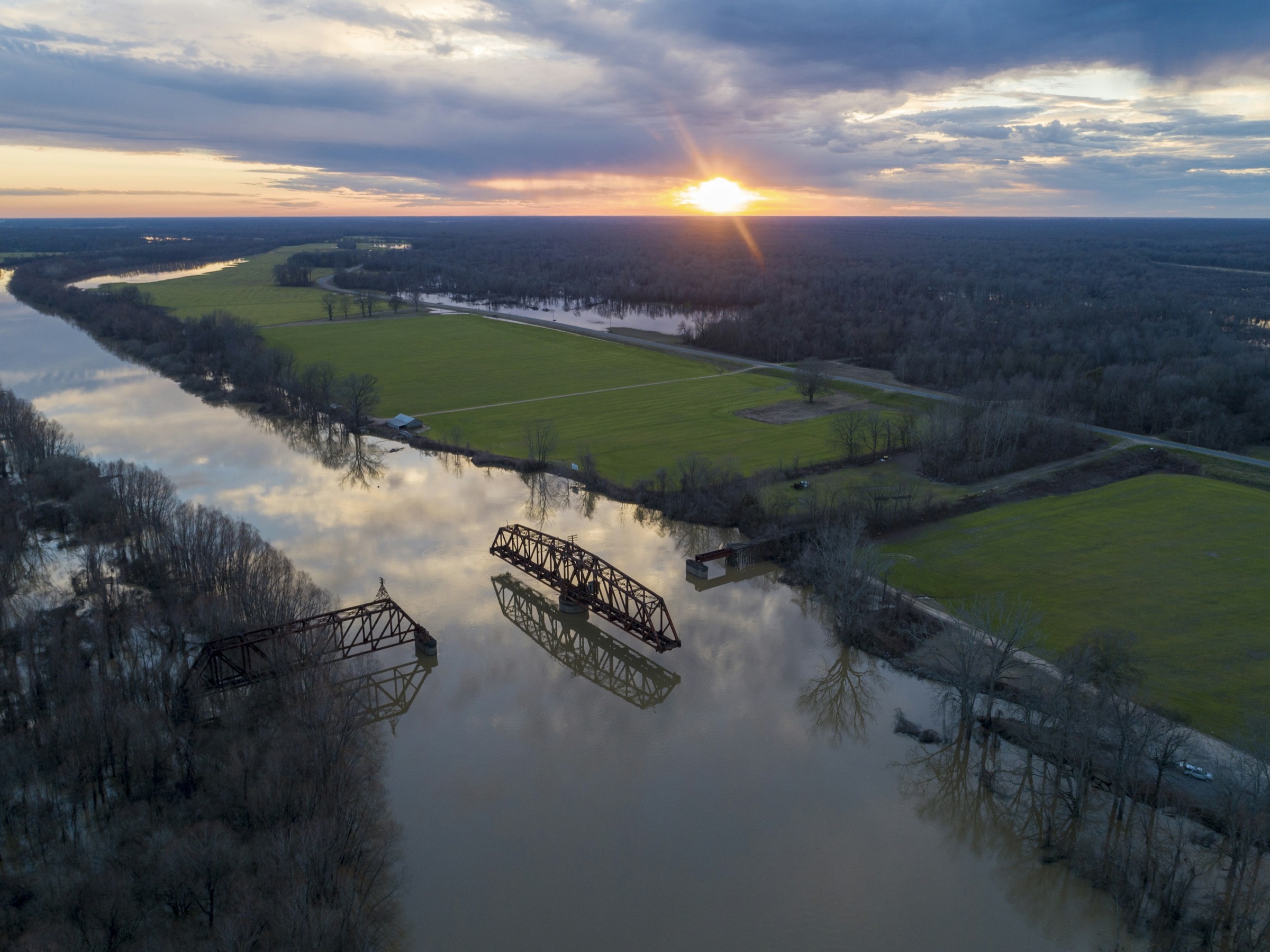
The Mississippi Outdoors report is our 2026-27 state edition for Mississippi. It sets public data from the Bureau of Economic Analysis, Visit Mississippi, the U.S. Fish and Wildlife Service, NOAA Fisheries and the Mississippi wildlife and marine agencies beside our October 2026 audit of 88 Mississippi outfitters, guides, charters, lodges and rental businesses. It is built for the people who run those businesses.
This post walks through the report chapter by chapter, with the numbers that matter and what they mean if you sell trips in the state. For the marketing playbook, see Marketing a Sporting Operation in Mississippi: The Full State Guide.
The Outdoor Economy
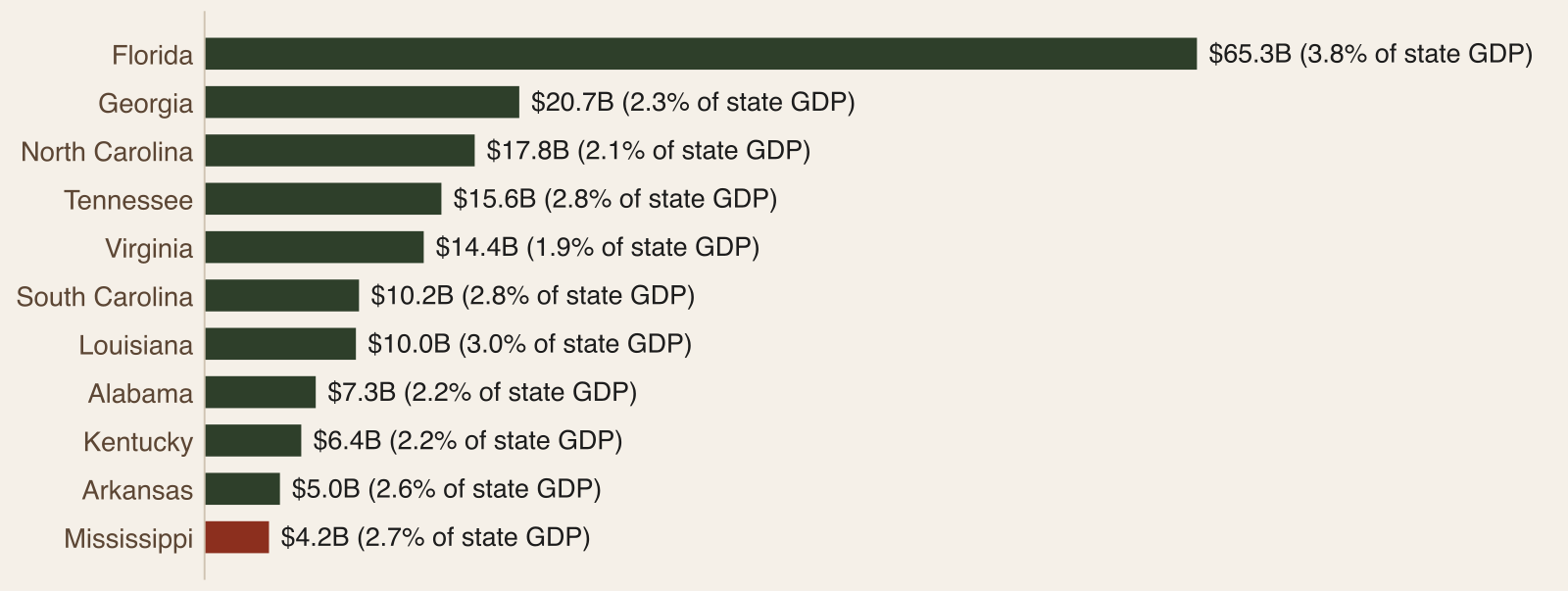
Outdoor recreation added $4.2 billion of value added to Mississippi's economy in 2024, according to the Bureau of Economic Analysis (BEA). That is 2% of the eleven-state Southeast total and 0.6% of the national figure, and it is the lowest of the eleven states. Florida's, the largest, was $65.3 billion. Outdoor recreation employed 36,605 people, 2.9% of wage and salary jobs.
Size and weight are different questions. Outdoor recreation was 2.7% of Mississippi's GDP, above the U.S. figure of 2.4% and the fifth-highest share of the eleven states.
The most detailed activity breakdown is for 2023, from an earlier BEA release, so it is compared only with other 2023 figures:
Mississippi did not rank first in any of the nine activity lines, and its best rank was eighth of eleven, in three lines.
Its largest share of the eleven-state total was in hunting and trapping, at 6%, or $118M.
Water-based guided tours and charters, the line closest to the guide and charter trade, produced $147M, 5% of the regional total.
Visitors are a bigger story than the BEA figure alone. Visit Mississippi counted 45.5 million visitors in 2025 and $12.4 billion of visitor spending, for a total economic impact of $18.9 billion and 137,728 supported jobs. That study counts travel of every kind, not only outdoor trips. The point for an operator is that every first-time guest arrives as one of these visitors first, usually searching from somewhere else.
Southwick Associates' estimates, built on the 2022 national survey, put angler spending at $0.9 billion in 2022 and hunter spending at $0.66 billion. The report never adds BEA value added, tourism impact and spending studies together, because they measure different things.
The 2023 activity table shows where the state is thin and where it is not. Mississippi ranked eleventh of eleven in boating and fishing ($250M), fishing excluding boating ($53M), RVing ($166M) and climbing, hiking and tent camping ($39M). It ranked eighth in water-based guided tours and charters ($147M) and in guided tours and outfitted travel of all kinds ($204M), eighth in hunting and trapping ($118M), tenth in shooting including archery ($81M) and in equestrian ($68M). Within that older vintage, outdoor value added moved from $3.0 billion in 2019 to $2.4 billion in 2020 and $4.0 billion in 2023, up 35% in current dollars. BEA revised the series in March 2026, so the report does not join it to the 2024 figure.
Visit Mississippi's study also counted $4.8 billion of personal income and $1.2 billion in state and local tax revenue. Southwick Associates counted 319,920 anglers supporting about 7,610 jobs, and 274,880 hunters. Target shooting added $0.9 billion from 692,110 participants, a separate and overlapping group.
Hunters and Anglers
Every year the U.S. Fish and Wildlife Service certifies each state's paid license sales. In license year 2024, Mississippi counted 313,710 paid fishing license holders, the lowest total of the eleven states, and 271,751 paid hunting license holders, the fourth-lowest. Per 100 residents, that is 10.6 fishing and 9.2 hunting license holders, the fifth-lowest and fifth-highest densities in the region.
Both series edged down over five years. Fishing license holders were 326,571 in 2020, the high of the period, and fell to 313,710 in 2024, down 3.9%. Hunting license holders fell from 286,056 to 271,751, down 5.0%.
The resident and nonresident split tells a useful story:
In 2024, 16% of fishing licenses, tags, permits and stamps sold went to nonresidents, the fourth-lowest share in the region, though nonresidents paid 32% of fishing license revenue.
Nonresidents bought 22% of hunting items but paid 69% of hunting license revenue ($10.8M against $4.9M from residents).
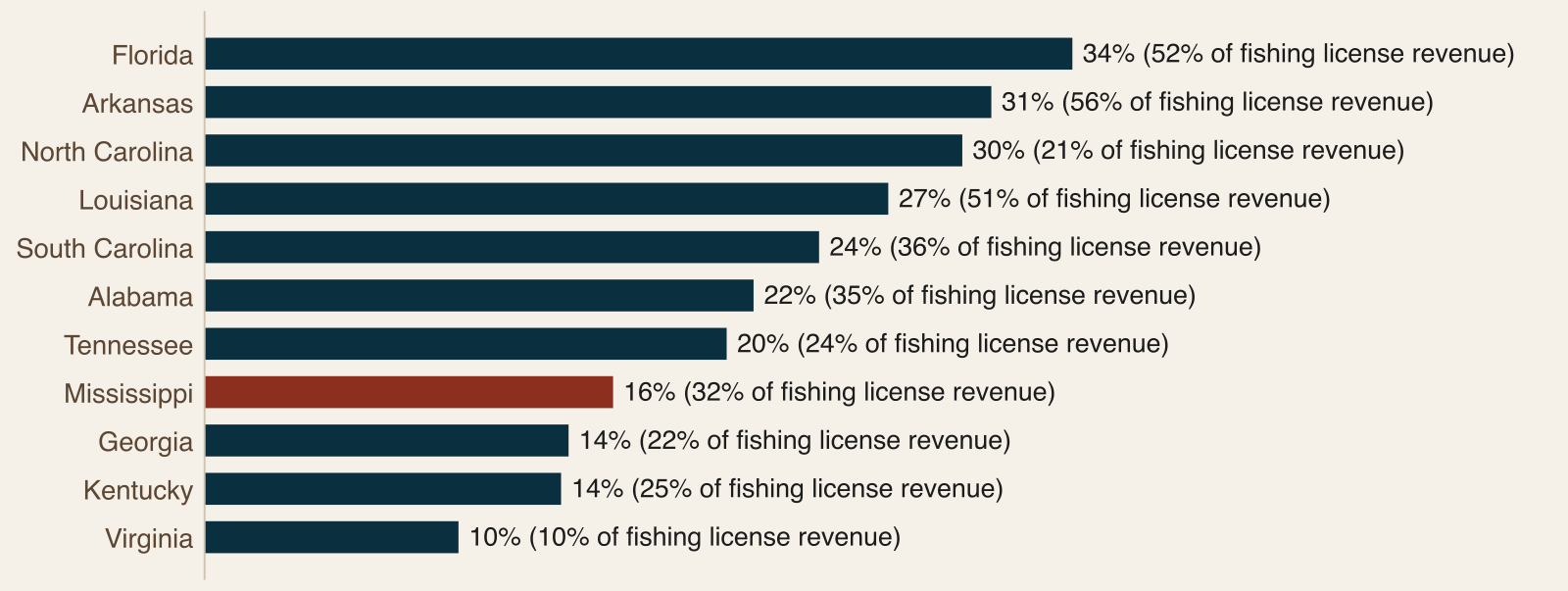
These are items sold, not people, and one person can buy several. Federal surveys give a second window: about 20,200 active duck hunters in 2024-25 (a preliminary estimate) and about 14,100 active dove hunters in 2025-26. Those are survey estimates and should not be added to license counts.
The takeaway: the fishing public is mostly local, since 84% of fishing license items went to residents. The out-of-state hunter is a smaller group by count but a large one by revenue.
The revenue table shows how different the two sports are. In 2024 Mississippi sold 322,883 resident and 61,529 nonresident fishing items, bringing in $4.4 million and $2.1 million. For hunting it sold 321,812 resident and 90,336 nonresident items, bringing in $4.9 million and $10.8 million. Hunting is the only line where nonresidents paid more than twice what residents did, from about a fifth of the items. For an outfitter, that is the case for writing to the traveling buyer.
The Resource and the 2026-27 Seasons
This chapter is a working reference for anyone quoting dates on a website. It starts with deer. The Mississippi Department of Wildlife, Fisheries, and Parks (MDWFP) divides the state into four deer management units: Delta, North Central, Hills and Southeast. Each has its own antler rules and, in places, its own dates. Archery opens October 1 in the Hills, Delta and North Central units and October 15 in the Southeast unit, and gun seasons run into late January.
The National Deer Association's 2026 report lists 271,289 deer harvested in 2024-25, 117,121 antlered and 154,168 antlerless, against 262,830 in 2022-23, up 3.2%. Antlerless deer outnumbered antlered in all three seasons shown.
On birds, USFWS estimated a duck harvest of about 274,400 in 2024-25 (preliminary), down 28% from 382,600 in 2023-24, and a dove harvest of about 367,200 in 2025-26 against 340,200 the season before. Single-season survey swings can be large.
Two rules deserve a line of their own:
Wild hogs are nuisance animals under state rule. Landowners and leaseholders may hunt them year-round on private land, so a guide cannot assume the same dates or license as other game. Confirm the details with MDWFP.
Saltwater limits come from the Department of Marine Resources. Spotted seatrout have a 15 inch minimum and a 15 fish daily limit, and red drum must be 18 to 30 inches, 3 per day. A charter captain and crew may not keep a recreational bag limit of spotted seatrout, red snapper or greater amberjack. A March 2026 notice proposes an amendment, so link to the agency's current pages rather than copying numbers.
The report includes the full 2026-27 calendar for deer, turkey, small game, ducks, geese and doves. Statewide dates do not replace area regulations, so confirm them with the managing agency.
The calendar table gives exact dates. In the Delta, North Central and Hills units, archery velvet runs September 11 to 13 by special permit, archery October 1 to November 20, youth gun November 7 to 20, gun with dogs November 21 to December 1, primitive weapon December 2 to 15, gun without dogs December 16 to 23 and gun with dogs December 24 to January 20. The Southeast unit follows the same pattern from an October 15 archery opener, with buck-only periods February 1 to 15. The deer limit is one antlered buck a day and three a season, four in the North Central unit, and antler rules differ by unit.
Spring turkey 2027 has a youth hunt March 8 to 14 and a season March 15 to May 2, with one gobbler a day and three a season for residents. Nonresidents get two a season, only one before April 1, and may not hunt public land before April 1 unless drawn. A Wild Turkey Stamp is required for non-exempt hunters 16 and older. Ducks run November 27 to 29, December 4 to 6 and December 9 to January 31, early teal September 19 to 27, and geese November 13 to 29, December 4 to 6 and December 9 to January 31. Dove runs September 5 to October 4, October 24 to November 22 and December 26 to January 24, with a daily bag of 15. USFWS also reports a 4.35 percent a year decline in the mourning dove Breeding Bird Survey trend in Mississippi over 2016 to 2025.
The Water
NOAA's Marine Recreational Information Program reports Mississippi as one area, the Gulf coast. Its recalibrated estimates count 3.09 million marine angler trips in 2025, down 14% from 3.58 million in 2021, and 3% of all trips in the seven Southeast states it covers. Shore fishing was 68% of 2025 trips and private and rental boats 31%. The series peaked at 3.81 million in 2024. NOAA recalibrated every estimate in August 2026, so these figures should not be compared with anything published before then.
The charter fleet is small. Charter-boat trips numbered 13,460 in 2025, 0.4% of Mississippi trips. The yearly count ranged from 11,134 to 13,460 over 2021-2025. The charter mode includes offshore trips, and no mode isolates inshore guiding.
What the trips are worth:
Trip spending supported $73 million in sales impact in 2023 and about 306 jobs, 1% of the Southeast's nine coastal areas, the lowest of the nine.
Charter customers spend the most per day: $169 per angler-day on the Mississippi coast, against $9 for the shore angler and $31 for the private boat.
The U.S. Coast Guard counted 131,643 registered recreational vessels in 2024, the lowest of the eleven states, up 5.0% from 2023.
Five Corps of Engineers lakes logged 3,320,736 visits in fiscal 2024, 16% of them for fishing. Sardis Lake and Arkabutla Lake drew 990,732 and 704,455 visits.
For salt water, a vessel carrying a passenger for hire to fish is a charter vessel under Marine Resources rules, and its decal is not valid without the proper Mississippi charter license. The report notes that guiding on public land and water may need a further permit.
The trip table breaks the 2025 Gulf coast count into 2.11 million shore trips, 0.97 million private and rental boat trips and 13,460 charter trips, with a percent standard error of 6.2 on the all-trips estimate. Charter trips were 0.7% of the seven-state charter total. The report notes that headboats are surveyed separately and are not included. Among the Corps lakes, fishing was 16% of visits overall and 22% at Arkabutla Lake, which had the highest fishing share.
Public Land and the Rules for Guides
This is the chapter to read twice. Much of the water and woods a Mississippi guide sells is public: MDWFP's wildlife management areas (WMAs) cover over 700,000 acres on more than 50 areas, and six national forests add about 1.2 million acres, with refuges, a parkway, a national seashore and Corps lakes on top.
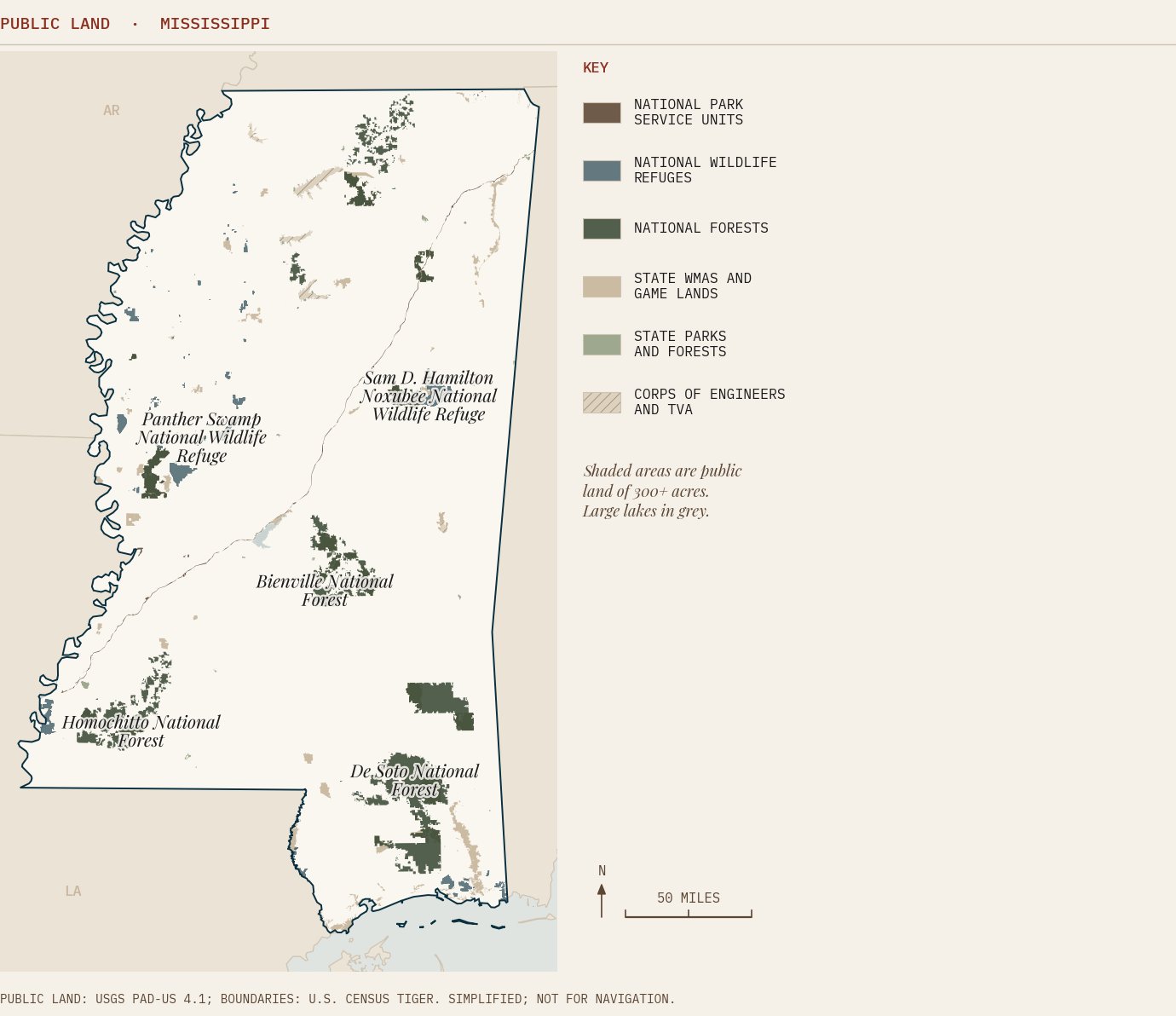
The rules differ by landowner, and one permit does not cover another:
MDWFP wildlife management areas: the basic WMA rules say no person may act as a guide, outfitter, or in any capacity for which they are paid or promised payment. Paid guiding is barred, and individual areas add their own rules.
Gulf Islands National Seashore: the National Park Service requires a Commercial Use Authorization for charter fishing, motorized boat tours and scuba and snorkeling in park waters, Mississippi included.
Natchez Trace Parkway: bicycle tours and charter-bus road tours need a Commercial Use Authorization.
National wildlife refuges: commercial enterprise is prohibited except as authorized by special permit.
National forests: selling goods or services, including guiding, requires a special-use authorization.
Corps of Engineers lakes: rules vary by project, and the report found no rule text to cite, so check with the Corps project office.
An NPS authorization does not cover a refuge, a refuge permit does not cover a forest, and a charter license covers the boat, not the right to operate inside a park or refuge. Confirm with the agency that manages the exact place you plan to guide. The report summarizes published rules and is not legal advice.
Two details help planning. Users must carry a WMA user permit, annual individual or family, on areas not owned by the U.S. Forest Service unless license-exempt. And Holly Springs National Forest has its own deer rules: it is either-sex on gun days when other open public land is legal bucks only, and its buck limit is three a season where it lies in the North Central unit. The Natchez Trace Parkway also states that all commercial bicycle tours, and private groups of 8 or more, must apply for a permit.
The Regions
The audit groups Mississippi's 88 operators into ten sub-regions. Our house rule requires 15 operators and 10 readable homepages before a group gets a mean or percentages, and no Mississippi sub-region meets both. The largest, the Gulf Coast, has 19 operators but only five readable homepages. So this chapter is a map in words, not a league table.
Key points:
The Gulf Coast, Central Mississippi and Pascagoula hold 45 of the 88 operators, 51%. The two coastal sub-regions hold 31, 35%.
The Gulf Coast leans toward inshore fishing (ten operators), with eco-tours and offshore charters at four each. Central Mississippi and Ross Barnett Reservoir is led by bass and crappie guides.
The Tenn-Tom corridor and Pickwick Lake sub-region is led by marinas and boat rental. Pickwick lies in three states, so confirm which state's license and rules apply on your stretch.
The Hill Country, the Delta, the river corridor, the Black Belt, the Natchez Trace and the Yazoo basin share 33 operators. Waterfowl and plantation operations are prominent in the Delta, and cycling tours on the Trace.
Each region carries its own rule notes, from deer management unit lines near Jackson to refuge permits in the Delta and Yazoo basin.
The sub-region counts show how thin each sample is. The Gulf Coast has 19 operators and five readable homepages, Central Mississippi and Ross Barnett 14 and four, Pascagoula and Southeast Mississippi 12 and six, and the Tenn-Tom, Northeast Mississippi and Pickwick area 10 and seven. The Hill Country has nine operators and one readable homepage, the Delta seven and six, the river corridor five and three, and the Black Belt, Yazoo and Big Black rivers and the Natchez Trace four each. Delta operators are mostly waterfowl hunting (three) and upland, plantation and sporting clays (two).
The Operator Landscape
Pine & Marsh audits the online storefronts of private, for-profit outdoor businesses. The Mississippi sample holds 88 operators, part of 1,546 across the eleven states. Their mean digital health score, a 1 to 10 rating assigned by researchers from observed evidence, is 4.39, the lowest of the eleven states, against 5.09 for the region.
Mississippi against the eleven-state benchmark:
Own website: 61%, against 80%.
Score 4 or below: 49%, against 40%.
Online booking engine (sites read): 10%, against 27%.
FAQ content: 22%, against 37%.
Newsletter signup: 30%, against 33%.
Only 40 of the 88 homepages could be read, so booking, FAQ and newsletter rates are lower bounds. None of the 40 mark answers up as FAQ structured data, and 27% of sites with a detectable copyright year still show 2023 or earlier.
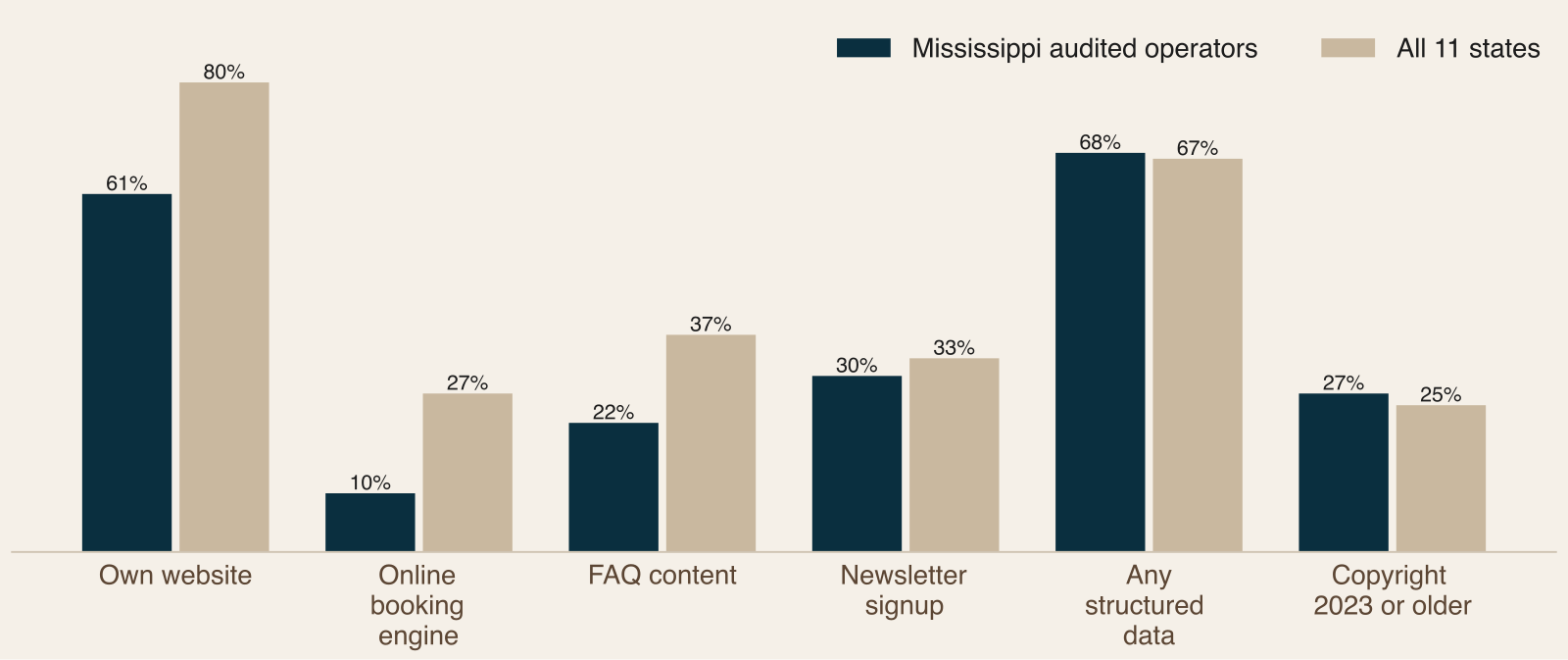
The sample is not a census, and it leans toward the lower tier: 20% of Mississippi's operators are top-tier against 32% regionally. Re-weighted to the region's tier mix, Mississippi's mean would be 4.71 rather than 4.39. So the mix explains part of the gap and the rest holds within tiers. Read the ranking as directional.
The separate October 2026 hunting audit counts 34 Mississippi hunting operators with a mean of 5.00, about level with the 5.23 for all 493 audited hunting operators. All have their own website, but only 3% of the 30 sites read show online booking.
No category reaches 15 audited Mississippi operators, so categories are counts only. The largest are inshore and flats fishing (14), bass, crappie and lake fishing (13) and lodging and campgrounds (10), followed by paddle, kayak and canoe (9), outfitter retail and tackle (8) and marinas and boat rental (7). In the hunting audit, tags overlap because one operator can sell several hunts: waterfowl (14), lodge or multi-program (12), upland and quail (11), whitetail (6), sporting clays (5), wild hog (4), turkey (2) and dove (1). Across those 34, 13% carry FAQ content and 20% offer a newsletter signup. By tier, Mississippi's top-tier operators average 6.50 against 7.06, middle-tier 4.72 against 4.95 and lower-tier 2.44 against 2.84.
What It Means for Operators
Mississippi is a small outdoor economy that weighs more than it looks, and a thinly presented one. The visitor and license data show demand is real, especially from out-of-state hunters who pay most of the hunting license revenue. The audit shows that many businesses are not yet easy to find, understand or book.
The report closes with six moves:
Start with the storefront. 39% of audited operators have no website of their own.
Make a ready buyer able to book, with a hold-a-date path that works on a phone.
Answer the questions buyers ask, then mark them up.
Publish the permits you hold and the rules you work under.
Write a page for each water, unit and season.
For hunting operators, put booking on the page.
On public land, the rule is simple. On MDWFP wildlife management areas, paid guiding is not an option, so do not sell it. Everywhere else, confirm with the managing agency first.
Get the Full Report
The full report adds the complete 2026-27 hunting calendar, the activity tables, the sub-region profiles, the public land map and sources for every chart.
Download the full 2026-27 Mississippi Outdoors report (free with your email).
Frequently Asked Questions
How big is Mississippi's outdoor economy?
Outdoor recreation produced $4.2 billion of value added in 2024, the lowest of the eleven Southeast states, but 2.7% of state GDP, the fifth-highest share and above the U.S. figure of 2.4%. It employed 36,605 people, 2.9% of wage and salary jobs. Visit Mississippi separately counted 45.5 million visitors in 2025 and $12.4 billion of visitor spending, for a total economic impact of $18.9 billion, measured on a different basis. The report never adds these measures together.
Can I guide paid trips on Mississippi wildlife management areas?
No. The basic MDWFP WMA regulations say no person or group may act as a guide, outfitter or in any capacity for which they are paid or promised payment for services rendered (40 Miss. Code R. 2-1.1, paragraph W). Individual areas add their own rules. Do not sell paid guided trips on a WMA, describe hunts on private land you control, and confirm any question with MDWFP before you publish a trip page.
What permits apply to guiding on federal land in Mississippi?
It depends on the land. The National Park Service requires a Commercial Use Authorization on Gulf Islands National Seashore for charter fishing, motorized boat tours and scuba and snorkeling, and on the Natchez Trace Parkway for bicycle tours and charter-bus tours. Refuges require a special permit for any commercial enterprise, and national forests require a special-use authorization. For Corps of Engineers lakes, the report found no rule text, so check with the project office.
Why is Mississippi's digital health score the lowest in the region?
The 88 audited operators average 4.39 against 5.09 region-wide. Part of the gap is the sample: 20% of Mississippi's operators are top-tier against 32% regionally. Re-weighting to the region's tier mix would lift the mean to 4.71, and Mississippi still scores below the region within each tier. Only 61% have their own website. The score describes how businesses present themselves online, not the quality of their trips.
How many people fish Mississippi's coast?
NOAA estimates 3.09 million marine angler trips on the Gulf coast in 2025, down 14% from 3.58 million in 2021, with shore fishing 68%. Only 13,460 trips were on charter boats. Trips are not people, and NOAA recalibrated its estimates in August 2026, so the figures should not be compared with any published earlier. The series peaked at 3.81 million in 2024, and the estimates carry a margin of several percent, so small moves are noise.
When do Mississippi's main seasons open?
Deer archery opens October 1 in the Delta, North Central and Hills units and October 15 in the Southeast unit, with gun seasons into late January. Early teal runs September 19 to 27, ducks open November 27, and dove opens September 5. Spring turkey 2027 has a youth hunt March 8 to 14 and a season March 15 to May 2. WMAs, forests and refuges can set their own dates, so the statewide calendar does not replace area regulations.
How much do out-of-state hunters matter in Mississippi?
A great deal by revenue. Nonresidents bought 22% of hunting items in 2024 but paid 69% of hunting license revenue, $10.8 million against $4.9 million from residents. For fishing they bought 16% of items and paid 32% of revenue, so the fishing public is mostly local. An outfitter who writes for the traveling buyer, with lodging, tag, season and unit information, is addressing the group that carries most of the hunting license revenue.
What does the report advise operators to do first?
Start with the storefront, because 39% of audited operators have no website of their own against 20% region-wide. Then make a ready buyer able to book with a hold-a-date path that works on a phone, since only 10% of the 40 sites read show an online booking engine. After that, answer questions and mark them up, publish the permits you hold, write a page for each water, unit and season, and, for hunting operators, put booking on the page.
Sources
Pine & Marsh outfitter audit (1,546 operators) and hunting supplement (493 operators), October 2026


Comments