
Inside the 2026-27 Louisiana Outdoors Report: Heavy Outdoor Weight, a Separate Saltwater Survey and Strict Guide Rules
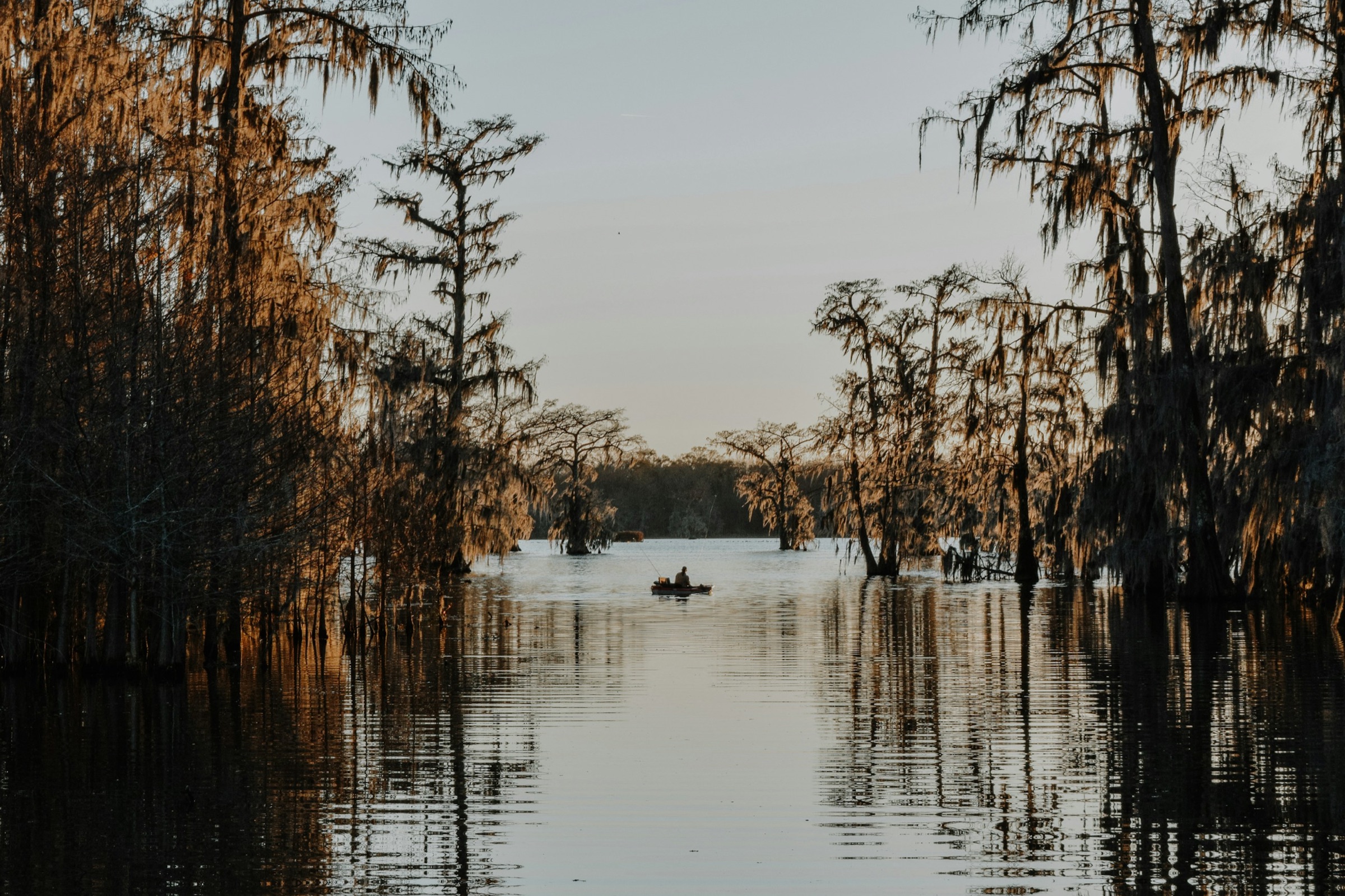
The 2026-27 Louisiana Outdoors report is a state-level look at the business of fishing, hunting and swamp tours in Louisiana. It puts public, primary-source data next to Pine & Marsh's October 2026 audit of private, for-profit outdoor businesses, 146 of them in Louisiana. The public data comes from the U.S. Bureau of Economic Analysis (BEA), the Louisiana Office of Tourism, the U.S. Fish and Wildlife Service, NOAA Fisheries, the U.S. Coast Guard, the Louisiana Department of Wildlife and Fisheries (LDWF) and federal land agencies.
It is written for charter captains, inshore and freshwater guides, eco-tour operators, hunting outfitters and marina owners who sell trips in Louisiana. This post walks through the report chapter by chapter, in the report's own order. For the marketing playbook, see Marketing a Sporting Operation in Louisiana: The Full State Guide.
At a Glance: Louisiana in Nine Numbers
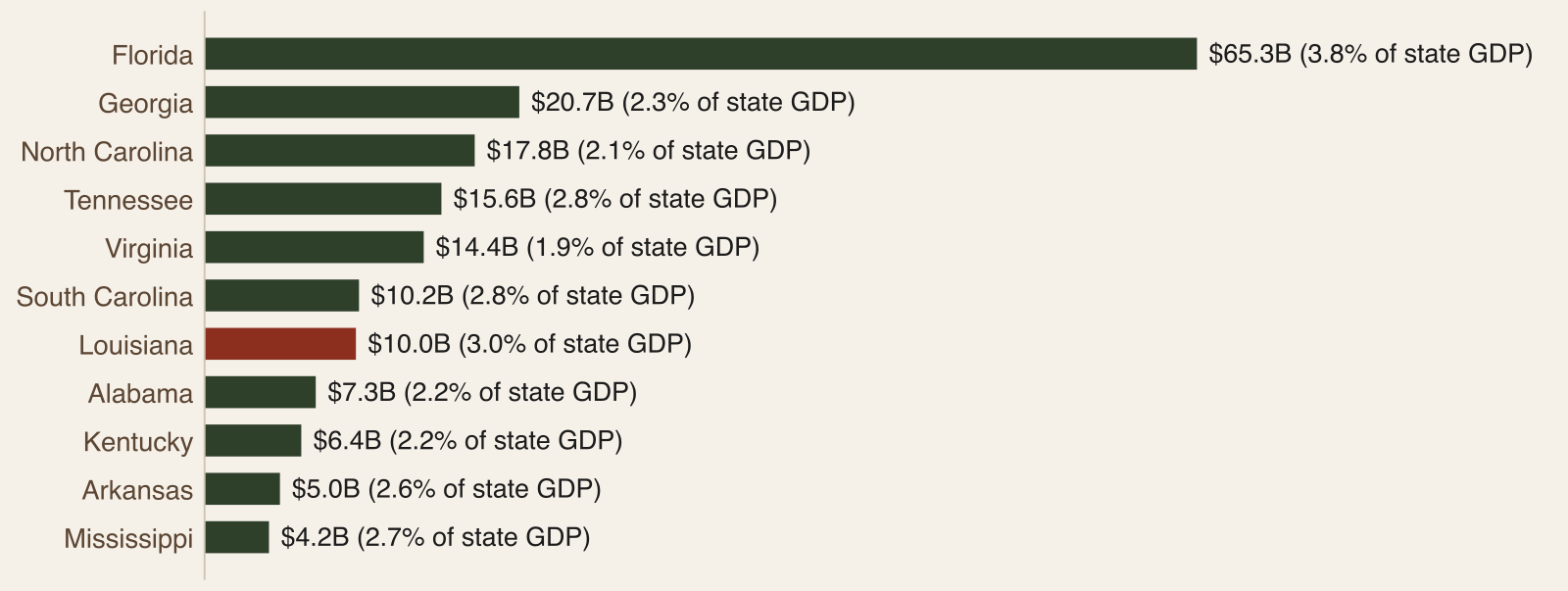
Outdoor recreation added $10.0 billion of value added in Louisiana in 2024, 6% of the eleven-state Southeast total, and was 3.0% of state GDP, the second-highest share of the eleven states, against 2.4% for the U.S. It employed 60K people, and the state tourism office counted 45.0 million visitors in 2025.
Louisiana is a fishing and hunting state. It had 691K paid fishing license holders and 9.8 paid hunting license holders per 100 residents, the third-highest density of the eleven states. Salt water is counted on its own survey: 1.6 million marine angler trips in 2022 on the LA Creel basis, because NOAA's survey does not publish Louisiana.
The 146 audited Louisiana operators score 4.84 out of 10 on digital health against 5.09 region-wide, and 23% of the sites read show an online booking engine against 27%. The report calls them about level with the region.
The Outdoor Economy: Heavy Weight, Mid-Sized Total
Louisiana's $10.0 billion was the fifth-lowest total of the eleven states and 1.4% of the national figure. Outdoor recreation employed 60,462 people, 2.9% of wage and salary jobs. The 3.0% share of GDP is what stands out: the weight is high even though the total is not.
The activity breakdown uses BEA's older 2023 vintage and is compared only within 2023. Louisiana ranked first in none of the nine lines, and its best rank was seventh of eleven, in four lines. Water-based guided tours and charters produced $154M, 5% of the regional total. Shooting, including archery, was $76M and ranked eleventh of eleven.
The visitor economy is measured separately. The Louisiana Office of Tourism counted 45 million visitors in 2025, who spent $19.5 billion and supported 225,600 jobs. Those figures cover all travel, not only outdoor trips, and are not added to BEA's numbers. Southwick Associates put angler spending at $3.1 billion in 2022 and hunter spending at $1.50 billion. Every first-time guest of a Louisiana guide, charter or tour arrives as one of these visitors first.
The 2023 activity table has more to say. Louisiana ranked seventh of eleven in boating and fishing ($510M), in water-based guided tours and charters ($154M) and in guided tours and outfitted travel of all kinds ($234M). It ranked seventh in hunting and trapping ($118M, 6% of the regional total), eighth in fishing excluding boating ($88M), in RVing ($217M) and in equestrian ($96M, 6%), and tenth in climbing, hiking and tent camping ($60M). Within that vintage, outdoor value added moved from $8.0 billion in 2019 to $5.2 billion in 2020 and $9.2 billion in 2023, up 15% in current dollars. BEA revised the series in March 2026, so the report does not join it to the 2024 figure.
The spending studies give the participant side. Southwick Associates counted 736,070 anglers supporting about 23,890 jobs, and 433,220 hunters. Target shooting added $1.1 billion from 645,520 participants, a separate and overlapping group, and none of these measures should be added together.
Hunters and Anglers: Dense, With a Falling Fishing Count
Louisiana counted 690,992 paid fishing license holders in 2024, the fifth-highest total of the eleven states, and 451,343 paid hunting license holders, also the fifth-highest. Against 4.6 million residents, that is 15.0 fishing and 9.8 hunting license holders per 100 people, the second-highest and third-highest densities in the region.
Fishing license holders fell from 801,672 in 2020 to 690,992 in 2024, down 13.8%. Hunting license holders rose from 439,489 to 451,343, up 2.7%. The report gives the five-year ranges as roughly 433,000 to 461,000 for hunting and roughly 691,000 to 802,000 for fishing, and notes that in 2024 the state counted more hunting license holders than hunting items sold, which may reflect lifetime licenses.
The nonresident split differs by sport:
Fishing: nonresidents bought 27% of items, the fourth-highest share in the region, and paid 51% of fishing license revenue, the third-highest share.
Hunting: nonresidents bought 11% of items and paid 30% of hunting license revenue. Hunting is a resident market.
Birds: USFWS estimated about 58,900 active duck hunters in 2024-25 and about 27,300 active dove hunters in 2025-26. These are survey estimates, not license counts.
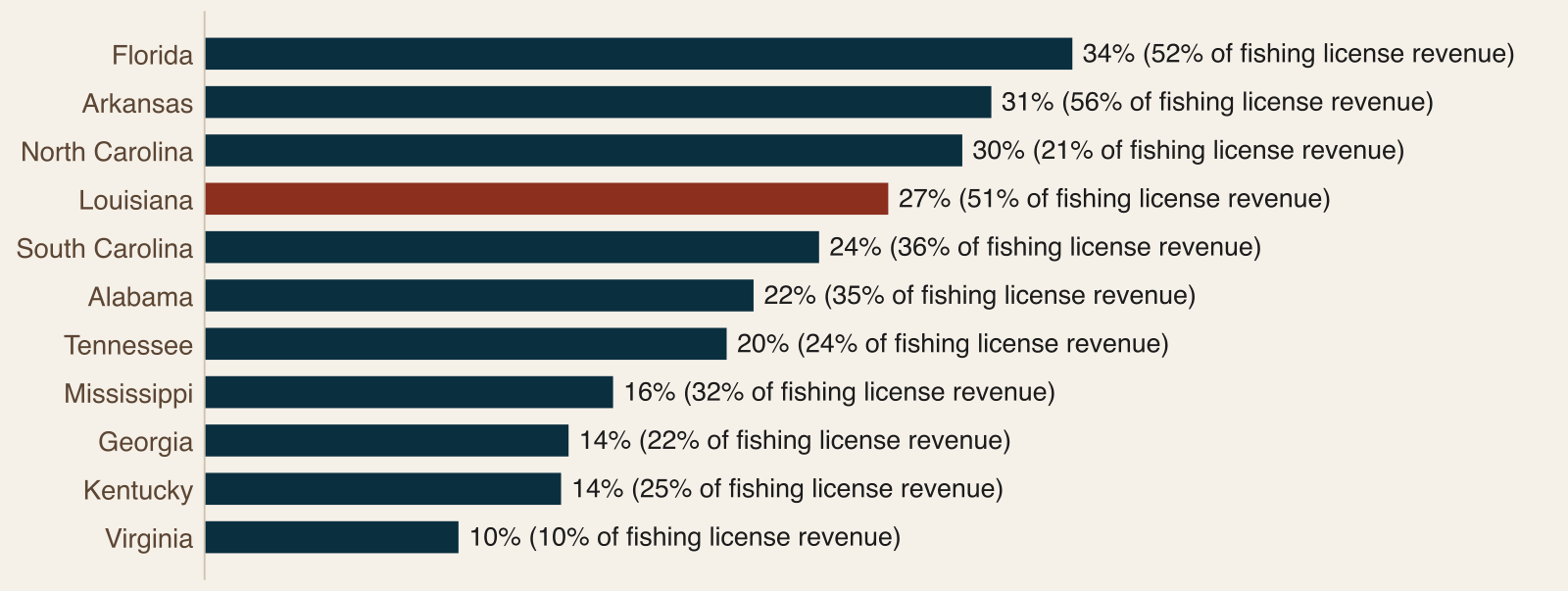
The revenue table shows why the two sports differ. In 2024 Louisiana sold 547,055 resident and 200,166 nonresident fishing items, bringing in $6.7 million and $6.8 million, so nonresidents paid slightly more than residents from about a quarter of the items. For hunting it sold 387,348 resident and 45,875 nonresident items, bringing in $6.3 million and $2.7 million. These count licenses, tags, permits and stamps, not people, because one person can buy several.
The Resource and the 2026-27 Seasons
LDWF divides Louisiana into 10 deer areas, each with its own calendar. Archery opens as early as September 19 in Areas 3, 7, 8 and 10 and runs to February 15 in Areas 5, 6 and 9, so a Louisiana season runs from September into mid-February somewhere in the state. The report's point for hunting properties is that each area's dates have to be stated precisely.
LDWF's hunter harvest survey index was 276,200 deer in 2025-26, against 233,400 in 2021-22. The department's reported harvest, which counts deer that were reported, was 143,527 in 2024-25. The report shows the two series side by side and never compares them, because they measure different things.
Spring turkey is the bright spot: LDWF reported 4,024 turkeys in the 2026 spring season, announced as a record, against 3,576 in 2025. USFWS estimated a duck harvest of about 1,246,600 birds in 2024-25 (preliminary) and a dove harvest of about 397,100 birds in 2025-26. The calendar tables cover deer areas, turkey, ducks, geese, dove, quail, rabbit and squirrel. Dates on WMAs, national wildlife refuges and the Kisatchie National Forest follow those areas' own schedules.
On salt water, the report deliberately does not copy size and bag limits. They change often, and LDWF has had fillet-size rules under notice of intent in 2026. A guide's website should link to LDWF's current recreational saltwater pages.
The deer calendar is the most detailed table in the report. Areas 1 and 4 open archery October 1 and run to January 31, with firearms with or without dogs from December 12 to January 3. Area 2 runs archery October 1 to January 31 with firearms December 10 to January 17. Areas 3, 7 and 8 open archery September 19 and run to January 15, with firearms November 30 to January 3. Areas 5 and 9 run archery October 16 to February 15, with bucks only October 1 to 15, and Area 6 has the same archery window with firearms December 12 to January 24. Daily bag is one antlered and one antlerless deer when legal, and the season limit is six, except Areas 1, 4 and 10.
The other calendars matter to waterfowl operators. East Zone ducks run November 21 to December 6 and December 19 to January 31, and West Zone ducks November 14 to December 6 and December 19 to January 24, each with youth and veterans days. Teal runs September 19 to 27, and light geese November 14 to December 6 and December 19 to February 7 with a daily bag of 20. Spring turkey 2027 opens April 3 in Areas A, B and C. Harvest history is steady: the survey index was 233,400, 217,700, 262,400, 239,000 and 276,200 deer from 2021-22 to 2025-26.
The Water: Louisiana Counts Its Own Trips
NOAA's Marine Recreational Information Program does not publish Louisiana, which runs its own survey, LA Creel. NOAA's expenditure study quotes Louisiana's 2022 trips on that basis: 1.61 million marine angler trips, of which 1.10 million were by private and rental boat, 347 thousand from shore and 162,620 on for-hire boats. The report found no public LA Creel table for later years, so it shows no trend, and it does not compare these counts with the other Gulf and Atlantic states.
The money per trip is the point. Spending per angler-day was $760 on for-hire trips, 2.5 times the private-boat figure of $309 and 5.6 times the shore figure of $136. NOAA's study put total marine angler trip spending in Louisiana at $478 million. The 2023 economic edition puts the sales impact at $327 million, supporting about 2,422 jobs. The report notes that the 2022 edition showed $590 million, and that the 45% drop may reflect survey inputs rather than fishing, so the two editions are not joined into a trend.
For credentials, LDWF requires a Charter Boat Fishing Guide License for any guide running a charter vessel in saltwater areas, along with a Coast Guard captain's license, Louisiana basic and saltwater fishing licenses and liability insurance. A separate Freshwater Charter Guide License applies in freshwater areas. Keeping reef fish or pelagics needs a free Charter Recreational Offshore Landing Permit. The Coast Guard counted 286,912 registered recreational vessels in 2024, the fifth-highest count of the eleven states.
The trip table splits by how anglers go. Private and rental boats took 1,099,439 trips, 68% of the total, at $309 per angler-day. Shore anglers took 347,191 trips, 22%, at $136. For-hire boats took 162,620 trips, 10%, at $760. The total was 1,609,250. A charter captain is therefore selling to a tenth of the trips and the highest spending per day, which suits pages that explain what a guided day includes.
Public Land and the Rules for Guides
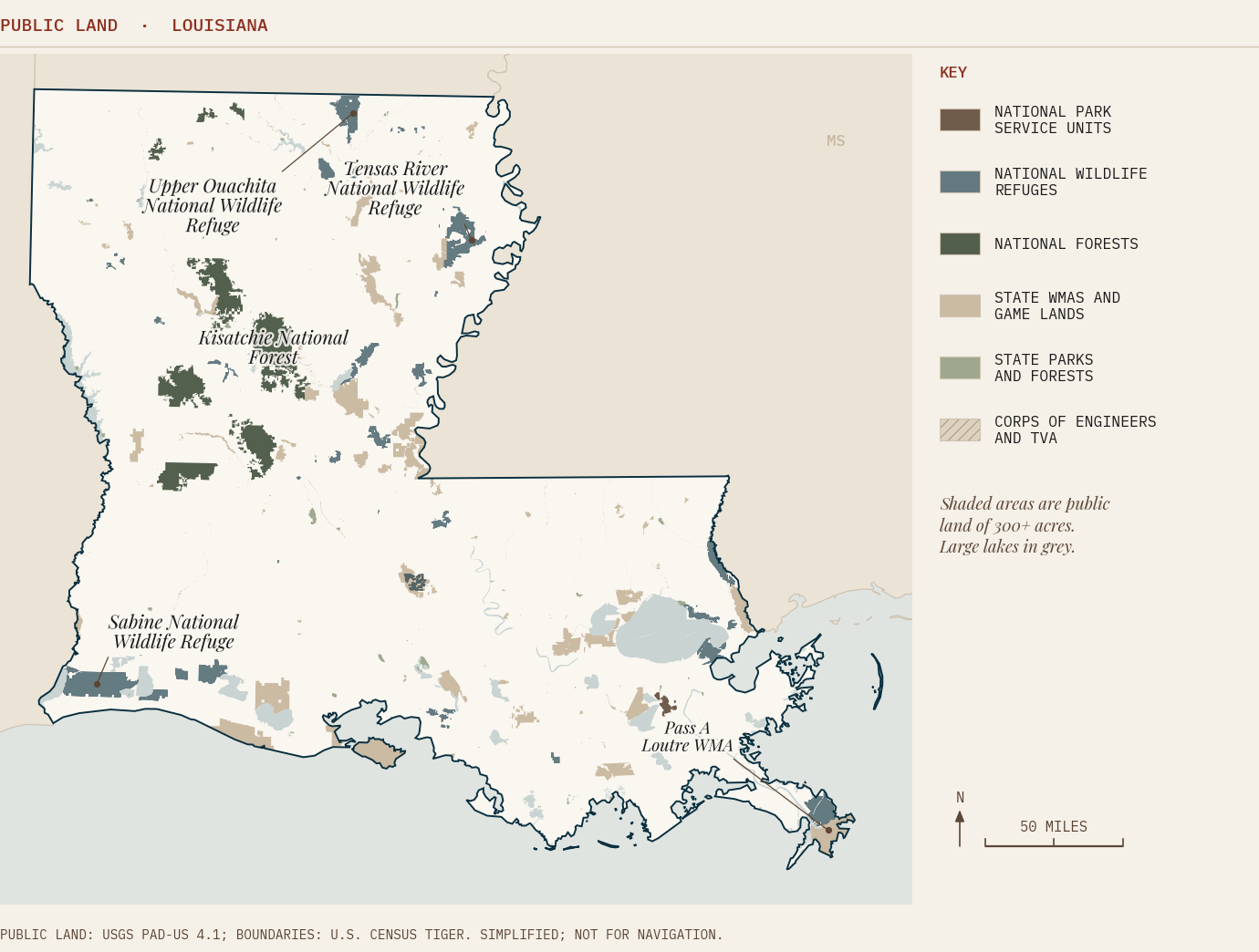
This is the chapter with the sharpest rules in the report. LDWF maintains more than 1.6 million acres of wildlife management areas, refuges and conservation areas. Federal land adds 23 national wildlife refuges, a national forest and national park units, each with its own authorization.
What the report finds:
LDWF WMAs: A WMA Access Permit is required. For hunting, no one may act as a guide or outfitter, or in any capacity for which they are paid by hunters, including for lodging or club memberships. For fishing, that provision does not apply to properly licensed and insured charter fishing guides unless a WMA specifically prohibits it, and the guide may not keep a bag limit.
National wildlife refuges: Commercial enterprise is prohibited except by special permit. The Southwest Louisiana complex (Cameron Prairie, Lacassine and Sabine) lists commercial guiding among the prohibited activities.
Kisatchie National Forest: Selling goods or services, including guiding, requires a special-use authorization.
National park units: Business operations, including at Jean Lafitte National Historical Park and Preserve, require an NPS permit, contract or written agreement. Confirm the current process with the park.
The report's reading is that Louisiana's WMA rule is not a blanket ban: paid hunting guiding and outfitting are barred on every WMA, while a licensed and insured charter fishing guide may work on a WMA that does not prohibit it. One agency's permit does not cover another's land, and the report advises reading the current LDWF pamphlet and checking with the manager of the exact place. It summarizes published rules and is not legal advice.
The Regions: Ten Sub-Regions, Seven Too Small to Score
The audit groups Louisiana into ten sub-regions, from Venice and the Mississippi Delta to the Kisatchie pines. Seven fall under the small-sample rule and are described in words only. Among the three with enough operators and sites read, scores range from 5.00 in Lafitte, Barataria and Grand Isle to 5.88 in New Orleans and Lake Pontchartrain.
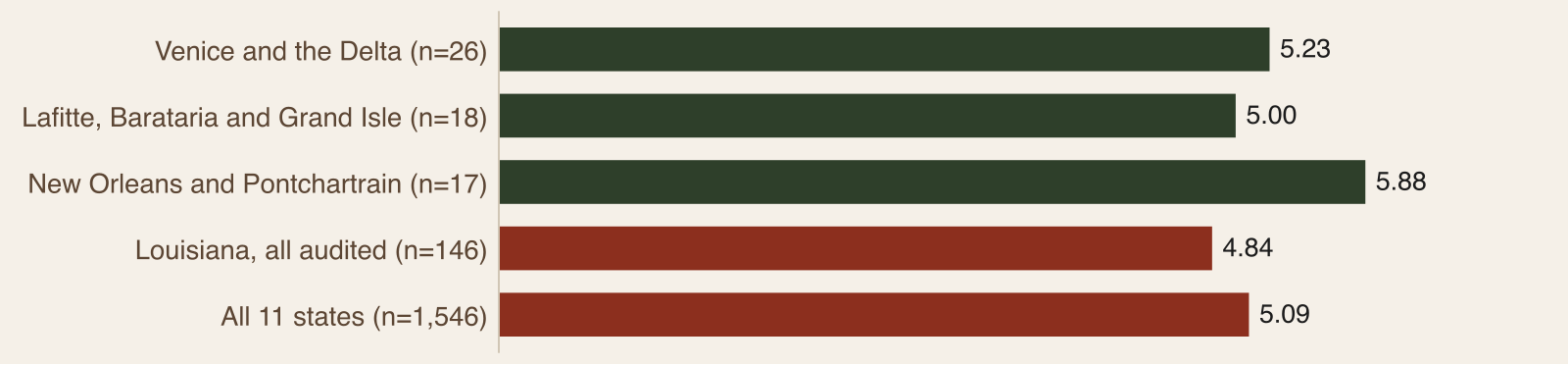
Venice and the Mississippi Delta is the state's largest sample at 26 operators, led by inshore guides and offshore charters, and 14% of sites read show online booking. New Orleans and Lake Pontchartrain is almost all eco-tours and paddling, and 60% of its sites read show online booking, far above the other sub-regions shown with figures. Lake Charles and Cocodrie have 20 and 18 operators, but only eight homepages could be read in each, so they are described in words. Each sub-region carries its own rule notes, including the WMA rule at Pass-a-Loutre in the delta and the refuge guiding prohibition around Lake Charles.
The sub-region notes show how different the places are. Venice has 26 operators, 21 with a readable homepage, all with their own website and 10% with FAQ content, scoring 5.23. Lafitte, Barataria and Grand Isle has 18 operators, 6% of sites read showing booking and 31% with FAQ content, scoring 5.00. New Orleans and Lake Pontchartrain has 17 operators, 94% with their own website and 40% with FAQ content, scoring 5.88. Toledo Bend has 15 operators but only three readable homepages, the Atchafalaya Basin 13, Cajun Prairie and Vermilion Bay nine, Kisatchie and central Louisiana nine and north Louisiana one. Those are described in words only.
The Operator Landscape: Level Overall, Behind in the Top Tier
The 146 audited operators have a mean digital health of 4.84, the fourth-lowest of the eleven states, 0.25 points below the region's 5.09 and inside the half-point noise band.
82% have their own website, against 80% across the region.
45% score 4 or below, against 40%.
23% of the 95 sites read show an online booking engine, against 27%. FareHarbor is on 17 of the 22 sites with one.
32% carry FAQ content, but none of the 95 mark answers up as FAQ structured data.
The tier mix is close to the region's, with 34% top-tier against 32%. Within tiers, though, they differ: top-tier operators average 6.55 against 7.06, and middle-tier 4.62 against 4.95. The report says Louisiana is below the region in the top tier, which the overall match hides. The largest categories are inshore and flats fishing (43, mean 4.53 against 4.69 across the eleven states), eco-tours and wildlife viewing (28, mean 5.79) and paddle, kayak and canoe (16).
The separate hunting audit (493 hunting operators, October 2026) counts 44 in Louisiana. Their mean digital health is 5.11, and only 5% of the 40 sites read show online booking, against 23% of Louisiana's main-audit sites. By tag, waterfowl leads with 28.
Category averages show where the gap sits. Inshore and flats fishing, the largest group at 43, scores 4.53 against 4.69 across 196 operators in the eleven states. Marinas and boat rental, at 15 operators, score 4.00 against 4.78 across 132. Eco-tours and wildlife viewing score 5.79 against 6.00 across 101, and paddle, kayak and canoe 5.31 against 5.36 across 231. The report also finds 32% of Louisiana sites offer a newsletter signup against 33% region-wide, and 27% of sites with a detectable copyright year still show 2023 or earlier.
What It Means for Operators
Louisiana's outdoor economy weighs heavily in a state of its size, and its guides sell into specific rules: a charter license for salt water, a different one for fresh, and a flat bar on paid hunting guides on every WMA. The audited operators sit about level with the region overall but behind in the top tier, with no site marking answers up for search.
The report's six moves are to write for the visitor and the nonresident, make the booking path work on a phone, answer questions and mark them up, publish the rules you work under, never sell a guided hunt on a WMA, and write a page for each water, parish and season. Its advice for this month is to make sure a visitor on a phone can find your homepage, see what a trip includes and which credentials you hold, and hold a date in under a minute.
Get the Louisiana Report
The full report adds the audit tables, every chart with its source and year, the 2026-27 season calendars, the sub-region notes and the full source list.
Download the full 2026-27 Louisiana Outdoors report (free with your email).
Frequently Asked Questions
Why does the report use a different saltwater survey for Louisiana?
NOAA's Marine Recreational Information Program does not publish Louisiana, which runs its own survey, LA Creel. NOAA's expenditure study quotes Louisiana's 2022 trips on that basis: 1.61 million marine angler trips, of which 1.10 million were by private and rental boat, 347 thousand from shore and 162,620 on for-hire boats. The report found no public LA Creel table for later years, so it shows no trend, and it does not compare these counts with MRIP figures for the other Gulf and Atlantic states.
Can I guide hunts on Louisiana WMAs?
No. LDWF's 2026-27 pamphlet bars paid hunting guiding and outfitting on every WMA, including payment for lodging or club memberships (LAC 76:XIX.111). Licensed and insured charter fishing guides may work on a WMA unless that WMA prohibits it, with a state charter boat guide license, a Coast Guard captain's license, commercial marine insurance, a recreational fishing license and a WMA Access Permit. The Southwest Louisiana refuges also list commercial guiding as prohibited, so describe hunts on private land you control.
What licenses does a Louisiana charter captain need?
For saltwater areas, an LDWF Charter Boat Fishing Guide License, a Coast Guard captain's license, Louisiana basic and saltwater fishing licenses and liability insurance. Freshwater areas need a separate Freshwater Charter Guide License. Keeping reef fish or pelagics needs a free Charter Recreational Offshore Landing Permit, and federal waters need NOAA permits. The report says to confirm the current list with LDWF each season, and to publish the credentials you hold on your site.
How much does a charter customer spend?
NOAA's 2022 expenditure study put for-hire spending in Louisiana at $760 per angler-day, 2.5 times the private-boat figure of $309 and 5.6 times the shore figure of $136. Total marine angler trip spending was $478 million. The 2023 economic edition put the sales impact at $327 million, but the report warns that the 2022 edition showed $590 million and that the drop may reflect survey inputs, so it does not join the two into a trend.
Are Louisiana fishing license sales growing?
No. Paid fishing license holders fell from 801,672 in 2020 to 690,992 in 2024, down 13.8%, while hunting license holders rose 2.7% to 451,343. The report presents the five-year spans as estimated ranges, roughly 691,000 to 802,000 for fishing, and suggests contacting LDWF for exact counts. Visitors still matter: nonresidents bought 27% of fishing items, the fourth-highest share in the region, and paid 51% of fishing license revenue.
How many deer areas does Louisiana have, and when do seasons open?
LDWF divides Louisiana into 10 deer areas, each with its own calendar. Archery opens as early as September 19 in Areas 3, 7, 8 and 10, opens October 1 in Areas 1, 2 and 4, and runs to February 15 in Areas 5, 6 and 9. New this season, Deer Area 1 limits are no more than two antlered and five antlerless deer. Because each area's dates differ, the report's advice is to state them precisely on a page for each parish or zone.
How do Louisiana operators compare online?
The 146 audited operators average 4.84 against 5.09 region-wide, inside the half-point noise band, and rank fourth-lowest of the eleven states. Booking is 23% against 27%, and 45% score 4 or below against 40%. The report finds Louisiana below the region in the top tier, where operators average 6.55 against 7.06, which the overall match hides. None of the 95 sites read mark answers up as FAQ structured data, though 32% carry FAQ content.
What are the report's six moves for operators?
Write for the visitor and the nonresident, because the state counted 45 million visitors in 2025. Make the booking path work on a phone, since 23% of sites read show an engine. Answer questions and mark them up as FAQ structured data. Publish the credentials and rules you work under. Never sell a guided hunt on a WMA. Write a page for each water, parish and season, since deer areas, duck zones and turkey areas each have their own dates.
Sources
U.S. Fish and Wildlife Service, certified hunting and fishing license data, license years 2020 to 2024
USGS Gap Analysis Project, PAD-US 4.1, for the public-land map
Louisiana Department of Wildlife and Fisheries 2026-2027 Louisiana Hunting Regulations pamphlet, WMA and for-hire guide pages, and LAC 76:XIX.111, read October 2026
Louisiana Office of Tourism announcement of April 29, 2026
Pine & Marsh Southeast audit, October 2026 (1,546 operators), and the Pine & Marsh hunting audit, October 2026 (493 operators)
Related Reading
Marketing a Sporting Operation in Louisiana: The Full State Guide
Inside the 2026-27 Waterfowl Report: Hunters, Breeding Numbers and the Duck Guide Storefront
Inside the 2026-27 Mississippi Outdoors Report: A Small Economy and Room to Grow Online
Inside the 2026-27 Saltwater Inshore Report: 108.7 Million Trips and 196 Guides Online


Comments