
The Big-Reservoir Diver Hunt: Marketing the Southeast's Open-Water Duck Specialty

Every November, the Southeast's duck marketing turns into the same picture: a hunter in waders under flooded oaks, mallards cupped through a hole in the canopy, a black Lab with a greenhead. It is a good picture. It also crowds out one of the region's most distinctive waterfowl products, the open-water diver hunt on big reservoirs, where bluebills, redheads, ring-necked ducks, buffleheads, and the occasional canvasback raft up on water so wide the far shore is a gray line.
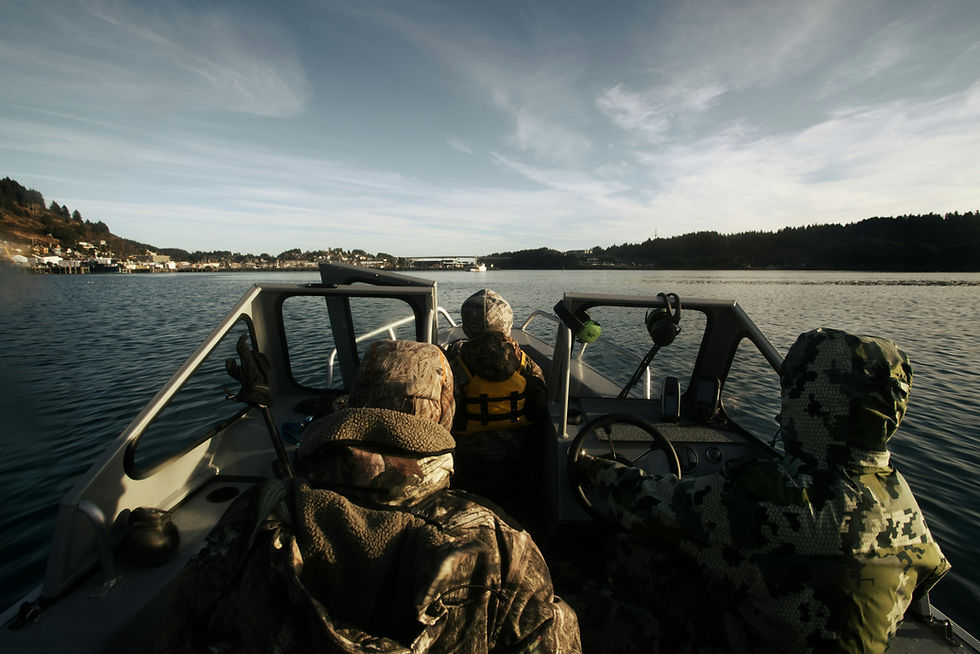
The reservoir diver hunt sells something timber cannot. Timber sells intimacy, tradition, and a small hole in the trees. Big water sells scale and spectacle: dozens of decoys strung out on long lines, birds that come in fast and low over open water, a boat ride across the lake before dawn, and a hunt that depends on reading wind, waves, and weather. It is a different aesthetic for a different hunter, and operators who offer it often market it as generic "duck hunting," which can make it hard for hunters searching for divers specifically to find them.
This hub defines the product on its own terms, a few weeks before the 2026-27 regular seasons open: the ecology, the flagship waters, the 2026-27 diver limits by state, the gear barrier, the safety posture, and the permit questions every operator needs answered in writing before advertising a guided hunt on public water.
Why diver hunting needs its own marketing
Diving ducks behave differently from the puddle ducks that dominate Southern duck content, and that difference is the foundation of the product. Mallards, gadwall, and wigeon feed at the surface and drop into shallow flooded fields and timber. Divers, as their name says, dive for their food, and they favor larger and deeper water. Ducks Unlimited describes lesser scaup wintering on large lakes and rivers, brackish coastal bays, and nearshore waters, and canvasbacks moving to large freshwater lakes, rivers, and coastal bays for the winter. That preference for big water is why a Southeastern reservoir hunt looks nothing like a flooded-timber hunt, and why it needs its own pages, photos, and language.
The searcher is different too. A hunter typing "bluebill hunting" or "canvasback hunt Georgia" or "Kentucky Lake diver guide" already knows what he wants. He has often hunted dabblers for years and is looking for something new, or he is a Northern hunter who grew up on big-water diver hunts and wants to extend his season south. When an operator's site does not name the species, the water, and the method, that buyer bounces to a forum thread and books whoever is mentioned there.
There is also a positioning advantage. Diver hunting is often folded into generic duck pages, so a page that treats it as a distinct specialty has room to stand out, and the cross-reservoir story is rarely told in one place. That is what a topical authority hub is built to fix: one page that defines the subject for the whole region, linked to detailed pages on each water, so that search engines and AI answer engines see a complete, connected body of work rather than one stray paragraph on a services page.
The ecology: why divers concentrate on a few reservoirs
The core claim of any diver operation is that the birds use its water, and that claim is only credible when it is grounded in why. Divers are not spread evenly across the Southeast. They concentrate where two things come together: food they can reach by diving, and open water large enough to rest on safely.
Food is the first half. Ducks Unlimited notes that canvasbacks shift heavily to plant foods in winter, including wild celery tubers and pondweeds, and turn to mussels where those plants have declined, while lesser scaup shift to small bivalves outside the breeding season. Southeastern reservoirs with extensive submerged vegetation or productive shallow flats can hold those foods in volume. Lake Seminole is the clearest example in the region: the Florida Fish and Wildlife Conservation Commission reports that hydrilla has expanded to nearly 70 percent coverage of the lake's area since the early 1990s. Vegetation frustrates some boaters and anglers, but for a diver guide, grass beds are the reason the birds show up.
Open water is the second half. Divers rest in rafts well away from shore, where they can see danger coming. The Tennessee Valley Authority describes Kentucky Reservoir as about 160,300 acres of water surface, 184 miles long, and the largest reservoir in the eastern U.S. Guntersville covers about 67,900 acres by TVA's count. Santee Cooper describes Lakes Marion and Moultrie as 160,000 acres together, and FWC lists Lake Seminole at 37,500 acres. Wide water, with protected sanctuary areas nearby, gives rafted divers somewhere to sit out pressure and weather.
Timing is the third piece, and it matters for marketing because it sets expectations. Ducks Unlimited reports that canvasbacks begin arriving on wintering areas in mid-November, and that both canvasbacks and lesser scaup peak from mid-December into February. In practice, that means the best diver hunting on Southeastern reservoirs is often a December and January story, not an opening-weekend story. An operator who sells the November opener as diver prime time risks disappointing clients. An operator who explains that the diver bite builds through the season, and sells the late-December and January dates accordingly, earns trust and fills dates that dabbler-focused competitors struggle to sell.
The flagship waters: a tour of the spokes
This hub sits above detailed posts on individual reservoirs. Here is how they fit together.
Kentucky Lake is the anchor of the western Tennessee River system, and our post on marketing a Kentucky Lake diver and dabbler duck guide in Tennessee covers the mixed-bag positioning that makes sense there. The lake's sheer size is the headline, but the shoreline is a patchwork. TVA notes that it includes the Tennessee National Wildlife Refuge and two state wildlife management areas, and the refuge closes some waters and all of its impoundments to the public from Nov. 15 to Mar. 15 as waterfowl sanctuary. Those sanctuaries help hold birds on the lake; they are not places to take clients. Our Tennessee River and Kentucky Lake field report provides the ecological backdrop.
Lake Barkley runs parallel to Kentucky Lake on the Cumberland River, on the other side of Land Between the Lakes, and it is a Corps of Engineers project rather than a TVA lake. The post on marketing a Lake Barkley boat-in reservoir duck service in Kentucky handles the boat-access model. Barkley also holds Cross Creeks National Wildlife Refuge, which the U.S. Fish and Wildlife Service says lies in the Cumberland River floodplain, provides wintering habitat for about 30 waterfowl species, and closes for a sanctuary period from Nov. 15 to Mar. 15. Our Cross Creeks diving-duck post explains why that refuge matters to the diver story on the whole lake.
In north Alabama, the Lake Guntersville and Swan Creek post pairs Guntersville's big TVA water with the Swan Creek scene downstream near Decatur. Swan Creek Wildlife Management Area is an Alabama Department of Conservation and Natural Resources area, open to public waterfowl hunting, with a managed wetland unit of about 1,200 acres. It belongs in your marketing as habitat and as a place hunters go on their own, not as a guided product.
On the Georgia and Florida line, the Lake Seminole canvasback post covers the region's most recognizable canvasback water. Seminole is a Corps of Engineers reservoir, and Georgia's DNR lists it among the lakes where hunting is not allowed within 300 feet of a dock, house, structure, bridge, road, boat ramp, marina, or open recreation area. That kind of rule belongs on any Seminole guide's what-to-expect page, because it explains to clients why the boat runs where it runs.
In South Carolina, the Santee Cooper duck guide post covers Lakes Marion and Moultrie, which are owned and operated by the state utility, Santee Cooper. The utility notes that the lake system includes about 15,000 acres of federally managed land and water at Santee National Wildlife Refuge and about 18,250 acres managed by SCDNR as wildlife management areas, and that laws on the lakes are enforced by SCDNR. A diver guide on Santee Cooper should know exactly which water falls under which manager.
Read together, these posts make one argument: the Southeast has a diver circuit, and it runs from the Tennessee and Cumberland impoundments through north Alabama to the South Carolina lowcountry and the Georgia and Florida line. Each spoke should link back to this hub, and the hub to each spoke. The coastal side of the diver story, from Pamlico Sound to Back Bay, has its own set of posts, starting with our piece on marketing a Pamlico Sound open-water diver and sea-duck guide.
The 2026-27 diver calendar by state
Diver hunting happens inside each state's regular duck season, so the dates are the same as the general duck dates. What differs, and what clients ask about most, are the species limits on canvasbacks, redheads, and scaup. Here is what each agency's 2026-27 regulations show. All six states use a 6-duck daily bag for 2026-27, and every date and limit below should be confirmed with the agency before you publish it on your own site.
Kentucky (KDFWR): ducks Nov. 26 to 29, 2026 and Dec. 7, 2026 to Jan. 31, 2027. The 6-duck bag may include no more than 2 canvasbacks and 2 redheads. Scaup is 1 per day Nov. 26 to 29 and Dec. 7 to 17, then 2 per day Dec. 18 to Jan. 31.
Tennessee (TWRA): ducks Nov. 28 to 29, 2026 and Dec. 5, 2026 to Jan. 31, 2027. Canvasback and redhead are 2 each per day. Scaup is 1 per day through Dec. 17, then 2 per day Dec. 18 to Jan. 31.
Alabama (ADCNR): ducks Nov. 27 to 28, 2026 and Dec. 5, 2026 to Jan. 31, 2027. The 2026-27 waterfowl guide lists a 6-duck bag including no more than 2 redheads, 2 canvasbacks, and 1 scaup. Youth, veteran, and active military days are Nov. 21, 2026 and Feb. 6, 2027.
Georgia (GA DNR Wildlife Resources Division): Georgia's DNR explains that its first segment always runs from the Saturday before Thanksgiving to the Sunday after, which is Nov. 21 to 29 in 2026, and that the season is built to end on the last allowable day. Check the 2026-27 migratory bird flyer on the DNR site for the exact second-split dates and diver limits before you print them.
Florida (FWC): ducks Nov. 21 to 29, 2026 and Dec. 12, 2026 to Jan. 31, 2027. Canvasback and redhead are 2 each within the 6-duck bag. Scaup is 1 per day Nov. 21 to 29 and Dec. 12 to Jan. 11, then 2 per day Jan. 12 to 31.
South Carolina (SCDNR): ducks Nov. 21 to 28, 2026 and Dec. 12, 2026 to Jan. 31, 2027. Redheads and canvasbacks are no more than 2 each. Scaup is 2 per day Nov. 21 to 28 and Dec. 12 to 22, then 1 per day Dec. 23 to Jan. 31.
Two marketing lessons come out of that list. First, scaup limits change mid-season in most of these states, and they change in different directions. Your booking page and hunt reports should state the limit that applies on the dates you are selling, not one number for the year. Second, the split matters more for diver operators than for dabbler operators. If your best diver weeks are late December and January, the second segment is your core product, and your content calendar should sell it in October and November rather than treating it as an afterthought. Our duck opener countdown lays out the four-week run-up; diver operators should run the same plan with more weight on the second split.
The gear barrier: the diver guide's whole commercial case
Every guide service has to answer the question a do-it-yourself hunter asks: why pay you? For a flooded-timber guide on private ground, the answer is mostly access. For a diver guide, the answer is the entire system, and that system is expensive, specialized, and hard to run safely without experience.
Start with the boat. Open reservoir water in December can turn rough quickly when the wind shifts, and a boat that works fine on a creek arm can be the wrong tool for a predawn run across the main lake. With the motor, trailer, lights, and electronics, a diver rig is a serious investment before a single decoy goes in the water.
Then the spread. Diver hunting usually means far more decoys than a timber hole, often rigged on long lines for open water. A guide who owns that spread and knows how to set it for a given wind is selling something most hunters will never assemble for a few hunts a year.
Then the method. Some diver operators hunt from blinds on points or islands, some from boats rigged with cover, and some from layout boats. Be careful with that last one. Federal migratory bird regulations prohibit hunting from a sinkbox or any other low floating device that conceals the hunter beneath the surface of the water, and they prohibit shooting from a motorboat unless the motor is completely shut off and the boat's progress has ceased. Whether a given layout boat design and setup are legal in a given state is a question for that state's agency. Confirm it in writing before you build a product, a photo shoot, or an ad around it.
All of this belongs in your content, explained plainly. A page titled something like "What a big-water diver hunt involves" that walks through the boat, the spread, the blind or hide, and the morning's routine does three things at once. It qualifies the buyer, it answers the question of why a guide is worth it, and it gives search engines and AI answer engines a specific, citable explanation of a niche nobody else has explained. This is where the gear barrier becomes the sales argument: you are not selling a seat in a blind, you are selling a day on water most clients could not hunt well on their own. Our guide to marketing a waterfowl guide service in the Southeast covers the broader service-page structure this fits into.
Safety as trust content and liability posture
Cold-water, open-reservoir hunting is genuinely dangerous, and the operators who say so openly tend to win the cautious majority of buyers rather than scare them off. The hunter who has heard stories about boats swamping on big water is not looking for a guide who ignores the risk. He is looking for one who has clearly thought about it.
The facts are sobering. The National Weather Service explains that sudden immersion in cold water triggers cold shock, with involuntary gasping and rapid breathing over the first few minutes that can lead to drowning, and that cold shock can be as severe in 50 to 60 degree water as in near-freezing water. Physical incapacitation follows as muscles lose function, and hypothermia comes later. The agency's advice is simple: a life jacket significantly increases the chance of survival. That is the backbone of any diver guide's safety page.
A strong safety section on a diver operation's site should state, in plain language, at least the following:
The life jacket policy, including whether clients must wear one during every boat run, and what type you provide.
The boat, motor, and safety equipment you run, with the specifics a careful client would want to know.
Your weather and wind cancellation policy, including who decides and how far ahead clients are told.
Communication gear carried on the water, and your float plan practice.
Guide training and certifications, stated accurately and only if current.
What clients should wear and bring for cold, wet conditions, and what they should leave at home.
That list does double duty. It is marketing, because it answers the objections a careful buyer will not always say out loud. It is also liability posture, because it documents that you set expectations before the trip. Our post on why safety certification is a trust signal makes the broader argument, and if something does go wrong on the water, the playbook in our outfitter crisis communications guide starts from the policies you published before the incident.
Tone matters. Safety content works when it reads as competence, not fear: show the boat, the gear, and the pre-trip briefing, and write the weather policy as a promise rather than a warning.
Permits and public water: what you can sell, and where
This is the section most operators skip, and it is the one that can end a business. Southeastern reservoirs are a patchwork of federal, state, and utility management, and the rules for hunting are not the same as the rules for selling hunts. Before you advertise a guided diver hunt on any specific body of water, confirm in writing what licenses and permits that activity requires there.
A few examples show why. On Corps of Engineers projects such as Lake Barkley and Lake Seminole, federal regulations at 36 CFR 327.18 prohibit engaging in or soliciting business on project land or waters without the express written permission of the District Commander. Ask the project's resource manager's office whether your operation needs that permission and how to get it, and keep the answer on file.
On TVA reservoirs such as Kentucky Lake and Guntersville, TVA's waterfowl hunting page says TVA does not require a specific license for hunters beyond state licenses and state and federal waterfowl stamps, but it also notes that not all areas around its reservoirs are TVA-managed public lands; many are managed by state wildlife agencies with their own seasons, restrictions, and permit requirements. TVA's page addresses hunters, not commercial operations, so ask TVA and the relevant state agency directly about guiding on the specific lands and waters you use.
State rules add another layer. Kentucky requires a commercial guide license for anyone who advertises or offers services for profit to help others take fish or wildlife, under 301 KAR 2:030. Kentucky's wildlife management area regulation, 301 KAR 3:010, prohibits activity on a WMA that is commercial in nature and intent without department authorization. Other states have their own licensing and WMA rules; check each one where you operate.
Refuges are the clearest case. Tennessee National Wildlife Refuge and Cross Creeks National Wildlife Refuge close sanctuary areas from Nov. 15 to Mar. 15, which covers essentially the whole duck season. Federal regulations at 50 CFR 27.97 prohibit soliciting business or conducting a commercial enterprise on any national wildlife refuge except as authorized by special permit. Unless the refuge has issued you one, refuges belong in your content as habitat that holds birds on the lake, never as places you take paying clients.
The practical rule for marketing is simple. Describe your guided product only on the waters, lands, and blinds where you have confirmed you may legally operate commercially. Talk about public refuges, WMAs, and public draws such as Swan Creek as habitat, history, and places hunters use on their own. If a client asks about public options, point them to the agency's own pages. Our WMA duck draw vs guided hunt framework shows how to talk about public options honestly without blurring the line.
Building the diver content system
With the product defined, the content system follows: a structure that a diver-curious hunter, a search engine, and an AI answer engine can all follow from the general question to your booking page.
At the top is a diver hub on your own site. It defines the hunt on your water, names the species you see, explains the season timing honestly, and links to every supporting page. Beneath it sit the spokes:
A species page covering the divers that use your water, with identification notes and the 2026-27 limits that apply to each, dated and linked to your state agency.
A what-to-expect page for a big-water morning: launch time, boat ride, decoy set, blind or hide, the shooting window, and pickup.
A safety and gear page built on the list above.
A seasons and limits page for 2026-27, updated every year, with a clear "confirm with" link to the agency.
A booking page that names the weeks your water usually holds divers, and sells the second split as the core of the season.
A weekly hunt report during the season, with dated observations, weather, water, species seen, and remaining open dates.
Two disciplines make the system work: honesty about timing and numbers (no promised canvasbacks on opening day, no limits quoted from memory), and internal linking, with every spoke linking up to the hub and the hub linking down to each. That structure tells search engines and AI systems your site covers diver hunting thoroughly.
Third-party mentions matter too. AI answer engines and search results lean on independent sources, such as state agencies, conservation organizations, and regional outdoor media, more than on what an operator says about itself. Citing agency pages for every rule, and earning mentions in regional coverage of your lake, both help. The Southeast waterfowl flyway playbook puts diver content in the context of a full waterfowl marketing plan.
Selling the aesthetic: photos, video, and words
The last piece is the hardest to copy: the look and feel. Timber marketing has a settled visual language; diver marketing does not yet.
The photos that sell big-water diver hunting are wide. A long string of decoys running out toward a gray horizon. A boat silhouetted at first light on open water. A raft of birds lifting off the far side of the spread. Scaup or redheads coming in low over the chop. Hunters in life jackets loading the boat at the ramp before dawn, which quietly reinforces the safety story. Species close-ups belong in the mix too. Keep harvest photos restrained, and favor images of the hunt over piles of birds.
Video should show scale: the spread being set, or a slow pan across the water as birds approach. The words should match. Use the language divers deserve: big water, open water, bluebills, cans, ringnecks, long lines, the run across the lake. That vocabulary signals to the experienced diver hunter that you are the real thing, and it gives search engines the specific terms those hunters type.
An operator who builds this aesthetic early has room to stand out. Species-specific, safety-forward diver content that cites agency sources gives hunters, search engines, and AI answer engines something specific to quote.
Work with Pine & Marsh
Pine & Marsh builds content systems for Southeastern outdoor operators, including hub-and-spoke structures for specialties like open-water diver hunting. If you run a reservoir duck operation and want your site to explain your product, your safety posture, and your 2026-27 calendar clearly to hunters, search engines, and AI answer engines, we would be glad to talk.
Book a discovery call or ask for a free marketing check, and we will show you where your diver content stands today and what to build before the second split.
Frequently Asked Questions
What is diver duck hunting on Southeast reservoirs?
It is open-water waterfowl hunting aimed at diving ducks such as scaup (bluebills), redheads, canvasbacks, ring-necked ducks, buffleheads, and goldeneyes on large impoundments like Kentucky Lake, Lake Barkley, Guntersville, the Santee Cooper lakes, and Lake Seminole. Hunts usually involve boats, large decoy spreads set over open water, and a much heavier emphasis on weather and boat safety than a flooded-timber or field hunt.
When does the 2026-27 diver season open in the Southeast?
Divers are hunted inside each state's regular duck season. For 2026-27, Florida, Georgia, and South Carolina open Nov. 21, Kentucky opens Nov. 26, Alabama opens Nov. 27, and Tennessee opens Nov. 28, and most of these states close Jan. 31, 2027 after a December split. Confirm exact dates and zones with your state agency before you market them.
What are the 2026-27 canvasback and scaup limits?
The state pages we checked for Kentucky, Tennessee, Alabama, Florida, and South Carolina all allow 2 canvasbacks and 2 redheads within the 6-duck daily bag for 2026-27. Scaup varies by state and date: Kentucky and Tennessee allow 1 early and 2 from Dec. 18, Florida allows 1 until Jan. 12 and then 2, South Carolina allows 2 early and 1 from Dec. 23, and Alabama's guide prints 1. Check your state's current regulations before every season.
Why are diver hunts more guide-dependent than other duck hunts?
Open-water diver hunting requires a seaworthy boat, a large decoy spread with long-line rigging, cold-weather and cold-water safety gear, and the judgment to read wind and waves on big water. Most hunters do not own that equipment or have that experience, so the guide is selling access to a whole system, not just a spot to sit. That gear barrier is the commercial case for the specialty.
Is it legal to guide duck hunts on TVA or Corps of Engineers reservoirs?
It depends on where you operate and what permits you hold. Federal regulations for Corps projects prohibit engaging in business on project lands or waters without written permission from the District Commander, Kentucky requires a commercial guide license, and refuges and many state wildlife management areas restrict or bar commercial activity. Get your answer in writing from the relevant agency before you advertise a guided product on a specific body of water.
Can a guide take clients onto a national wildlife refuge or WMA on these lakes?
Do not assume so. Tennessee National Wildlife Refuge on Kentucky Lake and Cross Creeks National Wildlife Refuge on Lake Barkley close sanctuary areas from Nov. 15 to Mar. 15, and Kentucky's WMA regulation bars commercial activity without department authorization. Treat refuges and WMAs in your content as habitat and as places hunters use on their own, unless the managing agency has given you a permit.
Are layout boats legal for diver hunting?
Federal rules prohibit sinkboxes and other low floating devices that conceal the hunter below the water's surface, and prohibit shooting from a motorboat unless the motor is off and the boat has stopped moving. Whether a particular layout boat design is legal, and where, is a question for your state agency. Confirm it before you build marketing around it.
How should a diver guide talk about safety in marketing?
Lead with it. Publish your life jacket policy, boat and engine specifications, weather cancellation rules, communication gear, and guide training on the website and booking page. The National Weather Service warns that cold shock can cause gasping and drowning within the first minutes of immersion, so a clear safety posture is both a trust signal and a liability practice.
Sources
Kentucky Department of Fish and Wildlife Resources -- Waterfowl Hunting (Kentucky 2026-2027 waterfowl hunting seasons) -- https://fw.ky.gov/Hunt/Pages/Waterfowl-Hunting.aspx -- accessed October 2026
Tennessee Wildlife Resources Agency -- Waterfowl and Migratory Birds -- https://www.tn.gov/twra/hunting/migratory-birds.html -- accessed October 2026
Alabama Department of Conservation and Natural Resources -- 2026-2027 Alabama Waterfowl Hunting Guide -- https://outdooralabama.com/sites/default/files/2026-27%20Waterfowl%20Hunting%20Guide.pdf -- accessed October 2026
Georgia DNR Wildlife Resources Division -- Migratory Bird Info (season structure and lake-specific rules) -- https://georgiawildlife.com/migratory-bird-info -- accessed October 2026
Florida Fish and Wildlife Conservation Commission -- Migratory Bird Hunting Regulations, 2026-2027 -- https://myfwc.com/hunting/regulations/birds/ -- accessed October 2026
South Carolina Department of Natural Resources regulations (eRegulations) -- General Migratory Bird Seasons, Shooting Hours, Bag Limits -- https://www.eregulations.com/southcarolina/hunting/general-migratory-bird-seasons-shooting-hours-bag-limits -- accessed October 2026
Code of Federal Regulations -- 50 CFR 20.21, What hunting methods are illegal? -- https://www.law.cornell.edu/cfr/text/50/20.21 -- accessed October 2026
Code of Federal Regulations -- 50 CFR 27.97, Private operations (national wildlife refuges) -- https://www.law.cornell.edu/cfr/text/50/27.97 -- accessed October 2026
Code of Federal Regulations -- 36 CFR 327.18, Commercial activities (Corps of Engineers water resources projects) -- https://www.law.cornell.edu/cfr/text/36/327.18 -- accessed October 2026
Kentucky Administrative Regulations -- 301 KAR 2:030, Commercial guide license -- https://apps.legislature.ky.gov/law/kar/titles/301/002/030/ -- accessed October 2026
Kentucky Administrative Regulations -- 301 KAR 3:010, Public use of Wildlife Management Areas -- https://apps.legislature.ky.gov/law/kar/titles/301/003/010/ -- accessed October 2026
Tennessee Valley Authority -- Duck, Duck, Goose (waterfowl hunting on TVA lands) -- https://www.tva.com/environment/recreation/duck-duck-goose -- accessed October 2026
Tennessee Valley Authority -- Kentucky Reservoir -- https://lakeinfo.tva.gov/web/sites/kentucky.htm -- accessed October 2026
Tennessee Valley Authority -- Guntersville Reservoir -- https://lakeinfo.tva.gov/web/sites/guntersville.htm -- accessed October 2026
U.S. Fish and Wildlife Service -- Tennessee National Wildlife Refuge, Activities -- https://www.fws.gov/refuge/tennessee/visit-us/activities -- accessed October 2026
U.S. Fish and Wildlife Service -- Cross Creeks National Wildlife Refuge -- https://www.fws.gov/refuge/cross-creeks -- accessed October 2026
Florida Fish and Wildlife Conservation Commission -- Lake Seminole -- https://myfwc.com/fishing/freshwater/sites-forecasts/nw/lake-seminole -- accessed October 2026
Santee Cooper -- Lakes -- https://www.santeecooper.com/community/lakes/ -- accessed October 2026
National Weather Service -- Cold Water Safety -- https://www.weather.gov/safety/coldwater -- accessed October 2026
Ducks Unlimited -- Canvasback -- https://www.ducks.org/hunting/waterfowl-id/canvasback -- accessed October 2026
Ducks Unlimited -- Lesser Scaup -- https://www.ducks.org/hunting/waterfowl-id/lesser-scaup -- accessed October 2026
Ducks Unlimited -- Swan Creek WMA Wetlands Enhancement Project -- https://ducks.org/conservation/conservation-projects/swan-creek-wma-wetlands-enhancement-project -- accessed October 2026


Comments