
Inside the 2026-27 Alabama Outdoor Report: $7.3 Billion, One Short Coast and a Permit Map for Guides
The Alabama Outdoor Report is one of eleven state reports in our 2026-27 series. It combines public data from the Bureau of Economic Analysis, the Alabama Tourism Department, the U.S. Fish and Wildlife Service, NOAA Fisheries and the Alabama Department of Conservation and Natural Resources (ADCNR) with our audit of 136 private, for-profit outdoor businesses in the state, part of a 1,546-operator Southeast sample taken in October 2026.
It is written for Alabama guides, charter captains, outfitters, lodge owners, paddle and tour companies, and the people who market them. This post walks through it chapter by chapter, with the numbers that matter. For the regional and marketing view, see Marketing a Sporting Operation in Alabama: The Full State Guide.
At a Glance
The report opens with nine numbers. Outdoor recreation added $7.3 billion to Alabama's economy in 2024, 4% of the eleven-state Southeast total, and was 2.2% of state GDP against 2.4% for the U.S. It employed 71,755 people. The state had 29.2 million visitors in 2025, 626,040 paid fishing license holders in 2024, and 9.6 paid hunting license holders per 100 residents, the fourth-highest density in the region. On the coast, NOAA counted 5.8 million saltwater angler trips in 2025.
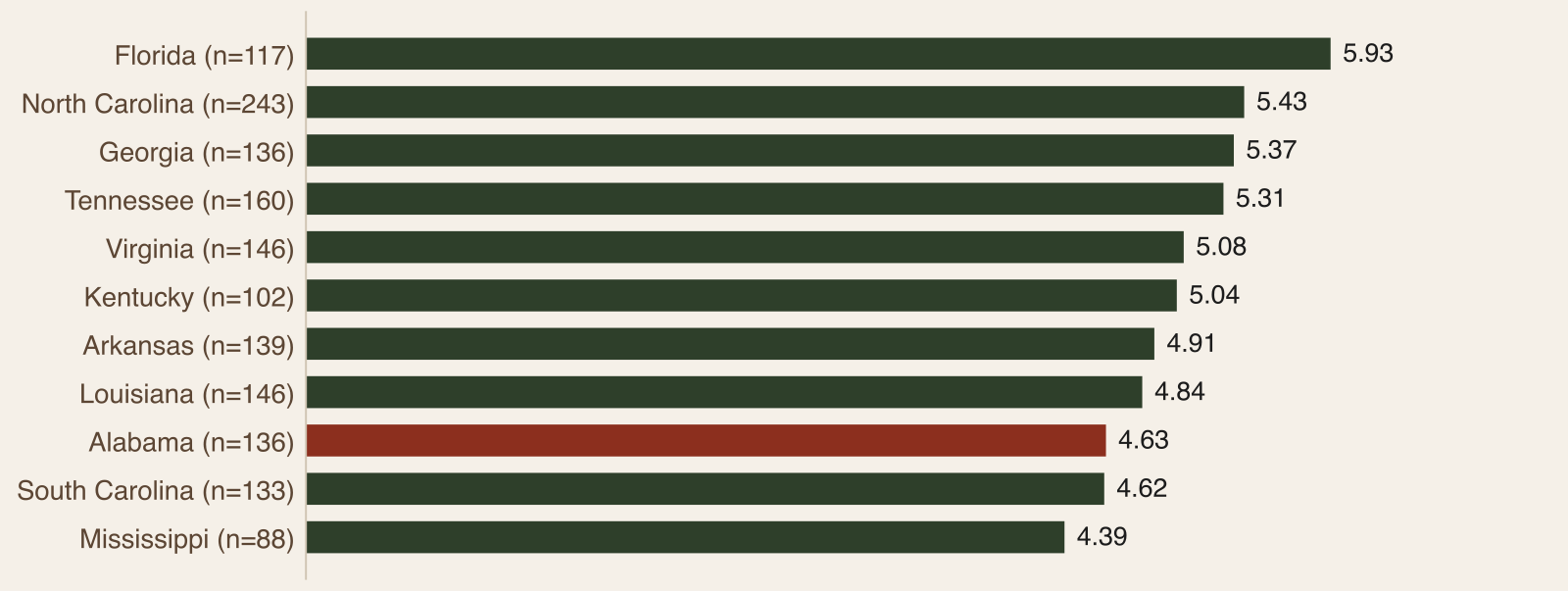
The audit numbers are the soft spot. Mean digital health, a 1 to 10 score our researchers assign from observed evidence, is 4.63 for 136 Alabama operators, against 5.09 region-wide. And 20% of Alabama sites read show an online booking engine, against 27% region-wide.
The Outdoor Economy
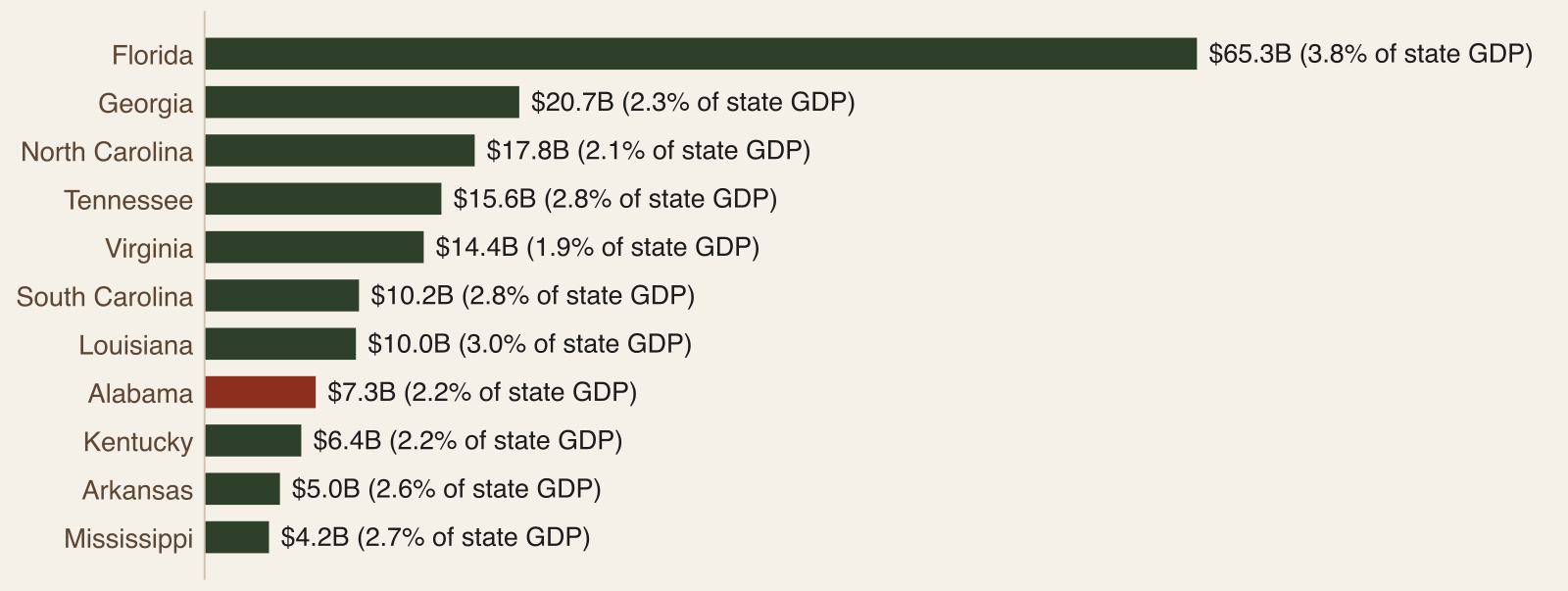
BEA's 2024 figure of $7.3 billion is the fourth-lowest of the eleven states, and Florida's $65.3 billion is the largest. Outdoor recreation employed 71,755 people, 3.2% of wage and salary jobs. Size and weight are different questions: the 2.2% share of GDP is tied with Kentucky for the third-lowest.
BEA's detailed activity table is from an older release (2023), so the report compares it only with other 2023 figures. In that year Alabama did not rank first in any of the nine activity lines, and its best rank was sixth of eleven, in RVing, where it held 8% of the regional total. Water-based guided tours and charters produced $89 million, 3% of the regional total and ninth of eleven. Hunting and trapping added $80 million, eleventh of eleven.
Tourism is measured separately, and on a different basis. The 2025 study counted more than 29.2 million visitors spending $24.9 billion, with travel expenditures at 6.5% of state GDP. It does not split out outdoor trips, but every first-time guest of a guide or charter arrives as one of those visitors, usually searching from somewhere else.
BEA value added, tourism impact and spending studies measure different things, so the report never adds them together.
The rest of the 2023 activity table is worth a look for operators. Boating and fishing produced $509 million (5% of the regional total, eighth of eleven), fishing excluding boating $124 million (7%, seventh), and guided tours and outfitted travel of all kinds $177 million (4%, ninth). Climbing, hiking and tent camping produced $107 million, shooting including archery $110 million and equestrian $82 million. Within that same vintage, Alabama's outdoor value added moved from $5.0 billion in 2019 to $4.2 billion in 2020 and $6.6 billion in 2023, up 33% over four years in current dollars. The report does not join those older-vintage figures to the 2024 number.
Southwick Associates' state estimates add the spending side. Alabama anglers spent $1.7 billion in 2022 (5% of the eleven-state total) from 466,240 resident and nonresident anglers, supporting about 15,060 jobs. Hunters spent $1.20 billion from 486,670 hunters, and target shooting added $1.2 billion from 697,820 participants, a separate and overlapping group.
Hunters and Anglers
In license year 2024 Alabama counted 626,040 paid fishing license holders, the sixth-highest total of the eleven states, and 497,063 paid hunting license holders, the fourth-highest. That is 12.1 fishing and 9.6 hunting holders per 100 residents.
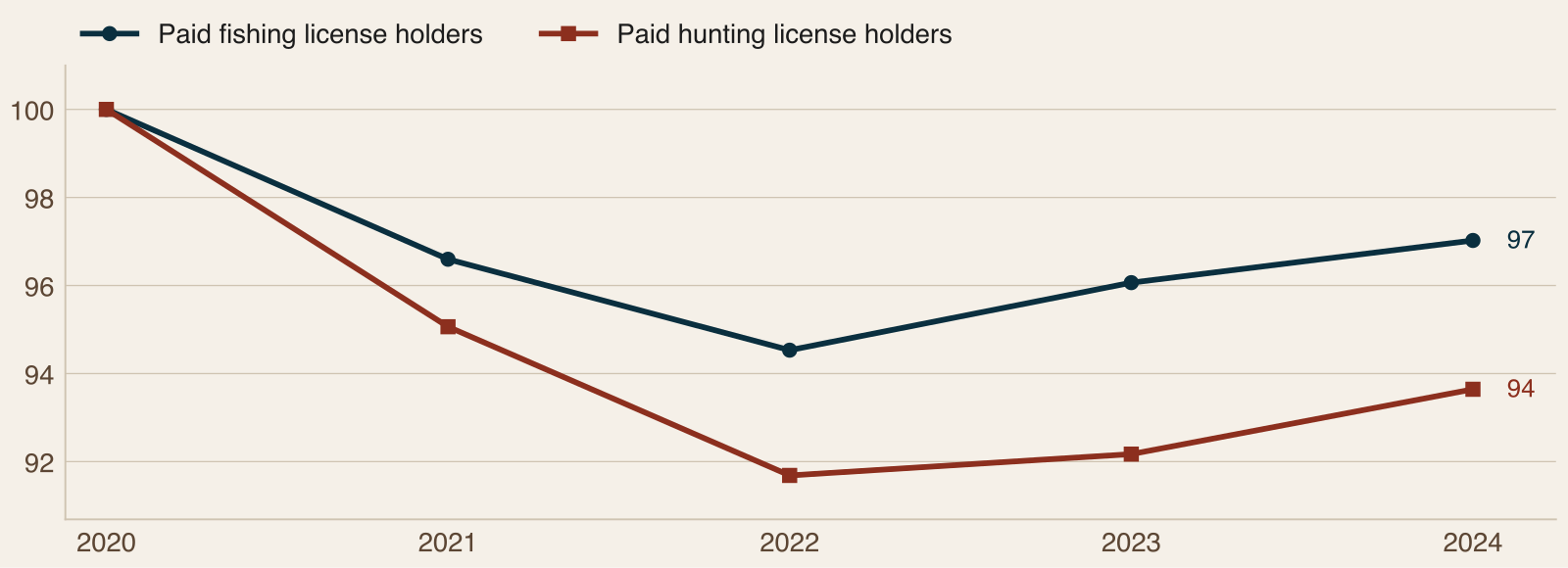
Over five years the trend is soft. Fishing holders were 645,248 in 2020, the high of the period, and 626,040 in 2024, down 3.0%. Hunting holders fell from 530,802 to 497,063, down 6.4%.
Federal harvest surveys give a second, smaller window on bird hunters. USFWS estimated about 15,200 active duck hunters in Alabama in the 2024-25 season, a preliminary figure with a margin of 14% at 95% confidence, and about 37,800 active dove hunters in 2025-26. Those are survey estimates of people who hunted, not license counts, and the report says they should not be added to the license figures.
It is mostly a resident market. Nonresidents bought 22% of fishing licenses, tags, permits and stamps in 2024, the sixth-highest share in the region, and paid 35% of fishing license revenue. Hunting is more local: nonresidents bought 8% of hunting items but paid 39% of hunting license revenue. License counts are not unique people, and free licenses and exempt hunters are not counted.
The Resource and the 2026-27 Seasons
This chapter is the one operators will keep open. ADCNR divides Alabama into five deer zones, A through E, plus a Chronic Wasting Disease Management Zone, each with its own calendar. Archery opens October 1 in Zones D and E and October 15 elsewhere. Private land and open-permit public land follow different calendars, so a guide must state which one applies.
Harvest is reported two ways. Hunters reported 205,913 deer through Game Check in 2024-25, against 201,518 in 2023-24, while the department's larger survey estimates were 314,496 for 2023-24. The report keeps the two methods apart. Hunters reported 17,049 gobblers in spring 2025, 7% fewer than the 18,263 reported in spring 2024. Spring turkey 2027 runs from March 20 to May 3 in Zone 1, and feral swine have no closed season and no bag limit in the daytime. The chapter also lays out dates and limits for deer, dove, quail, ducks and geese, with a reminder that WMAs and some national forest districts set their own dates.
The deer rules carry details a guide should quote correctly. The statewide limit is one antlered buck a day and three bucks a season, one of them with at least four points of one inch or longer on one antler, and Barbour County has its own three-point rule. Unantlered deer are two a day in Zones A, B, D, E and the CWD zone, while Zone C allows one unantlered deer and one buck a day. The National Deer Association's report lists 144,828 antlered and 176,220 antlerless deer for 2024-25, so antlerless deer were 55% of that total.
Other seasons are just as specific. Quail runs from the first Saturday in November through the last day of February at eight a day and is closed on the Bankhead National Forest. In the north dove zone the season runs September 6 to October 18 and again from November 21 to 29 and December 12 to January 17, and the south zone, which includes Baldwin and Mobile counties, starts a week later. The daily limit is fifteen. Teal run September 12 to 20, and ducks are six a day with species limits, though ADCNR notes that federal waterfowl guidelines were not final at printing. Spring turkey 2027 differs by zone: Zone 2 in the Tennessee Valley runs March 27 to May 3, and Zone 3 adds a fall season in November and December.
For anglers it lists freshwater and saltwater limits, such as 10 black bass a day with no more than five smallmouth, and redfish at 16 to 26 inches and three per person. Because many reservoirs carry exceptions, the advice is to link to the current Digest rather than copy a limit onto your site.
Chronic Wasting Disease rules deserve their own line on any North Alabama deer page. Lauderdale, Colbert and Franklin counties make up ADCNR's CWD Management Zone, with its own deer calendar on public land, sampling rules and rules on moving carcasses.
The Water
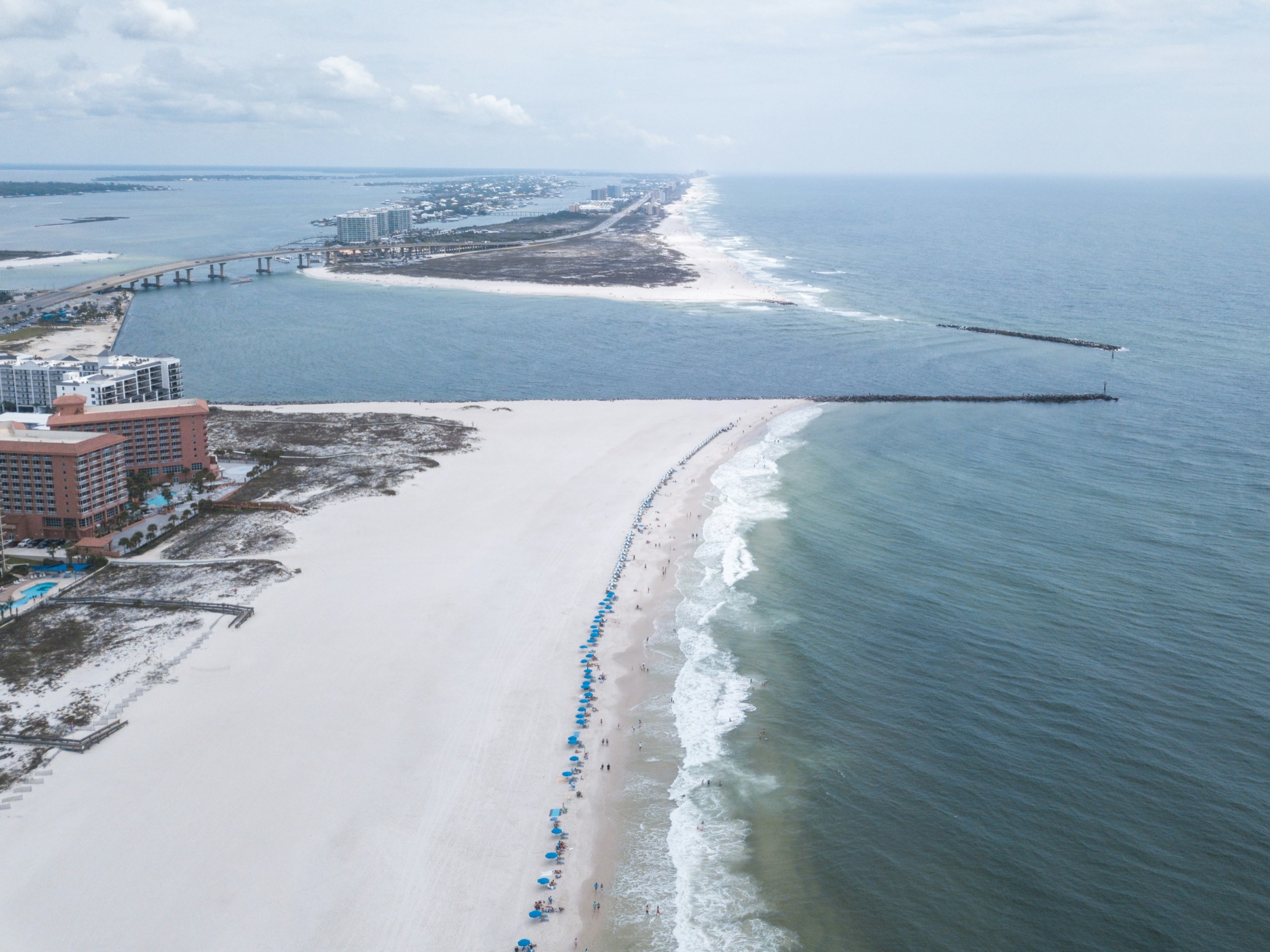
NOAA reports Alabama as one area, the Alabama coast. Its recalibrated estimates count 5.8 million marine angler trips in 2025, up 14% from 5.1 million in 2021. Of those trips, 72% were from shore, 26% from private and rental boats and 2.4% from charter boats. NOAA recalibrated every MRIP estimate in August 2026, so these figures should not be compared with any published earlier, and single-year moves of a few percent are within noise.
Charter-boat trips numbered 139,645 in 2025, 6.9% of the seven-state charter total, up 12% from 124,779 in 2021. The charter mode includes offshore as well as inshore, and no MRIP mode isolates inshore guiding.
Shore trips were 3.4 million in 2024 and 4.1 million in 2025, a 23% rise in one year, which is why the report tells readers to treat single years with care. The percent standard error on the all-trips estimate is 7.7% in 2025, so moves of a few percent between years are within noise. Alabama's coast accounts for 5% of all trips in the seven Southeast states MRIP covers.
The money is in the for-hire day. NOAA's 2022 survey put for-hire spending at $473 per angler-day, 4.8 times the $98 of a shore angler's day. Trip spending on the coast supported $878 million in sales impact in 2023.
The freshwater side has its own measures. The U.S. Coast Guard counted 247,730 registered recreational vessels in Alabama in 2024, the sixth-highest count of the eleven states. The Corps of Engineers counted 788,061 visits at the Alabama River Lakes in fiscal 2024, 103,802 of them for fishing, and 694,933 at the Black Warrior and Tombigbee Rivers, 124,589 of them for fishing. These are visitor counts at Corps projects, not counts of anglers or guided trips.
For carrying paying anglers, ADCNR requires a Commercial Party Boat License for any boat carrying, for a fee, one or more persons fishing in the salt and brackish waters it defines, and applicants need a U.S. Coast Guard Merchant Mariner Credential. The report found no ADCNR page on a separate state license for freshwater guides, so confirm what applies to your trips with ADCNR.
Public Land and the Rules for Guides
This chapter is where marketing copy can get an operator into trouble, so the report is careful. Much of the water and woods a guide sells is public, and nearly half of ADCNR's wildlife management area acreage is federal land managed under cooperative agreements, so a federal agency's rules apply there too.
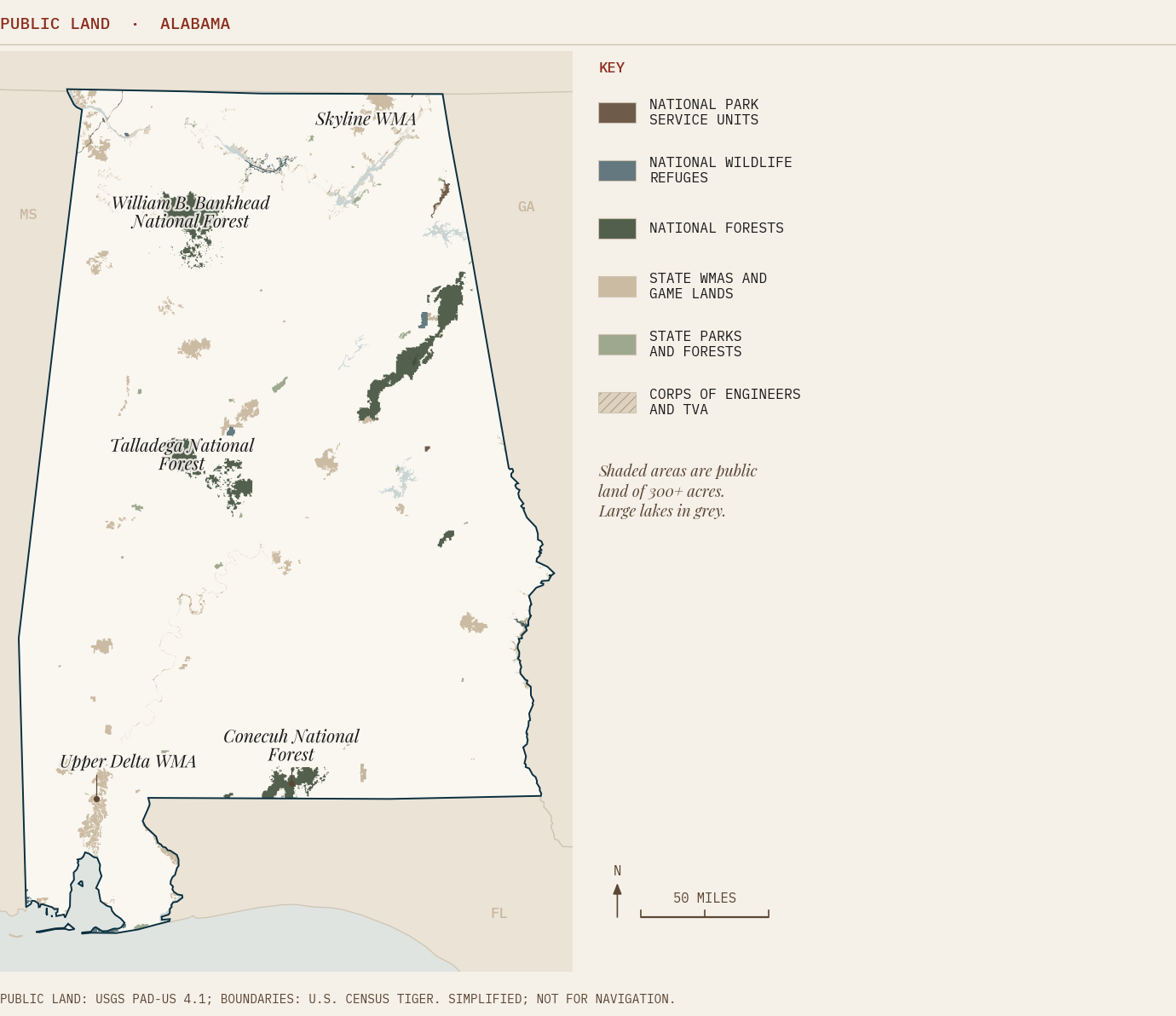
The rules differ by land type:
ADCNR wildlife management areas. More than 750,000 acres. Hunters need a WMA AREA permit and the right license. The report found no ADCNR page that authorizes commercial guiding on WMAs, so confirm with ADCNR and the landowner first.
National park units. Business operations in a park unit need an NPS permit, contract or written agreement. At Little River Canyon, all commercial uses require a permit and proof of insurance.
National wildlife refuges. Soliciting business or conducting a commercial enterprise on a refuge is prohibited except as authorized by special permit.
National forests. Four forests cover more than 673,000 acres, and selling goods or services, including guiding, requires a special-use authorization.
Army Corps of Engineers and TVA lakes. The report did not verify a commercial guiding rule, so ask the project office or TVA before selling trips from their property.
Alabama State Parks. No person may solicit, sell or advertise in any State Park without the written authorization of the Director of State Parks.
The takeaway is that a paid trip on public land or water needs the managing agency's authorization, specific to the agency and often to the site. A national forest authorization does not cover a refuge, and a party boat license covers the vessel, not the right to operate inside a park or refuge. The report summarizes published rules and is not legal advice.
The Regions
The audit groups Alabama's operators into ten sub-regions, from Northeast Alabama and Weiss Lake to the Gulf Coast, the Black Belt and the Mobile-Tensaw Delta. Only two have at least 15 operators and 10 sites read, so the rest are described in words. Among those two, scores run from 3.67 in Northeast Alabama to 4.00 in the Black Belt and prairie.
Each sub-region carries its own rule notes. Northeast Alabama has 18 operators, led by lodging and campgrounds, and Weiss Reservoir has its own 10-inch crappie minimum. The Gulf Coast has 17, led by inshore and flats fishing. The Black Belt has 16, mostly hunting operators, where deer zone dates on private land matter most. The Mobile-Tensaw Delta is paddle country, with 10 of its 16 operators in paddle, kayak and canoe, and the report notes that ADCNR lists the Delta among its WMAs, so confirm with ADCNR before selling a guided trip there. Sub-regions hold about 4 to 18 operators each, so differences under half a point are noise.
The profiles add specifics. In Northeast Alabama, 94% of operators have their own website, 13% of sites read show online booking and 20% carry FAQ content, and Little River Canyon bars motorized boats, including trolling motors. In the Black Belt, 94% have their own website, 7% show online booking and 40% carry FAQ content. The Gulf Coast's 17 operators include 5 inshore and flats guides and 4 offshore charters, but only nine homepages could be read, so the report gives no percentages. North Alabama has 16 operators, 12 of them bass, crappie and lake fishing, and Wheeler National Wildlife Refuge will have a 335-acre seasonal waterfowl sanctuary from November 15, 2026 to February 28, 2027. The remaining sub-regions are small: the Birmingham-area lakes have 14 operators, the Red Hills and Conecuh country 13 (all hunting and upland), the Wiregrass and Eufaula 12, central Alabama's rivers 10 and the Sipsey and Bankhead 4. Lake Eufaula's Barbour County has its own antler rule, and Smith Lake and Lake Martin carry exceptions to the statewide striped bass rule.
The Operator Landscape
Alabama's 136 audited operators average 4.63, the third-lowest of the eleven states, though the gap to the 5.09 regional mean is within the margin of noise. 80% have their own website, the same as region-wide, and 51% score 4 or below against 40%. Only 7% score 8 or above, against 12%.
Of the 101 sites read, 20% show an online booking engine. Where one shows, Wix Bookings is the most common, on 11 of 20 sites, followed by FareHarbor (10) and Peek (2). 32% carry FAQ content, but four of the 101 mark answers up as FAQ structured data, and 25% offer a newsletter signup against 33% regionally. 33% of sites with a detectable copyright year show 2023 or earlier.
Read the ranking with the sample in mind. 24% of Alabama's operators are top-tier against 32% region-wide, and re-weighted to the region's tier mix, Alabama's mean would be 4.84 rather than 4.63. The largest categories are bass, crappie and lake fishing (25 operators), multi-species hunting and guides (21) and paddle, kayak and canoe (20).
By category, bass, crappie and lake fishing averages 4.28 across Alabama's 25 operators against 3.83 across the eleven states, while multi-species hunting and guides averages 3.95 across 21 operators against 4.69. Paddle, kayak and canoe averages 5.15 across 20 against 5.36. Tier by tier, top-tier operators average 6.69 in Alabama against 7.06 region-wide, middle-tier 4.61 against 4.95, and lower-tier 2.89 against 2.84, so the state's gap sits in the top and middle tiers and is inside the half-point noise band.
The separate hunting audit, which is a different sample, counts 66 Alabama hunting operators with a mean of 4.77. 95% have their own website, but only 6% of the 62 sites read show online booking.
Six Moves for Operators
The closing chapter gives six moves: get the basics right first, make booking easy, answer the questions and mark them up, publish the rules you work under, write a page for each lake, river and season, and, for hunting operators, close the booking gap with a season calendar and deposit path. If you do one thing this month, make sure a visitor on a phone can find your homepage, see what a trip includes and which permits you hold, and hold a date in under a minute.
Each move is tied to an audit number. The basics matter because 51% of Alabama's audited operators score 4 or below, against 40% region-wide, and 20% have no website of their own. Booking matters because 80% of sites read show no booking engine on the homepage, which often leaves a ready buyer with a phone call or a form, and the report suggests testing the path from a phone before each season. The answer layer matters because four of 101 sites use FAQ structured data. For the rules move, the report suggests saying on your site which permits you hold, such as the ADCNR commercial party boat license and Coast Guard credential, an NPS commercial permit, a refuge special use permit or a Forest Service special-use authorization. It is reassurance for the buyer, and it keeps your content accurate when seasons and limits change.
What It Means for Operators
Alabama is not the biggest outdoor economy in the region, but it is a state of licensed hunters and anglers, a large visitor economy and a lot of public land. The audit says its operators sit below the region online, and a gap this small is not destiny. The booking and answer gaps are the same ones that show up elsewhere in the Southeast, and they are fixable in a season.
The less obvious takeaway is that rules are content. Deer zones, reservoir limits and agency permits differ so much by place that an operator who publishes the right ones, dated and sourced, answers questions a competitor's homepage leaves open.
Read the Full Alabama Outdoor Report
The full report has the season tables, the NOAA coast data, the sub-region profiles, the public land rules and the sources and methods behind each figure.
Download the full 2026-27 Alabama Outdoors report (free with your email).
Frequently Asked Questions
How big is Alabama's outdoor recreation economy?
BEA measured $7.3 billion of value added in 2024, 4% of the eleven-state Southeast total and 2.2% of state GDP, against 2.4% for the U.S. That is the fourth-lowest total of the eleven states, and Florida's $65.3 billion is the largest. The sector employed 71,755 people, 3.2% of wage and salary jobs. Size and weight are different questions, since the 2.2% share is tied with Kentucky for the third-lowest, but the figure counts the outdoor share of many industries, from retail and boat manufacturing to lodging and food service.
Is Alabama mostly a resident or a visitor market for hunting and fishing?
Mostly resident. Nonresidents bought 22% of fishing licenses, tags, permits and stamps in 2024 and 8% of hunting items, though they paid 35% of fishing license revenue and 39% of hunting license revenue. The state's tourism study counted 29.2 million visitors in 2025 who spent $24.9 billion, but it does not separate outdoor trips. For a guide, that means the base is local, and the out-of-state buyer is a smaller group who is searching from somewhere else.
Can I guide on a wildlife management area in Alabama?
The report found no ADCNR page that authorizes commercial guiding on a WMA, and the rule it reviewed, Rule 220-2-.55, has no guiding provision that it could find. Confirm with ADCNR and the landowner before selling a guided trip there. Nearly half of the more than 750,000 WMA acres are federal land under cooperative agreements, so federal rules apply as well. The same caution holds for refuges, national forests and parks, where each agency requires its own permit or authorization.
Do charter captains need a state license?
ADCNR requires a Commercial Party Boat License for any boat carrying, for a fee, one or more persons fishing in the salt and brackish waters it defines, and for commercial party boats fishing only in federal waters to allow passengers to possess fish in Alabama waters. Applicants must show a U.S. Coast Guard Merchant Mariner Credential. The report found no ADCNR page on a separate license for freshwater guides, so confirm with ADCNR what applies to your trips.
How do Alabama operators compare online with the rest of the Southeast?
The 136 audited operators average 4.63 on digital health against 5.09 region-wide, the third-lowest of the eleven states, though the gap is within the margin of noise. Booking engines show on 20% of sites read against 27%, 32% carry FAQ content against 37%, and 25% offer a newsletter signup against 33%. Re-weighted to the region's tier mix, Alabama's mean would be 4.84, so the ranking is best read as directional and not as a verdict on any one business.
Why does the report say single-year coast numbers should be read with care?
NOAA recalibrated every MRIP estimate in August 2026, which lowered shore and private-boat counts, so the 2025 figures should not be compared with anything published before then. The percent standard error on the all-trips estimate is 7.7% in 2025, and shore trips rose 23% in one year, from 3.4 million in 2024 to 4.1 million in 2025. Charter trips, at 139,645 in 2025, move with weather, storms and fuel as much as with demand. Look at the five-year direction, not one year's swing.
What are the Alabama deer and turkey seasons a guide has to know?
Deer seasons depend on the zone, with five zones A through E plus a CWD Management Zone, and on whether the land is private or open-permit public. Archery opens October 1 in Zones D and E and October 15 elsewhere, and gun dates on public land are shorter and more restricted than on private land. Spring turkey 2027 runs March 20 to May 3 in Zone 1 and March 27 to May 3 in Zone 2. State on your pages which calendar applies to the land you sell, and link to ADCNR for current dates.
Which Alabama sub-regions does the audit describe with percentages?
Only two of the ten sub-regions have at least 15 operators and 10 sites read: Northeast Alabama, with a mean of 3.67, and the Black Belt and prairie, with a mean of 4.00. The other eight are described in words because a single site would move a percentage by many points. Sub-regions hold about 4 to 18 operators each, so differences of less than half a point of digital health, or 10 points in a percentage, are noise.
Sources
U.S. Bureau of Economic Analysis, Outdoor Recreation Economic Statistics, U.S. and States, 2024, March 5, 2026
U.S. Fish and Wildlife Service, certified hunting and fishing license data, license years 2020 to 2024
Alabama Tourism Department, Economic Impact of Travel and Tourism in Alabama, 2025 (May 2026), and the USGS PAD-US 4.1 public land database
Pine & Marsh Southeast audit, October 2026 (1,546 operators, 136 in Alabama), and the Pine & Marsh hunting audit, October 2026 (493 operators)
Related Reading
Marketing a Sporting Operation in Alabama: The Full State Guide
Inside the 2026-27 Whitetail Report: Why You Cannot Rank Deer Harvest by State
Inside the 2026-27 Mississippi Outdoors Report: A Small Economy and Room to Grow Online
Inside the 2026-27 Georgia Outdoors Report: The Region's Biggest Hunting Market, Chapter by Chapter


Comments