
Inside the 2026-27 Georgia Outdoors Report: The Region's Biggest Hunting Market, Chapter by Chapter
The 2026-27 Georgia Outdoors report is a state-level look at the business of hunting, fishing and paddling in Georgia. It puts public, primary-source data next to Pine & Marsh's October 2026 audit of private, for-profit outdoor businesses, 136 of them in Georgia. The public data comes from the U.S. Bureau of Economic Analysis (BEA), the Georgia Department of Economic Development, the U.S. Fish and Wildlife Service, NOAA Fisheries, the U.S. Coast Guard, the Georgia Department of Natural Resources and federal land agencies.
It is written for plantation owners, hunting outfitters, fly-fishing and paddling guides, and coastal captains who sell trips in Georgia. This post walks through the report chapter by chapter, in the report's own order. For the marketing playbook, see Marketing a Sporting Operation in Georgia: The Full State Guide.
At a Glance: Georgia in Nine Numbers
Georgia is a hunting state first. It had 816K paid hunting license holders in license year 2024, the highest in the region, and 1.13 million paid fishing license holders. Outdoor recreation added $20.7 billion of value added in 2024, 12% of the eleven-state Southeast total, but only 2.3% of state GDP against 2.4% for the U.S. It employed 168K people. The state reports 175.6 million visitors in 2025.
The coast is short. NOAA counted 3.8 million saltwater angler trips in 2025 on one coast. The 136 audited Georgia operators score 5.37 out of 10 on digital health against 5.09 region-wide, and 28% of the sites read show an online booking engine against 27%. In other words, Georgia's audited businesses sit about level with the region.
The Outdoor Economy: Second-Largest, Lighter by Share
Georgia's $20.7 billion is second only to Florida's $65.3 billion, and 3.0% of the national figure. Outdoor recreation employed 168,231 people, 3.3% of wage and salary jobs and the second-highest count in the region. Its 2.3% share of GDP is the fifth-lowest of the eleven states.
The activity breakdown uses BEA's older 2023 vintage and is compared only within 2023. Georgia ranked first in the region in one of nine lines, hunting and trapping, at $387M and 21% of the eleven-state total. It ranked second in guided tours and outfitted travel (all kinds) at $610M and in shooting, including archery. Water-based guided tours and charters were $375M, 12% of the regional total.
The rest of the table fills in Georgia's profile. Boating and fishing produced $1,123 million (10% of the regional total, third of eleven), fishing excluding boating $177 million (11%), RVing $452 million (9%, fifth), climbing, hiking and tent camping $216 million (13%, third) and equestrian $163 million (11%, third). Within that same vintage, Georgia's outdoor value added moved from $13.8 billion in 2019 to $10.2 billion in 2020 and $18.5 billion in 2023, up 34% in current dollars, and outdoor employment from 155,543 to 161,816. The report does not join those older figures to the 2024 number.
The visitor economy is separate. The Georgia Department of Economic Development reported 175.6 million visitors in 2025 who spent $46.2 billion, for a total economic impact of $84.1 billion. Southwick Associates put angler spending at $4.4 billion in 2022 and hunter spending at $2.00 billion. The report never adds these measures together, because they count different things in different years. Every first-time guest of a Georgia guide, charter or outfitter arrives as one of these visitors first.
The tourism release also counts 473,837 supported jobs and $5.3 billion in state and local tax revenue. On the spending side, Southwick Associates counted 1,114,640 resident and nonresident anglers in 2022, supporting about 38,280 jobs, and 819,890 hunters, while target shooting added $2.1 billion from 1,251,750 participants, a separate and overlapping group. Every first-time guest of a Georgia guide, outfitter or rental arrives as one of those visitors first, usually searching from somewhere else.
Hunters and Anglers: Highest Hunting Count in the Region
Georgia counted 815,738 paid hunting license holders in 2024, the highest of the eleven states, and 1,129,635 paid fishing license holders, the third-highest. Against 11.2 million residents, that is 7.3 hunting and 10.1 fishing license holders per 100 people. Hunting license holders rose 9.3% from 2020 to 2024, and fishing license holders rose 6.0%, the high of the period.
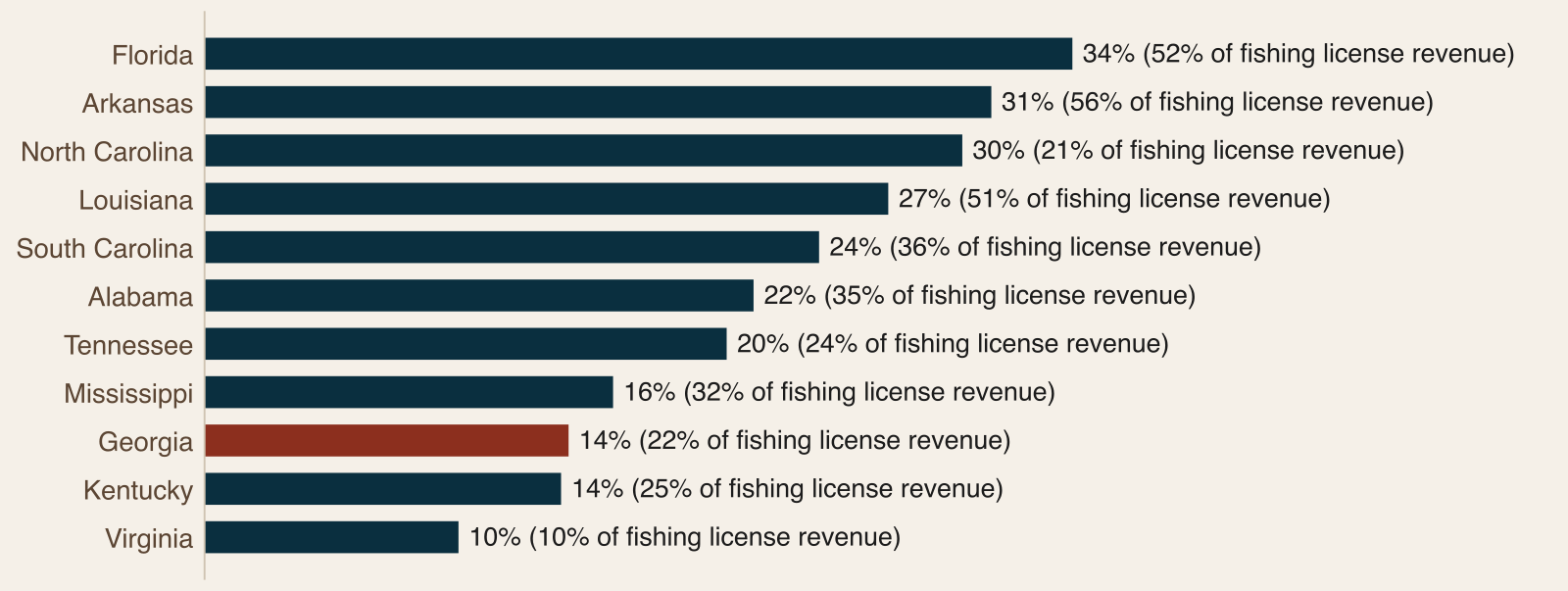
The resident and nonresident split is unusual. Nonresidents bought only 12% of hunting items but paid 53% of hunting license revenue, more than half of what hunters spent on licenses. On fishing, nonresidents bought 14% of items, the third-lowest share in the region, and paid 22% of revenue. The practical reading is that the out-of-state hunter is a smaller group in Georgia than elsewhere, but a valuable one.
The item counts show the scale. Georgia sold 1,402,849 hunting items to residents and 195,292 to nonresidents in 2024, with resident revenue of $9.9 million against $11.2 million from nonresidents. In fishing, residents bought 1,408,854 items and nonresidents 234,359, with revenue of $12.6 million against $3.5 million. Fishing license holders went from 1,065,774 in 2020 to 1,129,635 in 2024, up 6.0%, and hunting holders from 746,251 to 815,738. Items are not people, because one person can buy several, and the certified data flag no reporting anomaly for Georgia.
The report keeps surveys and licenses apart. USFWS estimated about 29,800 active duck hunters in 2024-25 and about 46,700 active dove hunters in 2025-26. The 2022 national survey, rounded as published, counts about 599,000 hunters and 1,700,000 anglers aged 16 and older, a different population from paid license holders.
The Resource and the 2026-27 Seasons
WRD estimated a Georgia deer harvest of 274,134 in 2024-25, against 270,272 in 2020-21. The highest of the five seasons was 2023-24 at 298,022. In 2024-25, 52% of the harvest was antlerless. Archery deer season opens September 12, 2026, and firearms season opens October 17, 2026, running to January 10, 2027 for most hunters, with other end dates in counties with extended seasons.
The 2024-25 harvest was 130,933 antlered deer and 143,201 antlerless. For 2025-26, WRD's own news release says about 250,000 deer, a rounded figure the report says should not be compared with the precise estimates above. The bag limit is up to 10 antlerless deer and no more than 2 antlered deer, with one antlered deer needing four or more points of at least one inch on one side or a 15 inch outside spread. Hunters need a hunting license, a big game license and a current deer harvest record, and every deer must be reported through Georgia Game Check within 24 hours.
Turkey and quail tell a more cautious story. Reported spring turkey harvest was 11,570 in 2024, down 20% from 14,412 in 2020. Poults per hen were 1.80 in 2024, 1.58 in 2025 and a preliminary 1.47 in 2026. For quail, the National Bobwhite and Grassland Initiative lists a 2022 harvest estimate of 373,193 birds and 12,203 hunters, against 504,683 birds and 15,060 hunters in 2015. The report warns that the 2022 estimate includes pen-reared birds, so the two harvests are not a like-for-like trend.
The calendar table covers deer, dove, early teal and Canada goose, ducks, quail, spring turkey and feral hogs. Quail season runs November 14 to February 28 with a daily bag of 12, or 3 per person on WMAs, VPAs and national forest land. Seasons on wildlife management areas follow area rules.
Dove runs September 5 to October 11, November 21 to 29 and December 19 to January 31 at 15 a day, and hunters 16 and older need a hunting license and a Georgia Migratory Bird License. Early teal runs September 12 to 20 at a daily bag of 6, early Canada goose September 5 to 27 at 5, and the regular duck season November 21 to 29 and December 12 to January 31 at 6 a day with no more than 4 sea ducks. Spring turkey 2027 runs March 27 to May 15 on private land and April 3 to May 15 on WMAs, VPAs and national forest land, with one gobbler a day and two for the season. Feral hogs on private land have no closed season and no limit, and hunters need a hunting license except residents on land they or their immediate family own and live on.
On salt water, Georgia publishes one set of limits for the whole coast rather than regional rules. The report lists red drum, spotted seatrout, flounder, sheepshead and black drum, and notes that from January 1, 2027 the red drum limit drops to three fish with a 15 to 24 inch slot. Because limits change, a guide's website should link to the current Coastal Resources Division page rather than copy them.
The table is short. Red drum are open all year at 5 fish with a 14 to 23 inch slot, spotted seatrout 15 fish with a 14 inch minimum, flounder 15 fish with a 12 inch minimum, sheepshead 15 fish with a 10 inch minimum fork length and black drum 15 fish with a 14 inch minimum. Red drum may be taken only with pole and line.
The Water: One Short Coast and Big Freshwater Lakes
NOAA's recalibrated estimates count 3.8 million marine angler trips in Georgia in 2025, down 2% from 3.9 million in 2021. Shore fishing was 66% of trips. Charter boats carried 24,868 trips, 0.6% of the state's total, down 24% from 32,925 in 2021. The guided saltwater trade is a small slice of a large public. NOAA's 2022 spending study puts a charter or guided angler-day at $270.56, against $69.30 for a shore angler-day, so a guided day is worth 3.9 times a shore day.
The low point for charters was 22,589 trips in 2024, and the report does not carry a standard error for mode-level estimates, so it asks readers to read the direction and not the exact numbers. Trip spending produced a $356 million sales impact in 2023, supporting about 2,281 jobs, which is 4% of the impact across the Southeast's coastal areas and sixth of nine areas. A charter or guided angler-day came to $270.56 in NOAA's 2022 study, against $69.30 for a shore day and $58.13 for a private boat, 3.9 times a shore day.
Most Georgia anglers fish fresh water. The 2022 national survey counts about 1.6 million freshwater anglers against about 561 thousand saltwater anglers, and the groups overlap. The three Corps of Engineers projects tagged to Georgia had 17.7 million visits in fiscal 2024, led by Lake Lanier at 11,418,528 visits, of which fishing was 9%.
The Corps table shows the freshwater crowd. Lake Lanier drew 11,418,528 visits, 1,004,933 of them for fishing (9%), Allatoona Lake 5,894,190 with 609,317 fishing (10%) and Carters Lake 350,482 with 54,625 fishing (16%). The Coast Guard counted 324,676 registered recreational vessels in Georgia in 2024, the fourth-highest of the eleven states and up 0.2% from 2023.
On licensing, Georgia requires a saltwater fishing guide license to work as a saltwater guide, and the Coast Guard separately requires a captain's license to carry passengers for hire. The report did not verify a state license rule for freshwater guides, so confirm with DNR before selling a freshwater trip.
Public Land and the Rules for Guides
WRD manages 133 wildlife management areas on 1,149,664 acres, but 57% of that is leased rather than owned by the state, and some of it is national forest or other federal land, so more than one set of rules can apply on the same ground.
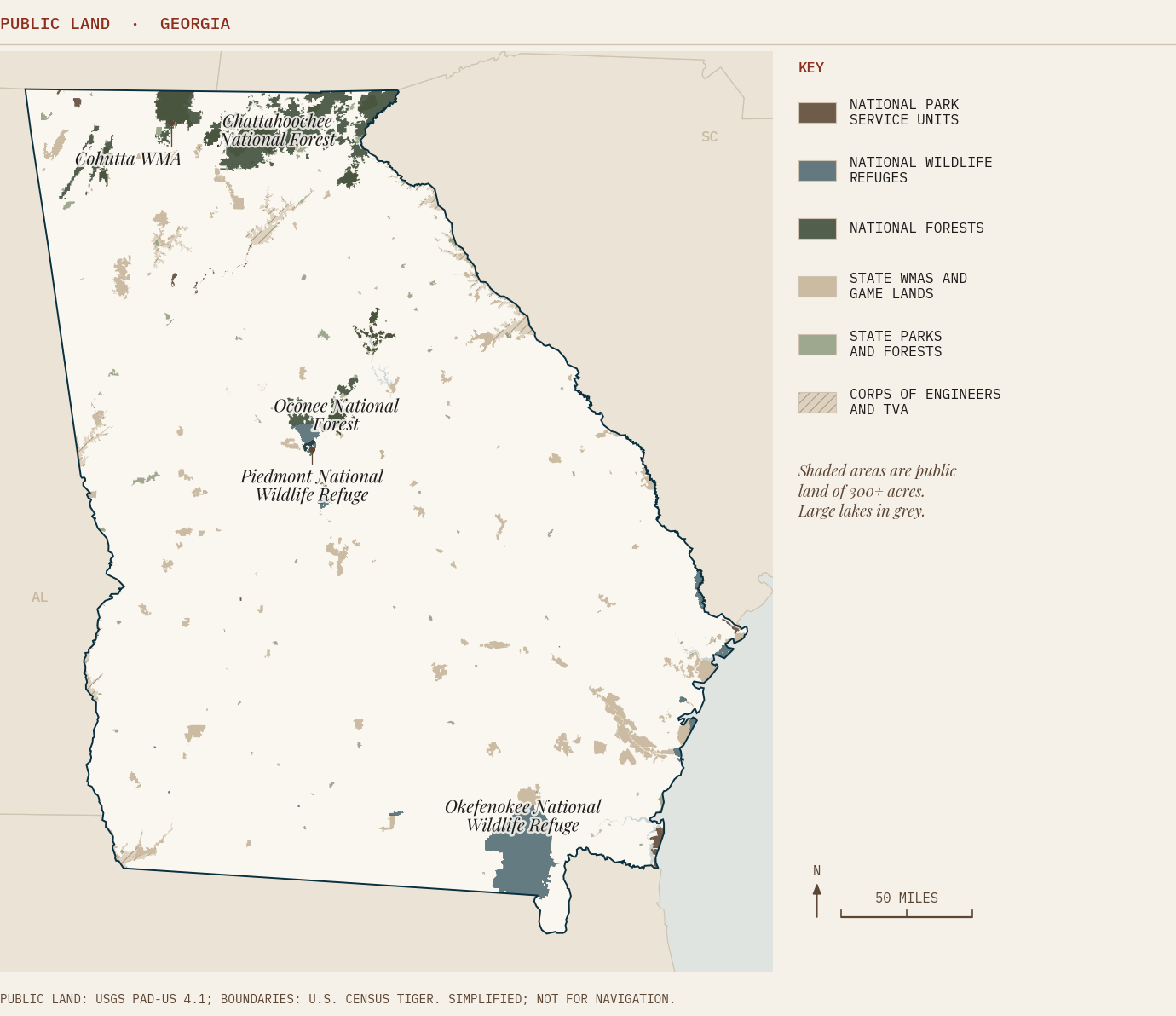
What the report finds:
Wildlife management areas: Georgia's general WMA rule lists permitted uses and does not address guiding, and the report found no WRD page authorizing it, so confirm with WRD before selling a guided trip on one. Confirm with WRD and the landowner first. Where a WMA is on national forest land, Forest Service rules apply too.
Chattahoochee-Oconee National Forests: Operating an outfitting or guiding business needs a special use permit, and the forest takes applications in open seasons, August 1 to 31 and February 1 to 28 or 29.
Okefenokee National Wildlife Refuge: A Commercial Guide special use permit is required for anyone who charges or includes a fee for guiding. The 2024 conditions describe annual permits, liability insurance and first aid and CPR certification.
Other refuges and Cumberland Island National Seashore: Commercial enterprise on a refuge needs a special permit, and business operations in an NPS unit need a permit, contract or written agreement.
State parks and Corps lakes: The report did not verify a commercial-guiding rule. Ask the managing agency for its permit before selling a trip there.
The summary line: never assume guiding on public land is allowed without a permit. A refuge permit does not cover a national forest, and a state saltwater guide license is not a right to run a business inside a refuge or park. The report summarizes published rules and is not legal advice.
The Regions: Six Sub-Regions
The audit groups Georgia into six sub-regions: the Piedmont and central Georgia, the North Georgia mountains, the Southwest Georgia plantation belt, the Savannah coast, the Golden Isles coast, and South Georgia and the Okefenokee. The last has twelve operators and is described in words. Scores for the other five range from 4.58 in the Southwest Georgia plantation belt to 5.88 in the North Georgia mountains.
The mountains lead with 26 operators, mostly fly-fishing and trout (14), and 96% have their own website. The plantation belt is the most specialized sub-region: of its 24 operators, 21 are upland, plantation and sporting clays, and only 17% of sites read show an online booking engine. The Piedmont scores 5.69, the Golden Isles 5.50 and the Savannah coast 5.04. Each sub-region carries its own rule notes, including the national forest permit seasons in the mountains and the Okefenokee guide permit in the south.
The profiles add detail. The Piedmont and central Georgia has 26 operators, with 92% having their own website, 35% of sites read showing online booking and 17% carrying FAQ content, and the report notes that Corps reservoirs such as Lake Lanier and Allatoona are managed by the Corps, so confirm with the project office before selling a guided trip that launches from its land. The North Georgia mountains have 32% of sites read showing online booking and 40% carrying FAQ content, and several WMAs there lie on national forest land, so Forest Service rules apply as well as WRD's. The report did not verify state trout stream rules. The Savannah coast has 24 operators, 71% with their own website, 29% showing online booking and 29% carrying FAQ content, while the Golden Isles coast has 24, with 83% having their own website, 25% showing online booking and 50% carrying FAQ content. The Southwest Georgia plantation belt has 92% with their own website and 39% carrying FAQ content, and South Georgia and the Okefenokee has 12 operators, led by multi-species hunting guides (4), lodging (3) and general fishing guides (3).
The Operator Landscape: About Level With the Region
The 136 audited operators have a mean digital health of 5.37, the third-highest of the eleven states, though the lead is within the margin of noise.
87% have their own website, against 80% across the region.
35% score 4 or below, against 40%.
28% of the 109 sites read show an online booking engine, against 27%. FareHarbor is on 13 of the 30 sites with one, followed by Wix Bookings (10) and Xola (4).
35% carry FAQ content, but only two mark answers up as FAQ structured data.
36% offer a newsletter signup, against 33% regionally.
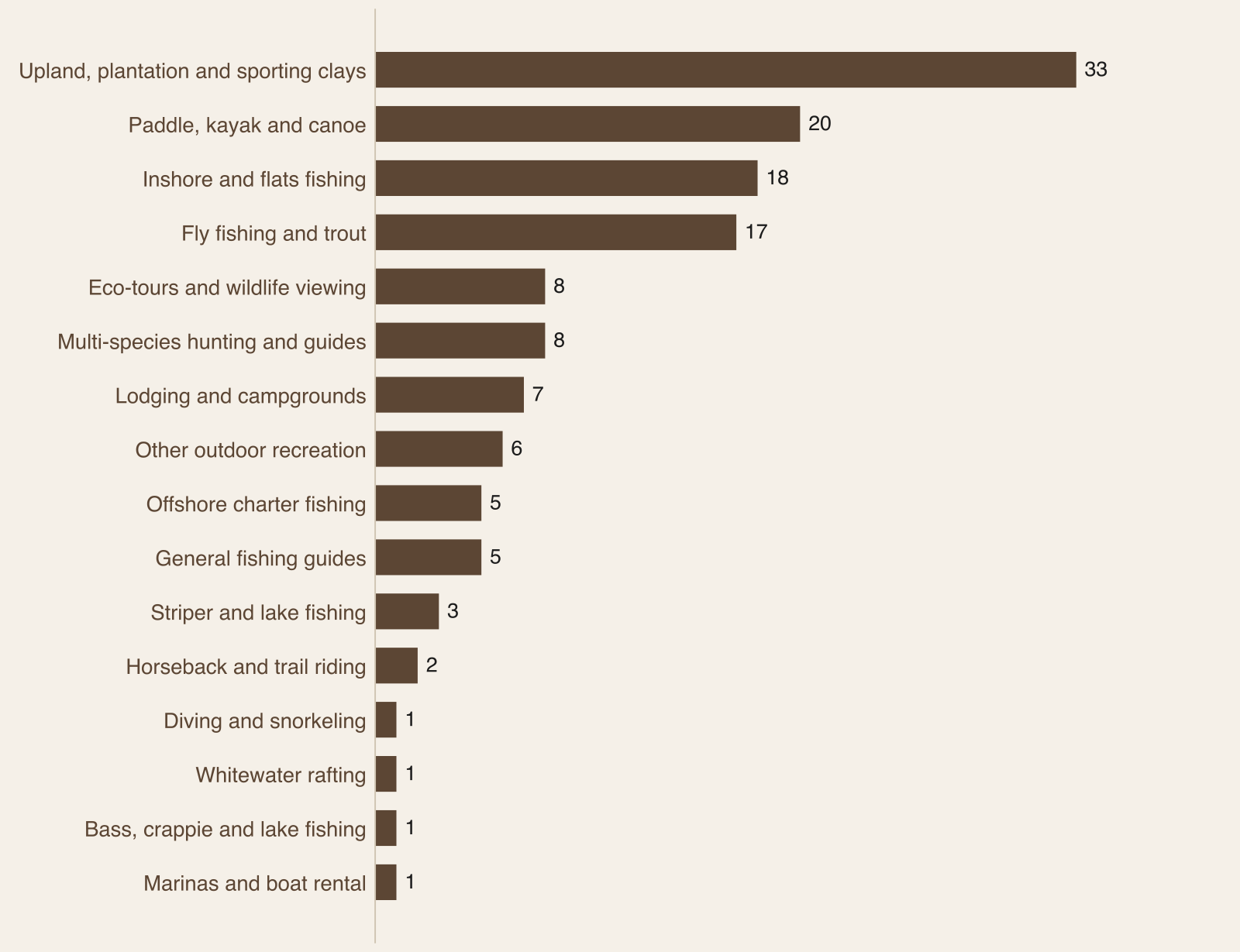
Georgia's tier mix is close to the region's: 34% of operators are top-tier and 26% lower-tier, against 32% and 26%. Within tiers, top-tier operators average 7.39 against 7.06, middle-tier 5.17 against 4.95 and lower-tier 3.08 against 2.84. The largest categories are upland, plantation and sporting clays (33, mean 4.82 against 5.21 across the eleven states), paddle, kayak and canoe (20), inshore and flats fishing (18) and fly fishing and trout (17, mean 6.06).
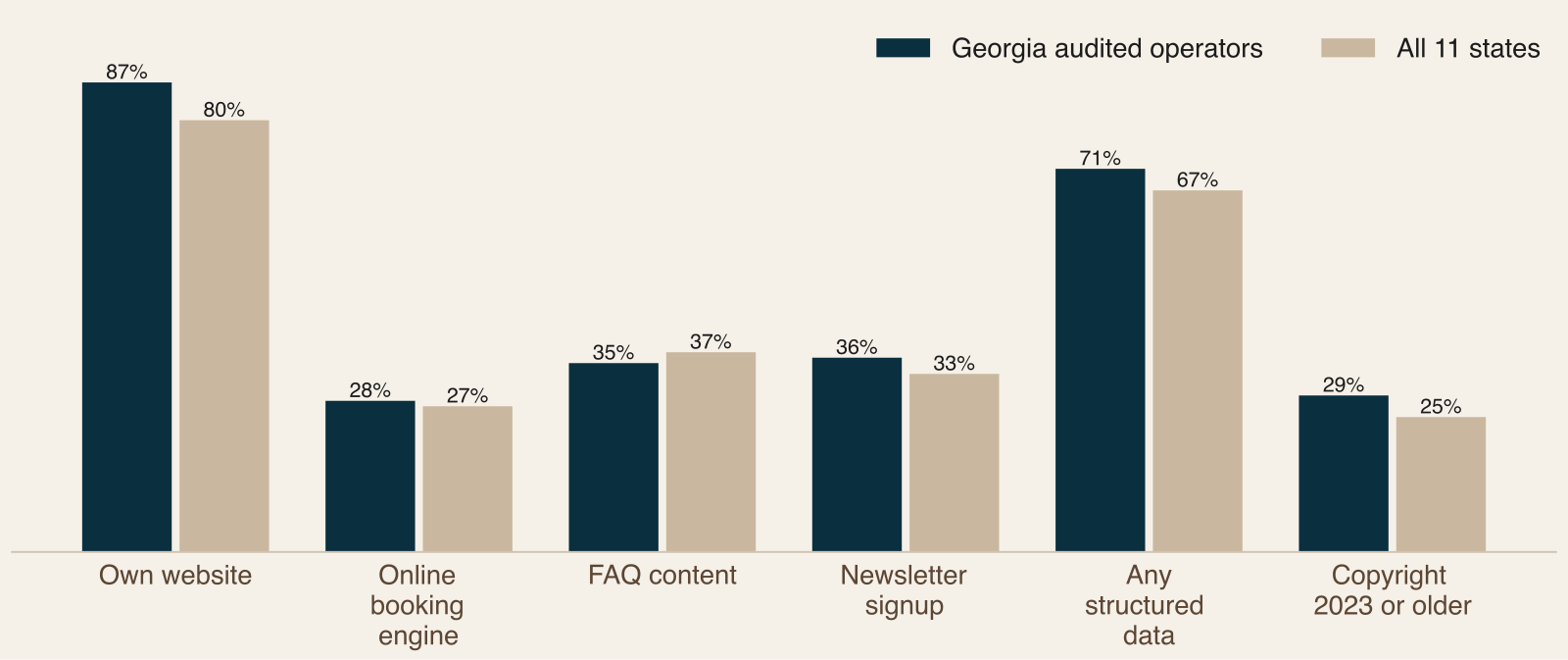
By category, upland, plantation and sporting clays averages 4.82 across 33 Georgia operators against 5.21 across the 82 in the eleven states, paddle, kayak and canoe 5.45 against 5.36, inshore and flats fishing 5.11 against 4.69, and fly fishing and trout 6.06 across 17 operators against 5.53 across 126. Of the 136 audited operators, 109 had a homepage that could be read, and 29% of sites with a detectable copyright year show 2023 or earlier.
The separate hunting audit (493 hunting operators, October 2026) counts 69 in Georgia. Their mean digital health is 5.62 and 97% have their own website, but only 15% of the 62 sites read show online booking, against 28% of Georgia's main-audit sites. By tag, upland and quail leads with 47.
What It Means for Operators
Georgia is the region's largest hunting market, yet its audited operators score about the same as everyone else, and the largest category, upland, plantation and sporting clays, scores below its eleven-state peers. The gap is clearest in the hunting audit, where booking is far less common than in the main audit.
The report's six moves are to write for the visitor and the out-of-state hunter, make booking work on a phone, answer questions and mark them up, publish the rules you work under, write a page for each water, region and season, and, for hunting operators, close the booking gap. Its advice for this month is to make sure a visitor on a phone can find your homepage, see what a trip includes and which permits you hold, and hold a date in under a minute.
Get the Georgia Report
The full report adds the audit tables, every chart with its source and year, the 2026-27 season calendar, the sub-region notes and the full source list.
Download the full 2026-27 Georgia Outdoors report (free with your email).
Frequently Asked Questions
How many hunters does Georgia have?
Georgia had 815,738 paid hunting license holders in license year 2024, the highest in the region and up 9.3% from 746,251 in 2020. That is 7.3 per 100 residents, sixth of the eleven states. The 2022 National Survey counts about 599,000 hunters, a different measure of people who took part, and the report says it should not be swapped for the license count or added to it. Licenses are also not unique people, since someone licensed in two states counts in both.
Do out-of-state hunters matter in Georgia?
By count they are a small group: nonresidents bought 12% of hunting items in 2024. By revenue they matter far more, paying 53% of hunting license revenue, $11.2 million against $9.9 million from residents, which is more than half of what hunters spent on licenses. For fishing, nonresidents bought 14% of items and paid 22% of revenue, both among the three lowest shares in the region. Hunting operators therefore have more reason than anglers' guides to write for the traveler.
Can I guide on Georgia WMAs, refuges and national forests?
Only with the right authorization. The report found no WRD page that authorizes guiding on WMAs, and the general WMA rule does not address it, so confirm with WRD and the landowner first. National forest guiding needs a Forest Service special use permit, with application windows in August and February, and the Okefenokee refuge requires a Commercial Guide special use permit with liability insurance and first aid and CPR certification. The report did not verify rules for state parks or Corps lands.
How big is Georgia's saltwater trade?
It is small. NOAA counted 3.8 million marine angler trips in 2025, down 2% from 2021, and charter boats carried 24,868 of them, 0.6% of the total and down 24% from 32,925 in 2021. A guided day is still worth 3.9 times a shore day in angler spending, $270.56 against $69.30, and trip spending produced a $356 million sales impact in 2023. Georgia requires a saltwater fishing guide license, and the Coast Guard requires a captain's license to carry passengers.
How do Georgia operators compare online?
The 136 audited operators average 5.37 against 5.09 region-wide, the third-highest of the eleven states, a lead the report calls within the margin of noise. Booking is level at 28% against 27%, FAQ content is 35% against 37%, and only two of the 109 sites read mark answers up as FAQ structured data. Georgia's tier mix is close to the region's, with 34% top-tier against 32%, so the sample does not explain the result the way it does in some states.
Why is Georgia's deer harvest hard to compare year to year?
Because the methods differ. WRD's estimate adjusts Game Check reports for reporting compliance using a hunter survey, and it put the 2024-25 harvest at 274,134, against a high of 298,022 in 2023-24. For 2025-26 WRD's own news release gives only about 250,000 deer, a rounded figure the report says should not be compared with the precise estimates. The practical lesson for a hunting property is to cite the source and season of any figure it quotes.
What is changing for coastal anglers in 2027?
From January 1, 2027, the Coastal Resources Division says the red drum limit drops to three fish with a 15 to 24 inch slot, down from five fish and a 14 to 23 inch slot. Georgia publishes one set of saltwater limits for the whole coast rather than regional rules, and limits can change, so the report's advice is that a guide's website should link to the Division's current page and not copy the numbers. Red drum may be taken only with pole and line.
Which Georgia sub-region scores lowest, and what does it sell?
The Southwest Georgia plantation belt averages 4.58 across 24 operators, the lowest of the five sub-regions with enough data, and it is the most specialized: 21 of the 24 are upland, plantation or sporting clays operations. Only 17% of its sites read show online booking, though 39% carry FAQ content. The North Georgia mountains lead at 5.88, with fly fishing and trout the largest group. The report notes that differences under half a point are noise.
Sources
Georgia Department of Economic Development tourism release of September 30, 2026, and Georgia DNR season pages, read October 2026
U.S. Fish and Wildlife Service, certified hunting and fishing license data, license years 2020 to 2024
USGS Gap Analysis Project, PAD-US 4.1, for the public-land map
Pine & Marsh Southeast audit, October 2026 (1,546 operators), and the Pine & Marsh hunting audit, October 2026 (493 operators)


Comments