
Inside the 2026-27 Florida Outdoors Report: The Southeast's Biggest Outdoor Economy, Built on Salt Water
The 2026-27 Florida Outdoors report is a state-level look at the business of fishing, diving, eco-tours and hunting in Florida. It puts public, primary-source data next to Pine & Marsh's October 2026 audit of private, for-profit outdoor businesses, 117 of them in Florida. The public data comes from the U.S. Bureau of Economic Analysis (BEA), VISIT FLORIDA, the U.S. Fish and Wildlife Service, NOAA Fisheries, the U.S. Coast Guard, the Florida Fish and Wildlife Conservation Commission (FWC) and federal land agencies.
It is written for charter captains, inshore guides, dive and eco-tour operators, hunting outfitters and marina owners who sell trips in Florida. This post walks through the report chapter by chapter, in the report's own order. For the marketing playbook, see Marketing a Florida Outdoor Operation: The State Overview.
At a Glance: Florida in Nine Numbers
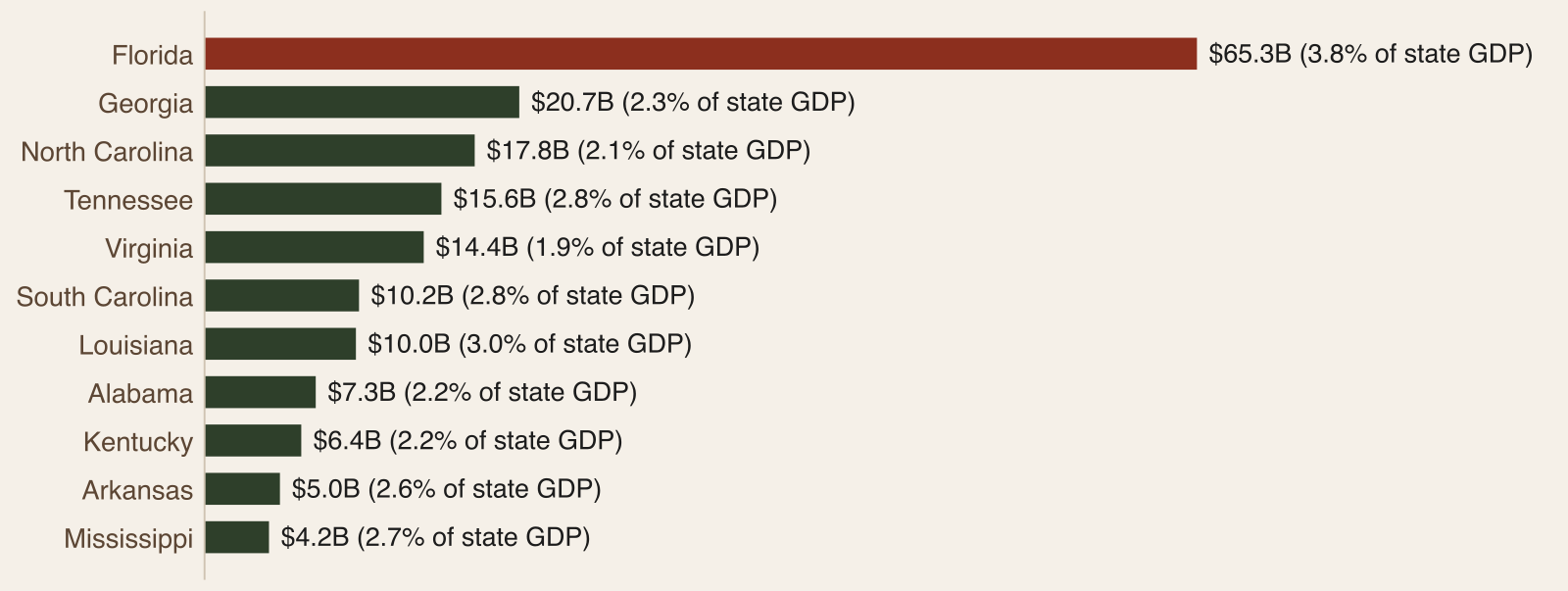
Outdoor recreation added $65.3 billion of value added in Florida in 2024, 37% of the eleven-state Southeast total, and 3.8% of state GDP against 2.4% for the U.S. The sector employed 509K people. VISIT FLORIDA's preliminary 2025 estimate was 143.3 million visitors.
On the water, Florida had 1.73 million paid fishing license holders in license year 2024, and 34% of the fishing licenses, tags and permits sold went to nonresidents, the highest share in the region. NOAA counted 65.3 million saltwater angler trips in 2025 across the Atlantic and Gulf coasts.
The two operator numbers frame the rest of the report. The 117 audited Florida operators have a mean digital health score of 5.93 out of 10, the highest of the eleven states, against 5.09 region-wide, and 46% of the sites read show an online booking engine, against 27%. The report's caution is that the answer layer is still thin, and that part of the lead is the sample.
The Outdoor Economy: Biggest in the Region by Far
Florida's $65.3 billion is 9.4% of the national figure and 3.2 times the next state, Georgia, at $20.7 billion. Outdoor recreation employed 508,656 people, 4.9% of wage and salary jobs and the highest count in the region. Its 3.8% share of state GDP is the highest of the eleven states.
The activity breakdown uses BEA's older 2023 vintage and is compared only within 2023. Florida ranked first in the region in eight of the nine activity lines. Its largest share was boating and fishing, at $4,185M and 37% of the eleven-state total. Water-based guided tours and charters, the line closest to the guide and charter trade, produced $1,185M, also 37% of the regional total. Hunting and trapping ranked second at $363M, 19%.
The rest of the table shows how broad Florida's lead is. Guided tours and outfitted travel of all kinds produced $1,649 million (34% of the regional total), fishing excluding boating $438 million (26%), RVing $1,663 million (33%), climbing, hiking and tent camping $375 million (23%), shooting including archery $314 million (18%) and equestrian $299 million (20%). Hunting and trapping, at $363 million and 19%, was the only line where Florida ranked second. Within that same vintage, Florida's outdoor value added moved from $45.4 billion in 2019 to $31.3 billion in 2020 and $57.8 billion in 2023, up 27% in current dollars, and outdoor employment from 493,734 to 469,357. The report does not join those older figures to the 2024 number.
The visitor economy is measured separately. VISIT FLORIDA's 2024 study counted 143 million visitors and $134.9 billion of spending by out-of-state visitors, $14.8 billion of it international. Southwick Associates put angler spending at $10.7 billion in 2022 and hunter spending at $0.97 billion. The report never adds these together, because BEA, tourism and spending studies measure different things in different years. Every first-time guest of a Florida guide or charter arrives as one of these visitors first, usually searching from somewhere else.
The tourism study also puts travel and tourism at 7.8% of gross state product and 1.8 million supported jobs. On the spending side, Southwick Associates counted 5,065,070 resident and nonresident anglers in 2022, 28% of the eleven-state total, supporting about 70,570 jobs. Hunters numbered 460,940, and target shooting added $2.6 billion from 1,981,850 participants, a separate and overlapping group. Every first-time guest of a Florida guide, charter, outfitter or rental arrives as one of those visitors first, usually searching from somewhere else.
Hunters and Anglers: A Big Fishing Market, a Resident Hunting Market
Florida counted 1,728,223 paid fishing license holders in 2024, the highest total of the eleven states, and 265,018 paid hunting license holders, the third-lowest. Against 23.3 million residents, that is 7.4 fishing and 1.1 hunting license holders per 100 people, the second-lowest and lowest densities in the region. The report's phrase is "a large market and a thin one at the same time."
Fishing license holders were 1,596,400 in 2020, peaked at 1,743,139 in 2021 and stood at 1,728,223 in 2024, up 8.3% over the period. Hunting license holders rose from 203,347 to 265,018 (up 30.3%), with most of that in the last year. The report does not treat the 18.4% one-year jump as a trend, and the data do not say what drove it. It gives the five-year range as roughly 203,000 to 265,000 for hunting and roughly 1,596,000 to 1,743,000 for fishing.
The resident and nonresident split differs sharply by sport:
Fishing: nonresidents bought 34% of items and paid 52% of fishing license revenue, the second-highest share.
Hunting: nonresidents bought 10% of items and paid 25% of hunting license revenue. Hunting is a resident market.
Birds: USFWS estimated about 30,200 active duck hunters in 2024-25 and about 14,600 active dove hunters in 2025-26. These are survey estimates, not license counts.
The Resource and the 2026-27 Seasons
Florida has four deer zones, each with its own calendar. Zone A opens archery on August 1, and Zones B and D run general gun seasons into late February, so a Florida season runs from August 1 into the last days of February somewhere in the state. The report's point for hunting properties is that each zone's dates have to be stated precisely.
FWC's telephone survey estimated a deer harvest of 113,629 in 2024-25, against 65,707 in 2020-21. The mandatory reporting system logged 57,772 deer, 51% of the survey estimate, so the report follows the survey series. Wild hogs occur in all 67 counties and on private land may be hunted year-round with the landowner's permission. The report's calendar table also covers spring and fall turkey, quail, ducks and dove.
Zone by zone, the calendar looks like this. Zone A runs archery August 1 to 30, with general gun September 19 to October 18 and November 21 to January 3. Zone B runs archery October 17 to November 15 and general gun December 5 to February 21. Zone C runs archery September 19 to October 18 and general gun November 7 to January 24. Zone D runs archery October 24 to November 25, with general gun November 26 to 29 and December 12 to February 21, and muzzleloading in early December and again in the last week of February. The bag limit is 2 a day, 4 in possession and 5 for the year, of which only 2 may be antlerless, and antler rules vary by deer management unit.
Saltwater rules come by region, not by state. Snook have winter and summer closed seasons in every region, and the two coasts differ. The bag is one fish everywhere, a snook permit is required, and on a for-hire trip the captain and crew may not keep a bag limit of snook or red drum. Red drum are open year-round with an 18 to 27 inch slot, and the Indian River Lagoon is catch-and-release only. Tarpon are catch-and-release statewide. The report says a guide's website should link to FWC's current pages rather than copy the rules.
The regional detail is what makes this a content opportunity. In the Gulf regions the snook seasons close December 1 to the end of February and May 1 to August 31 (to September 30 in the Charlotte Harbor and Southwest regions), with a 28 to 33 inch slot. In the Atlantic regions they close December 15 to January 31 and June 1 to August 31, with a 28 to 32 inch slot. Red drum have a vessel limit of four in the Panhandle, Big Bend and Northeast regions and two elsewhere, and tarpon over 40 inches must stay in the water unless a tag is held for a record attempt. These are FWC's published rules as read in October 2026, and they change, so the report says to link to FWC's current pages.
Spring turkey 2027 runs March 20 to April 25 north of State Road 70 and March 6 to April 11 south of it, with a two-bird limit of gobblers and bearded turkeys only. Quail runs November 14 to March 7 at 12 a day. The duck season runs November 21 to 29 and December 12 to January 31 at six a day with species limits, and dove runs September 26 to October 18, November 14 to December 6 and December 19 to January 31 at 15 a day. FWC's 2024 summer survey counted 2.03 turkey poults per hen, and USFWS estimated a duck harvest of about 307,500 birds in 2024-25 (preliminary, with a margin of 21%) and a dove harvest of about 163,400 in 2025-26.
The Water: 65.3 Million Saltwater Trips
NOAA's recalibrated estimates count 65.3 million marine angler trips in Florida in 2025, up 12% from 58.1 million in 2021 and 60% of all trips in the seven Southeast states the survey covers. NOAA recalibrated every estimate in August 2026, so these figures should not be compared with any published earlier.
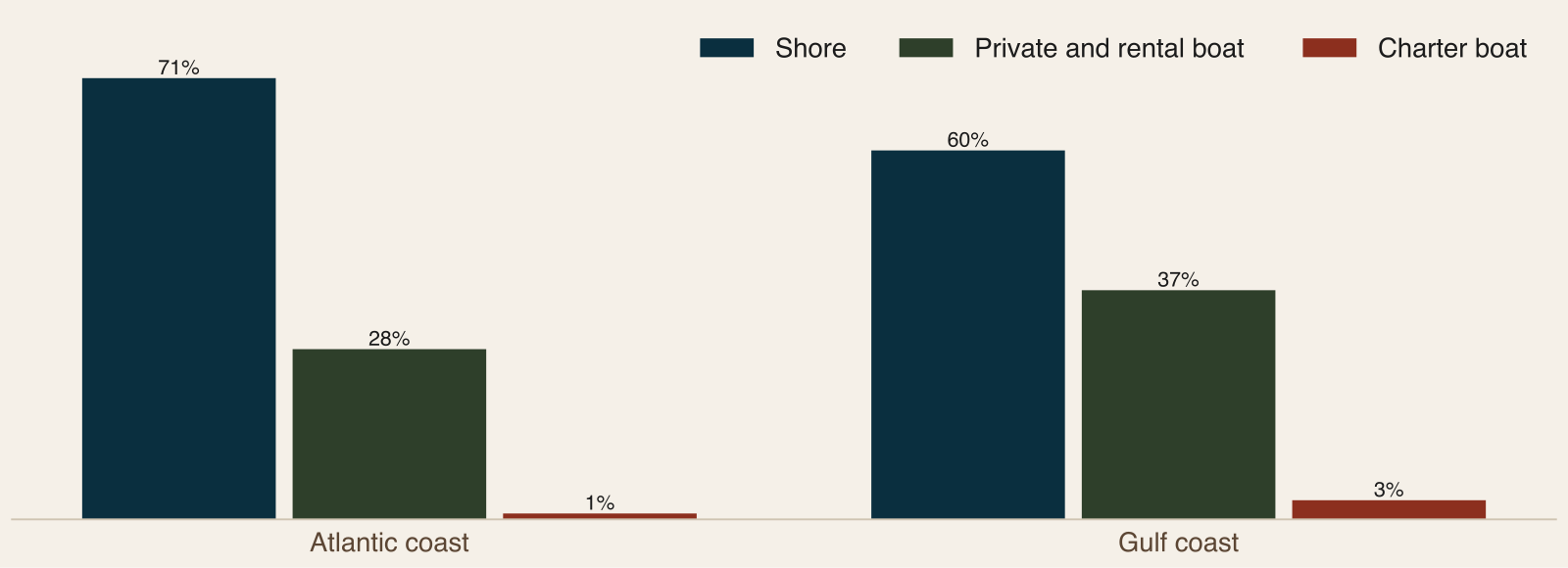
The coasts fish differently. The Atlantic coast had 33.3 million trips and the Gulf coast 32.0 million. Shore fishing was 71% of Atlantic trips against 60% on the Gulf, while private and rental boats carried 37% of Gulf trips against 28% on the Atlantic. Charter-boat trips, the mode closest to the guided trade, numbered 1,306,389 in 2025, 65% of the seven-state charter total, and the Gulf coast accounts for 76% of them. Charter trips were down 8% from 2021, and the report notes that charter counts move with weather, storms and fuel as much as with demand.
The coast-by-coast table fills in the numbers. The Atlantic had 23.8 million shore trips and 9.2 million private and rental boat trips, with 316,293 charter trips (1.0% of the coast's total). The Gulf had 19.1 million shore trips, 11.9 million private and rental boat trips and 990,096 charter trips (3.1%). The percent standard error on the all-trips estimate is 5.8 on the Atlantic and 4.9 on the Gulf, so moves of a few percent between years are within noise. Charter trips across both coasts were 1,424,766 in 2021 and 1,306,389 in 2025, down 8%, with a low of 1,170,045 in 2024.
The money per trip explains why charters matter. NOAA's 2022 expenditure survey put for-hire spending at $405 per angler-day on the Atlantic coast and $597 on the Gulf coast, at least 7.6 times the shore angler's day. The sales impact of marine angler trip spending was $6.28 billion on Florida's two coasts, supporting about 41,750 jobs.
The report's boats-and-freshwater section adds two caveats. The Coast Guard counted 1,171,432 registered recreational vessels in Florida in 2024, the highest count of the eleven states, but that is 27% above the 2023 count of 922,915, a jump that most likely reflects a change in reporting, so the report draws no growth rate from it. The Army Corps of Engineers counted 549,378 visits to the Okeechobee Waterway in fiscal 2024, 24,170 of them for fishing.
To carry paying customers in salt water, FWC requires a Charter Captain or Charter Boat license and the Coast Guard requires a captain's license for every operator of a for-hire vessel. Guiding on public land and water may need a further permit.
Public Land and the Rules for Guides
The estate is layered. The FWC wildlife management area system is more than 6 million acres, but FWC is lead manager or owner on only about 1.46 million of them. The rest belong to partners with their own rules.
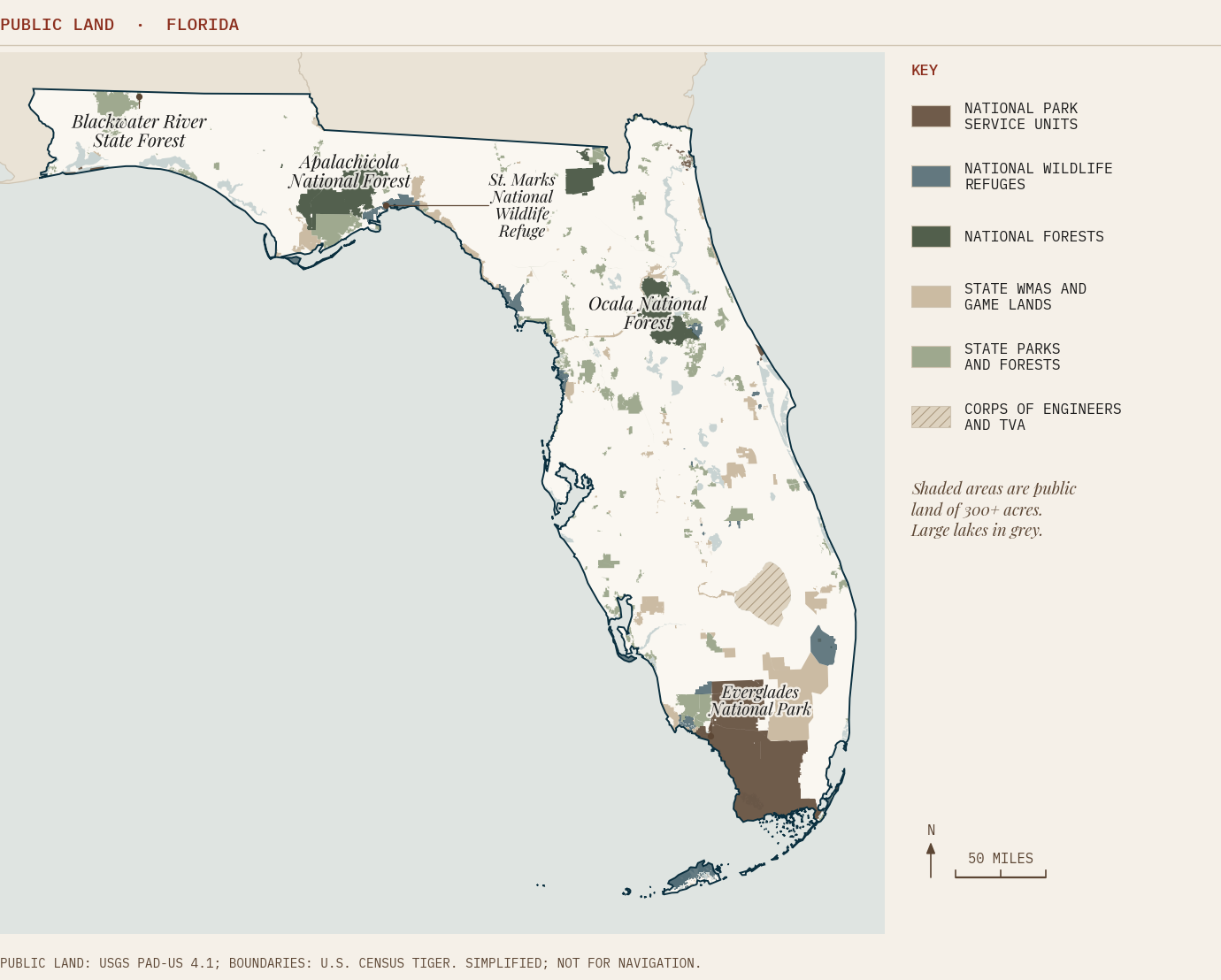
What the report finds:
WMAs: A management area permit and hunting license are needed to hunt, and each area sets its own seasons. The report found no FWC page that authorizes commercial guiding on WMAs, so confirm with FWC and the landowner before selling any guided trip on one.
National parks and seashores: Business operations require an NPS permit, contract or written agreement. In Everglades National Park, no commercial activity without a Commercial Use Authorization.
National wildlife refuges: Commercial enterprise is prohibited except by special permit.
National forests: Selling goods or services, including guiding, requires a special-use authorization.
State parks: Only the Division of Recreation and Parks or its concessionaire may rent watercraft in park waters, and for-hire excursion boats need a Division permit.
The report's summary is that a paid trip needs the managing agency's authorization, specific to the agency and often to the site. A national park authorization does not cover a refuge, and an FWC charter license covers the anglers on a boat, not the right to run a business inside a park or refuge. The report summarizes published rules and is not legal advice.
The Regions: Five Coastal Sub-Regions
The audit groups Florida into five sub-regions: the Florida Keys, the Everglades and Ten Thousand Islands, the western Panhandle coast, Southwest Florida, and Tampa Bay and the Nature Coast. The report is explicit that the sample has no Atlantic sub-region north of the Keys and none in the interior, so this chapter describes Florida's coastal guiding and tour trade, not every part of the state.
Scores range from 5.36 in the Everglades and Ten Thousand Islands to 6.43 in the Florida Keys. Southwest Florida scores 6.24, Tampa Bay and the Nature Coast 6.05, and the western Panhandle coast 5.55. In the Keys, 96% of operators have their own website and 56% of sites read show an online booking engine. Each sub-region carries its own rule notes. Rules change even inside one sub-region: FWC's Big Bend Region runs south to Fred Howard Park, so Crystal River and Homosassa fall in it with a four-fish vessel limit on red drum, while the Tampa Bay Region to the south allows two per vessel.
The profiles carry more detail. The Florida Keys have 28 operators, 25 with a readable homepage, and 60% of the sites read carry FAQ content. The Everglades and Ten Thousand Islands have 25 operators, 96% with their own website, 47% with online booking and 47% with FAQ content, and inside Everglades National Park a Commercial Use Authorization is required for any commercial trip, with charter captains also needing a Coast Guard license and an Everglades Boater Education Certificate for motorized tours. The western Panhandle coast has 22 operators, all with their own website and 36% showing online booking. Southwest Florida has 21, with 57% showing online booking and 57% carrying FAQ content, and Boca Grande Pass has its own FWC gear rules. Tampa Bay and the Nature Coast has 21, with 35% showing online booking and 41% carrying FAQ content, and the rules change inside it: Crystal River and Homosassa fall in FWC's Big Bend Region with a four-fish red drum vessel limit, while the Tampa Bay Region allows two.
The Operator Landscape: Ahead Online, Thin on Answers
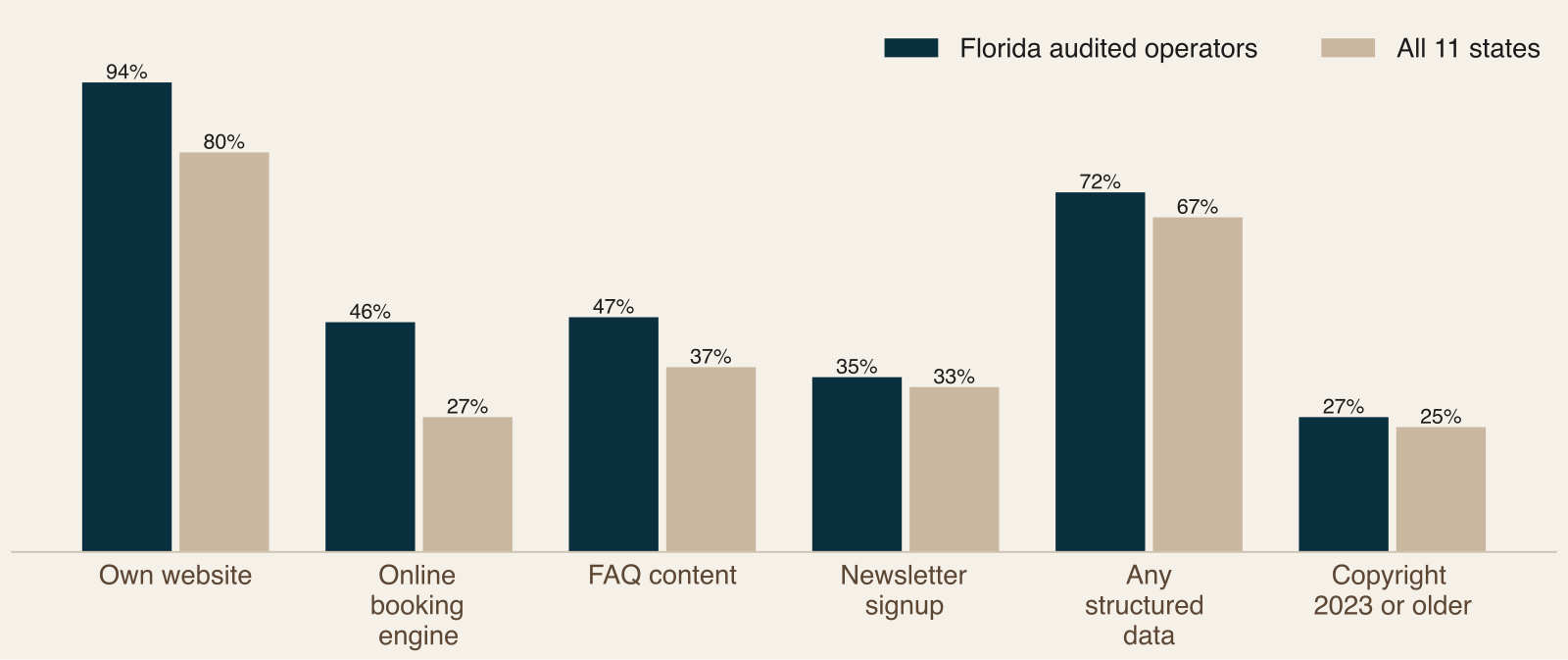
The 117 audited operators have a mean digital health of 5.93, the highest of the eleven states. They are ahead on most basics:
94% have their own website, against 80% across the region.
21% score 4 or below, against 40%.
46% of the 95 sites read show an online booking engine, against 27%. FareHarbor is on 38 of the 44 sites with one.
47% carry FAQ content, but only two mark answers up as FAQ structured data.
The report is blunt about the sample. 50% of Florida's operators are top-tier against 32% region-wide, and within tiers the lead mostly closes: top-tier operators average 7.08 against 7.06, and middle-tier 5.17 against 4.95. So much of the lead reflects which businesses were sampled, and the ranking is best read as directional. The largest categories are inshore and flats fishing (30), eco-tours and wildlife viewing (18) and diving and snorkeling (16).
By category, eco-tours and wildlife viewing average 6.83 across 18 Florida operators against 6.00 across 101 in the eleven states, and diving and snorkeling average 6.25 across 16 against 6.11 across 18. Inshore and flats fishing, with 30 operators, is the largest category and scores well above the 4.69 average of the 196 such operators across the eleven states. Of the 117 audited operators, 95 had a homepage that could be read, 35% of those sites offer a newsletter signup against 33% regionally, and 27% of sites with a detectable copyright year show 2023 or earlier.
The separate hunting audit (493 hunting operators, October 2026) counts 33 in Florida. Their mean digital health is 5.00, and only 7% of the 27 sites read show online booking, against 46% of the state's main-audit sites.
What It Means for Operators
Florida's operators already do the basics better than the rest of the region, and the market they sell into is the largest. The open ground is in the details the report keeps returning to: structured answers, rule pages that stay current, and a hunting side that has not caught up with the charter side on booking.
The report's six moves are to write for the visitor and the nonresident, keep the booking lead and make it work on a phone, answer questions and mark them up, publish the rules you work under, write a page for each water, region and season, and, for hunting operators, close the booking gap. Its advice for this month is to make sure a visitor on a phone can find your homepage, see what a trip includes and which permits you hold, and hold a date in under a minute.
Get the Florida Report
The full report adds the audit tables, every chart with its source and year, the 2026-27 season calendar, the sub-region notes and the full source list.
Download the full 2026-27 Florida Outdoors report (free with your email).
Frequently Asked Questions
How big is the outdoor economy in Florida?
Outdoor recreation added $65.3 billion of value added in 2024, per BEA, which is 37% of the eleven-state Southeast total, 9.4% of the national figure and 3.8% of state GDP, the highest share of the eleven states. It employed 508,656 people, 4.9% of wage and salary jobs and the highest count in the region. Florida is 3.2 times the next state, Georgia, and it ranked first in eight of nine activity lines in BEA's 2023 table.
How many saltwater fishing trips are taken in Florida?
NOAA's recalibrated estimates count 65.3 million marine angler trips in 2025 across the Atlantic and Gulf coasts, up 12% from 58.1 million in 2021 and 60% of all trips in the seven Southeast states MRIP covers. Of those, 1,306,389 were on charter boats. NOAA recalibrated every estimate in August 2026, which lowered shore and private-boat counts, so earlier figures should not be compared, and single-year moves of a few percent are within noise.
Do nonresidents drive Florida's license sales?
For fishing, yes. In 2024, 34% of the fishing licenses, tags, permits and stamps sold went to nonresidents, the highest share in the region, and they paid 52% of fishing license revenue. Hunting is a resident market, with nonresidents buying 10% of items and paying 25% of revenue. Items are not people, because one person can buy several, but the pattern argues for fishing pages written for the visitor.
Can I guide on Florida WMAs, parks and refuges?
Each agency has its own rule. The report found no FWC page that authorizes commercial guiding on WMAs, so confirm with FWC and the landowner. National parks need an NPS authorization, and Everglades requires a Commercial Use Authorization. Refuges require a special permit, national forests a special-use authorization, and state parks limit watercraft rental to the Division or its concessionaire and require a Division permit for for-hire boats landing in a park.
Why does Florida lead the region online?
Its audited operators average 5.93 against 5.09 region-wide, but the report says part of that lead is the sample, which leans toward the top tier: 50% of Florida's operators are top-tier against 32% region-wide. Within tiers the lead mostly closes, with top-tier operators at 7.08 against 7.06 and middle-tier at 5.17 against 4.95, so the ranking is best read as directional and not as a verdict on any one business.
What do the Gulf and Atlantic coasts do differently?
They fish differently. In 2025 the Atlantic had 33.3 million trips and the Gulf 32.0 million, and shore fishing was 71% of Atlantic trips against 60% on the Gulf, while private and rental boats carried 37% of Gulf trips against 28% on the Atlantic. The Gulf coast carries 76% of Florida's charter trips, 990,096 of 1,306,389, and for-hire spending is higher there, $597 per angler-day against $405 on the Atlantic.
Do snook and red drum rules differ by region?
Yes. Snook have a winter and a summer closed season in every region, but the dates and the slot differ by coast, with a 28 to 33 inch slot in the Gulf regions and 28 to 32 inches in the Atlantic regions. The bag is one fish everywhere and a snook permit is required. Red drum are open year-round with an 18 to 27 inch slot, but the vessel limit is four in some regions and two in others, and the Indian River Lagoon is catch-and-release only. A for-hire captain and crew may not keep a bag limit of either species.
What licenses does a charter captain need in Florida?
FWC requires a Charter Captain or Charter Boat license to carry paying customers to fish in salt water, and the U.S. Coast Guard requires every operator of a for-hire vessel to hold a captain's license. Customers fishing under a licensed vessel do not need their own recreational saltwater license. Charter fishing inside Everglades National Park also requires a Commercial Use Authorization and a Florida fishing license for each captain, so say on your site which permits you hold.
Sources
U.S. Fish and Wildlife Service, certified hunting and fishing license data, license years 2020 to 2024
USGS Gap Analysis Project, PAD-US 4.1, for the public-land map
Florida Fish and Wildlife Conservation Commission season, snook, red drum, tarpon and WMA pages, read October 2026
Pine & Marsh Southeast audit, October 2026 (1,546 operators), and the Pine & Marsh hunting audit, October 2026 (493 operators)


Comments