
Inside the 2026-27 South Carolina Outdoors Report: A Coast and Lake State with Room to Grow Online
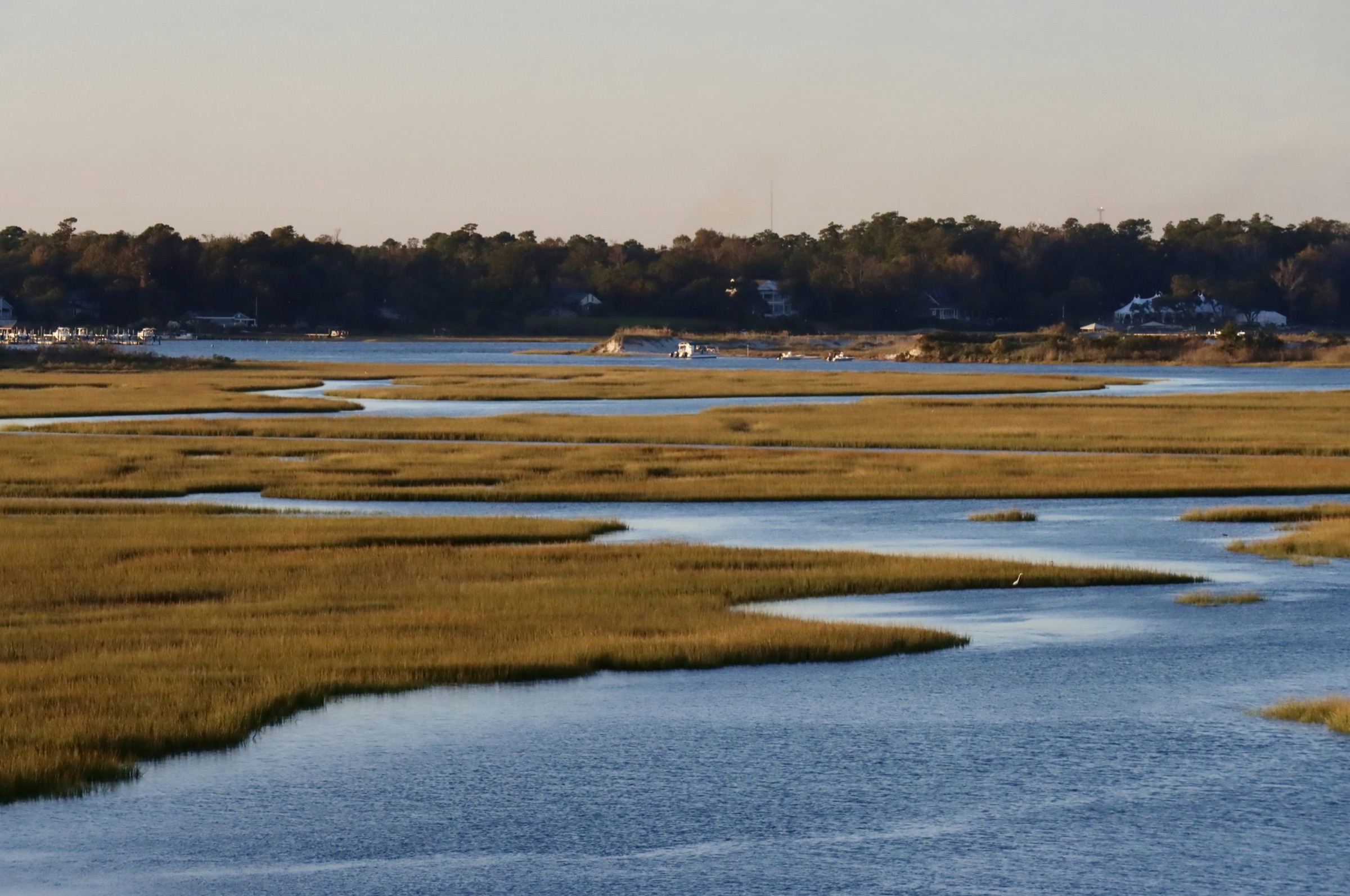
The South Carolina Outdoors report is our 2026-27 state edition for South Carolina. It sets public data from the Bureau of Economic Analysis, the state tourism department, the U.S. Fish and Wildlife Service, NOAA Fisheries and the South Carolina Department of Natural Resources (SCDNR) beside our October 2026 audit of 133 South Carolina guides, charters, outfitters, tour companies and lodges. It is written for the people who run those businesses.
This post walks through the report chapter by chapter, with the numbers that matter and what they mean for operators. For the marketing playbook, see Marketing a Sporting Operation in South Carolina: The Full State Guide.
The Outdoor Economy
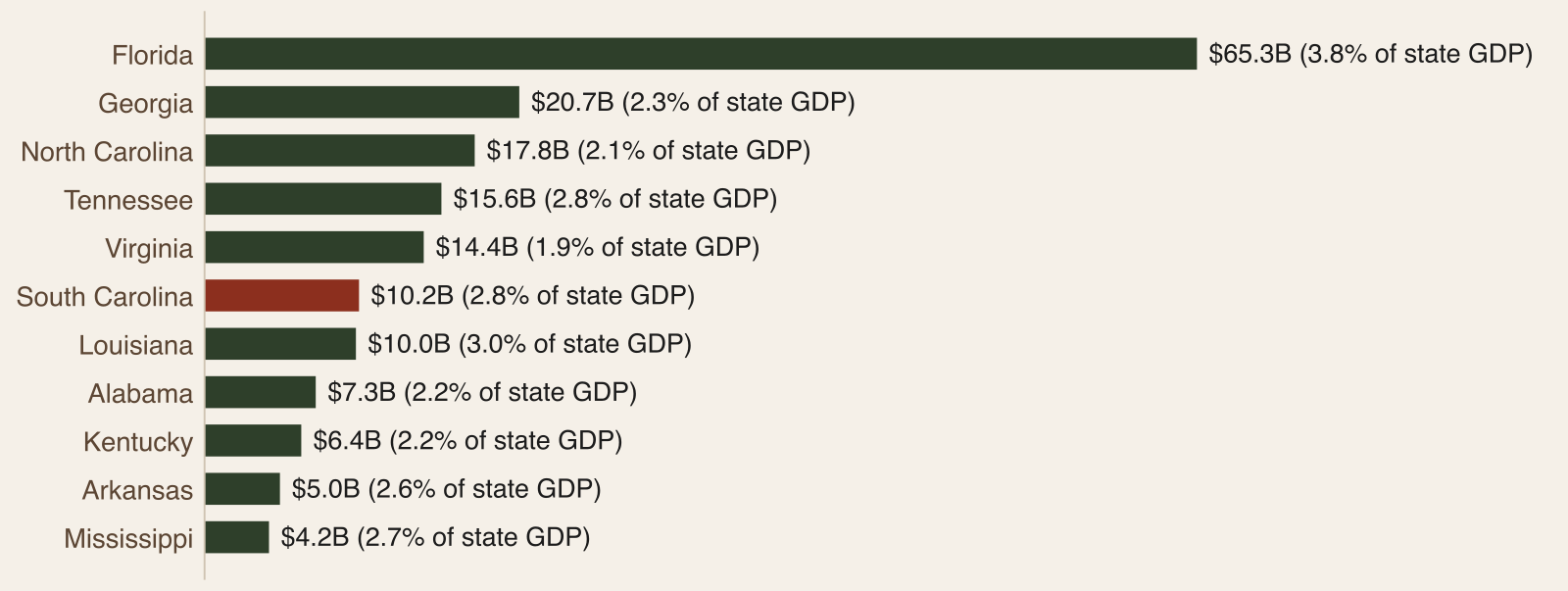
Outdoor recreation added $10.2 billion of value added to South Carolina's economy in 2024, according to the Bureau of Economic Analysis (BEA). That is 6% of the eleven-state Southeast total and 1.5% of the national figure, the sixth-highest total of the eleven states. It employed 92,135 people, 3.8% of wage and salary jobs.
The state weighs more than its size suggests. Outdoor recreation was 2.8% of state GDP, above the U.S. figure of 2.4% and tied with Tennessee for the third-highest share of the eleven states.
The activity breakdown, for 2023 from an earlier BEA release, shows a hunting strength:
South Carolina's best rank in any of the nine activity lines was third of eleven.
Its largest share of the regional total was in hunting and trapping, at 12%, or $224M.
Water-based guided tours and charters, the line closest to the guide and charter trade, produced $195M, 6% of the regional total.
Equestrian ranked eleventh of eleven.
Travel is the larger engine. The state tourism study counted $30.6 billion of direct travel expenditures and other travel-related activity in 2024, supporting about 241 thousand jobs and $3.2 billion in state and local tax revenue. It is a different measure from BEA's, and the two are never added.
Southwick Associates' estimates, built on the 2022 national survey, put angler spending at $2.1 billion in 2022 and hunter spending at $0.70 billion.
The rest of the 2023 activity table is worth reading. South Carolina ranked fifth of eleven in boating and fishing ($853M, 8% of the regional total) and in fishing excluding boating ($147M, 9%), and fourth in RVing ($456M, 9%). It ranked fifth in climbing, hiking and tent camping ($165M, 10%), sixth in guided tours and outfitted travel of all kinds ($323M, 7%) and in shooting including archery ($156M, 9%), and eleventh in equestrian ($61M, 4%). Within that older vintage, outdoor value added moved from $7.2 billion in 2019 to $5.5 billion in 2020 and $8.6 billion in 2023, up 20% in current dollars, but BEA revised the series in March 2026, so the report does not join it to the 2024 figure.
The tourism study calls the $30.6 billion one in every ten jobs in the state. Southwick Associates counted 577,420 anglers supporting about 18,120 jobs and 215,340 hunters, and target shooting added $0.8 billion from 508,750 participants, a separate and overlapping group.
Hunters and Anglers
South Carolina has a modest fishing market and the region's smallest hunting base. Using the U.S. Fish and Wildlife Service's certified license data, paid hunting license holders ran roughly 199,000 to 219,000 across license years 2020 to 2024, the lowest in the region, and paid fishing license holders roughly 518,000 to 603,000. The report gives these as estimated ranges, not exact counts, and notes that fishing holders fell by about 10% in 2023 and partly recovered in 2024. The data do not say why, so contact SCDNR for exact counts and reasons. Per 100 residents, the state has 9.6 fishing and 3.6 hunting license holders, the third-lowest density in the region for both.
Where the money comes from is the interesting part:
In 2024, nonresidents bought 24% of fishing licenses, tags, permits and stamps, the fifth-highest share, and paid 36% of fishing license revenue.
Hunting is resident-heavy by count but not by revenue. Nonresidents bought only 12% of hunting items, yet paid 52% of hunting license revenue, more than half of what hunters spent on licenses.
Items are not people, and one person can buy several. Federal surveys estimate about 32,800 active duck hunters in 2024-25 (preliminary) and about 40,100 active dove hunters in 2025-26. These are survey estimates and are not added to license counts.
For an operator, the hunting market is small but it is out-of-state money. A lodge or guide that can reach the nonresident hunter is reaching the group that pays about half of hunting license revenue.
The exact license counts show the shape of the decline. Fishing license holders were 600,672 in 2020, peaked at 603,247 in 2021 and fell to 529,509 in 2024, down 11.8%. Hunting license holders fell from 208,696 to 199,114, down 4.6%. In 2024 South Carolina sold 570,899 resident and 181,050 nonresident fishing items, bringing in $4.3 million and $2.4 million, and 827,025 resident and 109,583 nonresident hunting items, bringing in $5.4 million and $5.7 million. Hunting is the one line where nonresidents paid more than residents in total, from about an eighth of the items.
The Resource and the 2026-27 Seasons
SCDNR divides South Carolina into four game zones with their own calendars on private land. Zones 3 and 4 open in mid-August, while gun hunting in Zones 1 and 2 does not begin until October 11. Somewhere in the state a deer season runs from August 15 to January 1, followed by a statewide youth either-sex day on January 2. Each zone's dates have to be stated precisely.
On harvest:
The online hunter survey put the deer harvest at 197,893 in 2020-21 and 198,171 in 2023-24.
In 2024-25 the department moved to mandatory reporting through SC Game Check and counted 190,707 deer. Because the method changed, that figure is not compared with the survey series.
Turkey numbers are under pressure. SCDNR's 2024 summer survey counted 1.6 poults per hen, and the department says ratios consistently below 2.0 indicate a shrinking population. For 2025 the legislature cut the season bag from three to two, banned the harvest of jakes, shortened the season by nine days and moved the opener to April 3. The 2027 season keeps that opener. Bobwhite quail are in long decline, with a whistling-cock index 67% below its 1979 to 2023 average.
USFWS estimated a duck harvest of about 312,100 in 2024-25 (preliminary) and a dove harvest of about 622,700 in 2025-26. Feral hogs may be hunted by day on private land all year with a hunting license.
On the water, rules change by water, not by state:
Coastal limits were tightened on July 1, 2026, when red drum went to one fish per person and two per boat within an 18 to 25 inch slot.
Largemouth bass have a 14 inch minimum on Lakes Marion, Moultrie, Murray, Wateree and Jocassee and a 12 inch minimum with a combined ten-fish limit on Hartwell, Keowee, Thurmond and the Savannah and Chattooga rivers.
Crappie are 8 inches and 20 per day statewide. Striped bass are closed June 16 to September 30 in the Santee and Pee Dee river systems and many coastal rivers.
Link to SCDNR's current guide rather than copying these numbers.
The deer calendar is the most detailed table in the chapter. Zone 1 allows primitive weapons October 1 to 10 and gun October 11 to January 1. Zone 2 adds archery September 15 to 30. Zone 3 runs archery and gun August 15 to January 1, bucks only through September 14. Zone 4 allows archery August 15 to 31 and gun from September 1. Antlered deer are two per day and five per season for residents, four for nonresidents, and antlerless deer need a tag, valid from September 15 in Zones 2 to 4 and October 1 in Zone 1.
Other seasons run on their own dates. Spring turkey 2027 is April 3 to May 3, with youth weekends March 27 to 28 and May 8 to 9, two gobblers per season, no more than one per day and no more than one before April 10. Dove runs September 5 to October 3, November 13 to 28 and December 18 to January 31. Ducks run November 21 to 28 and December 12 to January 31, with early teal September 19 to 27, and Canada geese run September 1 to 30 and from November 21 into early March. Night hunting of feral hogs is allowed only on property registered with SCDNR, and is prohibited on WMAs.
On the water, other limits apply. Spotted seatrout have a 14 inch minimum and 10 per person, flounder a 16 inch minimum with five per person and 10 per boat, sheepshead a 14 inch minimum with 10 per person, and black drum 14 to 27 inches with five per person. Cobia must be 36 inches fork length. Gig harvest of red drum and spotted seatrout is closed December 1 to February 28.
The Water
NOAA's Marine Recreational Information Program counts 9.6 million marine angler trips in South Carolina in 2025, up 6% from 9.0 million in 2021, and 9% of all trips in the seven Southeast states it covers. Shore fishing was 73% of trips and private and rental boats 25%. NOAA recalibrated every estimate in August 2026, so do not compare these figures with anything published earlier.
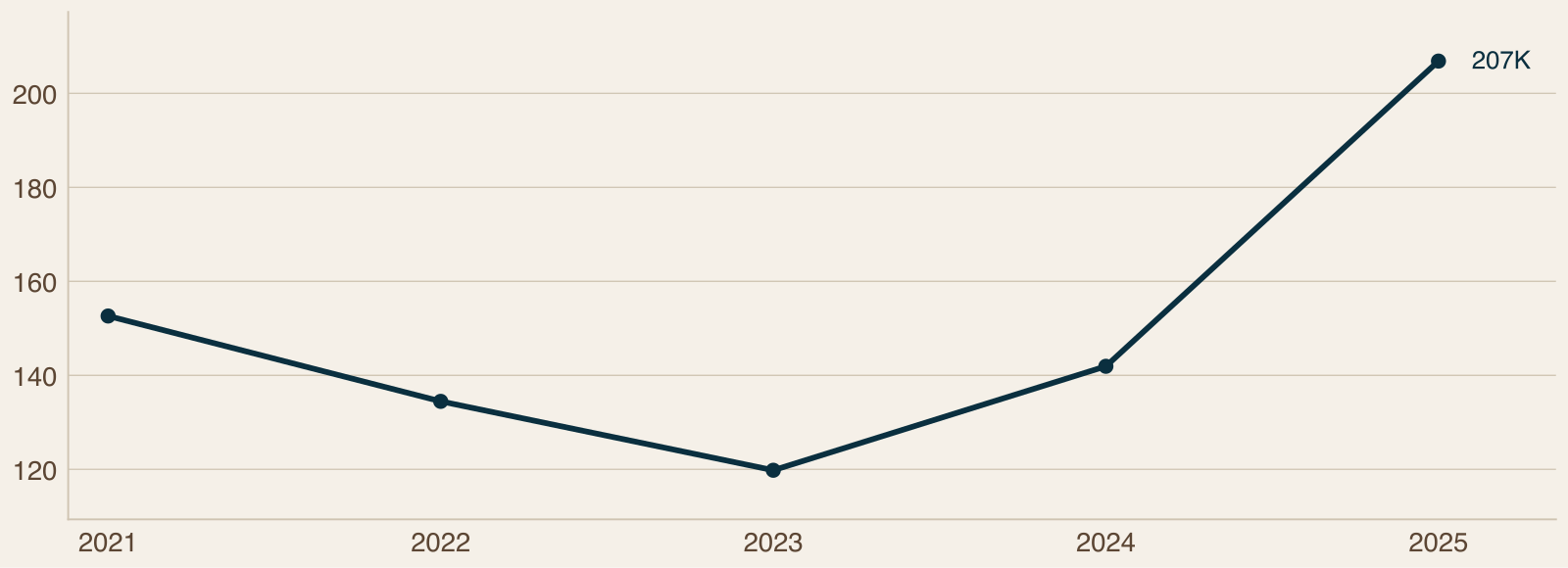
Charter-boat trips numbered 206,861 in 2025, 10% of the seven-state charter total, up from a low of 119,804 in 2023. Charter counts move with weather, storms and fuel as much as with demand, and the charter mode includes offshore trips, so no figure isolates inshore guiding.
What the trips are worth:
Trip spending supported $372 million in sales impact in 2023 and about 2,851 jobs, 4% of the Southeast's nine coastal areas.
Charter customers spend the most per day: $451 per angler-day for for-hire trips, against $46 for a private boat and $25 for the shore angler.
The U.S. Coast Guard counted 353,906 registered recreational vessels in 2024, the second-highest count of the eleven states.
To carry paying saltwater anglers, SCDNR requires an annual charter vessel license for each vessel, and U.S. Coast Guard captain's credentials must be presented to obtain it. Licensed vessels file monthly trip logs. A captain taking friends out for no fee does not have a charter, and everyone aboard then needs a license. Guiding on public land and water may need a further permit.
Two details help planning. The 2025 trip estimate carries a percent standard error of 6.4, so single-year moves of a few percent are within noise, and the 9.6 million trips split into 7.0 million from shore and 2.3 million from private and rental boats. Charter trips were 152,623 in 2021 and 206,861 in 2025, up 36%, and charter customers spend about 18 times a shore angler's day. For the charter vessel license, SCDNR lists fees of $275 for residents and $550 for nonresidents with six or fewer passengers, $450 and $900 for seven to 49 passengers and $650 and $1,300 for 50 or more, and licenses expire June 30.
Public Land and the Rules for Guides
Much of the water and woods a South Carolina guide sells is public, and the estate is layered.
What the report found:
SCDNR wildlife management areas: over 1.1 million acres in the program. A valid license and a WMA permit are required to hunt. The SCDNR regulations the report read do not address commercial guiding, and no SCDNR page authorizes it. Confirm with SCDNR and the landowner before selling any guided trip on a WMA.
National forests: selling goods or services, including guiding, requires a special-use authorization. Forest land in the WMA program is also under SCDNR's WMA regulations.
National parks: business operations require an NPS permit, contract or written agreement. At Congaree, NPS says outfitters hold commercial use authorizations that allow guided paddling tours, and a business without one may not guide there.
National wildlife refuges: commercial enterprise is prohibited except as authorized by special permit.
State parks: the report found no published rule or permit page for commercial guiding. Contact the park and the Department of Parks, Recreation and Tourism before offering paid trips on park land or water.
A national park authorization does not cover a refuge, a refuge permit does not cover a national forest, and an SCDNR charter vessel license covers the vessel and its anglers, not the right to run a business inside a park or refuge. Check with the agency that manages the exact place you plan to guide. The report summarizes published rules and is not legal advice.
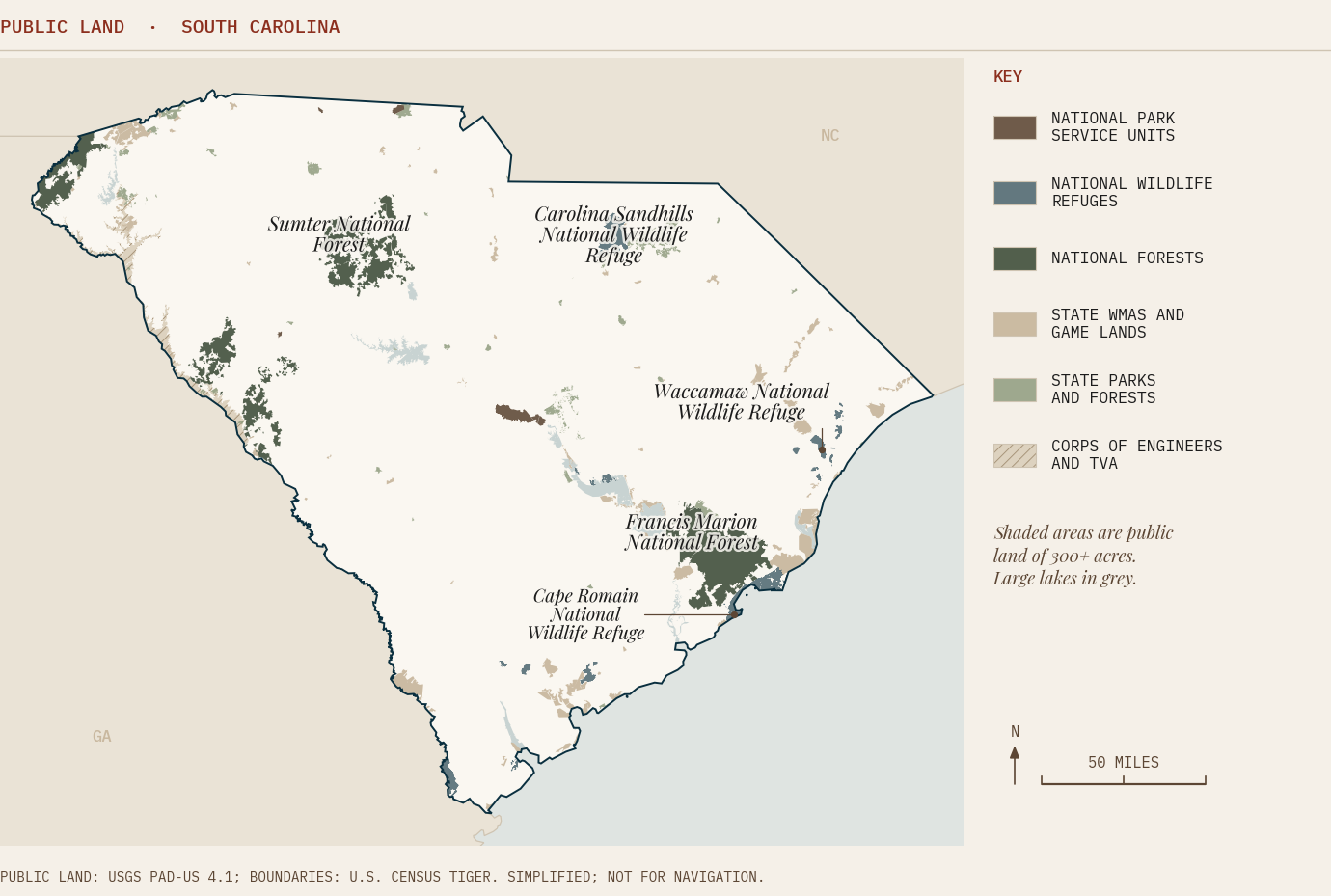
The land is layered. SCDNR's WMA program began in 1948 and includes U.S. Forest Service land, as well as land leased from other state agencies, utilities, local governments, timber and investment firms and private owners, and some hunts are by lottery. The national forests are the Francis Marion in the Lowcountry and the Sumter in the Upstate and Midlands. National parks include Congaree National Park and Fort Sumter and Fort Moultrie National Historical Park, and refuges include Cape Romain, ACE Basin, Santee, Pinckney Island, Waccamaw, Carolina Sandhills and Savannah. The report notes that acreages for the national forests and Congaree differ between pages it read, so it does not give them.
The Regions
The audit groups South Carolina's operators into six sub-regions. Four have at least 15 operators but fewer than 10 readable homepages, so they are described in words, without percentages or means. The hunting supplement records no sub-region, so this chapter describes the guiding, paddling and lake trade.
Pee Dee and Grand Strand: 27 operators, led by inshore and flats fishing (15). Striped bass on the rivers run October 1 to June 15.
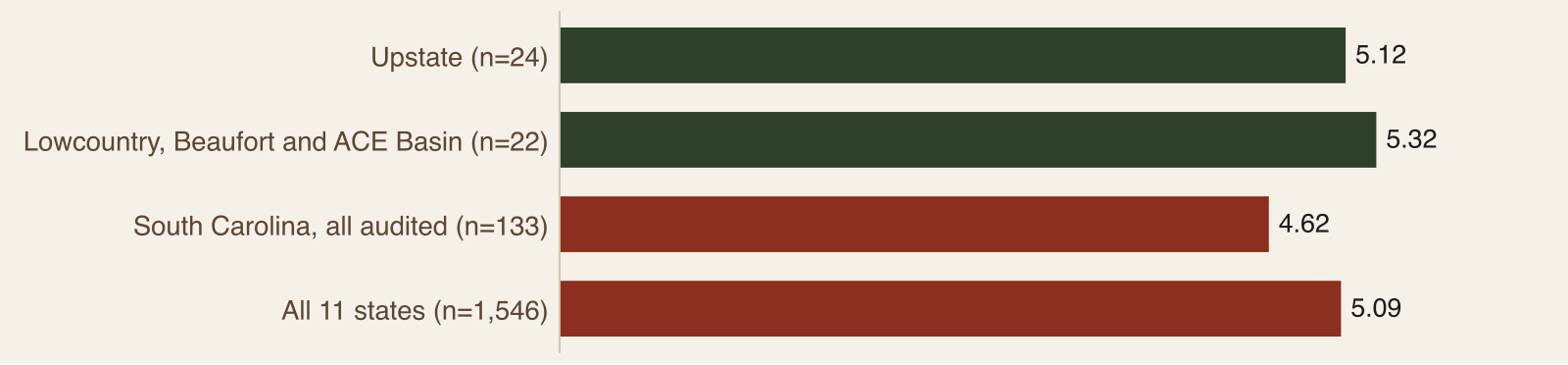
Upstate: 24 operators, mean digital health 5.12, led by fly fishing and trout (9) and paddle operators (8). 96% have their own website and 35% of sites read show a booking engine.
Midlands and Black Belt: 23 operators, led by bass, crappie and lake fishing (13). Congaree National Park outfitters need their own authorization.
Beaufort, Hilton Head and ACE Basin: 22 operators, mean 5.32, led by inshore and flats fishing (11). 41% of sites read show a booking engine.
Charleston Lowcountry: 21 operators, led by inshore and flats fishing (12), with Cape Romain and the Francis Marion National Forest to the north.
Santee Cooper: 16 operators, led by bass, crappie and lake fishing (10).
Among the two sub-regions with enough data to compare, scores range from 5.12 to 5.32. Differences under half a point are noise.
Each sub-region carries its own rules. Striped bass on the Waccamaw, Great and Little Pee Dee and Lynches rivers run October 1 to June 15 with a 26 inch minimum and three per day. On Lake Murray, black bass have a 14 inch minimum and five per day, and striped bass run October 1 to May 31 with a 21 inch minimum and five per day. Lakes Hartwell and Keowee have a 12 inch black bass minimum and 10 combined per day, and Lake Jocassee a 14 inch minimum and five per day. In the Lowcountry, red drum, seatrout and flounder follow the statewide coastal limits. Eight of the Pee Dee's 27 operators, eight of Charleston's 21 and four of the Midlands' 23 had readable homepages, which is why those groups are described in words.
The Operator Landscape
South Carolina's 133 audited operators are part of 1,546 across the eleven states. Their mean digital health, a 1 to 10 score assigned by researchers from observed evidence, is 4.62, the second-lowest of the eleven states against 5.09 for the region. The gap is within the margin of noise.
How South Carolina compares with the eleven-state benchmark:
Own website: 65%, against 80%.
Score 4 or below: 55%, against 40%.
Online booking engine (66 sites read): 38%, against 27%.
FAQ content: 33%, against 37%, but only one site marks answers up as FAQ structured data.
Newsletter signup: 23%, against 33%.
Where a booking engine shows, FareHarbor is the most common: 19 of the 25 sites with one use it, followed by Xola (3) and Peek (2). Only 9% of sites with a detectable copyright year still show 2023 or earlier.
The sample leans toward the lower tier: 26% of operators are top-tier and 34% lower-tier, against 32% and 26% region-wide. Re-weighted to the region's tier mix, the state's mean would be 4.89 rather than 4.62. Read the ranking as directional.
By category, inshore and flats fishing, the largest with 38 operators, averages 4.21 against 4.69 across the eleven states. Paddle, kayak and canoe operators average 5.63. Bass, crappie and lake fishing averages 3.87.
The separate October 2026 hunting audit counts 40 South Carolina hunting operators with a mean of 5.38, about level with the 5.23 for all 493 audited hunting operators. All have their own website, but only 5% of the 37 sites read show online booking.
The category table has three comparisons. Inshore and flats fishing has 38 operators at 4.21 against 4.69 across 196 in the eleven states. Paddle, kayak and canoe has 27 at 5.63 against 5.36 across 231, and bass, crappie and lake fishing 23 at 3.87 against 3.83 across 94. By tier, top-tier operators average 6.79 against 7.06, middle-tier 4.57 against 4.95 and lower-tier 3.02 against 2.84. In the hunting audit, tags overlap: upland and quail (22), lodge or multi-program (21), turkey (19), whitetail (18), wild hog (16), sporting clays (8), dove (6) and waterfowl (5). Across those 40, 16% carry FAQ content and 32% offer a newsletter signup.
What It Means for Operators
South Carolina is a coast and lake state where outdoor recreation matters more to the economy than the national average, and where nonresident hunters carry the license revenue. Its operators have a booking lead on the region but trail on having a website of their own at all.
The report closes with seven moves:
Write for the traveler.
Close the website gap.
Keep the booking lead, and make it work on a phone.
Answer the questions, then mark them up.
Publish the rules you work under.
Write a page for each water and season.
For hunting operators, close the booking gap.
On public land, do not assume. On WMAs, no SCDNR page authorizes commercial guiding, so confirm with SCDNR and the landowner. On state parks, contact the park first.
Get the Full Report
The full report adds the complete 2026-27 hunting calendar, the saltwater rules table, the activity and category tables, six sub-region profiles, the public land map and sources for every chart.
Download the full 2026-27 South Carolina Outdoors report (free with your email).
Frequently Asked Questions
How big is South Carolina's outdoor economy?
Outdoor recreation produced $10.2 billion of value added in 2024, sixth-highest of the eleven Southeast states, and 2.8% of state GDP against 2.4% nationally, tied with Tennessee for the third-highest share. It employed 92,135 people, 3.8% of wage and salary jobs. The state tourism study separately counted $30.6 billion of direct travel expenditures and other travel-related activity in 2024, supporting about 241 thousand jobs, measured on a different basis and never added to BEA's figure.
Why do nonresident hunters matter in South Carolina?
Nonresidents bought only 12% of hunting licenses, tags and permits in 2024 but paid 52% of hunting license revenue, $5.7 million against $5.4 million from residents. The state also has the region's smallest hunting base, 199,114 paid license holders and 3.6 per 100 residents. A lodge or guide that can reach out-of-state hunters is therefore reaching the group that pays about half of hunting license revenue.
Can I guide paid hunts or trips on South Carolina WMAs and state parks?
Confirm first. The SCDNR regulations the report read do not address commercial guiding, and the report found no SCDNR page that authorizes it, so confirm with SCDNR and the landowner before selling a guided trip on a WMA. Where a WMA sits on national forest or leased land, the Forest Service's or the landowner's rules apply as well. For state parks, the report found no published rule, so contact the park and the Department of Parks, Recreation and Tourism.
What license does a South Carolina charter need?
SCDNR requires an annual charter vessel license for each vessel carrying paying saltwater anglers, and licenses expire June 30. A U.S. Coast Guard captain's license must be presented to obtain it, and licensed vessels file monthly trip logs by the tenth of the following month. Anyone fishing aboard a hired charter does not need a personal fishing license, but a captain taking friends out for no fee does not have a charter, and everyone aboard then needs a license.
How do South Carolina operators compare online?
The 133 audited operators average 4.62 on digital health against 5.09 region-wide, the second-lowest of the eleven states, though the gap is within the margin of noise. 65% have their own website against 80% and 55% score 4 or below against 40%, but 38% of the 66 sites read show online booking against 27%. Only one of the 66 uses FAQ structured data, though 33% carry FAQ content.
How big is South Carolina's saltwater fishing market?
NOAA's recalibrated estimates count 9.6 million marine angler trips in 2025, up 6% from 9.0 million in 2021, and 73% were from shore. Charter boats made 206,861 trips, about 2.2%, up 36% from 2021 after a low of 119,804 in 2023. Charter customers spend the most per day, $451 against $46 for a private boat and $25 for shore. NOAA recalibrated its estimates in August 2026, so do not compare them with older figures.
What is happening with South Carolina turkey hunting?
The population is under pressure. SCDNR's 2024 summer survey counted 1.6 poults per hen, and the department says ratios consistently below 2.0 indicate a shrinking population. The spring harvest was about 13,074 birds in 2023, 12,428 in 2024 and 10,419 gobblers in 2025 on the corrected Game Check count. For 2025 the legislature cut the bag from three to two, banned the harvest of jakes and moved the opener to April 3, which the 2027 season keeps.
What changed for red drum in 2026?
On July 1, 2026, South Carolina tightened the red drum limit to one fish per person and two per boat within an 18 to 25 inch slot in state waters, down from two per person and six per boat, and possession is prohibited in federal waters. Because limits change by water and by year, the report advises linking to SCDNR's current regulations guide rather than copying numbers, and a charter captain should confirm the rules each season.
Sources
Pine & Marsh outfitter audit (1,546 operators) and hunting supplement (493 operators), October 2026
Related Reading
Marketing a Sporting Operation in South Carolina: The Full State Guide
Inside the 2026-27 Georgia Outdoors Report: The Region's Biggest Hunting Market, Chapter by Chapter
Inside the 2026-27 Saltwater Inshore Report: 108.7 Million Trips and 196 Guides Online
Inside the 2026-27 Upland and Quail Report: Scarce Wild Birds, 182 Operators and the Booking Gap


Comments