
Withlacoochee State Forest: 157,000 Acres and a Public Hunt Worth Explaining - The Pine & Marsh Florida Field Brief
Updated: Oct 21

By Jacob Mishalanie and Thomas Garner, Co-Founders
Roughly 157,000 acres of sandhill and flatwoods across five central-Florida counties, a public-land hog hunt, an FWC-managed WMA hunt structure that can include quota permits, multiple named tracts, and archery seasons across the calendar. For a hunter trying to draw a first Withlacoochee tag, the official sources are thorough but written for people who already know the system. That gap between what the forest offers and what a first-time visitor can easily understand is the Withlacoochee opportunity.
This is the Pine & Marsh Withlacoochee playbook. The forest is roughly 157,000 acres of sandhill, pine flatwoods, cypress strand and Brooksville Ridge scrub, with public-land hog hunting among its draws. The Florida Forest Service tract system (Citrus, Croom, Richloam and Jumper Creek among them), FWC's Withlacoochee WMA hunt structure, the Southwest Florida Water Management District, and the Croom mountain-bike loop anchor a public-land tradition under continuous prescribed-burn management. It is a working sandhill-and-flatwoods land base that most Florida visitors never think about, and the operators around it have plenty of room to explain it well.
The public hunt worth explaining
The forest's strength is scale paired with plain-language explanation that is still hard to find: roughly 157,000 acres of sandhill, pine flatwoods, cypress strand and Brooksville Ridge scrub spread across five central-Florida counties under continuous Florida Forest Service prescribed-burn management, organized into several non-contiguous tracts. America's Longleaf Restoration Initiative folds Withlacoochee sandhill into its broader restoration mapping. Florida scrub-jay (Threatened) and gopher tortoise (state Threatened) use the Brooksville Ridge edge habitat.
The Withlacoochee here is the central-Florida river, distinct from the north-Florida Withlacoochee that joins the Suwannee, and sorting out which is which is itself a useful long-tail topic. Most of the country knows the forest as a name on a Florida Forest Service map. The hunters who have figured it out know it as a public-land hog and archery destination.
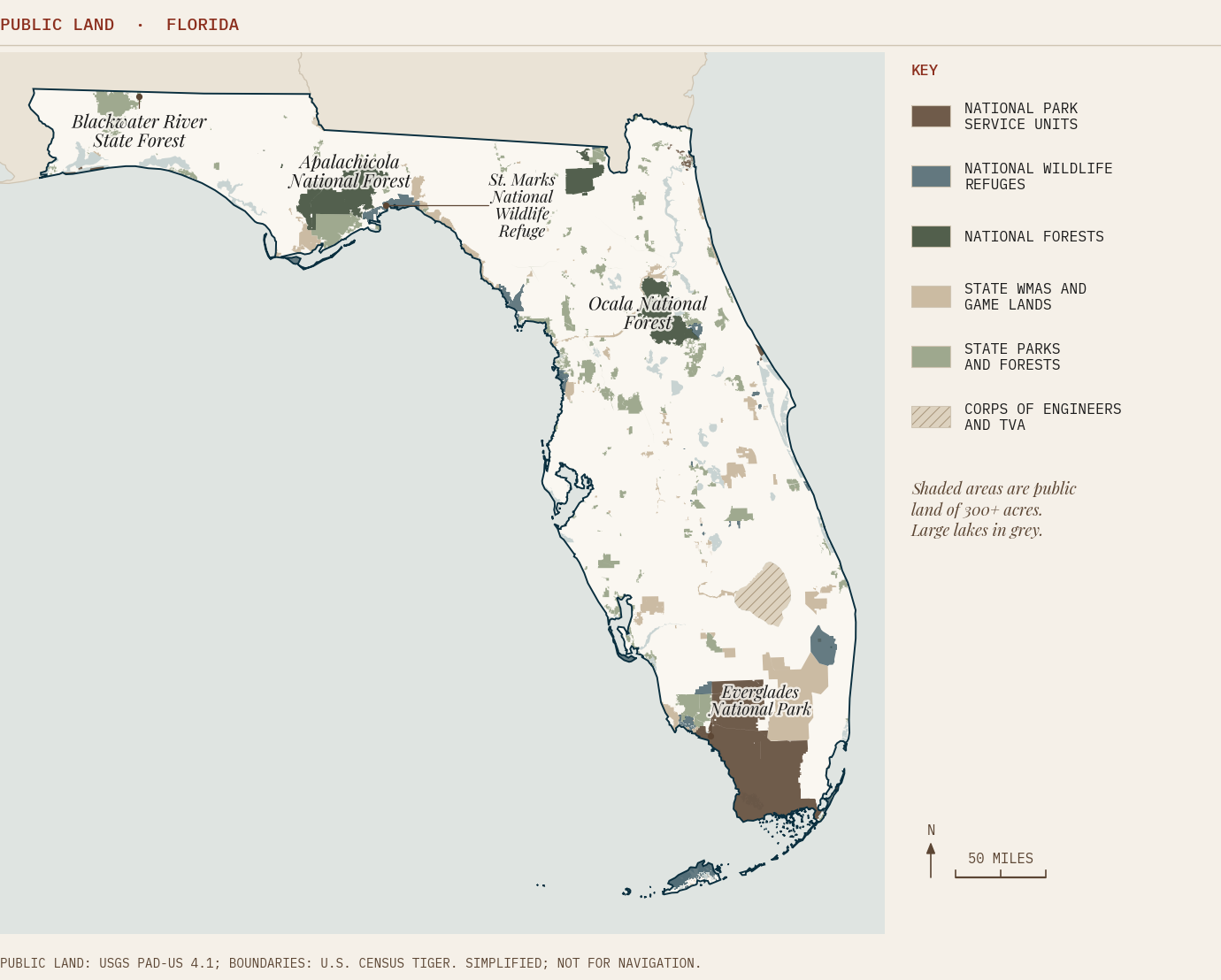
The habitat, mapped the way operators should publish it
Counties and habitat structure
The forest spans Citrus, Hernando, Pasco, Sumter and Marion counties. The Withlacoochee River drains north and west toward the Gulf, and the Tsala Apopka chain sits along its course in Citrus County. Sandhill carries longleaf pine and turkey oak; cypress strand frames the river and tributaries; floodplain hardwoods line the bottoms; the Brooksville Ridge edge transitions into scrub.
The Tsala Apopka chain is a connected series of lakes, marshes and pools in Citrus County, fed by the Withlacoochee River. The Floral City, Inverness and Hernando pools form the primary basins. The chain is a well-regarded central Florida largemouth bass fishery and a draw for kayak anglers. A guide service or lodge that ties spring turkey on the forest to bass on Tsala Apopka has a twelve-month content calendar, and its proximity to the Citrus and Croom tracts means one operator can credibly cover the hunt, the paddle and the fishing from a single geographic footprint.
The hog and Osceola economy
FWC's Withlacoochee WMA offers public-land hog hunting and archery seasons, and the archery seasons draw a loyal following. FWC runs both quota and non-quota hunts across its WMA system, so check the current brochure for which Withlacoochee hunts need a quota permit. The forest sits in the Osceola turkey range of peninsular Florida, though the current FWC rules decide what is huntable and when. Always check the current FWC regulations and hunt calendar before you plan around any date or tract.
The FWC quota system is a real explanation gap a local operator can fill. FWC divides WMA hunts into quota hunts, where permits are capped and distributed through a lottery, and non-quota opportunities that run on standard season dates. Application windows, results dates and tract-by-tract rules change from year to year, so the useful content is a plain-English walkthrough that points readers to the current FWC calendar: what a quota hunt is, how to apply, what to do if you do not draw, and how general-gun and archery seasons stack. A page like that, kept current and marked up with schema, serves every hunter searching "Withlacoochee WMA quota" or "Florida hog hunt permit."
Hog pressure is uneven across the forest system. Each tract has its own habitat, access and regulations, and a hunter-readable guide that explains the differences between tracts (river-bottom hardwoods, palmetto flatwoods, sandhill edges) helps visitors choose where to spend a trip. Check FWC for current tract rules and for which hunts are quota-controlled.
WMA boundaries and tract-level detail
Each tract operates as its own management unit, with distinct boundaries, access points and regulations. Richloam sits east of US-301 in Sumter and Pasco counties and is among the larger flatwoods units. Croom runs along the Withlacoochee River in Hernando County, anchored by the river corridor and the Croom mountain-bike trail system. The Citrus Tract lies in Citrus County, with the Tsala Apopka chain forming part of its drainage. Jumper Creek sits in Sumter County near Bushnell. FWC regulation brochures define the exact boundaries and rules. What visitors often cannot find is a hunter-readable map overlay that ties boundaries to access roads, check stations and campsites, and that is something a local operator can publish and keep current.
Croom MTB and the river layer
Croom carries a long-tenured mountain-bike loop with a loyal following. River-paddle liveries run the Hog Island, Nobleton and Iron Bridge sections of the Withlacoochee. Tsala Apopka bass and central-Florida archery deer round out the calendar.
The three Withlacoochee buyer archetypes
The DIY public-land hog hunter
This hunter works the FWC quota system, general-gun seasons and archery on his own. He routes through FWC pages and hunting forums today. Marketing posture: a full FWC quota explainer, real tactical content for the major tracts, ethical hog-hunt content, and, for the buyer who wants a guided version, a productized private-land alternative. Any guided service should be offered only where permitted, so check permit rules for public land with the Florida Forest Service and FWC before promising anything on the forest itself.
The public-land Osceola archer
This archer is distinct from the private-ranch market. Marketing posture: tag logic, public-hunt strategy and named tract specifics, with a clear pointer to current FWC rules.
The Croom MTB and river-paddle visitor
This visitor comes for the mountain-bike loop and the river paddle runs. Routes through Visit Citrus, Visit Hernando, Visit Pasco, trail guides and paddle liveries. Marketing posture: cross-vertical content tying recreation to hunt-season scheduling, so riders and paddlers know when the forest is busy with hunters.
Who owns the first page of results
The Florida Forest Service Withlacoochee State Forest page, FWC's WMA portal, Visit Citrus, Visit Hernando, Visit Pasco and trail and paddling directories carry most of the generic queries for this forest. That is normal for a public forest. These official and tourism sources are the right starting points for a visitor, and a local operator's content works best when it complements them rather than competing with them: the local read, the calendar, the practical details.
A plain-English explainer of how the Florida hog WMA hunt works, covering quota versus non-quota access, how seasons stack, and how to tell the two Withlacoochee rivers apart, is the kind of page that would serve a real search need. Withlacoochee is a natural anchor for it.
The operator cluster around the forest sits in three towns: Dunnellon on the northwest edge near the Rainbow River confluence, Inverness in Citrus County next to the Tsala Apopka chain, and Brooksville in Hernando County on the southern boundary of Croom. Each town has a small cluster of outfitters, river-paddle liveries, RV parks and lease brokers. A Brooksville-based guide running hog hunts on private land next to the forest benefits from content that names the forest and explains the connection between the private lease and the public ground. That bridge is a content problem, not a licensing problem.
What the 2026-27 audit does and does not tell us here
Our 2026-27 audit looked at 1,546 verified operators across 11 states and 97 sub-regions. Florida had the highest mean digital health score of any state, 5.93 out of 10, across 117 audited operators in five sub-regions. The sub-region closest to this forest is Tampa Bay / St. Pete / Crystal River / Homosassa, where we audited 21 operators with a mean digital health of 6.05 out of 10.
Some caveats matter. The audited Florida operators are overwhelmingly coastal and water-based: inshore and offshore charters, diving, eco tours, paddle outfits and marinas. We did not audit hunting outfitters in Florida, so this post does not rest on audit data about hunting operators. The website signals below come from a homepage scan on October 17, 2026, so they are lower bounds, and the sample is structured rather than a census.
With those limits in mind, across Florida about 72% of audited operators carried some kind of structured data and 47% carried FAQ content, but only about 2% used FAQPage schema. About 35% had a newsletter or email signup, and about 46% offered an online booking engine. For the Withlacoochee region, the lesson is simple: the basics are within reach, and a hunt calendar, a quota explainer and a clean FAQ would put an operator ahead of the typical pattern.
The forest's guided-hunt layer is modest. The adjacent private leases on cattle-and-hog ranches in Hernando, Sumter and Pasco counties are largely phone-first. Many of them run on multi-decade reputations and handshake relationships, which makes succession planning for the lease layer a real topic: a lease operator who writes down the history, the rules and the booking process builds an asset that can be handed to the next generation.
What to publish on Withlacoochee, in order
The FWC quota-application calendar. Schema-marked, annually updated, pointing to the current FWC dates and tract-specific rules.
The "How does the Florida hog WMA hunt work?" explainer. Quota versus non-quota, season stacking, where to apply, what is drawn and what is not. A high-leverage piece for the forest.
The Osceola public-land page. Tag logic, public-hunt strategy and named tract specifics, pointing to current FWC rules.
The central Florida archery calendar. A page that explains the archery seasons and points to the current FWC brochure is worth building.
The Croom MTB cross-vertical. A well-known trail network that deserves a calendar showing when hunts overlap with riding.
The Withlacoochee River disambiguation. Two Florida rivers share this name, and a clean explainer helps every visitor.
The cattle-ranch-lease story. Real narrative content for the private-lease layer ringing the forest.
Marketing gaps worth closing
The content opportunity on Withlacoochee is not a general-awareness problem. It sits in specific, high-intent query categories where the answers today come mainly from FWC institutional pages, hunting forum threads and tourism portals. Each of the following is a standalone pillar page a local operator could publish:
FWC quota-permit explainer: the step-by-step application walkthrough for Withlacoochee WMA quota hunts, including application windows and what happens if you do not draw.
Tsala Apopka bass hub: seasonal patterns, launch points, and the connection between the chain's bass fishery and the adjacent Citrus Tract hunt calendar.
Citrus Tract turkey calendar: spring gobbler season context, with a link to current FWC dates and any quota requirements.
Croom OHV crossover content: the overlap between the off-highway-vehicle trail system, the mountain-bike loop and the hunt calendar.
Withlacoochee River disambiguation guide: a clear, schema-marked page explaining which Withlacoochee is which, with maps and access points for the central-Florida river.
Private-lease directory for the Hernando-Sumter-Pasco cattle-ranch corridor: the phone-first lease operators need a digital bridge to the people searching for them.
Together these form a content cluster that would make an operator a trusted local authority on Withlacoochee hunting, fishing and outdoor recreation.
The foundation cluster
The foundation cluster Pine & Marsh builds for operators like these is the same everywhere: a claimed and maintained Google Business Profile, Organization and LocalBusiness schema, a real FAQ, five to ten schema-marked pillar pieces, and steady maintenance over many months. Note that the 2026-27 audit did not measure Google Business Profile quality, so treat that item as practical advice rather than a finding. Withlacoochee is a good example of a place where being early and disciplined matters. The forest is overwhelmingly DIY today, and the first local guide service to publish a clear explainer for the public hunt has a real head start.
Closing
A 157,000-acre working sandhill-and-flatwoods land base, a public hog hunt, public-land turkey hunting under FWC rules, a long-tenured MTB trail network, and a cattle-ranch lease layer running on multi-decade reputations. The marketing work for Withlacoochee operators, and the private-lease ranches ringing the forest, is converting all of that into clear, current content before the next generational handoff.
We will see you in the longleaf.
-- Jacob & Thomas
Work with Pine & Marsh
Pine & Marsh is a small, owner-operated marketing agency built specifically for the Southeastern outdoor industry: eleven states, ten verticals, two co-founders on every engagement. Our research baseline is a verified 2026-27 audit of 1,546 operators across 11 states and 97 sub-regions, plus our field-brief library, including a dedicated Withlacoochee State Forest brief feeding this playbook. We do not subcontract the strategy work. Jacob and Thomas sit on every call, write every brief and build every schema layer themselves.
For Withlacoochee operators and the private-lease ranches around the forest, the engagement starts with a diagnostic on where your operation sits against this playbook: your search presence, schema, FAQ coverage and editorial cadence, compared with the official Florida Forest Service and FWC pages, the local tourism sites, and the trail and paddling directories that currently serve your visitors. The diagnostic shows which content positions are still open.
The positions worth taking are specific. The FWC quota explainer is a high-leverage piece. The Tsala Apopka bass hub ties the chain's largemouth fishery to the adjacent Citrus Tract hunt calendar, creating a twelve-month content footprint. The Citrus Tract turkey calendar serves the public-land Osceola spring gobbler search. The Croom crossover content links the off-highway-vehicle and mountain-bike audience to the hunt calendar. Each position is a standalone pillar page; together they form the content cluster that makes you the local authority on this forest.
We come to the forest, we walk the stand, we photograph the real ground. Every Pine & Marsh engagement includes on-property time: the sandhill, the flatwoods, the check station, the river put-in and the camp. The images and the editorial voice come from the land itself, not from a stock library or a prompt. That is how the content earns trust with the hunter who has actually been to Richloam and knows what the palmetto understory looks like in January.
If you would like a direct read on where your Withlacoochee operation sits against this playbook, the conversation is a short call away.
About the authors
Jacob Mishalanie is co-founder of Pine & Marsh and a lifelong outdoorsman, gun enthusiast, and nationally-traveled hunter and angler. His career covers large-scale live production and on-property creative direction across the United States.
Thomas Garner is co-founder of Pine & Marsh and a Southeastern digital marketing operator with nearly a decade of experience in analytics, SEO, and AI search for outdoor and tourism businesses across the 11 states the agency serves.
Pine & Marsh is a small, owner-operated marketing agency built for the Southeastern outdoor industry: eleven states, ten verticals, two co-founders on every engagement. Our research baseline is a verified 2026-27 audit of 1,546 operators across 11 states and 97 sub-regions, plus a field-brief library covering the regions we work.
Frequently Asked Questions
How big is Withlacoochee State Forest?
Roughly 157,000 acres, organized into several non-contiguous tracts, including Citrus, Croom, Richloam and Jumper Creek, spread across Citrus, Hernando, Pasco, Sumter and Marion counties.
Where can I hunt hogs on the Withlacoochee?
The forest offers public-land hog hunting under FWC rules. Conditions and rules differ by tract, so check FWC's current hunt calendar and regulations before choosing where to go.
Can I hunt turkey on Withlacoochee public land?
The forest sits in the Osceola turkey range of peninsular Florida. Check FWC for current season dates, any quota requirements and the rules for each tract.
How does the FWC quota system work for hog and turkey on Withlacoochee?
FWC runs quota hunts, where permits are capped and awarded through a lottery, alongside non-quota opportunities on standard season dates. Application windows and rules change, so use the current FWC calendar as your source.
Is the Croom MTB loop on the same land as the hunt?
Yes. Croom carries both a long-tenured mountain-bike loop and an active hunt program, so scheduling around hunt dates is worth planning ahead.
Which Withlacoochee River is which?
The central Florida Withlacoochee runs through this forest and passes the Tsala Apopka chain on its way to the Gulf. A separate north Florida Withlacoochee River joins the Suwannee.
What is a high-leverage piece a Withlacoochee operator can publish?
A plain-English explainer of how the Florida hog WMA hunt works: quota versus non-quota access, season stacking and where to apply, linked to the current FWC calendar.


Comments