
The Duck River Is the Longest River Inside Tennessee - and One of the Most Biodiverse Temperate Rivers in North America. The Smallmouth Fishing Is Good Because the Science Is Good.
Updated: Jun 12
By Jacob Mishalanie & Thomas Garner, Co-Founders
One hundred and fifty fish species. Fifty freshwater mussel species. Two hundred biological lines on a single 270-mile river. More documented aquatic diversity than nearly any other temperate freshwater system in North America. The Duck River, the longest river entirely inside Tennessee, is statistically closer to a tropical biodiversity hotspot than to the working bass reservoirs forty miles north of it. That is the surprising number our 09-series Tennessee field briefs kept circling back to. Smallmouth fishing on the Duck is good because the science is good. The Nature Conservancy runs the Duck River program as one of TNC flagship Southeast freshwater initiatives. Endangered Species Act-relevant listings cover several mussels and fish. Marshall, Maury, and Williamson county utilities have made the Duck one of the most actively litigated water-rights rivers in the South.
Almost none of that shows up on the websites of the operators who guide and outfit the river. The conservation-and-water-rights story is owned by TNC, by TDEC, and by academic press. The smallmouth-on-the-Duck story is regionally celebrated and editorially under-claimed in operator voice. Our 2,206-outfitter Southeast audit flagged the Duck as the rare sub-region where the editorial story is led by the science, not by tournament results. The operators who translate that science for anglers earn AI-defensible content that no generic fishing-guide page can replicate.
The watershed, in geographic specifics
Counties, headwaters, and the Western Highland Rim
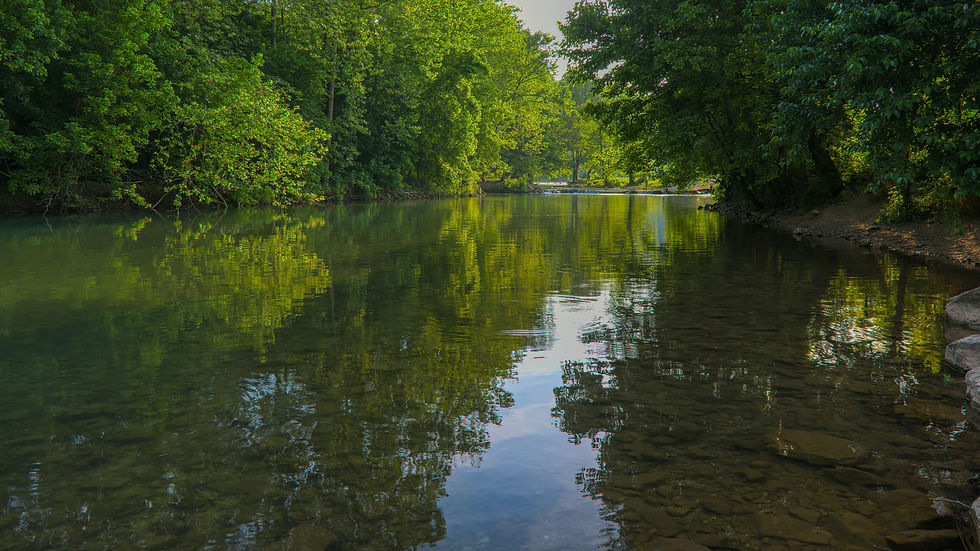
The Duck drains roughly 3,600 square miles through Coffee, Bedford, Marshall, Maury, Hickman, and Humphreys counties. The river is fed primarily by groundwater from the Western Highland Rim and surface tributaries, which is why its base flow holds when smaller surrounding streams go warm-and-low in late summer. Henry Horton State Park in Marshall County anchors public access in the upper-middle reach. Public lands include Henry Horton SP, the Duck River Unit of Tennessee NWR at the mouth (USFWS), and TWRA river-access points throughout the corridor.
The Western Highland Rim limestone substrate drives the quality of the smallmouth fishery on the upper-middle reach. Limestone geology stabilizes pH, buffers water temperature, and provides the cobble-and-gravel substrate that smallmouth bass require for spawning. The river corridor reads as a public-access spine from Coffee County headwaters to the Tennessee River confluence in Humphreys County, 270 miles of riffle-and-pool structure that holds bass on substrate year-round.
The Central Basin physiographic province intersects the Duck drainage in Bedford and Marshall counties, contributing spring-fed tributaries that maintain dissolved oxygen levels through Tennessee summers. This groundwater contribution is a structural advantage the Duck holds over reservoir-dependent fisheries in the region. When impoundments draw down or stratify in July and August, the Duck continues to fish because its hydrology is spring-supported rather than dam-controlled.
Mussel-and-fish biodiversity numbers
The biodiversity numbers put the Duck on a short list of the most diverse temperate rivers globally. Roughly 150 fish species and 50 freshwater mussel species across 270 river miles entirely inside Tennessee. USGS species-occurrence data and TNC Duck River program records together document the picture. The mussel diversity, in particular, is the Duck's claim to fame in conservation literature.
Freshwater mussels are the unsung infrastructure of river health. They filter the water column, stabilize substrate, and serve as indicator species for ecological function. A single mussel can filter 10 to 15 gallons of water per day. Multiply that by millions of mussels across the Duck watershed, and you begin to understand why the water clarity and quality on this river hold when comparable systems degrade. The mussel beds are the reason the smallmouth fishing is good. They are not a separate story from the fishery. They are the fishery foundation.
Species of particular conservation note on the Duck include the birdwing pearlymussel, the Cumberland monkeyface, and the Tennessee pigtoe. Several species are protected under the federal Endangered Species Act. The presence of these species is why TNC, TWRA, and USFWS maintain active monitoring and management programs on the watershed. For operators, the takeaway is direct: the river functions because the biology functions, and the biology functions because the conservation investment has been sustained across decades.
Among the 150 fish species documented, the smallmouth bass population benefits from forage diversity that includes sculpin, darters, stonerollers, and crayfish. Darter diversity alone on the Duck exceeds that of entire river systems in neighboring states. The food web is deep, which means smallmouth grow well and fight hard. Anglers who fish the Duck notice the quality before they understand the science behind it.
Climate windows and seasonal patterns
Smallmouth peak in May through October on the upper-middle reach. The pre-spawn push begins in late April as water temperatures cross the 55-degree threshold, and topwater action extends into early November in mild years. Sauger run cold season in the lower reach below the Tennessee River confluence. Multi-species fishing, including bream, catfish, and gar, holds year-round. Paddling runs from spring through fall, with optimal flows typically from March through June and September through November.
Summer base flows on the Duck generally hold between 200 and 600 CFS on the Shelbyville gauge, which is wadeable and floatable for most of the recreational corridor. The spring-fed hydrology means the Duck rarely blows out the way rain-dependent creeks do. It also means recovery time after rain events is measured in days rather than weeks. This predictability is a booking advantage that almost no Duck River operator currently market on their website.
The sporting profile
Smallmouth on the upper-middle reach
Smallmouth bass on the upper-middle reach is the headline. Tennessee smallmouth-on-the-Duck identity is regionally celebrated. Bassmaster and In-Fisherman coverage is intermittent but consistent. Largemouth, sauger, catfish, and bream supplement the calendar. The typical Duck River smallmouth runs 12 to 16 inches, with fish over 18 inches present throughout the float corridor. These are not reservoir smallmouth. They are stream-bred fish that hold on current seams, undercut banks, and ledge structure, and they fight proportionally harder than their impoundment cousins.
The upper-middle reach from Shelbyville through Columbia offers the best combination of access, flow, and fish density. Wading anglers work the riffle tails and pocket water. Float anglers cover more river and reach the long pools that hold bigger fish in summer. The substrate is predominantly limestone cobble and gravel, with occasional bedrock ledges, making it a textbook smallmouth habitat. Fly anglers throwing Clouser Minnows, crayfish patterns, and topwater poppers find willing fish from May through October.
What makes the Duck smallmouth fishery different from the Caney Fork or the Elk tailwaters is the warm-water ecology. There is no dam release schedule to plan around. There is no trout-versus-smallmouth species debate. The Duck is a smallmouth river, full stop, and the warm-water food web is what produces the fish. This clarity of identity is a content advantage that operators should be leveraging in their digital presence.
Multi-day paddle tradition
Paddling is co-equal primary on the Duck. Multi-day Duck River canoe trips are a regional tradition that predates the modern outdoor-recreation economy. Outdoor Tennessee and Tennessee Magazine-tier coverage rotates the river through every paddling-season feature. Liveries operate out of Columbia, Centerville, and Henry Horton State Park. The river is Class I throughout the recreational corridor, which makes it accessible to intermediate paddlers and families while still offering enough current to keep experienced canoeists engaged.
The multi-day float from Henry Horton State Park to Centerville is roughly 60 river miles and typically done in three to four days. This is the Duck signature trip, combining camping, fishing, and paddling in a single itinerary. The gravel bars that serve as campsites are the same bars that expose mussel diversity in low-water years. Science and recreation occupy the same substrate.
Lodging, fly fishing, and eco-tourism
Lodges and resorts are anchored by the Henry Horton State Park Inn. Commercial cabin and bed-and-breakfast inventory is light along the corridor. Fly fishing is a credible secondary vertical. Smallmouth-on-fly is regionally well-established, but no nationally known fly outfitter dominates. The Middle Tennessee Fly Fishers chapter and Nashville-area guides work the river. Birding and eco-tourism are credible secondary verticals. Mussel-and-fish biodiversity drives an eco-and-research-tourism layer through partnerships with TWRA and TNC, though it is not currently a commercial outfitter market.
The eco-tourism gap is significant. Rivers with comparable biodiversity status elsewhere in the country support research-tourism outfitters who run guided natural-history floats, mussel-identification trips, and biodiversity education programs. The Duck has the science to support this market but lacks the operator infrastructure to serve it. This is an opportunity for existing guides to diversify their calendar and for new operators to enter a market with no established competition.
The biodiversity story translated for anglers
Most river operators in the country market their water by leaning on tournament results, hero-shot fish photography, and lodge-and-meal infrastructure. The Duck does not fit that template cleanly. Its claim is the science. Operators who explain that the smallmouth fishing is good because the river functions ecologically are translating a credible regional reality into content that earns AI citations.
The translation works like this. The substrate is intact because the Western Highland Rim limestone provides a stable cobble-and-gravel bottom. The mussel beds filter the water column, removing particulates and maintaining clarity that smallmouth require for sight-feeding. The spring-fed base flow maintains dissolved oxygen throughout summer, when comparable rivers are stressed. The riparian buffer holds in the Marshall County pasture sections, shading the river and controlling sediment input. Each of these ecological facts maps directly to a fishing-quality claim, and operators who make the connection explicitly produce content that is both scientifically accurate and commercially valuable.
This is the work that no Tennessee fishing guide site we have audited is currently doing well. TNC owns the conservation framing. Academic Press owns the species-by-species detail. The operator's voice, translating the science into why the fishing is good, is editorial whitespace. The operator who fills that gap first owns the category for the next decade of AI-mediated search.
The water-withdrawal question
Marshall, Maury, and Williamson County utilities have proposed expanded water withdrawals from the Duck. TWRA, TDEC, and TNC are publicly engaged in the regulatory process. The dispute is one of the most actively litigated water-rights cases in the Southeast and has been the subject of repeated coverage in The Tennessean and Garden and Gun.
The water-withdrawal question is the Duck River brand right now. Any prospective traveler who researches the river seriously will encounter the dispute. Operators who address the water-withdrawal issue directly, explaining the proposed permits, the conservation positions, the fishery implications, and the operator's own perspective, earn editorial credibility and rank for the search demand the dispute generates.
The municipal demand is driven by population growth in Williamson County, one of Tennessee's fastest-growing counties. The tension between residential water supply and river-ecosystem health is real and unresolved. For operators, the strategic question is not whether to address the topic but how. The operators who treat it seriously, linking the water-rights question to the biodiversity story and the fishery quality, produce the most credible content. The operators who ignore it cede the narrative to TNC and to news outlets, neither of which speaks in operator voice.
The aggregator picture and search landscape
Henry Horton State Park captures the top-of-funnel lodging for Duck River lodging and similar queries. Tennessee State Parks recreation pages carry the canoe-and-paddle queries. TWRA river-access pages carry the angler-regulation queries. The Nature Conservancy Duck River program captures the conservation framing and outranks operators on a biodiversity-themed search.
The Aggregator Interception Index reads MEDIUM for the Duck, lower than the TVA chain and the Cumberland mainline, and higher than the Hatchie. The implication is that operator-direct search position is achievable with disciplined content investment, but it requires the operator to claim categories that the aggregators are not currently optimizing for. Biodiversity-as-fishery-quality is one such category. Smallmouth-on-fly with TNC framing is another.
Demand signals and the trajectory
TWRA does not publish per-river-system license data. Henry Horton State Park visitation runs in the mid-six-figure range annually. Five-year trajectory shows expanding demand for paddle-tourism and smallmouth-fly-fishing tourism on the back of the national smallmouth-content boom across Duck-and-Caney-Fork-tier streams. Traditional bass tourism is flat. Biodiversity and eco-traveler demand are expanding. Nashville-area in-migration is a steady tailwind for demand.
The Duck is a 60- to 90-minute drive from downtown Nashville, which puts it within the weekend-day-trip catchment area of one of the fastest-growing metros in the country. This geographic proximity to a top-ten growth metro is a structural demand advantage that compounds annually. Operators who build content and booking infrastructure now capture the in-migration cohort before competitors who wait.
Where the editorial whitespace sits
What an outfitter on the Duck likely does not have on their website: a longest-river-in-Tennessee positioning piece (the geography itself is a content asset); a Duck-River-biodiversity explainer translated to angler audience (mussel-and-fish ecology meets smallmouth-fishery quality); a water-withdrawal-impact piece (current event, high search volume); a Henry Horton State Park as base camp itinerary linking the lodge, the paddle, and the smallmouth fishing into a single trip.
The single highest-ROI content asset, in our view, is the biodiversity-as-fishery-quality piece. The science explains why smallmouth fishing is good, and translating it for anglers yields durable, AI-defensible content. The piece writes once, ranks for years, and earns AI citations from answer engines that currently default to TNC conservation framing or to tournament-tier bass content that does not fit the Duck profile.
What Pine and Marsh brings to Duck River operators
Across the 2,206 outfitters Pine and Marsh have audited, the mean digital-health score is 5.57 out of 10. Tennessee sits at 5.78 with 22.4 percent AI high-visibility, mid-to-high digital, low AI, the precise quadrant where structured content compounds fastest. Roughly 80 percent of operators run no schema beyond CMS defaults. 85 percent have no FAQ page. Newsletter adoption runs under 40 percent. The 09-series Duck River, Columbia, and Tims Ford record set documents 10 to 20 fishing-and-paddle guides plus a small lodging-and-livery layer with most operators in the lower-tier digital cohort.
Whether you are growing or protecting the brand and heritage your family has built across generations of Duck River lease, livery, or guide service, the gap is the same. Smallmouth-on-the-Duck is editorially well-established but AI-thin in operator voice. A generation of river knowledge sits in Facebook posts instead of headlining a content strategy. Pine and Marsh's role is to convert the buried equity, the multi-day float-route notes, smallmouth seasonal patterns, mussel-and-fish identification, into a schema-marked publishing asset that survives the next ownership transition.
The foundation cluster, Pine and Marsh, runs for Duck River operators and follows the Black Camp and Jocassee Lake Tours playbook: GBP optimization, Organization and LocalBusiness and Service schema, an FAQ that answers what smallmouth travelers ask ChatGPT, and 5 to 10 schema-marked pillar pieces. A longest-river-in-Tennessee positioning piece. The biodiversity-as-fishery-quality explainer. A water-withdrawal-impact piece is refreshed annually. A Henry-Horton-State-Park-as-base-camp itinerary linking Nashville day-trip geography to multi-day floats. Ten to fifteen authoritative inbound links and 18 months of maintenance make the category AI-cited.
What we would do tomorrow if we ran a Duck River guide service
Audit and complete the Google Business Profile. Add LocalBusiness, FAQPage, and TouristTrip schema markup with areaServed properties tied to specific river sections (Columbia-to-Centerville, Henry-Horton-to-Hickman) and geoCoordinates for the operator takeout points.
Build the FAQ around the questions clients actually ask:
When does the Duck smallmouth peak?
What flies work for Duck River smallmouth?
Where is the safest takeout below Henry Horton?
Is the water withdrawal proposal affecting the fishery?
What are the river flow ranges, and how do I read them?
Can I do a multi-day float trip with built-in fishing?
What is the best section of the Duck for fly fishing?
Do I need a drift boat, or can I wade the Duck?
Publish the biodiversity-as-fishery-quality piece as the canonical content asset. Build supporting content: a longest-river-in-Tennessee positioning piece, a water-withdrawal-status update refreshed annually, a Henry-Horton-as-base-camp multi-day itinerary linking lodging, paddling, and fishing, and a smallmouth-on-fly hatch and fly-pattern field guide tied specifically to the Duck.
Most of the river operators publish little of this kind of content. Those who do will own regional search for the next decade.
The Duck is what most rivers used to be. Science is the moat. Operators who write the science earn the search.
We will see you on the smallmouth water.
Jacob and Thomas
Work with Pine and Marsh
Pine and Marsh is a small, owner-operated marketing agency built specifically for the Southeastern outdoor industry, and the Duck River is one of the rare Tennessee sub-regions in our 2,206-outfitter Southeast audit where the editorial story is led by science rather than by tournament results. The biodiversity numbers, roughly 150 fish species and 50 freshwater mussel species on a single 270-mile river, put the Duck on a short list of the most diverse temperate rivers in the world. The water-withdrawal litigation is one of the most actively contested in the Southeast. The operator class is small, and the editorial whitespace is wide.
The work we do with Duck River Outfitters usually starts with a digital audit anchored to our Southeast baseline and a reading of where the operator domain authority sits relative to the TNC Duck River program, the Tennessee State Parks Henry Horton pages, and the Nashville-area smallmouth-fly cohort. From there, we build the technical foundation: schema markup applied specifically (LocalBusiness, FAQPage, TouristTrip) with areaServed properties tied to specific reaches; an FAQ structured around the seasonal smallmouth peak, fly-pattern selection, water-withdrawal impact, and flow-reading literacy; a Google Business Profile completed past the obvious; and a content body that translates the science, substrate, mussel filtration, base-flow chemistry, and riparian-buffer condition into pages that rank for the question prospective destination anglers run before they book.
The high-leverage content asset is the biodiversity-as-fishery-quality piece. The science explains why the fishing is good, and translating it for an angler audience yields durable, AI-defensible content that no generic fishing guide page can match. The water-withdrawal explainer, refreshed annually, captures the current-events search demand the dispute generates and earns the trust of prospective travelers researching the river seriously.
If you operate a Duck River fly- or smallmouth-guide service, a paddle livery, or an eco-and-research-tourism operation, that conversation is one we are usually willing to have.
Frequently asked questions
What makes the Duck River one of the most biodiverse rivers in North America?
Roughly 150 fish species and 50 freshwater mussel species across 270 river miles entirely inside Tennessee. Mussel diversity, in particular, indicates ecological functions that have eroded on most mid-sized rivers in the country. The Nature Conservancy runs one of its flagship Southeast freshwater programs on the Duck specifically because of its concentration of biodiversity.
When is the Duck River smallmouth peak?
May through October on the upper-middle reach. The pre-spawn push begins in late April as water temperatures cross 55 degrees. Topwater action extends into early November in mild years. Sauger run cold season in the lower reach below the Tennessee River confluence. Multi-species fishing for bream, catfish, and gar is available year-round.
What is the Duck River water-withdrawal dispute?
Marshall, Maury, and Williamson County utilities have proposed expanded withdrawals from the Duck. TWRA, TDEC, and The Nature Conservancy are publicly engaged in the regulatory process. It is among the most actively litigated water-rights cases in the Southeast. The municipal demand is driven primarily by population growth in Williamson County.
Where is the best public access to the Duck for paddling and fishing?
Henry Horton State Park in Marshall County anchors the upper-middle reach with a state-park inn, boat ramp, and river access. Liveries operate out of Columbia, Centerville, and Henry Horton. TWRA river-access points run throughout the watershed. The Duck River Unit of Tennessee NWR provides access at the Tennessee River confluence.
Are there trout on the Duck River?
No. The Duck is a smallmouth-and-warm-water river. For Tennessee tailwater trout closest to the Duck region, the Caney Fork below Center Hill Dam and the Elk River below Tims Ford Dam are the primary cold-water trout fisheries. Different river, different species, different content category.
What is the highest-ROI content asset for a Duck River operator?
The biodiversity-as-fishery-quality piece. The science explains why smallmouth fishing is good, and translating that for anglers is AI-defensible content that ranks for the question destination travelers actually research before they book. The piece writes once, ranks for years, and earns AI citations that generic fishing-guide pages cannot.
How does the Duck compare to the Caney Fork or the Elk for fly fishing?
The Caney Fork and the Elk tailwater are cold-water trout fisheries below USACE and TVA dams. The Duck is a warm-water smallmouth river with a paddling tradition and biodiversity moat. Different fisheries, different audience, different content categories. Operators on the Duck compete in the smallmouth and paddle space, not the tailwater trout space.
Last updated: May 2026
About the authors
Jacob Mishalanie is co-founder of Pine and Marsh and a lifelong outdoorsman, gun enthusiast, and nationally-traveled hunter and angler. His career covers large-scale live production and on-property creative direction across the United States.
Thomas Garner is co-founder of Pine and Marsh and a Southeastern digital marketing operator with nearly a decade of analytics, SEO, and AI search work for outdoor and tourism businesses across the 11 states the agency serves.
Pine and Marsh is a small, owner-operated marketing agency built for the Southeastern outdoor industry. Eleven states, ten verticals, two co-founders on every engagement. Our research baseline is a 2,206-outfitter Southeast audit and a 09-series field-brief library covering operator-level digital health across every region we work.
Sources: Pine and Marsh Tennessee Duck River brief; 09-series Duck River, Columbia, and Tims Ford outfitter research; TWRA Annual Reports 2020 to 2024; TWRA Duck River regulation pages; TDEC Duck River water-quality records; The Nature Conservancy Duck River program publications; USGS streamflow and species-occurrence data; Henry Horton State Park and Tennessee State Parks records; Garden and Gun, The Tennessean, regional outdoor coverage.


Comments