
The New River Valley: One of the Oldest Rivers on Earth, the East's Premier Fly-Rod Muskie Water
Updated: Jun 12
By Jacob Mishalanie & Thomas Garner, Co-Founders
The New River is older than the Appalachian Mountains it cuts through—according to USGS and academic geological consensus, it is often cited as the second-oldest river on Earth after the Nile. The operators currently working it are mostly selling Claytor Lake. That is the brand inversion. The most editorially valuable geological curiosity fact in southwestern Virginia -- a river that predates the mountains it flows through, and one of the few major North American rivers that flow north -- is sitting in the H1 of almost no operator websites in the corridor. Claytor Lake is sold as a 4,500-acre Appalachian Power impoundment. The deeper story does not show up until you are already booked.
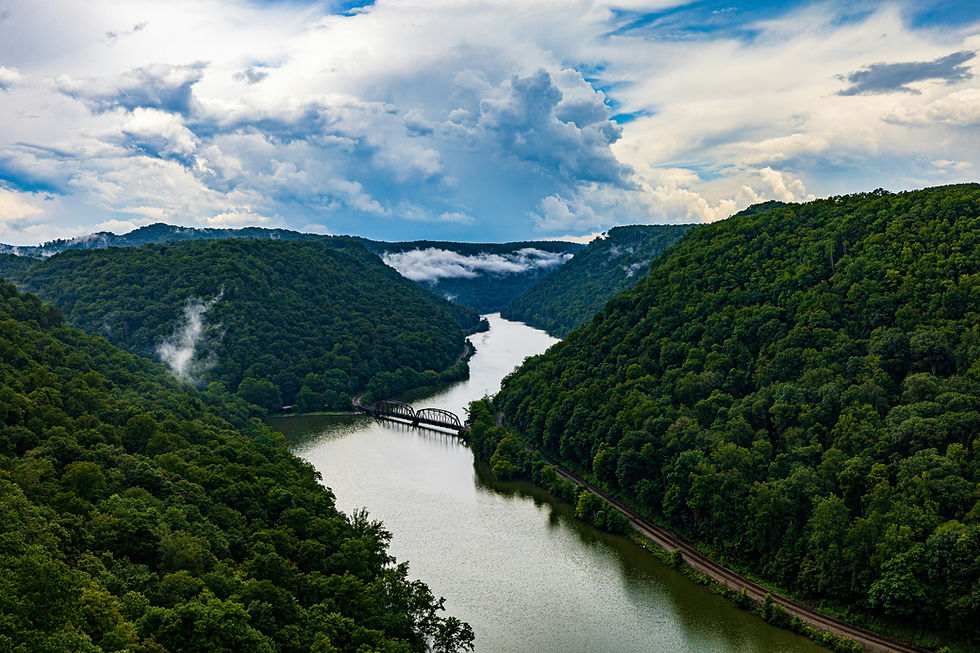
Within Virginia, the New River runs roughly 160 miles, rising in North Carolina and crossing Grayson, Carroll, Wythe, Pulaski, Montgomery, and Giles counties before continuing into West Virginia, where it joins the Gauley as the Kanawha. Claytor Lake -- built in 1939, FERC relicensing currently in progress -- is the defining structure, and above and below the lake, the river produces some of the most-cited fly-rod muskie water on the East Coast. The geological-age narrative is the brand. The operators who own the geology will own the SEO.
The geography and the moat
The New River corridor in Virginia covers Grayson, Carroll, Wythe, Pulaski, Montgomery, and Giles counties. The New River Trail State Park -- a 57-mile rail-trail along the river -- is among the longest linear state parks in Virginia and the structural recreation backbone of the corridor. Claytor Lake State Park sits on the impoundment. Mountain Lake (private, in Giles County) is one of only two natural lakes in Virginia and the documented filming location of Dirty Dancing—a Wikipedia-anchored cultural property that draws steady tourism. The Cascades Recreation Area inside the USFS Jefferson NF carries one of the region's most-photographed waterfall hikes. Jefferson NF itself surrounds the corridor with roughly 700,000 acres of public land.
The fishery character changes through the corridor. The upper New (Grayson, Carroll, Wythe) is wadeable and float-friendly smallmouth water. Claytor Lake (Pulaski) holds smallmouth, largemouth, walleye, and striped bass; Bassmaster events have visited Claytor periodically. The lower New (Montgomery, Giles) below the lake is wadeable to float-deep water, with the muskie fishery concentrated here, and the New River Gorge (West Virginia, just over the state line) provides the regional context for Class V whitewater.
For operators, the geographic moat matters. The corridor is long enough -- 160 miles of river, a 4,500-acre impoundment, a 57-mile rail-trail, and a 700,000-acre national forest -- that no single aggregator page can capture the full product mix. A Giles County muskie guide and a Claytor Lake striper guide are functionally different businesses serving different anglers on different water at different times of year. The operator who writes the geography owns the disambiguation, and disambiguation is where aggregator interception fails.
Muskie on the fly -- national-press canon
Cold-season muskie on fly
The Upper New is the East's premier fly-rod muskie fishery. Eastern Fly Fishing, Drake magazine, Field & Stream, and the broader fly-fishing-YouTube ecosystem return to the New River muskie story on a recurring cycle. Mossy Creek Outfitters' New River muskie content is a flagship product run from the Harrisonburg shop. Greasy Creek Outfitters out of Willis runs deep New River muskie programming. Tangent Outfitters in Pembroke covers the Giles County reach.
The cold-season window -- November through March -- is the canonical muskie-on-fly season. Cold water concentrates fish, slows metabolism, and makes the structural water predictable enough that an angler can spend a day actually casting to muskie rather than searching for them. The technical demands are real -- 10- and 11-weight rods, articulated streamers, figure-eight retrieves at the boat, the discipline to throw the same fly to the same water for hours -- and the angler base is small but serious.
The fly-rod muskie angler is a high-value, low-volume client. These anglers travel specifically for muskie water, book multi-day trips, and return to the same guide season after season. The lifetime value of a single muskie-on-fly client exceeds the lifetime value of a dozen casual smallmouth floaters. For operators, the muskie product is not a volume play -- it is a margin play, and the editorial content that captures muskie intent converts at a rate that no generic river-fishing page can match.
Smallmouth on the upper New peaks May through October. The smallmouth fishery is the volume product; the muskie fishery is the editorial trophy. Operators who hold both seasons in one voice -- the way Mossy Creek and Greasy Creek do -- own the integrated New River fly-fishing identity at the digital layer.
Claytor Lake -- the under-marketed reservoir
Claytor Lake, at 4,500 acres, is one of the most multi-species-productive reservoirs in Virginia and the most under-marketed at the operator-content layer. Striped bass were stocked by VDWR and have established a self-sustaining population that produces fish into the 30- and 40-pound class. Walleye are the cold-water signature species. Largemouth and smallmouth populate the lake's structural water. The cold, deep-water profile -- Claytor is one of the deeper reservoirs in Virginia -- supports a multi-species mix that warmer Southern reservoirs cannot.
Bassmaster events have visited Claytor periodically. The tournament-history-and-current-guidance content asset -- what Bassmaster taught about Claytor, what the local guide knows that the tournament did not -- sits unwritten by any current Claytor operator. The aggregator capture pattern on Claytor Lake reads MEDIUM. FishingBooker, Visit Pulaski, Visit New River Valley, and the New River Trail State Park ecosystem capture significant intent. The independent Claytor guide market is genuinely undersaturated -- the number of guides relative to the lake's productivity is lower than the regional pattern would predict.
Claytor's FERC relicensing process is the single most consequential regulatory variable on the corridor right now. Appalachian Power's existing license governs water-level management, flow regime, and shoreline access. The relicensing outcome will determine whether Claytor's fishery improves, holds steady, or degrades over the next 30 to 50 years. Operators who publish content anchored to the FERC relicensing timeline -- explaining what it means for water levels, fish habitat, and guide access -- will own a content territory that no aggregator is currently contesting.
The operator density on Claytor Lake is notably lower than that of comparable Virginia reservoirs. Smith Mountain Lake, at roughly 20,000 acres, supports a substantially larger guide fleet and a more developed digital-content ecosystem. Claytor, at 4,500 acres with its cold, deep-water, multi-species productivity, should support more independent guides than it currently does. The gap between the lake's fishing quality and its operator-content coverage is one of the widest we have logged in the Virginia 09-series.
Whitewater paddle and the Cascades
The New River Gorge in West Virginia, just over the state line, is the East's premier big-water whitewater destination. The Virginia reach above the Gorge carries Class II-III paddle and float-fishing water. Adventure outfitters in Pearisburg and Narrows handle the paddle market. The Russell Fork Class V dam-release weekends in the southwestern corner of the state provide the other half of the regional whitewater story.
Cascades Recreation Area, within the USFS Jefferson NF, is the Virginia paddle-and-hike anchor. The waterfall hike is one of the most photographed in the corridor and draws Virginia Tech weekend traffic on a steady cycle. The combined Cascades-and-New-River-Trail product creates a paddle-hike-bike weekend that no Virginia operator currently markets as an integrated package.
Virginia Tech and the feeder market
Virginia Tech in Blacksburg is the structural feeder market for the New River Valley outdoor-recreation cluster. Student traffic, alumni traffic, and the broader Hokie network drive paddle, fly, and float-fishing demand on a steady weekly cycle. Virginia Tech's outdoor club channels carry meaningful demand. The university's research forestry, fisheries, and biological sciences programs maintain an active relationship with the Jefferson NF and the New River fishery.
The implication for operators is the same one we have made elsewhere -- when a destination has a structural feeder-market anchor, content that explicitly speaks to that anchor (Virginia Tech alumni, in this case) creates leverage. A Hokie-traveling-back-for-football-weekend itinerary that includes a half-day fly trip, a Cascades hike, and a Claytor Lake afternoon is the kind of integrated content piece that captures a specific recurring demand cycle no aggregator above is currently fighting for.
The 09-series Session-2 audit
Pine & Marsh's 2,206-outfitter Southeastern competitive audit (mean digital health 5.57 out of 10) logged 25 records on the New River corridor in our Session-2 work. The distribution is similar to the James -- four to six anchor operations carrying real digital authority, a mid-tier of ten to twenty operations with functional sites, and a long tail of phone-first operations. Mossy Creek Outfitters, Greasy Creek Outfitters, Tangent Outfitters, and a small cluster of Claytor Lake guides anchor the corridor.
The operator density comparison is instructive. The James River corridor logged 40-plus records in the same audit window. The Shenandoah Valley logged 35-plus. The New River Valley at 25 records for a 160-mile corridor with a 4,500-acre impoundment and a nationally recognized muskie fishery is under-indexed relative to its fishing quality. The gap is not in demand -- Virginia Tech alone generates steady weekly recreational traffic -- but in the supply of operator content.
The Aggregator Interception Index reads MEDIUM. Visit Pulaski, Visit New River Valley, Virginia Tourism Corporation, FishingBooker (Claytor), and the New River Trail State Park ecosystem capture significant generic intent. The geological-age content territory and the Mountain Lake / Dirty Dancing nostalgia layer are largely operator-thin.
The regulatory current
VDWR sets freshwater regulations -- smallmouth, muskie, walleye, striper. USFS Jefferson NF administers a public-land hunting overlay. Appalachian Power operates Claytor under an FERC license. VDCR administers Claytor Lake State Park and the New River Trail State Park.
Last 24 months: muskie size and bag rules on the upper New continue to evolve toward catch-and-release-trophy posture; ongoing Jefferson NF prescribed-fire and bear-season management; FERC relicensing variables on Claytor Lake water-level and flow regime; alewife invasive-species pressure in Claytor. The New River Conservancy serves as the dominant watershed advocacy organization. Trout Unlimited tributary chapters cover the stocked-trout streams that feed the river. Pending threats include shoreline development pressure on Claytor and continued FERC relicensing impact on the flow regime.
The geological-age content asset
Here is the single most defensible piece of content on this river. "Why does the New River flow north?" A geology and age explainer that turns a Wikipedia-canonical fact -- one of the oldest rivers on Earth, predating the Appalachians, flowing against the way the rest of eastern North America drains -- into operator-level credibility. The piece writes itself for a thoughtful editorial voice. It has the kind of evergreen search-volume potential that AI summary engines genuinely need a credible operator-published source for. And it gives any operator on the river a credibility hook that no aggregator above is currently competing for at the editorial layer.
The Mossy Creek Outfitters analog matters here. Mossy Creek Fly Fishing and Mossy Creek Outfitters have built their domain authority partly by writing the geology of Mossy Creek itself -- the karst, the spring chemistry, the limestone-influenced bug life. The same playbook applies to the New, with different geology. The age, the northward flow, the multi-province crossing, the muskie water that grew out of the cold-deep-water reservoir behind Claytor.
What the New River operator should publish first
Five pieces, in priority order.
First: "Why the New River flows north." Geological-age and drainage-orientation explainer. Highest-ROI piece on the corridor. Second: a Claytor Lake multi-species guide -- striped bass, walleye, largemouth, smallmouth -- with the cold-deep-water structural argument that explains why Claytor produces what it does. Third: a New-River-Trail rail-trail-and-fish hybrid itinerary that converts the trail's user base (Virginia Tech alumni, regional weekenders) into half-day fly bookings. Fourth: a Mountain Lake natural-drainage / Dirty Dancing nostalgia-meets-sporting integrated piece -- niche but durable cultural-tourism cross-pollination. Fifth: a muskie-on-the-fly winter-season technical guide that operates under the Mossy Creek and Greasy Creek brand canopy in a complementary rather than competing position.
That is a year of content. That is the content-cluster anchor for any New River Valley operation seeking to build digital authority outside the existing canopy of operators.
The geology is the brand here. The river is older than the mountains. The fly-rod muskie canon belongs to a small group of operators who have already built the editorial reference frame. And the operators who own the geology will own the SEO.
Work with Pine & Marsh
Pine & Marsh is a small, owner-operated marketing agency built for the Southeastern outdoor industry. Eleven states, ten verticals, two co-founders on every engagement. Our research baseline is a 2,206-outfitter Southeast competitive audit -- Session 2 covered the New River corridor directly with 25 records -- and a 09-series field-brief library that lets us put your operation in context against every cold-water reservoir from Norris to Watauga. We do not subcontract. We do not hand you off to a junior account manager. Jacob and Thomas are on every call, every shoot, and every content sprint.
For a New River Valley operator, our audit offer starts with the names you already know. We benchmark your digital footprint against Tangent Outfitters in Pembroke, Greasy Creek Outfitters out of Willis, Mossy Creek Outfitters running muskie programming from Harrisonburg, VDWR's regulation and stocking pages, New River Trail State Park's trail-and-access content, Claytor Lake State Park's recreation portal, FERC's relicensing docket, FishingBooker's Claytor Lake guide listings, and Airbnb Experiences' New River Valley results. We show you exactly where you rank, where aggregators intercept your demand, and where content gaps are open.
The urgency on this corridor is real, and it is structural. Claytor Lake's FERC relicensing window is open now -- the operator who publishes content anchored to the relicensing timeline, explaining what it means for water levels, flow regime, and guide access, will own a content territory that no aggregator is currently contesting. The fly-rod muskie editorial space is claimed by three operators and zero aggregators; the fourth entrant who writes the muskie-on-fly technical guide with original cold-season photography will rank, because the editorial canon is still small enough that a well-built piece enters the rotation immediately. These windows do not stay open once the content is written.
We show up on the property. At first light, in the muskie cold-season window on a wadeable Giles County float. At dawn on Claytor for striped bass with the fog still on the water. On the New River Trail with a fly rod and a bike rack. We produce the photography and the on-property content that converts a Hokie alumnus scrolling flight deals, a fly-curious traveler reading muskie forums, or a family looking at Claytor Lake cabin rentals into a confirmed booking. The content we build is yours -- your domain, your brand, your editorial authority.
If you guide on the New, run a lodge on Claytor, or operate anywhere on the corridor between Grayson County and the West Virginia line, the next step is a discovery call. No pitch deck. No templated proposal. A conversation about your water, your product mix, your shoulder-season gaps, and the content runway that turns the oldest river in the Appalachians into the SEO asset it should have been all along.
Frequently asked questions
How old is the New River?
According to the USGS and academic geological consensus, it is often cited as the second-oldest river on Earth after the Nile. The river predates the Appalachian Mountains it flows through and is one of the few major North American rivers that flows north.
What is the muskie season on the New?
The cold-season window -- November through March -- is the canonical muskie-on-fly season. Cold water concentrates fish and slows metabolism, making the structural water predictable enough to spend a day actually casting to muskie.
What does Claytor Lake hold?
Smallmouth, largemouth, walleye, and striped bass -- the cold-deep-water multi-species mix that warmer Southern reservoirs cannot support. Bassmaster events have visited Claytor periodically.
What is special about Mountain Lake?
One of only two natural lakes in Virginia (with Lake Drummond in the Dismal Swamp) and the documented filming location of Dirty Dancing. Wikipedia-anchored cultural property in Giles County.
What is the Cascades Recreation Area?
A USFS Jefferson NF waterfall hike and paddle anchor in Giles County -- one of the most-photographed waterfall hikes in the corridor.
What is the New River Trail State Park?
A 57-mile rail-trail along the river -- among the longest linear state parks in Virginia and the structural recreation backbone of the corridor.
How does Mossy Creek Outfitters fit in the New River fly-fishing ecosystem?
Mossy Creek Outfitters runs flagship New River muskie programming from the Harrisonburg shop. Greasy Creek Outfitters out of Willis and Tangent Outfitters in Pembroke run deep New River fly programs. Smaller operators on the New benefit from operating under that brand canopy in complementary positioning.
Last updated: May 2026
About the authors
Jacob Mishalanie is co-founder of Pine & Marsh and a lifelong outdoorsman, gun enthusiast, and nationally-traveled hunter and angler. His career covers large-scale live production and on-property creative direction across the United States.
Thomas Garner is co-founder of Pine & Marsh and a Southeastern digital marketing operator with nearly a decade of analytics, SEO, and AI search work for outdoor and tourism businesses across the 11 states the agency serves.
Pine & Marsh is a small, owner-operated marketing agency built for the Southeastern outdoor industry -- eleven states, ten verticals, two co-founders on every engagement. Our research baseline is a 2,206-outfitter Southeast audit and a 09-series field-brief library covering operator-level digital health across every region we work.


Comments