
The Alabama Black Belt: A Sporting Deep-Dive on Chalk-Soil Country
Updated: Oct 21

By Jacob Mishalanie & Thomas Garner, Co-Founders
7:14 a.m. outside Hurtsboro. Frost on the broomsedge, a brace of pointers locked up forty yards out, and the soil under their feet is older than every quail belt the rest of the South has lost. Selma Chalk - calcareous, water-retentive, Cretaceous-age marine sediment - is the reason a wild-flushed bobwhite still exists as a commercial product in the deep South in 2026. Sandy soils elsewhere in the Gulf states gave up on commercial bobwhite a generation ago. The chalk did not.
That soil is the entire reason commercial quail in the Alabama Black Belt is a real product and not a nostalgia exercise. It is also why late-rut whitetails fatten on the prairie edges in mid-January, why Eastern turkey gobbles ricochet across chalk pasture in mid-March, and why corporate dove fields have been planted in the same loops by the same families for generations. The Black Belt is a crescent roughly 300 miles long and a few dozen miles wide, running east-to-west from Sumter County on the Mississippi line to the Russell County lobe at Phenix City. The chalk is the moat. This piece is a sporting deep dive into what sits atop it: the geology, the species roster, the operator map, the whitetail economy, the rut calendar, and the marketing reality the lodges face. In our 2026-27 audit, the 16 operators we audited in the Black Belt / Prairie sub-region average 4.0 out of 10 on digital health, well below the 11-state mean of 5.09, even though the area holds some of Alabama's best-known sporting product.
Ecology Deep-Dive - The Selma Chalk and the Prairie It Built
Geology: 70 million years of marine sediment
The Black Belt's identity is geological first and human second. The defining substrate is the Selma Group - principally the Demopolis Chalk and Mooreville Chalk formations - deposited as marine sediment during the Late Cretaceous period, approximately 70-85 million years ago, when a shallow tropical sea covered what is now central Alabama. Those organisms died, settled, and compressed into a soft, calcium-carbonate-rich limestone that weathers into the heavy, dark, alkaline clay soil that gives the Black Belt its name - black when wet, calcium-rich, water-retentive, and fertile in the narrow band where it surfaces.
The chalk outcrops in a crescent arc from the Mississippi state line on the west through Sumter, Greene, Hale, Perry, Marengo, Dallas, Wilcox, Lowndes, Bullock, and Macon Counties, terminating at the Russell County lobe near Phenix City on the east. The crescent is roughly 300 miles long and 20 to 35 miles wide at its broadest - a thin band that produces disproportionate ecological and sporting output relative to its footprint.
The Black Belt Prairie as an ecoregion
At the time of European contact, the Selma Chalk surface supported a distinct plant community: the Black Belt Prairie - a tallgrass prairie and post-oak savanna system that existed as an island of grassland in the broader forested Southeast. The prairie was fire-maintained and calcium-dependent. Big bluestem, little bluestem, indiangrass, and switchgrass dominated the uplands. Post oak and eastern red cedar occupied the savanna margins. The alkaline soil chemistry supported a browse and forb layer richer in calcium, phosphorus, and protein than the acidic sandy soils of the Coastal Plain to the south or the Piedmont red clays to the north - a nutritional advantage that still drives the quality of deer body weights and antler mass in the belt today.
The Black Belt Prairie is classified as a distinct ecoregion within the Southeastern Plains by the EPA's Level IV framework. NASA reports that less than 1 percent of the original prairie remains, which makes it a rare ecosystem. For an operator, that rarity is a story: the same soil that grows the heaviest deer in Alabama supports one of the rarest plant communities on the continent, and almost nobody is telling both stories on the same page.
Transition zones: Piedmont, Coastal Plain, and the longleaf edges
The Black Belt does not exist in isolation. It sits between two very different physiographic provinces, and the transition zones matter for both ecology and hunting opportunity.
To the north, the Fall Line Hills mark the transition from the calcareous Black Belt Prairie into the Piedmont's red-clay uplands. This boundary runs roughly along the northern edges of Greene, Hale, Perry, and Dallas Counties. The soils shift from alkaline chalk to acidic clay, the canopy transitions from open pasture and post-oak savanna to mixed hardwood-pine forest, and the browse quality changes measurably. Deer harvested north of the chalk tend toward lower body weights and smaller antler frames - the nutritional baseline is different.
To the south, the Southern Red Hills and the upper Coastal Plain mark the transition into deep sand and longleaf-pine country. This is where the Black Belt edges become ecologically interesting for operators: the interface between chalk prairie and longleaf pine produces habitat mosaics - open pasture grading into pine-savanna edges - that concentrate game at the ecotone. Quail use the prairie-to-pine transition zones heavily. Deer bed in the pine thickets and feed on the chalk-enriched browse at the prairie edge. Turkey roost in the hardwood drains that cut through the chalk and strut on the open pasture above.
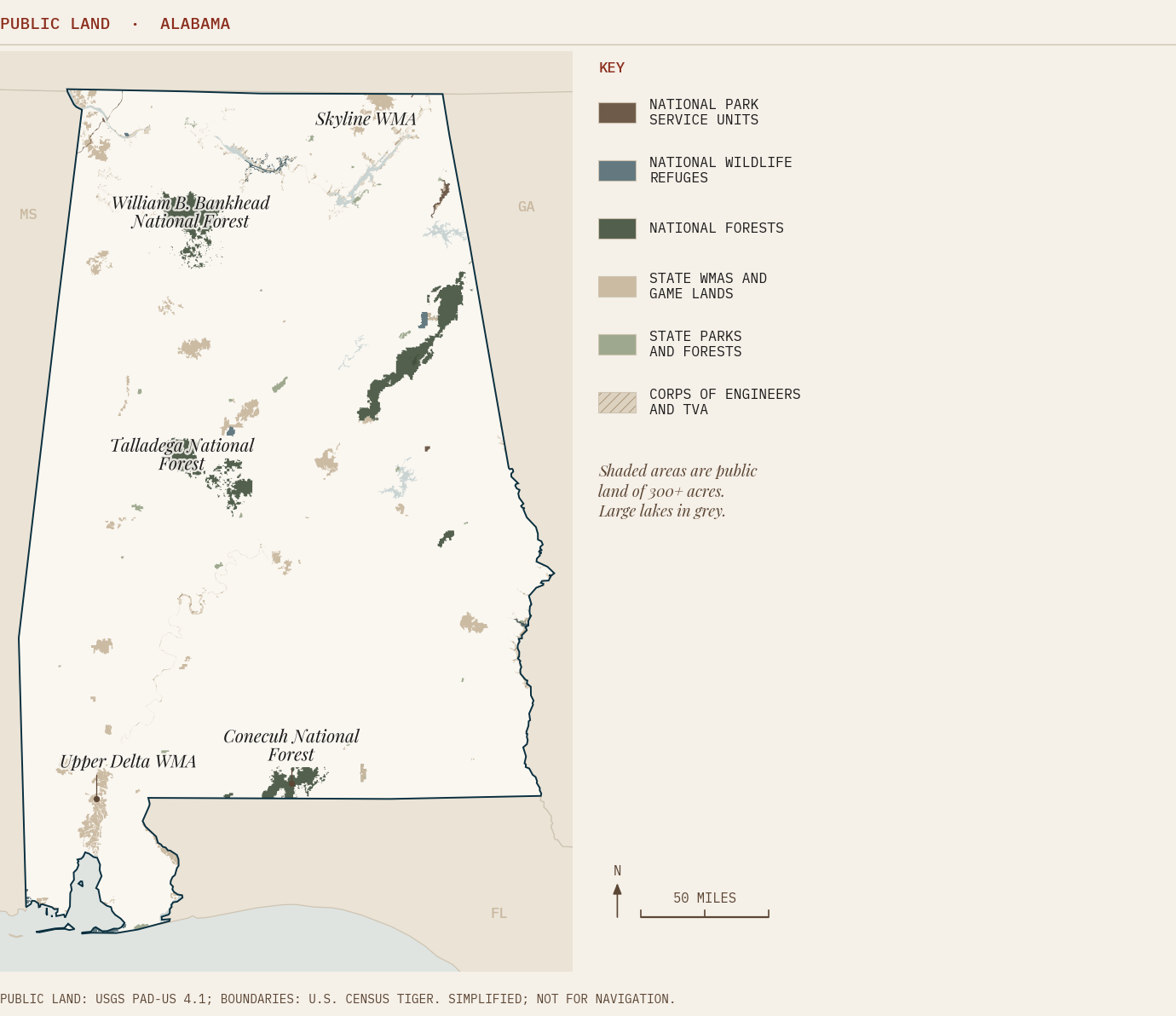
Longleaf-pine remnants on the southern and eastern margins of the Black Belt, particularly in the Oakmulgee Ranger District of Talladega National Forest, which straddles Bibb, Hale, Perry, and Tuscaloosa Counties, are a notable area of longleaf restoration work in the state. The Oakmulgee unit is a large block of national forest, so check the USFS for current acreage, management and habitat projects, which typically rely on prescribed fire, midstory hardwood removal, and native grass restoration. For an operator on the chalk, the Oakmulgee adjacency is a conservation-credibility asset. The longleaf story and the chalk-prairie story converge at the Black Belt's edges, and an operator who publishes that convergence in a coherent ecological narrative offers something a generic directory cannot.
Soil chemistry and browse quality: the nutritional moat
The calcium carbonate content of Selma Chalk soils translates directly into browse and forage quality that is measurably superior to that of the acidic sandy soils that dominate most of Alabama's Coastal Plain. Soil pH in the chalk belt runs 7.0 to 8.2 - neutral to moderately alkaline - compared to 4.5 to 5.5 on the sandy Coastal Plain. That pH differential drives higher calcium and phosphorus availability in plants, which translates to better bone growth (antler mass), higher body weights, and higher reproductive rates in white-tailed deer. The same chemistry produces richer seed heads in native grasses and forbs, which drives insect populations (the primary food source for quail chicks in their first weeks) and seed availability for adult bobwhite through winter.
This is not speculation - it is the mechanism behind the Black Belt's reputation as trophy deer country and the ecological reason commercial quail still pencils out on the chalk when it has collapsed on the sand. An operator who can explain the soil-to-forage-to-animal pathway in 500 words - and tie it to the specific property they manage - has a credibility piece that separates their brand from every lodge running on lineage alone.
Agricultural history: cotton to cattle to timber to hunting leases
The human history of the Black Belt's landscape is inseparable from its sporting present. Cotton arrived in the early 1800s and dominated for a century - the chalk soil's fertility made the Black Belt one of the richest cotton-producing regions in the antebellum South. The boll weevil crossed the Mississippi state line into Alabama in 1910 and reached the eastern Black Belt by 1916, devastating the cotton monoculture. Soil exhaustion, the boll-weevil collapse, and the Great Depression ended cotton's dominance by the 1930s.
What replaced cotton shaped the landscape we hunt today. CCC-era pine plantings in the 1930s and 1940s established loblolly and longleaf on abandoned cropland. Post-war pasture conversion turned the open prairie into cattle country. Timber company acquisitions in the 1960s through the 1980s added managed pine plantations. And hunting leases - the economic backbone of much of the rural Black Belt today - emerged as landowners discovered that the same soil chemistry that grew cotton could grow trophy deer and hold quail coveys on the open-pasture / pine-edge mosaic that the post-cotton transition produced.
The commercial-shoot lineage tracks this transition. Some of the belt's best-known quail properties trace their commercial roots to the 1930s, while others consolidated mid-century or came up through the 1970s to 1990s as commercial lodges, building durable client lists through corporate relationships with major Southern timber, paper, banking, and chemical companies. That client base, corporate, relationship-driven, and often phone-booked, helps explain why much of the belt's marketing has historically run on word of mouth. Relationship funnels can narrow over time, and lodges that build a digital complement to them are better placed to reach the next generation of clients.
The Species Roster - What the Chalk Carries
White-tailed deer
The Black Belt's whitetail herd is the primary sporting draw in dollar terms, and the reputation is well established. Mature bucks in the chalk belt are widely described as among the heaviest in the Southeast, and Boone and Crockett entries from Black Belt counties, particularly Dallas, Wilcox, Marengo, and Greene, have been reported to rise as quality deer management practices have spread through the private-lease economy. Well-managed Black Belt properties are known for a strong share of mature bucks, though the belt is not known for producing the very largest entries at the rate Iowa or the Kansas Flint Hills do. Check current Boone and Crockett and ALDCNR data before quoting specifics.
Rut timing is the competitive advantage. Alabama's rut is staggered by zone across the state, and the Black Belt sits in the southern half of the rut map. In the core chalk counties, Dallas, Wilcox, Lowndes, and Marengo, peak rut activity is generally reported in January, sometimes extending into early February. This is later than the rut windows in much of the Eastern United States. The implications for destination booking are structural and underexploited, and we address them in the Rut Calendar section below. Habitat signals: deer in the Black Belt are chalk-edge browsers. They bed in pine thickets and hardwood draws, feed on the protein-rich forbs and browse produced by the alkaline soil on pasture edges and fallow fields, and concentrate at the prairie-to-timber ecotone during feeding hours. Food plots on Black Belt properties generally perform well because calcium and phosphorus availability supports clover, brassica, and chicory production that sandy-soil operators have to work harder to match with lime and fertilizer. Seasonality: archery opens in mid-October by zone, gun seasons are staggered into November by zone, and late-season hunting runs into early February in most belt counties. Confirm current dates in the ALDCNR proclamation. The mid-January peak rut is the destination signal.
Eastern wild turkey
The Black Belt's spring gobbler tradition is deep and commercially viable, though the product faces headwinds. Alabama's Eastern wild turkey season, under the post-2019 framework, generally opens in mid-to-late March and closes in early May, with the northwest zone opening a week later. Confirm exact dates in the current ALDCNR proclamation. Bag limits have been reduced, fall seasons have been closed in many counties, and method restrictions have been adjusted in response to the long-term gobbler-decline trend that has affected turkey populations across the Southeast.
The Black Belt's chalk-prairie-and-hardwood-drain mosaic is strong turkey habitat. Birds roost in the hardwood bottoms along the Tombigbee, Alabama, and Cahaba river systems and their tributaries, then fly down to strut and feed on the open pasture and agricultural edges above. The visual of a tom strutting in broomsedge on chalk pasture at sunrise, gobbling across the open ground, is the iconic image of the Alabama spring, and it is rarely captured in operator content. Habitat signals: mature hardwood trees for roosting, open ground for strutting, agricultural edges and native grass for feeding, moderate understory for nesting. The chalk belt provides all four in proximity. Seasonality: spring season, roughly mid-March through early May, with the opening weeks the destination window and gobbling typically peaking in early to mid-April. Fall turkey seasons are closed in many counties under the post-2019 framework. Check the current ALDCNR proclamation.
Northern bobwhite quail
The Black Belt's bobwhite is the species that built the commercial-lodge economy, and the distinction between wild-bird and pen-raised programs matters enormously for operator credibility. Wild bobwhite populations in the Black Belt exist in a state between remnant and recovering - they have not collapsed as completely as in the Gulf Coastal Plain's sandy-soil counties, but they are far below historical densities. The chalk soil's nutritional advantage, combined with active habitat management (prescribed fire, fallow-field rotation, native grass planting) on the anchor plantations, sustains wild coveys on managed properties at levels that the sandy-soil Southeast has largely lost.
Commercial-shoot operations run pen-raised birds, bobwhite and sometimes chukar, on managed courses that simulate wild-bird habitat. The shoot windows run from November through March. Destination-tier lodges commonly run mixed programs: pen-raised volume for the corporate-event bookings, and wild-bird coveys on the best-managed blocks where habitat investment has paid off. The buyer who cares about wild vs. pen-raised should ask before booking, and the operator who explains the distinction openly earns the conservation-aware buyer who is increasingly the high-value buyer.
Habitat signals: open ground with native bunchgrass (broomsedge, little bluestem), scattered shrub cover for escape and thermal regulation, bare-ground corridors for brood movement, and a seed-and-insect food base driven by the chalk soil's nutritional baseline. Seasonality: commercial-shoot windows November through March. Wild-bird season follows ALDCNR proclamation - typically mid-November through late February.
Mourning dove
Mourning dove over managed sunflower, millet, and corn fields is the Black Belt's corporate-event flagship. The early-September opener has been a tradition in the belt for decades, and corporate groups from chemical, timber, banking, and paper-mill companies have long run opening-day shoots on the same fields. The split seasons run through December and January, but the early-September shoots are the commercial product. The product is overwhelmingly corporate and relationship-driven, and often hard to book online. That is a structural opportunity: corporate procurement increasingly sources through search and platforms that read schema-marked pages, and a product that cannot be found is hard to book. Habitat signals: recently harvested or manipulated agricultural fields on chalk soil, standing sunflower or milo strips, watering sources (ponds, stock tanks), and scattered dead timber perching structures along field edges. Seasonality: early-September opener (set annually, so confirm the date with ALDCNR). Split seasons through December-January. The September shoots are the corporate-event window.
Feral hog
Feral hog populations on Black Belt properties are significant and year-round harvestable. According to ADCNR, feral hogs can be taken year-round on private land with no bag limit, so confirm the current rules. For operators, hog hunts fill calendar gaps between deer season and turkey season and provide a year-round revenue line - the demand for hog hunting has grown nationally, and the Black Belt's river-bottom hardwood and agricultural-edge habitat support dense populations. Habitat signals: river-bottom hardwood, agricultural edges, rooting-disturbed pasture, water sources. Seasonality: year-round on private land. No closed season, no bag limit.
Largemouth bass
The Black Belt's fishing story is undermarketed relative to its quality. Farm ponds on chalk soil - fed by calcium-rich groundwater - produce largemouth bass at growth rates that sandy-soil impoundments cannot match. The calcium availability drives the invertebrate food chain that feeds forage fish that feed bass. A well-managed 10-acre pond on chalk soil in Dallas or Marengo County will outproduce a comparable pond on sandy Coastal Plain soil by a meaningful margin.
Beyond farm ponds, the Tombigbee River system on the west side of the belt, the Alabama River through the center, and the Cahaba River on the eastern flank all carry legitimate largemouth and spotted-bass fisheries. The Alabama River impoundments, Miller's Ferry / William "Bill" Dannelly Reservoir and Claiborne Lake, are the named bass waters in the belt, and Miller's Ferry is well regarded among Alabama bass anglers. Habitat signals: submerged structure, aquatic vegetation, stable water levels, calcium-enriched forage base. Seasonality: year-round, with peak action March through June (spawn and post-spawn) and October through November (fall feed-up).
Crappie and catfish
Crappie, both black and white, work the Alabama River impoundments and the Tombigbee pools at fishable densities. Miller's Ferry is a known crappie destination on the Alabama tournament circuit, though guide services for the fishery look limited.
Channel and blue catfish work the river systems year-round. Flathead catfish occupy the deeper holes and submerged timber structures. The catfish layer is a night-fishing and jug-fishing vertical with lodge-stay cross-sell potential that few Black Belt operators have built out. Seasonality: crappie peak March through May (pre-spawn and spawn). Catfish year-round, with trophy-size potential peaking in summer.
Rabbit and squirrel: the small-game tradition
The Black Belt carries a small-game tradition that the commercial lodges have largely abandoned in their marketing, but that still runs in the rural counties. Rabbit hunting with beagles - cottontail on the pasture edges and briar patches - is a deep-South tradition that predates the commercial quail economy. Squirrel hunting in the hardwood bottoms along river systems remains one of the most popular hunting activities in rural Alabama in terms of participation, even as it has almost entirely disappeared from commercial-operator content.
For an operator building a multi-vertical calendar, small game fills the late-fall and winter shoulder weeks when quail bookings are light, and deer clients have not yet arrived. A beagle-rabbit hunt or a morning squirrel hunt in the hardwood bottom is also a low-barrier entry point for family groups and younger hunters - a customer segment that every lodge needs for long-term viability and that almost none are marketing to. Seasonality: squirrels typically live from September through February. Rabbit is typically hunted from October through February. Check ALDCNR annual proclamation for current dates and bag limits.
The Sporting Stack by Vertical - Operator Opportunity Analysis
Deer (primary vertical)
Whitetail is the dollar anchor. Guided deer hunts on managed Black Belt properties typically command premium pricing, see The Whitetail Economy section below, and the late-January rut gives the belt a calendar advantage. The operator opportunity: every Black Belt deer lodge can own a pillar page explaining why the late rut exists, what it means for booking timing, and how the chalk-soil nutritional advantage translates to the antler quality the client will see in the field.
Turkey (strong secondary)
Spring gobbler is the belt's second commercial vertical. The opportunity is in explainer content: the post-2019 season changes, the county-by-county regulation differences, and the practical guidance an out-of-state hunter needs to plan a March or April trip. A schema-marked 'Alabama Spring Turkey: What Changed in 2019 and What It Means for Your Hunt' page is the kind of content a destination turkey hunter researches.
Quail (heritage and restoration)
Quail is the brand. The word 'plantation' in the Black Belt context refers primarily to quail. The operator opportunity splits in two: the commercial-shoot volume (corporate groups, pen-raised birds, long-established lodge lineages) and the wild-bird credibility (habitat management, prescribed fire, covey monitoring). The lodge that tells both stories, commercial volume with wild-bird restoration underneath, holds the credibility position. The lodge that obscures the wild-vs-commercial distinction risks losing the conservation-aware buyer who reads Garden & Gun and subscribes to Covey Rise.
Dove (agricultural tradition)
The corporate dove shoot is one of the belt's most valuable and hardest-to-book products. The operator opportunity is a landing page: a corporate dove page with structured schema, seasonal calendar, group-booking logistics, and FAQ targeting 'corporate dove shoot Alabama.' Our 2026-27 audit looked at homepage signals, not individual landing pages, so we do not count how many operators have one. A page like this captures a procurement channel that is migrating from phone calls to search.
Fishing (pond-based and river)
Fishing is one of the belt's most under-marketed verticals. The farm-pond bass opportunity is real: lodges with managed ponds can offer a half-day of fishing as a cross-sell to deer or quail clients, filling midday schedule gaps that would otherwise go unused. The Alabama River impoundments (Miller's Ferry, Claiborne) carry legitimate bass and crappie fisheries that few lodges market as part of the destination package. The operator who bundles a morning deer sit with an afternoon bass trip on a managed pond, and builds that itinerary into a multi-day package page, captures a family-travel and buddies-trip segment that the hunting-only lodge misses.
Small game (tradition and entry point)
Rabbit and squirrel hunting carry no premium pricing, but they fill calendar gaps and serve as the entry-point vertical for family groups and younger hunters. The lodge that publishes a "bring your kids" small-game weekend - beagle rabbit on Saturday morning, squirrel in the bottom on Sunday, lodging and meals included - is building the client pipeline that pays off in five to ten years when those kids are booking their own quail and deer trips.
The Whitetail Economy
Lease economics
The hunting-lease economy is a financial backbone of rural Black Belt land management. Leases on managed timber and agricultural tracts vary widely with acreage, habitat quality, management history, and proximity to the anchor-plantation cluster, and can be a more reliable income stream than cattle or timber on the same ground. The lease economy has made deer a dominant land-use revenue driver on private land across much of the belt, which means habitat management follows the money: food plots, age-class management, and controlled harvest are the norm on leased tracts, and that management intensity is what produces the antler quality the belt is known for.
Guided-hunt pricing
Guided whitetail hunts on premium Black Belt properties are typically sold as multi-day packages that include lodging, meals, guide services, and access to managed stands on large acreages. Day-rate guided hunts on mid-tier operations are priced lower and vary by property and outfitter. Trophy-management properties with strong harvest histories command the top end. Corporate-group packages, where a company books an entire lodge for a week of deer hunting as a client-entertainment or team-building event, tend to be the highest-margin bookings. Pricing varies widely, so operators should publish clear rates or ranges on their own sites.
The corporate-entertainment angle
The Black Belt whitetail lodge serves as a corporate entertainment venue in a way no urban conference center can replicate. The C-suite client-entertainment model that built the belt's quail economy in the mid-20th century has migrated to deer: a Birmingham law firm hosting key clients on a week-long late-January rut hunt, a timber company booking a lodge for its largest suppliers, a banking group using a deer camp as the annual relationship-renewal event. These bookings are high-margin, recurring, and largely relationship-driven, which means they can be hard to find in search. The operator who builds a corporate-program landing page with structured Service schema and FAQ targeting 'corporate deer hunting Alabama' and 'corporate hunting lodge Black Belt' captures procurement-stage traffic as corporate event planners increasingly source through search.
The traveling trophy hunter: positioning Alabama against Iowa, Kansas, and Texas
The traveling trophy hunter - the client from Texas, the Midwest, or the Northeast who books 2-4 destination deer hunts per year - is the Black Belt's growth customer segment. This buyer evaluates destinations on antler quality, body weight, rut timing, and value. The Black Belt's positioning in that evaluation:
Against Iowa: Iowa is widely regarded as a top Boone and Crockett state. The Black Belt does not compete at the very top antler tier. Where it competes: value (Iowa guided hunts are generally priced higher, and nonresident preference-point accumulation can take years) and calendar (Iowa's rut peaks in November; the Black Belt's peaks in January, so you can book both without overlap).
Against Kansas: Similar genetics and body-weight reputation. Kansas nonresident tags are draw-based with potentially long waits. Alabama nonresident licenses are available over the counter, a structural booking advantage. Confirm current rules with each state agency.
Against Texas Hill Country: The Hill Country's thin limestone soils tend to limit body weights. The Black Belt's chalk-soil nutritional advantage supports heavier deer, often at a lower price point.
Positioning content that makes this case is a clear opportunity for any Black Belt operator who publishes it.
Operator Map and Aggregator Analysis
Named operators and lineages
A short list of the kinds of operators a destination buyer encounters in the belt:
Destination buyers typically encounter long-established quail plantations, several of them near Hurtsboro, with generations of commercial wingshooting history. Multi-vertical lodges in places such as Hurtsboro, Jachin in Choctaw County, Tuskegee, and Greensboro cover deer, turkey, hog, fishing, sporting clays, and corporate programming. Because we do not name individual businesses in audit commentary, check each operator's own website for its current offerings.
A mid-tier of multi-vertical lodges and a fragmented, family-run lower tier of smaller shoots fill in around the anchors, along with smaller deer and turkey leases that occasionally take outside hunters. In our audit the Black Belt / Prairie sub-region has 16 operators, 11 of them in the Multi-Species Hunting / Guide category and 4 in Upland / Plantation / Sporting Clays. That is a structured sample, not a count of every business in the belt.
The Alabama Black Belt Adventures Association
The Alabama Black Belt Adventures Association is a regional directory and the primary backlink source for many small operators, and its regional brand is useful for top-of-funnel awareness. The operator who relies on a directory listing as their main web presence cedes some category authority to the directory, so the best approach is to keep the listing and build an independent publishing surface strong enough that the directory becomes supplementary rather than primary.
Property-listing sites and brand search
Property-listing sites can show up in search results for a lodge's own brand name, especially after a sale or a family transition. A schema-marked operating site, a configured Google Business Profile, and a quarterly content cadence help an operating brand hold its own search results. None of those three things is hard, but many small lodges have not yet done them.
Digital health in the 2026-27 audit
Our 2026-27 audit covers 1,546 verified, private, for-profit operators across 11 southeastern states, with a mean digital health score of 5.09 out of 10. Alabama's 136 audited operators average 4.63. In the Black Belt / Prairie sub-region, the 16 operators we audited average 4.0, and 11 of them score 4 or below. Of the 15 sites we could read, 6 carry any FAQ content, 1 publishes FAQPage schema, and 1 offers a newsletter or email signup. These come from a homepage scan in October 2026, so they are lower bounds. The sample is structured, not a census of every business in the belt.
Checking the answer-engine layer yourself
Ask ChatGPT, Perplexity, and Google's AI overviews questions such as 'Alabama Black Belt quail hunting,' 'late January rut Alabama,' and 'corporate dove shoot Alabama,' and note which sources they cite. We did not publish AI-visibility results from the 2026-27 audit, so run the test yourself. Where answers lean on generic or institutional pages, schema-marked, specific content on deer, turkey, dove, and fishing gives answer engines something better to cite.
Anchor operators in the belt are often fully booked in peak quail and turkey weeks, and that demand is what a strong digital footprint can convert and protect.
The Rut Calendar and the Late-January Advantage
Alabama's staggered rut zones
Alabama manages whitetail across a zone framework, with rut timing varying by several weeks from the northern border to the southern Gulf counties. The northern counties peak in mid-November to early December, the same window as most of the Southeast. The central-south zones that encompass the Black Belt peak substantially later:
The spread runs several weeks from north to south. Northern Black Belt counties, including Greene, Hale, Perry, and Bibb, generally see peak rut activity from mid-December through early January. The core belt counties of Dallas, Wilcox, Lowndes, and Marengo generally peak in January. Southern Black Belt counties and the southern-Alabama fringe can push the peak rut into late January and early February. Check ALDCNR and local biologists for current rut-timing data.
The spread means a hunter who books strategically can hunt the rut in Alabama over a long window, from mid-November through early February.
The late-January rut as a content and booking moat
The late-January rut in the core Black Belt falls later than the rut in much of the Eastern United States. By late January, many other major whitetail destinations east of the Mississippi have finished their rut cycle. The traveling trophy hunter who wants one more rut hunt before the season ends has few options, and the Alabama Black Belt is one of them.
That calendar position is a structural booking advantage. It means the Black Belt does not compete head-to-head with Iowa or Kansas for the November rut customer. It can capture the customer who has already hunted Iowa in November and Kansas in December and wants one more quality rut window before spring. The content prescription is obvious: a 'Last Rut of the Season' destination page, with rut-timing data, historical peak dates, booking windows, and FAQ schema targeting 'when does the rut peak in Alabama' and 'latest rut in the US.' A page like that can rank for queries with real search interest and relatively little operator-level competition.
Rut timing as a multi-state itinerary driver
The traveling trophy hunter who books a rut circuit, such as Iowa in November, Kansas in December, Mississippi Delta in late December, and Alabama Black Belt in late January, spends heavily across four destinations. The Black Belt is the anchor close. An operator who positions the belt as the circuit-closer captures a customer at the highest-intent stage of a multi-destination funnel.
Lodging Economy
Plantation lodges
The anchor lodges operate their own on-property lodging as part of the all-inclusive package. These are typically plantation-style lodge buildings with multi-room capacity, communal dining, dog kennels, and sporting-clay courses on the property. The lodging is usually not independently bookable. It comes with the hunt package, and all-inclusive pricing bundles lodging, meals, guide services, and access into a single rate.
Cabin and STR inventory
Outside the anchor lodges, the Black Belt's independent lodging inventory appears thin. The rural counties that make up the belt, Dallas, Wilcox, Lowndes, Marengo, Perry, and Greene, have limited hotel infrastructure (mostly budget motels in Selma, Demopolis, and Greensboro) and a growing but still small short-term rental layer. We did not count short-term rentals in the audit, but the supply looks small compared with comparable destination sporting regions.
This thinness is both a constraint and an opportunity. An independent cabin or STR operator who builds purpose-positioned sporting lodging, with gun-safe storage, dog-friendly policies, and proximity to mid-tier outfitters, fills a structural gap and can serve the traveling hunter who currently bypasses the belt.
The Selma-Montgomery-Tuscaloosa triangle
The three cities that bracket the Black Belt - Selma (central), Montgomery (southeast), and Tuscaloosa (northwest) - serve as the practical lodging and logistics hubs for destination travelers who are not booked at an anchor lodge.
Selma sits in the geographic center, and civil-rights heritage dominates the city's tourism marketing. Montgomery is the closest airport hub (MGM), with a deeper lodging tier, 45 minutes to 1.5 hours to core belt counties. Tuscaloosa brackets the northwest corner and serves as the Oakmulgee and western-belt hub, and the University of Alabama drives its hotel infrastructure.
Birmingham and Montgomery as feeder markets
Birmingham (90 minutes to 2 hours away) is the primary feeder market - the banking, legal, medical, and industrial C-suites that have historically driven Black Belt lodge bookings. That customer increasingly researches online before picking up the phone. Montgomery serves a dual role: airport hub for destination travelers and secondary feeder for state government and military (Maxwell AFB) corporate bookings.
Comparable Markets
The Black Belt competes for the traveling sportsman's calendar and budget against a handful of other destination markets. The comparison below is qualitative, drawn from general reputation rather than audit data. Confirm current pricing and rules with each destination.
The Mississippi Delta is the Black Belt's closest analog: late-rut whitetail on rich agricultural soil, a strong reputation for mature bucks, and over-the-counter tags. The Delta adds a waterfowl vertical that the Black Belt lacks, but its rut window runs slightly earlier, from late December through January, versus the Black Belt's late-January peak.
The Georgia Piedmont and Plantation Belt are a well-known quail market in the region, with whitetail and turkey as secondary verticals. Rut timing peaks earlier, around mid-November, and tags are over the counter. The Thomasville-Tallahassee corridor is a brand standard for quail hospitality, and Black Belt operators compete directly for the same corporate-entertainment buyer.
Texas Hill Country whitetail operations are a highly visible competitor set, with strong marketing and well-known genetics. Body weights tend to be lighter on thin limestone soils, with a mid-November peak rut. The Black Belt's advantages against Texas are body weight, a later rut window that extends the huntable season, and generally lower pricing for comparable trophy quality.
Iowa is widely regarded as a top Boone and Crockett state, with big mature bucks and a mid-November peak rut. The constraint is access. Iowa operates a draw-based system with preference points that can take years to accumulate for nonresidents. The Black Belt does not compete at the very top antler class, but its over-the-counter license availability, late-January rut window, and lower price point make it a complementary destination rather than a substitute.
The Kansas Flint Hills produce heavy-bodied bucks with high trophy density and a mid-November peak rut, with draw-based tags. Kansas genetics and body weights are comparable to the Black Belt, but the Black Belt's over-the-counter access, late-January rut window, and multi-vertical stack of quail, turkey, dove, and corporate entertainment give it a positioning angle Kansas cannot match.
Why the Black Belt can be a good value for the quality: the belt's body weights and trophy entries are often compared with Kansas, its guided-hunt pricing is generally lower than the best-marketed destinations, nonresident licenses are available over the counter annually, and the late-January rut gives it a calendar position few competitors hold. Lodges that built their client books on phone relationships have not always needed to compete on search, while better-marketed destinations in Iowa, Kansas, and Texas have invested heavily in it. The traveling hunter who discovers the Black Belt through content, rather than through a personal referral, finds a value proposition that is easy to explain.
Against the Mississippi Delta: The Delta is the Black Belt's closest analog, with late-rut whitetail on rich agricultural soil and similar positioning. The Delta adds a waterfowl vertical the Black Belt lacks; the Black Belt adds quail, and a September dove tradition the Delta does not carry at the same commercial scale.
Seasonality Matrix
January and February are the belt's peak booking months. Whitetail rut peaks in January across the core counties, commercial quail shoots run at full capacity, small-game seasons for rabbit and squirrel overlap, and corporate deer camps fill lodges through late January. February extends the late deer season and the tail of the quail window while pre-spawn bass fishing begins to pick up on farm ponds and the river systems.
March through May is turkey and fishing season. The statewide gobbler opener falls in mid-to-late March (confirm the current ALDCNR proclamation), with peak hunting in April and the season running into early May. Quail commercial operations close in March. Bass fishing hits its spawn and post-spawn peak from March through June on farm ponds and the Tombigbee and Alabama River impoundments. Corporate turkey events fill the gap left by deer camp departures.
June through August is the quiet window, but not empty. Catfish fishing peaks on the Tombigbee and Alabama River systems in June and July. Hog hunting runs year-round on private land with no closed season and no bag limit. August is dove-field preparation season, when operators plant and manage the sunflower, millet, and corn fields that anchor the early-September opener. Corporate fishing events can fill June dates.
September through December is the ramp into peak season. The early-September dove opener is the belt's flagship corporate event and often the first booking touchpoint for new corporate clients. Archery deer opens in October alongside early commercial quail shoots and the opening of squirrel season. Gun deer season opens by zone in November, with both deer and quail at peak commercial volume through December. Corporate bookings layer across deer camps, quail shoots, and combination packages through the holidays and into the January rut peak.
A multi-vertical operator can maintain 12-month calendar coverage. Deer carries October through February, quail November through March, turkey March through May, dove anchors September, fishing fills warm-season gaps, and hog runs year-round. The corporate-event layer provides the highest-margin bookings at four points across the calendar.
This matrix is itself a publishable content asset. An operator who builds it into a seasonal calendar page with FAQ schema targeting "best time to hunt Alabama Black Belt" and "when is rut in Alabama" captures planning-stage traffic across every vertical, year-round.
The Succession Problem
Multi-generational operations and the digital handoff gap
Succession planning is an important issue for family-owned sporting operations everywhere, including the Black Belt. The pattern is familiar: a family-owned commercial quail or deer/turkey operation built over two or three generations on personal relationships, phone bookings, and word-of-mouth referrals. The founding generation, or the generation that commercialized the property, ages. The digital infrastructure needed to let the next generation inherit the brand may not yet exist. We did not measure ownership age or succession plans in the 2026-27 audit, so this is general advice, not a finding.
What often exists: a property name with regional recognition, a phone number, a client list in a contacts app, maybe a five-page website. What may be missing: a Google Business Profile with reviews, schema-marked service pages, an FAQ stack, a content body that answer engines can cite, an email list, a booking system. In our Black Belt / Prairie sample, only 1 of 15 readable sites offered a newsletter or email signup and only 6 had any FAQ content. The digital surface that would enable the brand to survive a handoff takes deliberate work to build.
Lease dependency
Many mid-tier and lower-tier operations in the belt do not own the land they hunt. They lease it, and the lease relationship is personal, built over years between the guide or outfitter and the landowner. When the founding-generation operator retires, the lease does not automatically transfer. The landowner may choose a different lessee, may not renew, or may sell the property to a buyer with no interest in maintaining hunting access. The outgoing operator may have little to sell: no transferable lease, no transferable web presence, and no client list beyond a phone.
Brand risk on family transition
When a founding operator exits, a property-listing page can end up inheriting the brand's search visibility while the old operating-brand page goes stale. The brand then survives only as a line item in a listing description.
It is fixable. The schema, FAQ, and Google Business Profile foundation cluster, a vertical-anchored content stack, and a quarterly editorial cadence help keep the operating brand visible in search.
Content Prescriptions - 15 Specific Pieces by Operator Type
For a multi-vertical Black Belt lodge:
A multi-vertical lodge should lead with a soil-as-origin-story piece targeting queries like 'Alabama Black Belt deer hunting' and 'why Alabama deer are big,' establishing the Selma Chalk nutritional advantage as the foundation narrative. The second priority is a rut-calendar destination page positioning late-January whitetail as the booking window many hunters miss, targeting 'when is rut in Alabama' and 'latest rut in the US.' Third, a post-2019 turkey-season explainer covering what changed and how to plan a March hunt for the out-of-state buyer. Fourth, a corporate-dove-shoot landing page converting the September tradition into a bookable product with Service and FAQPage schema. Fifth, a property-specific QDM management page with acreage figures, harvest data, and food-plot results targeting 'quality deer management Alabama.' All five should carry Article and FAQPage schema citing ALDCNR, USFS, Tall Timbers, and Quail Forever data.
For a quail-primary plantation:
A quail-primary plantation's highest-value content asset is an ecology piece explaining why the Black Belt grows quail when sandy soils elsewhere in the Gulf states lost theirs, targeting 'Alabama quail hunting' and 'Black Belt quail.' The second piece addresses the editorial tension head-on with a wild-versus-commercial quail explainer for buyers who need to understand the difference before booking. Third, an experiential narrative piece built for social sharing and editorial pickup rather than search volume, capturing a day behind pointers on Black Belt broomsedge in the kind of content that earns links and shares organically.
For a deer-primary outfitter or lease operation:
A deer-primary outfitter or lease operation needs two foundational pieces. First, a comparative-market page positioning the Alabama Black Belt against Iowa, Kansas, and Texas on the actual trophy-deer data, covering body weights, B&C entry density, rut timing, pricing, and tag availability, and targeting 'best deer hunting states' and 'Alabama vs Iowa deer hunting.' Second, a booking-intent page with Service and FAQPage schema targeting 'guided deer hunt Alabama' and 'Alabama deer hunting lodge,' built to convert hunters who have already decided on a late-January rut hunt and need to find and book an operation.
For any Black Belt operator:
Every Black Belt operator, regardless of vertical, should build five additional pieces. A seasonality calendar hub providing a month-by-month guide to hunting and fishing the Alabama chalk belt, targeting the 'best time to hunt Alabama Black Belt.' A fishing-vertical page covering Miller's Ferry and the Alabama River for bass and crappie, the belt's most undermarketed water. A feeder-market trip-planning page targeting the Birmingham audience 90 minutes away, because that metro is the primary source market for weekend sporting trips. A conservation-credibility piece on prescribed fire and why the lodge burns, built for conservation-press citation and backlink acquisition. And a conservation-adjacency piece tying the operation's land management to longleaf restoration work on the belt's edges.
Fifteen pillar pieces. Schema-marked, citing ALDCNR, USFS, Tall Timbers, Quail Forever, and the conservation research community by name. Plus a complete Google Business Profile, a steady review habit, and an off-season email cadence that keeps the destination-buyer pipeline active between booking seasons.
For the Visiting Sporting Traveler
Getting there
Flight hubs: Atlanta (ATL, 2.5-3.5 hours to core belt counties depending on east or west), Birmingham (BHM, 1.5-2.5 hours), Montgomery (MGM, 45 minutes to 1.5 hours, the closest in-state airport). For hunters flying with firearms, Birmingham and Montgomery are the practical hubs - Atlanta works but adds drive time.
From Birmingham, Selma is 1.5 hours away, Demopolis is 2 hours away, and Hurtsboro is 2.5 hours away. From Montgomery, Selma is about 1 hour, and Tuskegee is 45 minutes. Atlanta to Hurtsboro is about 2.5 hours, while Atlanta to Greensboro is about 3.5 hours. From Jackson, Mississippi, Jachin is about 2.5 hours. Nashville to Tuscaloosa is about 3.5 hours. Confirm drive times for your route.
Licensing
Alabama nonresident hunting licenses are available over the counter through the ALDCNR/WFF online portal, with no draw, no preference points, and no wait. Nonresident small-game licenses cost less than the all-game license. Dove hunters must also register in the Harvest Information Program (HIP). Turkey and deer require a harvest record and Game Check reporting. Check ALDCNR's annual proclamation for current fees and requirements. The agency updates them annually.
Gear conventions
Quail: A 20-gauge over-under or side-by-side is the regional convention; sub-gauges (28-gauge especially) are increasingly common. Field-formal apparel - Filson tin cloth, bird vest, shooting glasses - not because the lodges insist but because the corporate clientele has set the standard. Most anchor lodges supply guns and dogs; ask in advance.
Deer: Stand hunting is the dominant method. Bring cold-weather layering for pre-dawn sits in January (temperatures in the 20s-40s F). A climber or lock-on stand may be needed, depending on whether the outfitter provides them. Confirm caliber and cartridge preferences with the outfitter -.30-06,.308, and 6.5 Creedmoor are standard; straight-wall-cartridge requirements do not apply in Alabama.
Turkey: Shotgun (12-gauge, 3-inch loads, #5 or #6 shot) with a full or extra-full turkey choke. Camo head-to-toe. Decoys, calls, and blinds are typically supplied by the guide.
Dove: 12-gauge or 20-gauge. Bring a case of shells (250+). A folding stool or bucket. Sunscreen and water for September heat.
Ethics and expectations
Pen-raised vs. wild-bird programs have very different conservation footprints, and a buyer who cares about that distinction should ask before booking. Most Black Belt lodges are private, gated, and prefer multi-day packages over single-day shoots. Tipping guides is customary; ask the lodge for their guidance.
Multi-day itinerary suggestions
The late-January rut weekend (3 days): Fly into Montgomery on Friday. Drive to your lodge. Saturday and Sunday: morning and afternoon deer sits during peak rut. If the lodge offers it, a Saturday afternoon pond-bass trip fills the midday break. Monday morning: one more sit before driving to the airport.
The quail-and-deer combination (4-5 days): Book a lodge that offers both verticals. Two days of guided quail over pointers in the morning, deer sits in the evening. One full day of deer only - the rut-hunt day. One half-day of sporting clays and one half-day of exploring the Black Belt's small towns and history. This is the multi-vertical itinerary that the belt can deliver better than any single-vertical competitor.
The corporate-group week (5-6 days): Full-lodge buyout. Three days of deer hunting, one day of quail, one sporting-clays tournament. Meals and lodging included. A corporate-program landing page is how these bookings are captured.
The September dove opener (2 days): Fly in Friday. Saturday morning: dove shoot on managed sunflower and millet. Saturday afternoon: sporting clays. Sunday morning: second shoot or early departure.
Conservation Context
ALDCNR management
The Alabama Department of Conservation and Natural Resources (ALDCNR), through its Wildlife and Freshwater Fisheries Division (WFF), manages wildlife and fisheries across the state. Key management actions affecting the Black Belt:
Key management frameworks include the zone-based deer system with staggered seasons and bag limits adjusted annually based on harvest data and population surveys. Turkey management tightened significantly after 2019 with delayed openers, reduced bag limits, fall-season closures, and method restrictions in response to the long-term gobbler decline trend, all directly relevant to belt-destination turkey operators and the content that out-of-state hunters need before booking. For CWD, check ALDCNR for the current management zone, since it has been far from the belt in the northwest of the state, and statewide carcass-transport rules and testing protocols apply. Reputable lodges walk destination hunters through handling procedures as part of the booking process.
CRP, EQIP, and federal conservation programs
Federal conservation programs - the Conservation Reserve Program (CRP), the Environmental Quality Incentives Program (EQIP), and the Regional Conservation Partnership Program (RCPP) - provide cost-share and rental payments to landowners who implement habitat conservation practices on agricultural land. In the Black Belt, these programs fund:
Federal programs fund native-grass establishment on fallow agricultural fields through CRP, converting unused cropland to native warm-season grass that provides quail nesting and brood-rearing habitat. EQIP cost-shares prescribed-fire equipment, firebreak installation, and certified-burner training. CRP also funds streamside buffer planting along Tombigbee, Alabama, and Cahaba tributaries, improving water quality while creating wildlife travel corridors. EQIP covers food-plot establishment costs, including seed, lime, and fertilizer, on managed deer properties.
For operators, the conservation-program story is a credibility asset. A lodge that documents CRP enrollment, EQIP participation, and specific habitat outcomes holds a conservation narrative that marketing alone cannot match.
Longleaf restoration on Black Belt edges
The Oakmulgee Ranger District, which straddles Bibb, Hale, Perry, and Tuscaloosa counties, is a notable area of longleaf restoration, and national-forest habitat work there is the public-land analog of the private-land habitat work the anchor plantations conduct. The Longleaf Alliance - headquartered in Andalusia, Alabama - coordinates longleaf restoration efforts across the Southeast, and the Black Belt's edges are priority geography within their range-wide plan.
The quail-recovery question
Is wild-quail recovery achievable at landscape scale in the Black Belt? The honest answer is conditional. On individual managed properties where prescribed fire, midstory removal, native grass establishment, and predator management are consistently applied, covey densities can improve over several years. At the landscape scale - across the fragmented mosaic of timber company, cattle ranch, and small-farm parcels that make up the belt - recovery requires multi-landowner coordination, and we are not aware of an equivalent program in the Black Belt. The Alabama Wildlife Federation, Tall Timbers, and Quail Forever are doing the research and the advocacy. The funding and the coordination mechanism are the gaps.
For operators, the honest framing is the credible framing: "We manage [X] acres for wild-quail habitat. We burn on a 2-year cycle. We monitor covey call counts in October. We supplement with released birds for commercial-volume bookings." That is a defensible, citable position.
Public Lands and the Conservation Backdrop
The Black Belt's public-land map is shorter than the private one, but real.
The Oakmulgee Ranger District of Talladega National Forest straddles Bibb, Hale, Perry, and Tuscaloosa counties and offers public hunting for deer, turkey, and small game under ADCNR rules, so check ADCNR and USFS for current seasons, permits and area rules. Cahaba River National Wildlife Refuge covers a few thousand acres on the Bibb-Perry edge, protecting part of the Cahaba River watershed. Guiding on federal land requires the appropriate permits, so check agency rules.
Choctaw NWR adds roughly 4,000 acres on the lower Tombigbee for bottomland hardwood and waterfowl management. State WMAs such as Barbour fill in the remaining public-access footprint. Check current agency maps and rules before planning a trip.
Conservation partners in the belt: Alabama Wildlife Federation, Tall Timbers, Quail Forever, NWTF Alabama, Alabama Black Belt Conservancy, and the Longleaf Alliance. An operator who integrates the actual habitat-management story, not the marketing-poster version, attracts a class of buyer that generic marketing misses.
Demand Signals and the Regulatory Wind
ALDCNR publishes hunting-license sales and harvest data, which are worth checking for the demand signals that matter to destination lodges, particularly nonresident sales and turkey tags after the 2019 changes. Turkey participation and harvest trends are relevant to belt-destination turkey lodges. For CWD, check ALDCNR for the current management zone and for carcass-transport rules and testing protocols, which affect destination hunters who search for CWD information before they search for bookings.
What is changing now
Two longer-term threats sit on the conservation horizon: timber-investment-fund consolidation continues to fragment hunting leases, and solar-farm conversion of marginal Black Belt cropland is rising. ALDCNR has flagged habitat-loss concerns. Operators who talk about both accurately and without the cynicism that surrounds energy-policy debates earn the trust of the conservation-aware buyer, who is increasingly the destination buyer. Turkey-season tightening and CWD zone expansion are the third and fourth live variables.
The cultural and editorial DNA
The story stacks run deep and one-sided. Garden & Gun, Covey Rise, Quail Unlimited, and Quail Forever Journal have all kept the Black Belt quail tradition in their editorial rotation, and outdoor magazines feature Black Belt lodges from time to time. There is no comparable feature-film record of Black Belt life to the Georgia Plantation Belt. There is also no defining tournament. This is shoot country, not tournament country, and that distinction matters for the editorial calendar an operator can build around.
The competing identities matter. Civil-rights heritage - Selma, the Lowndes Interpretive Center - and birding/ecotourism through the Black Belt Nature & Heritage Trail both fight for the same Google attention as sporting. Alabama Tourism promotes the first two and gives sporting no halo. That is a structural reality every lodge in the belt operates under, and one that an operator-built content stack can re-balance only by being specific, citable, and real.
Frequently Asked Questions
When is Alabama's Eastern turkey season?
Under the post-2019 framework, the statewide opener is in mid-to-late March, with the season closing in early May. Confirm exact dates in the current ALDCNR proclamation. Bag and method restrictions shifted in 2019 and have been adjusted since. Fall seasons are closed in many counties.
What is the best week of the year for Black Belt whitetail?
Mid-January for most belt counties. The peak rut runs notably later than most Southeastern destinations, later than much of the Eastern US, and that calendar position is the destination-booking driver.
Is the Black Belt quail hunt wild-bird or pen-raised?
Both. Anchor lodges run mixed programs - pen-raised birds for the corporate-event volume, wild-bird coveys on managed properties where habitat work has paid off. Ask the lodge directly which mix they are running.
How do I book a corporate dove shoot for the September opener?
Most opening-day shoots are booked many months in advance through direct relationships rather than online. Start by contacting lodges directly and asking about their September programs. The product is often hard to book through search, which is a structural opportunity for operators with a corporate-dove landing page.
Do I need a hunting guide to hunt the Black Belt?
For private commercial properties, yes - the lodge model is a turnkey package. For public-land hunts on Oakmulgee and the Black Belt WMAs, a guide is not required under ADCNR rules as we understand them, but local knowledge can help a destination hunter, and commercial guiding on public land typically requires permits, so check agency rules.
Is CWD a problem in the Black Belt?
Check ALDCNR for the current CWD management zone, which has been well north of the belt. Statewide carcass-transport rules apply; reputable lodges will walk you through their handling protocols.
What is the gear convention for a Black Belt quail shoot?
20-gauge over-under or side-by-side; field-formal apparel; a tin-cloth bird vest is regional convention. Sub-gauges (28-gauge especially) are increasingly common. Lodges typically supply guns and dogs; ask in advance.
How does the Alabama Black Belt compare to Iowa for deer hunting?
Iowa is widely regarded as a top Boone and Crockett state, and the Black Belt does not compete at the top of the antler-class distribution. Where the Black Belt competes is on value (guided hunts are generally priced lower), tag availability (over-the-counter annual licenses, no draw or preference points), and calendar (the late-January rut means you can hunt both without overlap).
What rivers and lakes are fishable in the Black Belt?
The Tombigbee system on the west, the Alabama River (Miller's Ferry / Dannelly Reservoir, Claiborne Lake) through the center, and the Cahaba on the eastern flank all carry legitimate bass and crappie fisheries. Farm ponds on chalk soil produce largemouth bass at growth rates that sandy-soil impoundments cannot match.
What happens to a lodge's brand in search after a sale or family transition?
When an operating plantation changes hands or a founder retires, property-listing sites can end up ranking for the property's name while the operating brand's own site goes stale. It is preventable with a schema-marked site, a configured Google Business Profile, and a quarterly content cadence.
Work with Pine & Marsh
Our 2026-27 audit covers 1,546 verified, private outfitters and outdoor operators across 11 southeastern states. In the Black Belt / Prairie sub-region we audited 16 operators, and their mean digital health score is 4.0 out of 10, compared with 5.09 across the region. Alabama's statewide mean is 4.63. The Black Belt, despite housing a high-value commercial-lodge cluster, runs well below the regional mean.
Family-owned commercial quail or deer/turkey operations running on phone bookings, with thin or aging websites and no younger family member positioned to inherit the digital footprint, face a real continuity challenge. We did not measure succession in the audit, but the fix is the same everywhere: the schema, FAQ, and Google Business Profile foundation cluster, a vertical-anchored content stack, and a quarterly editorial cadence help keep the operating brand visible through a handoff.
If you operate inside the belt, or you're protecting a quail or whitetail lineage that deserves to outlive the next handoff, we'd like to talk. Reach out via our contact page for a direct read on where you stand.
About the Authors
Jacob Mishalanie is a co-founder of Pine & Marsh and a lifelong outdoorsman, gun person, and nationally-traveled hunter and angler. His career covers large-scale live production and on-property creative direction across the Southeast.
Thomas Garner is a co-founder of Pine & Marsh and a Southeastern digital marketing operator with nearly a decade of analytics, SEO, and AI search work for outdoor and tourism businesses across the 11 states the agency serves.
Pine & Marsh is the small, owner-operated marketing agency built for the Southeastern outdoor industry: eleven states, ten verticals, two co-founders on every engagement. Our research baseline is a 2026-27 audit of 1,546 verified, private operators across 11 states, plus regional field briefs covering the areas we work.
Sources: ALDCNR Annual Performance Reports; ALDCNR/WFF CWD Management announcements; ALDCNR deer-harvest data and zone-framework maps; Alabama Black Belt Adventures Association directory; Garden & Gun Black Belt features; USFS Oakmulgee Ranger District documentation; USFWS Cahaba River and Choctaw NWR records; Tall Timbers Research Station publications; Quail Forever habitat-management publications; Alabama Wildlife Federation reports; The Longleaf Alliance range-wide conservation plan; USDA NRCS CRP and EQIP program data for Alabama; EPA Level IV Ecoregion classifications; Boone and Crockett Club entry data; Quality Deer Management Association whitetail reports; Pine & Marsh 2026-27 audit of 1,546 verified, private Southeastern operators (11-state mean 5.09/10; AL mean 4.63; Black Belt / Prairie sub-region, 16 operators, mean 4.0).
Last updated: October 2026


123b.com mình ghé xem qua lúc rảnh, chủ yếu tò mò trang có viết những gì chứ chưa tìm hiểu kỹ. Có một điểm mình thấy dễ đọc là phần câu hỏi thường gặp, mỗi câu hỏi nói rõ một chuyện nên lướt qua cũng biết chỗ nào có thông tin mình đang muốn xem. Mình thường ngại những bài viết dài mà phải kéo mãi mới tìm được ý cần đọc, nên cách chia nội dung thế này khá hợp. Ngoài ra có mục bài viết mới nhất để xem thêm, đỡ phải tìm từng bài khi chưa biết bắt đầu từ đâu. Mình mới xem nội dung thôi nên không bàn tới trải nghiệm sử dụng dịch vụ.…
Bài của bạn trình bày rõ ràng, vào thẳng ý chính nên mình đọc một lượt là nắm được hết, cảm ơn bạn đã chia sẻ. Mình cũng có thói quen xem thống kê XSMB hằng ngày, nhưng hồi trước phải mở vài nơi để so sánh nên khá mất công. Sau này mình tự gom lại cho gọn, kiểu lưu một chỗ để lúc cần thì lôi ra xem nhanh, và mình để trên soicau247.com để khỏi phải tìm lại từng trang. Mình không có gì cao siêu, chỉ là muốn theo dõi cho tiện và đỡ rối khi đối chiếu các ngày. Nếu bạn nào cũng hay cập nhật số liệu theo ngày giống mình thì có thể…