
Marketing Northampton and Halifax County: North Carolina's Buck Capital Corridor
Updated: Oct 21

From 1992 through 2017, the county with the most reported deer in North Carolina was either Northampton or Halifax, every single season. That is twenty-six straight seasons of state leadership by two rural counties facing each other across the lower Roanoke River, and in twenty-five of those seasons they held first and second place together. When hunters in Richmond, Norfolk, or Raleigh call this stretch of northeastern North Carolina the state's buck capital, that run is what they are remembering, whether they know the numbers or not.
The run ended. Since 2018, Piedmont counties like Randolph and Anson have topped the state, and in 2025-26 Northampton ranked seventh and Halifax eighth in total reported harvest. But the corridor still produced 7,340 deer last season, nearly all of them on private land, and the reputation it built over a quarter century has not gone anywhere. Hunters still type the county names into search bars. They still ask AI assistants where the best deer hunting in North Carolina is. And some of the pages that answer them lean on old claims with no source attached.
This post is for the lodges, outfitters, landowners and lease operators on both sides of the river, written two days after the Northeastern zone gun season opened on October 17. It does three things: lays out what the North Carolina Wildlife Resources Commission's own data actually says about the corridor, explains the private-land, cross-border market that data describes, and gives a small-county operator a page architecture for owning the search term that matters most to them: Northampton County NC deer hunting.
What NCWRC's Harvest Data Actually Says
Every number in this section comes from NCWRC's harvest statistics page, specifically the 2025-2026 Reported White-tailed Deer Harvest by county and the agency's long-run Reported Deer Harvest by County, 1976-2025. Those are the primary sources, and they are the only sources a corridor operator should cite. A lot of what circulates about these counties, on lodge sites, in directories, and in old magazine forecasts, is a per-square-mile figure from a single peak year that gets repeated as if it were current. Leave it alone. The total harvest record is stronger, longer, and verifiable by anyone with a browser.
Here is the long view. In NCWRC's series, Northampton or Halifax was the state's top county in 1976, 1977, 1978, 1986, 1987 and 1988, and then every season from 1992 through 2017. Both counties hit their highest totals in the 2008 season, when Halifax reported 6,276 deer and Northampton 6,212, a combined 12,488. In 2010, Northampton reported 6,063 and Halifax 5,841. As recently as the 2016 season, the top three were Northampton at 4,213, Halifax at 3,937 and Anson at 3,448, with Bertie County, the corridor's downstream neighbor, a frequent third place through the 1990s and 2000s.
Then the leaderboard shifted. Anson took first in 2018, and Randolph or Anson has led every season since. The corridor's totals settled into the 3,000s: Northampton reported 3,446 in 2018, 3,130 in 2022, 3,427 in 2024 and 3,683 in 2025, while Halifax reported 3,094, 3,192, 3,570 and 3,657 in the same seasons. Over the same period the statewide harvest grew, reaching 199,770 deer in 2025-26, the highest total in NCWRC's fifty-year county series. The corridor did not collapse. The rest of the state caught up and passed it.
The 2025-26 county report adds the detail that matters for marketing. Northampton's 3,683 deer included 1,624 antlered bucks, 225 antlerless males and 1,834 does. Halifax's 3,657 included 1,814 antlered bucks, 192 antlerless males and 1,651 does. By antlered harvest, Halifax ranked ninth in the state and Northampton sixteenth. NCWRC also reports antlered bucks per square mile, and here the honest picture is middle-of-the-pack-plus: Northampton posted 3.38 and Halifax 2.94 against a statewide figure of 2.87, well behind the mountain and Piedmont counties at the top of that column.
None of this tells you why the numbers moved, and NCWRC's harvest tables do not try to. Reported harvest reflects hunter numbers, effort, regulations, reporting, and weather as much as it reflects how many deer are on the ground. That is the caveat to print on your own page, and it is also your advantage: the operator who explains the data honestly will be more believable than the one who claims to be number one in a ranking that has changed hands.
The Reframe: Lead With the Twenty-Six-Season Record
So what does a corridor operator say instead of "the number one buck county in North Carolina"? Say what is true and still impressive. Northampton and Halifax led North Carolina in reported deer harvest every season from 1992 through 2017, according to NCWRC, and together they still report more than 7,000 deer a year. That sentence is checkable, dated, and stronger than a superlative, because it describes a quarter century of production rather than one good year.
The second true claim is about scale on private ground. Combined, the two counties reported 3,438 antlered bucks in 2025-26, and more than 95 percent of all their deer came from land NCWRC classifies as other than game lands. A visiting hunter reading that understands immediately that this is ag-and-timber country where access is the product, which is exactly the frame a lodge or lease operator wants.
The third claim is about time. The corridor's gun season is long, and it opens weeks before the season across the state line in Virginia (more on that below). For a hunter planning a trip, a long season on productive private land is a better promise than a ranking.
This reframing also protects you. Hunters increasingly check claims, and so do the AI systems that summarize your site for them. A page that says "number one" and cites nothing will lose to a page that says "led the state for twenty-six seasons, per NCWRC" and links the report. We covered why agency data carries that kind of weight in Your State Wildlife Agency Already Has More Search Authority Than You Do. In this corridor, the agency's data is the best marketing asset you have, and it is free.
Row Crops Meet River Bottom: The Landscape Behind the Numbers
The usual story about this corridor is peanuts. Peanuts are part of it, but the USDA's 2022 Census of Agriculture describes a broader row-crop base. Northampton County had 257 farms and 171,478 acres in farms, with soybeans the top crop by acreage at 49,755 acres, followed by cotton at 38,912, corn at 13,217, wheat at 9,724 and peanuts at 8,250. Its cotton sales ranked fourth in North Carolina. Halifax County had 220 farms and 183,565 acres in farms, led by cotton at 55,793 acres, then soybeans at 41,585, peanuts at 10,323, corn at 9,206 and wheat at 4,517. Halifax ranked first in the state in cotton and cottonseed sales.
Those are big farms, too. The census counts 65 farms of 1,000 acres or more in Northampton and 67 in Halifax, and each county reports more than 35,000 acres of farm woodland on top of the cropland. Put that next to the Roanoke itself, which separates the two counties and carries a wide band of bottomland hardwoods and swamp below Roanoke Rapids on its way toward Albemarle Sound, and you get the picture a hunter should see on your website: soybean and cotton fields, cut corn and winter wheat, woodlots and creek drains between them, and river-bottom timber along the edge.
Be careful about how far you push the biology. NCWRC's reports do not credit any single factor for the corridor's harvest, and it is not your job to settle the question. What you can say, and photograph, is the landscape: fields, edges, bottoms, and the travel between them. A hunter does not need a nutrition lecture. They need to see that your ground looks like deer country, with the county name attached, so that the reputation and the place connect in their mind and in search results. Our Roanoke River Valley lodge post covers the broader valley as a destination; this corridor post is the county-level companion to it.
The 2026-27 Calendar Every Corridor Page Needs
Both Northampton and Halifax sit in NCWRC's Northeastern deer season zone, along with counties like Bertie, Hertford, Edgecombe, Warren and Vance. The NCWRC 2026-2027 season-dates sheet lists archery from September 12 to October 2, 2026, blackpowder from October 3 to 16, 2026, and gun from October 17, 2026 to January 1, 2027, with antlerless dates matching antlered dates in every weapon season. NCWRC labels that sheet tentative, so every season page you publish should say "confirm with NCWRC" and link the agency.
The bag limit comes from the 2026-27 North Carolina Inland Fishing, Hunting and Trapping regulations digest: six deer per season and in possession, no more than two antlered and up to four antlerless, with no daily bag limit. One change catches people who learned the rules years ago. Bonus Antlerless Harvest Report Cards, which once let hunters add does in many counties, are now valid only for deer taken inside participating municipalities during the Urban Archery Season. If your site still tells guests that bonus cards add two does on your farm, fix it this week.
Two more rules shape the corridor's hunting culture and belong on your pages. First, dogs. The digest allows dog hunting for deer during open seasons in listed counties, and NCWRC's 2025-26 still-versus-dog report shows how much it matters here: hunters with dogs reported 938 deer in Halifax and 750 in Northampton, about a quarter and a fifth of each county's harvest, compared with under 9 percent statewide. If you run dog drives, say so plainly. If you run stand hunts only, say that too, because hunters choose camps on exactly that distinction. Second, the gun. Roughly nine of every ten deer in both counties were taken with a rifle or shotgun in 2025-26, and bow and crossbow harvest combined ran in the low hundreds per county. This is a gun-season market, and your content calendar should weight October through December accordingly.
For a deeper look at how to stage content across those weeks, see The August-to-January Whitetail Marketing Calendar. The short version for the corridor: right now, with gun season open and more than ten weeks left, is when hunters who did not book in summer go looking for open dates.
The Virginia Line: A Cross-Border Market Built on the Calendar
Northampton County's northern edge is the Virginia line, and the corridor has always drawn hunters from Southside Virginia, Richmond and Hampton Roads. The demand comes from geography and the calendar. Virginia DWR's 2026-27 hunting schedules for its wildlife management areas east of the Blue Ridge, such as Featherfin WMA, list the general firearms deer season from November 14, 2026 to January 2, 2027. North Carolina's Northeastern zone gun season opened October 17. A Virginia hunter who wants to hunt deer with a rifle in late October has a short drive and a reason to make it.
That four-week head start is a marketing message, not a regulation lecture. A page aimed at Virginia hunters should say, in plain terms, that gun season in Northampton and Halifax opens in mid-October, weeks before most of eastern Virginia, and runs to New Year's Day. Confirm both states' dates every year and say so on the page, since Virginia sets some seasons county by county and the dates shift.
The licensing piece belongs on the same page. Under North Carolina law, nonresidents need a nonresident license with big game privileges; the statute provides a season nonresident big game license and a ten-day version valid only on the ten consecutive dates printed on it. Do not publish fee figures unless you have checked them that week, because the agency adjusts them; link to NCWRC's license page instead. A Virginia hunter who knows exactly what to buy is a hunter who books.
Cross-border demand also explains the lease conversation you hear at every feed store in the corridor. We looked for a public, dated survey of hunting lease rates in Northampton or Halifax and did not find one, so we are not going to put a number on it. What operators describe is familiar across the Southeast and is covered in When the Lease Renews Higher, Southeast Trip Prices Follow: out-of-area demand competes for the same private acres, renewals get tighter, and outfitters either raise trip prices or explain them better. In this corridor, the second option starts with the data. A hunter who understands that the land in front of him sits in a county with a twenty-six-season harvest record is easier to sell on a fair price than one who has only seen a directory listing.
The corridor continues north, too. Southside Virginia has its own whitetail story, which we covered in Marketing a Southside Virginia Trophy Whitetail Lodge, and a future post on Southampton County will pick up where this one leaves off.
Public Land: The Upper Roanoke River Wetlands
The corridor is overwhelmingly private, but it is not all private. NCWRC's Upper Roanoke River Wetlands Game Land includes tracts in Bertie, Halifax and Northampton counties, managed alongside the Lower Roanoke River Wetlands and the Roanoke River National Wildlife Refuge. NCWRC's 2025-26 game-land report lists 154 deer harvested on the Upper Roanoke River Wetlands. Deer hunting there runs through NCWRC's permit system, some tracts are reachable only by boat, and the rules change, so anyone planning to hunt it should read the game land page and map first.
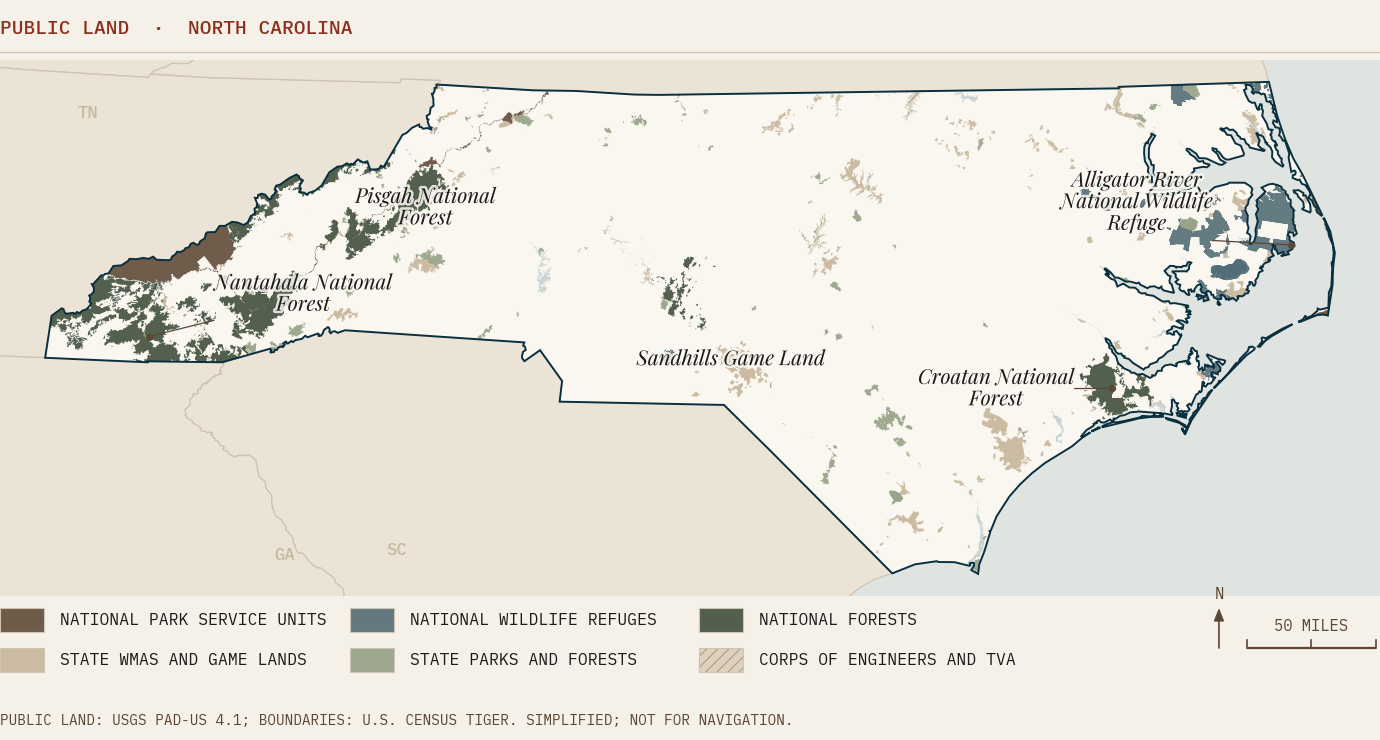
For an operator, the right way to talk about this ground is as habitat and as something a hunter can do on his own, not as a product you sell. We did not find NCWRC authorization for paid guiding on these game lands, and refuge ground has its own federal permit rules, so do not imply that your guests will be guided there. What you can do is acknowledge it honestly. A short section on your county page that says "the public Upper Roanoke River Wetlands Game Land is nearby; here is NCWRC's page if you want to hunt it yourself during your stay" makes you look like a local authority rather than a seller hiding the alternative, and it costs you nothing, because the hunter who wants a stand on a managed private farm was never going to settle for a boat-access draw tract.
The location-type split in NCWRC's data is the point to keep in mind: in 2025-26, only 92 of Northampton's deer and 165 of Halifax's came from game lands. This is a private-land market, and the operators who control access to good private ground are the ones the reputation actually serves.
The Geo-Moat: Own the County Name
Here is the strategic center of this post. A small outfitter in Jackson or Scotland Neck is not going to outrank statewide directories, national hunting sites, and NCWRC itself for "North Carolina deer hunting." That term is too broad, too contested, and too loosely tied to booking intent. But "Northampton County NC deer hunting," "Halifax County deer hunting," "Roanoke River deer hunting," and their variants are a different game. They are narrow, they carry high intent, and they are exactly what a reputation-driven searcher types after hearing about the corridor from a buddy. Pages that simply assert "best county" without citing NCWRC data or explaining the landscape are easy to beat. That is the opening.
Think of it as a geo-moat. The county name is a boundary a national competitor has no reason to defend and a local operator has every reason to own. The more specifically and accurately you describe your county, the harder you are to displace, because a directory cannot cheaply produce a page with Northampton's fifty-year harvest record, its season zone, its dog-hunting share, its crop mix, its game land, and photos from actual fields. We made the general case for this kind of local positioning in Local SEO for Outfitters: The Google Business Profile Playbook That Beats the Aggregators. In this corridor, the county is the keyword.
The query set is bigger than two county names. Hunters search by town (Jackson, Woodland, Rich Square, Garysburg, Seaboard and Conway in Northampton; Scotland Neck, Enfield, Weldon, Littleton, Halifax and Roanoke Rapids in Halifax), by the river, by the neighboring counties they confuse with yours (Bertie, Hertford, Edgecombe), and by question ("is Northampton County good for deer hunting," "when does gun season open in Halifax County"). Roanoke Rapids, with its hotels and its Interstate 95 exits, is a lodging search as much as a hunting search. Every one of those is a phrase a single well-built page can answer.
The County-Page Architecture
Here is the build. It works for a lodge, an outfitter, a lease manager, or a landowner selling a few hunts a year, and it scales by adding a county page for each county you actually hunt and nothing more.
One primary county page per county where you hold ground, at a clean URL such as /northampton-county-nc-deer-hunting, with the county name in the title, the H1, the first paragraph, and the image alt text.
A data block near the top citing NCWRC: the county's latest total and antlered harvest, its rank, the twenty-six-season leadership record, and a dated link to the report. Update it every spring when NCWRC posts the new season.
A season block for the current year: Northeastern zone dates, bag limit, the bonus-card change, dog rules, license basics for nonresidents, and a "confirm with NCWRC" line with a link.
A landscape block: what your ground looks like, in your own photos, described with the crop mix and river-bottom cover that census data supports.
An access block that is honest about what you sell: stand hunts or dog drives, acreage you control, lodging, meals, deer care, and a short note on the nearby public game land as a do-it-yourself option.
A Virginia block for cross-border hunters: the earlier gun opener, the license they need, and drive-time context in plain language.
A FAQ section of eight to twelve questions, marked up with FAQ schema, answering the questions hunters actually ask. Our post on the outfitter FAQ page as a booking engine covers how to write them.
One booking call to action per screen, pointing to dates and a phone number, not a generic contact form.
Behind those pages, align everything else to the county. Your Google Business Profile should name your actual service area by county and town. Your review requests should invite guests to mention where they hunted, because "great hunt in Northampton County" in a review is local relevance you cannot write yourself. Your social posts and harvest photos should carry the county name in the caption. And if you hunt both sides of the river, resist the temptation to build one page called "Northampton and Halifax County deer hunting." Two strong pages beat one diluted page, and each county has its own story: Northampton's longer run at the top of the harvest table, Halifax's higher antlered count last season and its first-in-the-state cotton economy.
The same structure is what gets you cited in AI search. Assistants assembling an answer to "where is the best deer hunting in North Carolina" lean on sources that state specific, dated, attributable facts. A county page that says "Northampton or Halifax led North Carolina in reported deer harvest every season from 1992 through 2017, according to NCWRC" is precisely the kind of sentence those systems quote, and a page that states it clearly, with the source linked, gives those systems something they can cite.
What to Do This Week, With Gun Season Open
The calendar is your friend right now. Gun season opened October 17, and the window between now and January 1 is when late planners go looking. Five moves, in order:
Audit every page on your site for old claims. Remove any per-square-mile ranking you cannot source to a current NCWRC report, and remove any mention of bonus antlerless cards adding rural does.
Publish or rebuild your primary county page with the data block and the 2026-27 season block above.
Post open dates. If you have December slots, put them on the county page and on your Google Business Profile this week; a hunter in Richmond deciding between a Virginia opener and an earlier North Carolina hunt needs to see availability, not a "call for details" line.
Start collecting the county-named reviews and harvest photos you will need for next year's pages.
Put a calendar reminder on the day NCWRC posts the 2026-27 county harvest report next spring, and update every number the same week.
Our Rut Content Calendar covers the publishing rhythm for the rest of the season. For the corridor, the rule is simpler: every post should name the county, cite the agency, and point to dates.
Work with Pine & Marsh
If you run a lodge, an outfitter, a lease operation, or a family farm that sells a few hunts in Northampton, Halifax, or the surrounding Roanoke counties, we can help you turn the corridor's reputation into pages that rank and book. We build county-level pages with cited agency data, FAQ schema, and Google Business Profile alignment that tells search engines and AI assistants exactly where you are and what you offer.
Book a discovery call or ask for a free marketing check. We will look at what currently ranks for your county name, what your site says about your ground, and what a hunter in Richmond or Raleigh sees when he goes looking for a late-season North Carolina deer hunt.
Frequently Asked Questions
Is Northampton County the number one deer county in North Carolina?
It was for a long stretch. NCWRC's county harvest series shows Northampton or neighboring Halifax led the state in total reported deer harvest every season from 1992 through 2017. Since 2018, Piedmont counties such as Randolph and Anson have led. In 2025-26, Northampton ranked seventh with 3,683 deer and Halifax eighth with 3,657.
How many deer were harvested in Northampton and Halifax counties in 2025-26?
NCWRC's 2025-2026 Reported White-tailed Deer Harvest lists 3,683 deer in Northampton County, including 1,624 antlered bucks, and 3,657 in Halifax County, including 1,814 antlered bucks. Together that is 7,340 deer. Statewide, North Carolina hunters reported 199,770 deer, the highest total in NCWRC's 1976-2025 county series.
When is deer season in Northampton and Halifax County for 2026-27?
Both counties are in NCWRC's Northeastern deer season zone. The 2026-2027 season-dates sheet lists archery September 12 to October 2, 2026, blackpowder October 3 to 16, 2026, and gun October 17, 2026 to January 1, 2027, with antlerless dates the same as antlered. NCWRC labels that sheet tentative, so confirm with NCWRC before you hunt.
What is the North Carolina deer bag limit?
The 2026-27 North Carolina Inland Fishing, Hunting and Trapping regulations digest sets a season and possession limit of six deer, no more than two antlered and up to four antlerless, with no daily limit. Bonus Antlerless Harvest Report Cards are now valid only inside participating municipalities during the Urban Archery Season, so they do not add rural does in these counties. Confirm the current digest with NCWRC.
Can you hunt deer with dogs in Northampton and Halifax counties?
NCWRC allows dog hunting for deer during open seasons in the counties listed in the regulations digest, and its 2025-26 harvest report shows dog hunting is active in both counties. Hunters with dogs reported 938 deer in Halifax and 750 in Northampton, roughly a quarter and a fifth of each county's total. Check the digest for the current county list and rules.
Why does the Roanoke corridor produce so many deer?
NCWRC's harvest reports do not assign causes, so treat any single explanation with care. What the public data does show is a landscape of big row-crop farms and river-bottom woods. The 2022 Census of Agriculture lists more than 171,000 acres in farms in Northampton and more than 183,000 in Halifax, dominated by soybeans and cotton, with peanuts, corn and wheat in the rotation, all bordering the Roanoke River's bottomland timber.
Is most deer hunting in these counties on private land?
Yes. NCWRC's 2025-26 report splits harvest by location type, and only 92 of Northampton's 3,683 deer and 165 of Halifax's 3,657 came from game lands. Everything else came from other lands, which is mostly private farms, timber tracts, leases and clubs. That makes the corridor a private-access market.
Is there public deer hunting along the Roanoke in these counties?
Yes. NCWRC's Upper Roanoke River Wetlands Game Land includes tracts in Bertie, Halifax and Northampton counties, and NCWRC reported 154 deer harvested there in 2025-26. Deer hunting there runs under NCWRC's permit system and some tracts are reachable only by boat. It is a do-it-yourself option for hunters, not a guided product, so check NCWRC's game land rules before you go.
Do Virginia hunters need a North Carolina license to hunt the corridor?
Yes. Nonresidents need a North Carolina nonresident license with big game privileges. State law provides a season nonresident big game license and a ten-day version valid for ten consecutive dates printed on the license. Check NCWRC or Go Outdoors North Carolina for current license types and fees before buying.
How can a small outfitter rank for Northampton County NC deer hunting?
Build one deep page per county you actually hunt, with that county's NCWRC harvest numbers cited and dated, its season zone, its access type, and the towns hunters search for. Add a FAQ section, mark it up with schema, and keep your Google Business Profile tied to the same county. A county page with real data is something a statewide directory cannot easily copy.
Sources
North Carolina Wildlife Resources Commission -- Harvest Statistics -- https://www.ncwildlife.gov/hunting/harvest-statistics -- accessed October 2026
North Carolina Wildlife Resources Commission -- 2025-2026 Reported White-tailed Deer Harvest (by county) -- https://www.ncwildlife.gov/media/5234/download?attachment -- accessed October 2026
North Carolina Wildlife Resources Commission -- 1976-2025 North Carolina Reported Deer Harvest by County -- https://www.ncwildlife.gov/media/5236/download?attachment -- accessed October 2026
North Carolina Wildlife Resources Commission -- 2024-2025 Reported White-tailed Deer Harvest (by county) -- https://www.ncwildlife.gov/media/4367/download?attachment -- accessed October 2026
North Carolina Wildlife Resources Commission -- 2025-2026 Reported White-tailed Deer Harvest, Still Hunting vs. Dog Hunting -- https://www.ncwildlife.gov/media/5233/download?attachment -- accessed October 2026
North Carolina Wildlife Resources Commission -- 2025-2026 Reported White-tailed Deer Harvest by Game Land -- https://www.ncwildlife.gov/media/5235/download?attachment -- accessed October 2026
North Carolina Wildlife Resources Commission -- 2026-2027 Season Dates at a Glance (tentative) -- https://www.ncwildlife.gov/regulations/2026-2027-season-dates-glance/download -- accessed October 2026
North Carolina Wildlife Resources Commission -- 2026-27 North Carolina Inland Fishing, Hunting and Trapping Regulations Digest, deer bag limits and bonus antlerless cards -- https://online.flippingbook.com/view/424369678/66/ -- accessed October 2026
North Carolina Wildlife Resources Commission -- Upper Roanoke River Wetlands Game Land map -- https://www.ncwildlife.gov/media/904/download -- accessed October 2026
North Carolina General Assembly -- G.S. 113-270.3, Licenses for hunting, nonresident big game hunting license -- https://ncleg.gov/EnactedLegislation/Statutes/HTML/BySection/Chapter_113/GS_113-270.3.html -- accessed October 2026
Virginia Department of Wildlife Resources -- Featherfin WMA Hunting Seasons 2026-2027 -- https://dwr.virginia.gov/wp-content/uploads/media/Featherfin-WMA-Hunting-Seasons-2026-2027.pdf -- accessed October 2026
USDA National Agricultural Statistics Service -- 2022 Census of Agriculture County Profile, Northampton County, North Carolina -- https://data.nass.usda.gov/Publications/AgCensus/2022/Online_Resources/County_Profiles/North_Carolina/cp37131.pdf -- accessed October 2026
USDA National Agricultural Statistics Service -- 2022 Census of Agriculture County Profile, Halifax County, North Carolina -- https://data.nass.usda.gov/Publications/AgCensus/2022/Online_Resources/County_Profiles/North_Carolina/cp37083.pdf -- accessed October 2026

Comments