
Alabama Outdoors: A Deep Dive on Ecology, Sporting Operations, and the Road into 2027 and Beyond
Updated: Jun 12

Alabama runs from the last green ridges of the Appalachians to the white sand of the Gulf, and along the way, it quietly assembles one of the most complete sporting portfolios in the country. It is one of the best deer and turkey states in America, the red snapper capital of the Gulf, the site of the largest artificial reef program in the nation, and, less famously but just as remarkably, the single richest state in the country for freshwater aquatic life. Few states pack as much into their borders with as little fanfare.
This deep dive treats Alabama as a whole, across its sporting landscape. It walks the geology and ecology from the mountains and the Tennessee River lakes in the north to the Mobile-Tensaw Delta and the Gulf in the south, giving the bass lakes, rivers, deer and turkey woods, delta, and snapper coast the depth they deserve. It then turns to how sporting operations actually run on this ground today, and where Alabama is headed into 2027 and beyond.
Alabama also deserves a closer look than it usually gets. The Black Belt's trophy deer are well known, but the Cahaba's biodiversity, the Sipsey's trout, the aquatic richness of the Mobile basin, and the scale of the Gulf reef fishery are stories that even many Alabamians underrate. Understanding the land comes first. Understanding the gap between what the state offers and how little of it is marketed well comes close behind.
Mountains to the Gulf: The Shape of Alabama
Alabama steps down from the southern Appalachians to the sea. The north holds the tail of the mountains -- the Cumberland Plateau, the Ridge and Valley, and the Appalachian foothills around Cheaha, the state's high point. The Tennessee River cuts across the far north, impounded into a chain of large lakes. The center is the Piedmont and the fertile Black Belt, and the south is the broad Coastal Plain, the Wiregrass, and finally the Gulf Coast and the Mobile-Tensaw Delta.
Water organizes the state. Almost all of Alabama drains into the Mobile River basin -- the Alabama, Coosa, Tallapoosa, Cahaba, Black Warrior, and Tombigbee rivers -- which collects runoff from most of the state and funnels it through the Mobile-Tensaw Delta to Mobile Bay. That single great basin and the Tennessee River across the north define the freshwater geography.
Each region carries its own soils, water, and sporting tradition, from the trout of the northern mountains to the trophy deer of the Black Belt to the red snapper of the Gulf. Six river systems, a string of big lakes, a famous delta, and a short but productive coast give Alabama a remarkable range, and the sections that follow take its regions in turn.
The Appalachian North: Mountains, Canyons, and the Sipsey
Northern Alabama is mountain country, the southern end of the Appalachians. The Talladega National Forest holds Cheaha Mountain, the highest point in the state, and the Ridge and Valley and Cumberland Plateau country offer rugged terrain, hardwood ridges, and dramatic landforms. Little River Canyon, one of the deepest canyons east of the Mississippi, carves the top of Lookout Mountain and is protected as a national preserve.
The Bankhead National Forest and the Sipsey Wilderness anchor the northwest, a country of bluffs, waterfalls, and hardwood gorges known as the Land of a Thousand Waterfalls. Below Smith Lake, the cold water released from the dam creates the Sipsey Fork tailwater, the only year-round trout fishery in Alabama, a cold-water trout stream stocked in a state otherwise far too warm for them.
The northern mountains are hunting and hiking country as well, with deer, turkey, and a growing presence of black bears in the Appalachian foothills, plus public land in the national forests. It is a cooler, steeper, more Appalachian Alabama than the popular image of the state, and it anchors the northern end of a long sporting range.
The Tennessee Valley: The TVA Bass Lakes
The Tennessee River sweeps across northern Alabama, impounded by the Tennessee Valley Authority into a chain of large lakes that form one of the premier bass-fishing regions in the country. Lake Guntersville, roughly 69,000 acres of grass-filled river, is one of the most famous largemouth fisheries in America and a perennial host of the sport's biggest tournaments, anchoring a deep guide, marina, and tourism economy.
Downstream, Wheeler Lake wraps around the Wheeler National Wildlife Refuge, a major wintering ground for sandhill cranes and waterfowl, and Wilson Lake at Muscle Shoals is renowned for trophy smallmouth and big catfish. Pickwick, on the Tennessee-Mississippi-Alabama line, is a premier smallmouth fishery wrapped in the tourism halo of the Shoals region. The Tennessee Valley is bass country at the highest level.
These lakes draw tournament and recreational anglers from across the country and support a substantial fishing economy in North Alabama. The combination of the famous Guntersville largemouth fishery, the Wilson and Pickwick smallmouth, and the Wheeler waterfowl makes the Tennessee Valley one of the most productive and varied stretches of water in the state.
America's Aquatic Biodiversity Capital: The Rivers
Alabama holds a distinction few residents fully appreciate: it is widely recognized as the richest state in the country for freshwater aquatic biodiversity. The Mobile River basin and the state's other waters hold more species of fish, mussels, snails, turtles, and crayfish than anywhere else in the United States, a concentration of aquatic life that ranks among the most significant in North America.
The Cahaba River is the jewel. The longest free-flowing river in Alabama, the Cahaba runs undammed through the center of the state, home to federally listed endemic species and famous for the Cahaba lilies that bloom on its shoals each spring. It is a shoal-bass fishery and a paddling river, and a stretch of it is protected as the Cahaba River National Wildlife Refuge, safeguarding one of the most biodiverse reaches of the river in the country.
That biodiversity also carries a cautionary history. The damming of the Coosa River for hydropower in the twentieth century is associated with one of the largest extinction events of aquatic species in modern North American history, a stark reminder of what is at stake. Today, the state's rivers are a focus of intensive conservation, and the aquatic richness of Alabama is both a point of pride and a responsibility.
The Lakes: The Coosa Chain, Lake Martin, Smith, and Eufaula
Beyond the Tennessee River, Alabama holds a deep portfolio of reservoirs. The Coosa River chain -- Weiss, Neely Henry, Logan Martin, Lay, Mitchell, and Jordan -- forms a staircase of bass lakes across the northeast and central state, with Weiss long known as the crappie capital and the chain as a whole a strong bass and tournament fishery.
On the Tallapoosa, Lake Martin is a large, clear, deep reservoir prized for spotted bass and for recreation and lakeside activities. Smith Lake, on the Black Warrior system, is another deep, clear lake known for spotted and striped bass, and its dam releases create the Sipsey Fork trout tailwater below it. On the Chattahoochee at the Georgia line, Lake Eufaula -- long called the bass capital of the world in its heyday -- remains a storied largemouth fishery.
Together, these lakes give Alabama one of the deepest reservoir-fishing menus in the Southeast, from the grass flats of Guntersville to the clear deep water of Lake Martin to the crappie of Weiss. For the guide and tournament economy, variety is a genuine asset, and each named lake carries its own search intent and following.
The Black Belt and the Wiregrass
Central and southern Alabama are home to two distinct deer regions. The Black Belt, the crescent of dark, alkaline chalk-prairie soil across the center of the state, is famous for trophy whitetail deer grown on its mineral-rich ground, along with a cattle-and-catfish economy, and is the subject of its own in-depth treatment in our Black Belt regional guide. It remains one of the premier deer regions in the Southeast.
To the southeast lies the Wiregrass, the longleaf and peanut country around Dothan, named for the wiregrass that carpets the longleaf pine flatwoods. It is a distinct region from the Black Belt prairie, a sandy, agricultural, longleaf landscape that supports strong deer hunting and a traditional farm-country sporting culture in the far southeastern corner of the state.
The Coastal Plain between them, including the Conecuh National Forest and its longleaf, rounds out the southern hunting country. Alabama's long deer season and high deer numbers, combined with the trophy potential of the Black Belt and the river bottoms, make the southern half of the state a deep and productive deer region.
The Mobile-Tensaw Delta: America's Amazon
Where the Mobile basin meets the coast, the rivers braid into the Mobile-Tensaw Delta, the second-largest river delta in the United States and one of the most biologically diverse regions in North America. Often called America's Amazon, the delta is a vast maze of cypress swamp, bottomland hardwood, tidal marsh, and bayou, teeming with fish, birds, alligators, and an extraordinary range of life.
The delta and Mobile Bay support a rich fishery. The upper delta holds largemouth bass, catfish, and bream in its freshwater reaches, while the lower delta and the bay support inshore redfish, speckled trout, and flounder. Mobile Bay is also famous for the jubilee, a rare natural phenomenon in which fish and crabs crowd the shallows in such numbers that they can be gathered by hand, a happening found in only a couple of places on Earth.
The delta is a working wilderness within reach of a major city, and one of the great natural areas of the Gulf Coast. For anglers and hunters, it offers a freshwater-to-saltwater fishery and a duck- and small-game tradition in a setting of remarkable wildness, and it is increasingly a conservation focus as one of the most biodiverse and important wetlands in the country.
The Gulf Coast: Red Snapper Capital
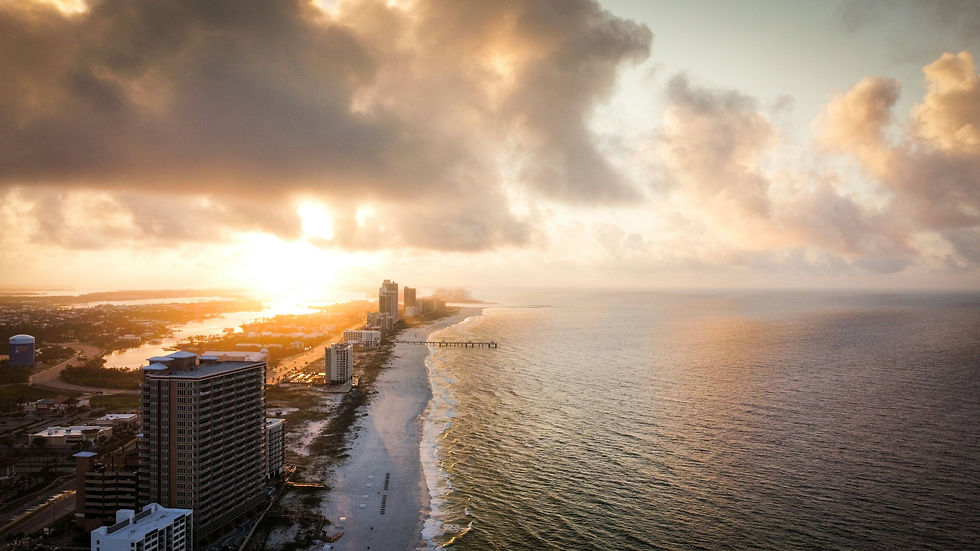
Alabama's Gulf coastline is short, but it punches far above its length. The state built the largest artificial reef program in the nation off its coast, sinking an enormous number of reef structures across a designated permit zone, and that reef system transformed Alabama's small stretch of Gulf into one of the most productive red snapper fisheries in the country. Alabama is, in a real sense, the red snapper capital of the Gulf.
The charter fleet out of Orange Beach, Gulf Shores, and Dauphin Island runs to the reefs and the deeper Gulf for red snapper, other reef fish, and pelagics, supporting a substantial offshore industry. Inshore, the bays and backwaters along the coast offer redfish, speckled trout, and flounder, and the white-sand beaches of Gulf Shores and Orange Beach anchor a major tourism economy that supports the fishing business.
Alabama has also been a leader in managing the red snapper fishery, advocating for state-level management and building reef infrastructure that sustains it. For the charter industry, the combination of the reef zone, the snapper reputation, and the tourism draw of the beaches makes the Alabama coast a powerful, if compact, sportfishing destination.
The Deer and Turkey State
Alabama is one of the great deer and turkey states in the country. Deer hunting benefits from a long season, high deer numbers, and the trophy potential of the Black Belt and the river bottoms, supported by a deep lease, club, and lodge culture, and by management by the Alabama Department of Conservation and Natural Resources. Deer hunting is woven into the rural culture of the state as thoroughly as it is in any other Southern state.
The turkey hunting is equally renowned. Alabama carries one of the longest spring turkey seasons and some of the highest turkey populations in the country, and it is a destination for traveling turkey hunters chasing the eastern wild turkey across its farmland, hardwood, and longleaf country. The spring turkey woods are a defining Alabama sporting tradition.
Wild hogs are abundant and damaging, and they can be hunted widely, providing accessible year-round opportunity. Between the trophy deer, the celebrated turkey hunting, and the small game and hogs, Alabama offers a hunting menu as deep as any in the Southeast, on a strong base of both private land and public lands, including national forests and wildlife management areas.
Conservation: The Cahaba, the Delta, and the Aquatic Biodiversity
Alabama's conservation story is, above all, about water and aquatic life. As the most aquatically biodiverse state in the country, Alabama carries a special responsibility for its rivers, and the protection of the free-flowing Cahaba, with its endemic species and its lilies, and the vast Mobile-Tensaw Delta, are central conservation priorities. The Cahaba River National Wildlife Refuge and the delta's protected lands safeguard globally significant biodiversity.
The cautionary history of the Coosa extinctions has helped focus attention on freshwater conservation across the state, and organizations and agencies work to protect the remaining aquatic richness of the Mobile basin. In the south, longleaf restoration in the Conecuh National Forest and elsewhere recovers a fire-dependent ecosystem and its rare species, and the state's Forever Wild program has conserved significant land for public recreation and habitat.
On the coast, restoration accelerated in the years following the 2010 Gulf oil spill, with major funding directed toward the Mobile-Tensaw Delta, coastal marshes, oyster reefs, and water quality, as well as the artificial reef program that sustains the snapper fishery. These efforts, led by the Alabama Department of Conservation and Natural Resources and its partners, reflect how the sporting tradition and the conservation work reinforce one another.
Sporting Operations in Alabama Today
Alabama supports a varied sporting economy across its regions. The Tennessee Valley lakes support a deep bass-guide and tournament economy anchored by Guntersville; the Gulf coast supports a substantial red-snapper and inshore charter fleet; the Black Belt and the river bottoms support trophy-deer plantations and leases; and the whole state carries a strong turkey-hunting and small-game tradition. The Coosa and other lakes add more guide and tournament fishing.
Each of these is a different market. The Guntersville bass scene competes in a high-profile tournament economy, the Gulf charter fleet competes in a busy coastal-tourism market, and the deer and turkey operations compete in a more specialized, reputation-driven world. Each demands its own approach, but all benefit from specificity rather than generic state-level claims.
The recurring pattern in our statewide audits is under-marketing relative to the quality and variety of our resources. Alabama's bass lakes, its trophy deer, its turkey hunting, and its snapper coast are exceptional, yet many of the operations working them compete on thin, generic listings rather than the specific, place-anchored content that would set them apart. The reputation of the water and the woods precedes the digital footprint of the businesses on them.
That gap is the opportunity. The operators who build genuine, place-anchored authority -- content that explains their specific lake, river, delta, reef, or stretch of deer or turkey country, the species and seasons, and the experience they deliver -- can capture demand that is already flowing toward Alabama. Generic listings are a race to the bottom. A real, specific presence is how an operator takes ownership of their corner of the state.
Alabama into 2027 and Beyond
Several forces are reshaping the Alabama outdoors as the state moves into 2027 and the years after. On the coast, growth and restoration both press hard. The Gulf Shores and Orange Beach tourism economy continues to boom, driving demand for charters and coastal recreation, while restoration funding from the 2010 Gulf oil spill settlements flows into the Mobile-Tensaw Delta, coastal marsh, and oyster reefs, and the artificial reef program continues to expand the snapper fishery.
Red snapper management remains a defining coastal issue, with Alabama continuing its leadership in state-level management and reef building, and the future of the fishery tied to how those efforts evolve. The state's aquatic biodiversity, meanwhile, remains both a global treasure and a conservation challenge, with the health of the Cahaba, the delta, and the Mobile basin central to the long-term picture.
Inland, wildlife management faces the chronic wasting disease challenge. The disease was detected in northwest Alabama in 2022, and the Alabama Department of Conservation and Natural Resources manages it through a dedicated zone with testing and carcass rules. Because zones and requirements can change, hunters should always confirm the current regulations. The state's strong traditions and management of deer and turkey give it solid tools for the task.
The change that will matter most to operators, though, is in discovery. The way hunters and anglers find guides, charters, lodges, and outfitters is shifting toward search engines and AI answer engines that synthesize and cite the best available content. In a state this varied and this underrated, that shift rewards specificity, and the operators who build real authority around their specific water and ground are the ones who will be found and cited into 2027 and beyond. That is the throughline for Alabama: an extraordinarily complete sporting state, quietly under-marketed, in a discovery landscape that finally rewards the operators who best tell its specific stories.
Frequently Asked Questions
What makes Alabama's outdoors so diverse?
Alabama runs from the southern Appalachians to the Gulf, assembling one of the most complete sporting portfolios in the country. It is one of the best deer and turkey states in America, the red snapper capital of the Gulf with the largest artificial reef program in the nation, and the single richest state for freshwater aquatic biodiversity, with the Mobile River basin, the Tennessee Valley bass lakes, the Mobile-Tensaw Delta, and a short but productive coast.
What is the Sipsey Fork and Bankhead National Forest?
The Bankhead National Forest in northwest Alabama, home to the Sipsey Wilderness, is a country of bluffs, hardwood gorges, and waterfalls known as the Land of a Thousand Waterfalls. Below Smith Lake, cold water released from the dam creates the Sipsey Fork tailwater, the only year-round trout fishery in Alabama, a stocked cold-water stream in a state otherwise far too warm for trout.
What are Alabama's best bass lakes?
Lake Guntersville, roughly 69,000 acres of grass-filled Tennessee River water, is one of the most famous largemouth fisheries in America and a top tournament lake. The Coosa River chain -- Weiss, Logan Martin, Lay, and others -- offers strong bass and crappie fishing, Lake Martin and Smith Lake are clear, deep spotted-bass lakes, and Lake Eufaula on the Chattahoochee is a storied largemouth fishery. Wilson and Pickwick add a trophy smallmouth.
Why is Alabama the aquatic biodiversity capital?
Alabama is widely recognized as the richest state in the country for freshwater aquatic biodiversity, with more species of fish, mussels, snails, turtles, and crayfish than anywhere else in the United States. The Mobile River basin -- the Alabama, Coosa, Tallapoosa, Cahaba, Black Warrior, and Tombigbee rivers -- holds one of the most significant concentrations of aquatic life in North America.
What is the Cahaba River?
The Cahaba is the longest free-flowing river in Alabama, running undammed through the center of the state. It is home to federally listed endemic species and famous for the Cahaba lilies that bloom on its shoals each spring, and it offers shoal-bass fishing and paddling. A stretch of the Cahaba River is protected as the Cahaba River National Wildlife Refuge, safeguarding one of the most biodiverse river reaches in the country.
What is the Mobile-Tensaw Delta?
The Mobile-Tensaw Delta, where the Mobile basin rivers braid into Mobile Bay, is the second-largest river delta in the United States and one of the most biologically diverse regions in North America, often called America's Amazon. It is a vast maze of cypress swamp, bottomland, and marsh supporting bass and catfish in its fresh reaches and inshore redfish, trout, and flounder in the lower delta and bay, which is also famous for the jubilee phenomenon.
Why is Alabama the red snapper capital?
Alabama built the largest artificial reef program in the nation off its short coastline, sinking an enormous number of reef structures across a designated permit zone. That reef system made Alabama's small stretch of Gulf one of the most productive red snapper fisheries in the country, supporting a substantial charter fleet out of Orange Beach, Gulf Shores, and Dauphin Island, and the state has been a leader in red snapper management.
Is Alabama a good deer state?
Yes. Alabama is one of the great deer states in the country, with a long season, high deer numbers, and real trophy potential in the Black Belt's chalk-prairie soils and the river bottoms. A deep lease, club, and lodge culture and management by the Alabama Department of Conservation and Natural Resources support the hunting. Confirm current seasons and regulations with the state.
Is Alabama a good turkey state?
Yes. Alabama carries one of the longest spring turkey seasons and some of the highest turkey populations in the country, and it is a destination for traveling turkey hunters chasing the eastern wild turkey across its farmland, hardwood, and longleaf country. Spring turkey hunting is one of the state's defining sporting traditions.
What is Lake Guntersville?
Lake Guntersville is a roughly 69,000-acre Tennessee Valley Authority reservoir on the Tennessee River in north Alabama, filled with aquatic grass and fertile water. It is one of the most famous largemouth bass fisheries in the country and a perennial host of the sport's biggest tournaments, anchoring a deep guide, marina, and tourism economy in the Tennessee Valley.
Does Alabama have chronic wasting disease?
Chronic wasting disease was detected in northwest Alabama in 2022, and the Alabama Department of Conservation and Natural Resources manages it through a dedicated zone with testing and carcass-transport rules. Because zones and requirements can change, hunters should always confirm the current chronic wasting disease regulations with the Alabama Department of Conservation and Natural Resources before each season.
What is the conservation story of Alabama?
As the most aquatic-biodiverse state in the country, Alabama's conservation centers on its rivers and aquatic life, including the protection of the free-flowing Cahaba River and the vast Mobile-Tensaw Delta. The historic Coosa River extinctions focused attention on freshwater conservation; longleaf restoration recovers a fire-dependent ecosystem; the Forever Wild program conserves public land; and Gulf restoration funding flows into the delta, marsh, and oyster reefs.
How should an Alabama outfitter or guide market their operation?
Build content around your specific lake, river, delta, reef, or stretch of deer or turkey country rather than generic state-level terms or thin listings. Name the water and ground you work on, explain the species, the seasons, and what you deliver, and tie it to the real ecology of the region. That place-anchored, sourced content ranks in search, earns AI citations, and sets an operation apart in a varied, underrated state.
Sources and Further Reading
This deep dive draws on public sources from government agencies, conservation organizations, and academic institutions. Readers who want to go deeper should consult the following bodies of work directly.
Alabama Department of Conservation and Natural Resources -- fish and game management, deer and turkey seasons, marine resources and red snapper management, the artificial reef program, and chronic wasting disease management; confirm current regulations directly.
U.S. Forest Service -- the Talladega, Bankhead, Conecuh, and Tuskegee National Forests.
National Park Service -- the Little River Canyon National Preserve and Russell Cave National Monument.
U.S. Fish and Wildlife Service -- the Wheeler, Cahaba River, Bon Secour, and Mountain Longleaf National Wildlife Refuges.
Tennessee Valley Authority -- the Guntersville, Wheeler, Wilson, and Pickwick reservoirs and their fisheries.
The Geological Survey of Alabama and conservation partners -- the Mobile River basin and the state's freshwater aquatic biodiversity.
University and Sea Grant programs in Alabama -- the Mobile-Tensaw Delta, the Cahaba River, longleaf ecology, and the Gulf Coast fishery.


Comments