
Inside the 2026-27 Dove Hunting Report: Big Hunter Numbers, a Very Small Market
Dove hunting is a mass-participation sport with strong federal data and a very small commercial market. The 2026-27 Dove Hunting in the Southeast report, part of the Pine & Marsh Research industry series, puts those two facts side by side. It combines U.S. Fish and Wildlife Service harvest and hunter estimates, the 2026-27 federal framework, license data and Bureau of Economic Analysis figures with our October 2026 audit of hunting businesses in the 11 Southeastern states.
It is written for lodge, plantation and preserve owners who host hunters, and anyone weighing a dove shoot. Dove is the smallest operator category in our audit, so the report leads with public hunter and harvest data and keeps the business chapters short. This post walks through it chapter by chapter, in the report's own order.
At a Glance: Nine Numbers
The report opens with nine headline figures. The first four describe the hunters and the birds.
311,400 active dove hunters in the 11 states in the 2025-26 season, essentially flat on 2024-25.
4,800,600 doves harvested in the 11 states, 31% of the 15,517,700 birds taken in the United States.
47,700 active dove hunters in North Carolina, the most of any of the 11 states.
About 7% of the 11 states' 4,714,399 paid hunting license holders were active dove hunters. The ratio compares two different years, so it is an order of magnitude, not a participation rate.
The rest describe the resource and the market. Eastern Management Unit abundance was 82.5 million in 2025 against 97.3 million in 2007, a -15% change. Only 28 of 493 audited hunting operators carry a dove tag, and 27 of those 28 sell other hunts too. Just 2 of the 28 dove operator sites show an online booking engine.
Demand: Who Hunts Doves
Quail and most upland birds have no federal hunter count. Doves do. The U.S. Fish and Wildlife Service estimates active dove hunters and the dove harvest for each state every year, which the report calls the strongest demand data in any of the hunting reports in this series.
In 2025-26 the 11 states had an estimated 311,400 active dove hunters who took 4,800,600 doves, or 15.4 birds per active hunter. North Carolina (47,700), Georgia (46,700) and South Carolina (40,100) had the most hunters. Mississippi had the fewest (14,100). Georgia led the harvest at 829,200 birds, then South Carolina (622,700) and Alabama (590,300).
Between seasons the 11-state hunter count moved from 311,600 to 311,400, a change of -0.1%, while the harvest rose 4%, from 4,606,500 to 4,800,600 birds. Single states swung more: Louisiana rose 44% and Mississippi fell 43%. The estimates come from a survey of license buyers, so a swing that size in one state could reflect sampling as much as real change. The safer reading is the 11-state total and the two largest states, North Carolina and Georgia, which lead in both seasons.
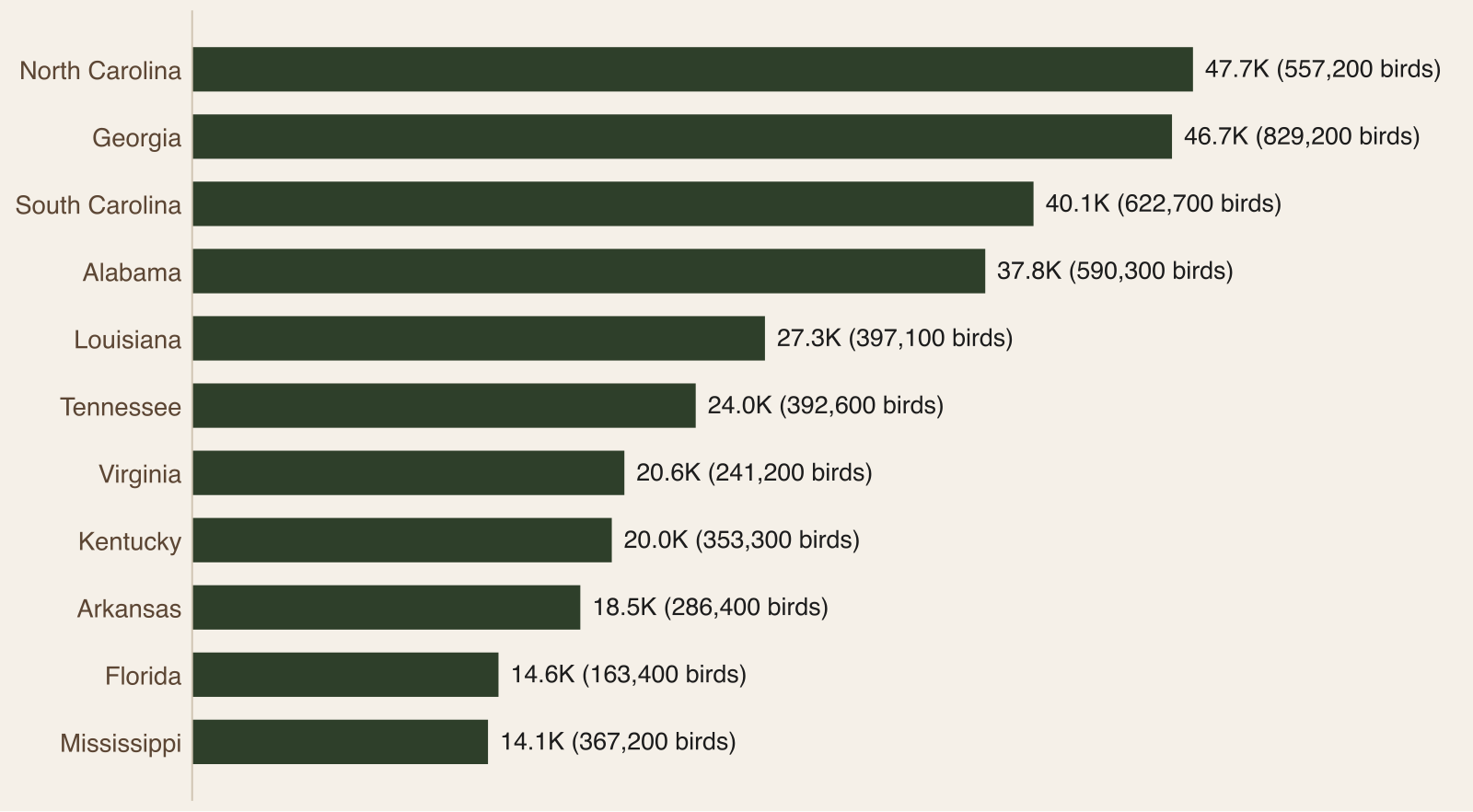
The full state table adds two derived columns worth reading. Birds per active hunter average 15.4 across the 11 states, from 11.2 in Florida and 11.7 in North Carolina and Virginia to 17.8 in Georgia, 17.7 in Kentucky and 26.0 in Mississippi, the state with the fewest hunters. The report warns that differences like that reflect field conditions, season structure and survey error as much as hunter skill. The second column sets dove hunters against each state's paid hunting license holders. South Carolina is highest at 20% (40,100 hunters against 199,114 holders) and Tennessee lowest at 3% (24,000 against 734,342). Because the ratio compares two different years and survey methods, it ranks states against each other and is not a participation rate.
For the wider market, the 2022 National Survey counted 14,374,589 hunters age 16 and older in the United States, about 2.8 million of whom hunted migratory birds, a group that includes waterfowl hunters. Nationally, hunting, shooting and trapping added $16.5 billion of value in 2024, up 95% from $8.5 billion in 2019, covering all hunting and shooting, not dove alone.
The report is careful about what the counts mean. They measure how many people hunt doves and how many birds they take. They do not measure how many pay a business for access. Most dove hunters hunt their own land, land of friends and family, or public fields. The count is the size of the pool, not the size of the commercial market.
The Resource: Mourning Dove Status
The mourning dove is among the most abundant game birds in North America. The federal status report puts the U.S. population at about 329 million birds on September 1, 2025. For the Eastern Management Unit, which includes most of the Southeast, abundance was about 82.5 million in 2025 against 97.3 million in 2007.

For scale, the Eastern Management Unit as a whole, a federal management area that does not match the 11 states, reported 5,484,700 birds taken by 387,600 active hunters in 2025-26. The U.S. total was 15,517,700 birds.
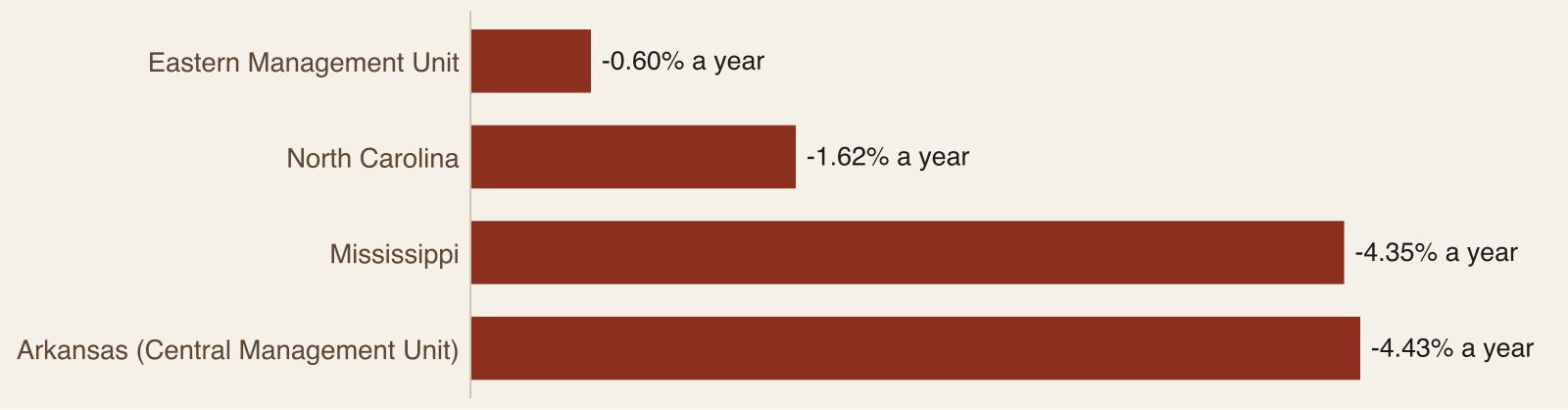
The 10-year Breeding Bird Survey trend for the unit is -0.6% a year over 2016 to 2025, a gentle decline. Three areas show a credible decline on their own: Mississippi (-4.35% a year), North Carolina (-1.62% a year) and Arkansas (-4.43% a year, reported for the Central Management Unit). A credible decline is a statistical statement from the survey, not a forecast. It does mean operators in those states should watch the local picture and be careful about promising numbers of birds.
The 2026-27 federal framework allows a season of up to 90 days in the Eastern Management Unit and a daily bag of 15 mourning and white-winged doves combined. Those are ceilings. Each state sets its own opening date, season structure and bag within them, so an operator must publish its own state's dates and not the framework's.
The business conclusion: supply is not the constraint. The limit on a commercial dove hunt is access to a good field at the right time, which is why dove is sold as an add-on to properties that already have land.
On field preparation, the report says rules differ by state and by federal migratory bird regulation, and it does not summarize them. Nothing in it suggests any method of attracting birds is lawful. Read the current USFWS migratory bird regulations and your state wildlife agency's rules, and ask the agency if you are unsure.
Where It Happens
By birds taken per active hunter, Mississippi is highest (26.0) and Florida lowest (11.2), but differences like that reflect field conditions, season structure and survey error, so treat them as a rough guide.
Measured against paid hunting license holders, South Carolina has the highest ratio of dove hunters (20%) and Tennessee the lowest (3%). The figures come from different years and methods, so use the ratio only to compare states.
The audit finds dove operators in 9 of the 11 states, with the most in South Carolina (6), Alabama (5) and Georgia (5). Counts are a handful per state, so they say more about where an operator that tags dove could be verified than about where dove hunting is strong. North Carolina has the most hunters of the 11 states and 2 audited dove operators.
By state, the audited dove operators are South Carolina 6, Alabama 5, Georgia 5, Virginia 4, Louisiana 3, North Carolina 2, and Arkansas, Florida and Mississippi 1 each, with none in Kentucky or Tennessee. These are counts of a verified sample, not a census, so a small count does not mean a state has little dove hunting. Tennessee and Kentucky, with 24,000 and 20,000 active dove hunters, show how far hunter counts and verified operators can diverge.
Three settings cover most dove hunting:
Private and family land, where no business is involved. This is the largest share and none of it is sold.
Public fields, which state wildlife agencies make available under their own rules. They are not businesses, and many hunters without land go there first.
Lodges, preserves and sporting properties that offer a dove shoot as part of a stay or as a day hunt. This is the commercial market, and it is small.
On public land, follow the report exactly. Hunting and commercial guiding on wildlife management areas, national wildlife refuges and leased public fields follow the managing agency's rules, and guiding there generally requires a permit or special-use authorization. Do not advertise a guided dove hunt on public land or a public field without the permit for that unit, and confirm with the state wildlife agency and the managing agency.
The Business Landscape: 28 Operators
Dove is the smallest of the eight species groups in the audit. Only 28 of 493 audited hunting operators (6%) carry a dove tag, against 182 for upland and 178 for whitetail. The report calls that the finding, not a gap in the research: commercial dove shoots are rare, and dove is mostly sold as an add-on or hunted on public fields. The 493 figure is our October 2026 hunting audit, kept separate from the 1,546-operator Southeast benchmark.
Of the 28, 1 sells dove alone and 27 sell something else too. 18 carry four or more species tags. 18 are also tagged upland, 15 whitetail, 13 waterfowl, 12 as lodges, 11 turkey, 9 wild hog and 3 sporting clays. In practice these are lodges, plantations and preserves that put a dove shoot at the front of the year.
Online they look like the rest of hunting. All 28 have their own website, and mean digital health, a 1 to 10 score our researchers assign from observed evidence, is 5.11. That compares with 5.23 for all audited hunting operators and 5.09 for the Southeast benchmark, which covers every outdoor business type. 43% of dove operators score 4 or below, against 34% of hunting operators and 39.8% in the benchmark.
The group comparison in the full report shows the same pattern. All 28 dove operators have their own website and all 28 sites could be read, against 95% with their own site among the 493 hunting operators (449 sites read) and 80.2% in the benchmark (1,093 sites read). 25 of the 28 operators came from the new October 2026 hunting audit and 3 from the larger Southeast audit. All seven other species tags score higher than dove on digital health, led by sporting clays and lodges, though the spread is small. The audit does not record what a dove hunt costs or what it includes, and the report does not discuss pricing.
With only 28 operators, each business moves the group percentages by about 4 points, so differences smaller than about 10 percentage points are noise. The more useful reading is structural: dove is a product line inside a larger operation, marketed as a page and an offer within a lodge or preserve site.
How Buyers Find Dove Hunts
For a large share of dove hunters, the search starts and ends with the state wildlife agency, which publishes public field locations and rules. A paid dove hunt therefore competes with a public option. The buyer who chooses to pay is buying something the public field does not offer: a managed field, a host, a meal, a lodge stay, a setting for a group.
The audit shows what a visitor finds on a homepage. It does not measure how any buyer searches, and no search-volume data were collected. As general guidance, buyers want to know what the hunt includes, how many guns make a party, whether lunch and a stay are part of it, which licenses and stamps each hunter must hold, and what happens in bad weather.
The homepage signals, from the 28 dove sites read:
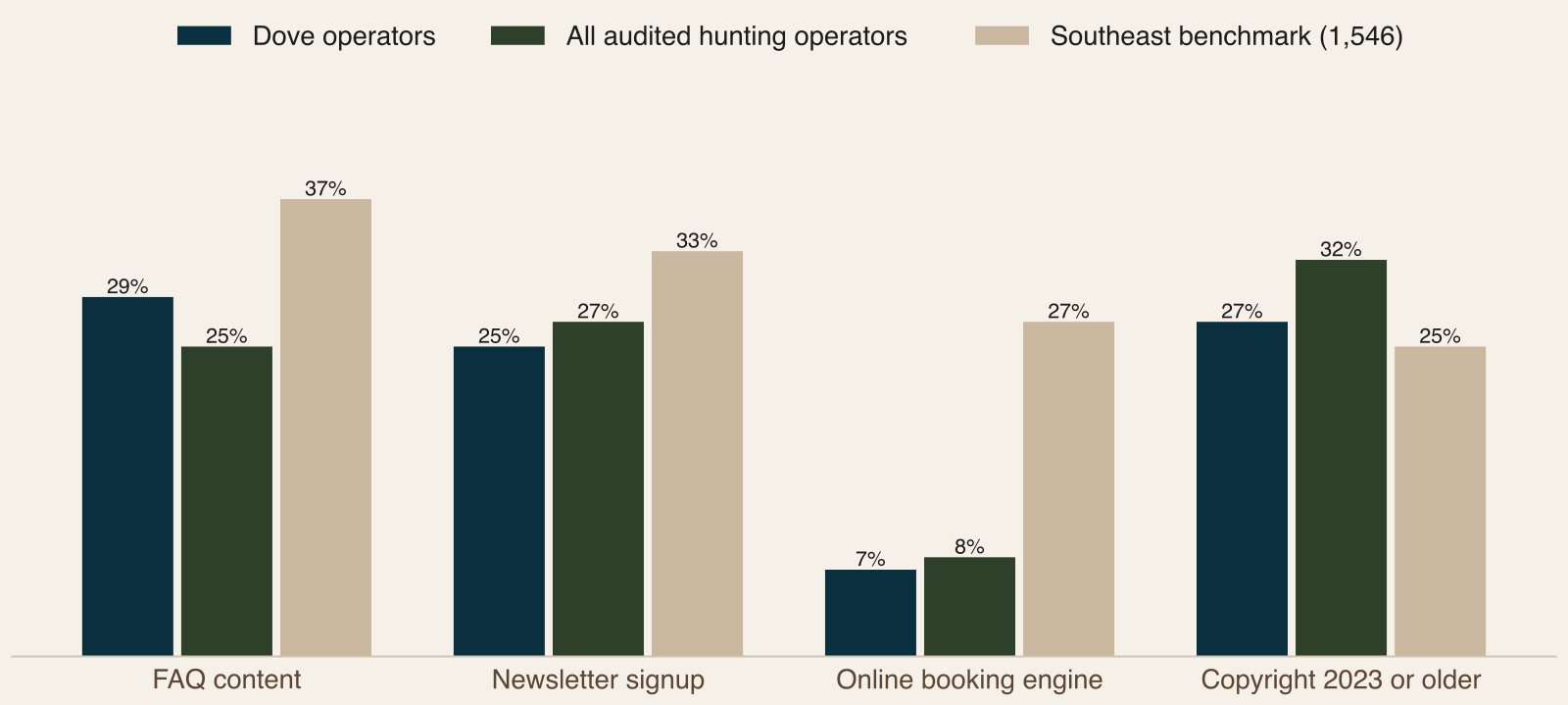
7% show an online booking engine (2 of 28), against 8% for audited hunting operators and 27.0% in the benchmark.
29% carry FAQ content, against 25% for hunting and 36.9% in the benchmark. None of the 28 uses FAQ structured data.
25% offer a newsletter signup, against 27% for hunting and 32.7% in the benchmark.
27% of sites with a detectable copyright year show 2023 or earlier, against 32% for hunting and 25.0% in the benchmark.
These are lower bounds, because a feature may sit deeper in a site. Low online booking is no surprise for hunts sold by phone and deposit, but dove is often booked as a group event, and organizers want a date, a headcount and a quote in one message. An inquiry or date-hold form does that without a full booking engine.
One detail makes the 2-of-28 booking figure easier to act on. Dove is a fast, social hunt, often booked as a group event, and group organizers want a date, a headcount and a quote in one message. A simple inquiry form or a date-hold form does that work for operators who do not want a full booking engine.
The Season and Booking Calendar
Dove opens early in the hunting year, so a dove offer can start the season for a property that sells later ones. The report's calendar is general guidance, not audit or public data, and gives no state season dates. It runs in four phases.
Spring and summer: groups plan opening-day events. Settle the offer and publish the page and a date-hold form.
Late summer: organizers ask about dates before the state announces them. Open a waiting list and write to past guests first.
Opening of the season: a burst of group bookings, many close to the date. Answer inquiries the same day.
Rest of the year: hunters turn to deer, turkey and waterfowl. Offer dove guests the lodge's other seasons.
The report adds a do-list to each phase. In spring, review the site for a stale copyright year. In late summer, post the state's season dates the day they are published, with your own available days beside them. At the opening, share honest reports and photographs with guest permission and ask every party for a review. In the rest of the year, send dove guests a thank-you with a rebooking link for next year's opening. The calendar gives no state season dates, and the federal framework for 2026-27 allows up to 90 days in the Eastern Management Unit, so the best calendar is your own: note when inquiries begin, when bookings peak and when they stop, and publish a little earlier than feels necessary.
Six Moves for Operators
The report closes with six moves. For the detailed marketing playbook, see our guide, Dove Hunting Operators Online: What a Short Season Means for Digital Marketing.
Treat dove as an offer inside your property, not a separate business. 27 of 28 audited dove operators sell other hunts too, so give dove a short page of its own on your existing site, linked from the homepage, with the offer, the field, what is included and party size.
Lodges: add dove at the front of your year. A property that already hosts hunters has the land, the rooms and the meals. Dove opens early, so a dove shoot can start your season and fill a calendar gap. Plan the offer around groups and add lodging and meals as options.
Be exact about the field, and follow the rules. Describe what the field is and where, in plain words. Rules on field preparation differ by state and under federal migratory bird regulations, so do not advertise a method you have not confirmed is allowed.
Know what the buyer is comparing you to. Many dove hunters begin with a public field. Say what a paid hunt offers that a public field does not: a managed field, a host, a meal, a stay, a place for a group.
Make it easy to hold a date. 2 of 28 dove sites show an online booking engine, against 8% for hunting and 27.0% in the benchmark. A group inquiry form or a date-hold link that works on a phone is enough.
Answer the questions, publish dates early and keep a list. 29% of dove sites have FAQ content against 36.9% in the benchmark, and 25% offer a newsletter signup. Cover inclusions, party size, licenses and stamps, lodging and weather, and write first to past guests.
If you run a lodge or preserve and want to add dove, the report's advice is to spend one afternoon on the page: what the hunt is, the setting, what is included, party size, what each hunter must hold, and a way to hold a date that works on a phone. Then read the federal and state rules for your field before you publish.
What the Report Cannot Tell You
The report is plain about its data gaps, and they matter when you read the numbers above.
There is no count of paid dove hunts. The federal and state data count hunters and birds, not hunters who pay a business, so the size of the commercial dove market is unknown.
The state estimates come from surveys and the data collected do not include confidence intervals, so single-state swings, such as Mississippi's, may reflect sampling.
There is no national count of dove hunters. The 2.8 million migratory bird hunters in the National Survey include waterfowl, so that figure is an upper bound.
The operator sample is very small: 28 operators and 28 sites read, so no state or regional percentages are shown, and each operator moves the group percentages by about 4 points.
Season dates, bag limits, shooting hours, public field rules and rules on field preparation are not summarized. Confirm them with USFWS and your state wildlife agency.
What It Means for Operators
Three conclusions run through the report. Demand is real and measurable but mostly not for sale: most of the 311,400 hunters hunt where no business is involved, so the number is the size of the pool, not of your market.
The resource will not limit you. Abundance is drifting down slowly, with credible declines in Mississippi, North Carolina and Arkansas, so promise the experience and not a number of birds.
And dove is a line inside a bigger offer. With 27 of 28 audited operators selling other hunts too, the approach is a short dove page on a lodge or preserve site, a way to hold a date from a phone, and honest, rules-aware copy about the field.
Get the Report
The full report adds the state-by-state table, the group comparison tables and a methodology chapter with data gaps and sources.
Download the full 2026-27 Dove Hunting report (free with your email).
Frequently Asked Questions
How many people hunt doves in the Southeast?
The 11 states had an estimated 311,400 active dove hunters in the 2025-26 season, essentially flat on 2024-25, and they took an estimated 4,800,600 birds, about 31% of the U.S. harvest. North Carolina (47,700), Georgia (46,700) and South Carolina (40,100) led on hunters, and Mississippi had the fewest (14,100). The estimates are federal, state by state, which makes dove the best-measured hunt in this report series, but they count people who hunt, not people who pay a business for access.
Is the dove population declining?
Slowly. Eastern Management Unit abundance was about 82.5 million in 2025 against 97.3 million in 2007, a change of -15%, and the 10-year Breeding Bird Survey trend is -0.6% a year. Mississippi (-4.35% a year), North Carolina (-1.62%) and Arkansas (-4.43%, reported for the Central unit) show credible declines on their own. The report says a credible decline is a statistical statement, not a forecast, and that supply is not the limit on a commercial hunt. Access to a good field at the right time is.
How big is the commercial dove hunting market?
The report cannot say. The federal and state data count hunters and birds, not hunters who pay a business, and no count of paid dove hunts exists. What the audit shows is thin: only 28 of 493 audited hunting operators (6%) carry a dove tag, and 27 of them sell other hunts too. Pine & Marsh's researchers also found that much dove hunting happens on private land and on public fields run by state agencies, which are not businesses.
Why do dove hunter counts swing so much between seasons?
Because they come from a survey of license buyers. The 11-state total was essentially flat, 311,600 to 311,400, but single states moved a lot: Louisiana rose 44% and Mississippi fell 43%, from 24,800 to 14,100 hunters. The data collected do not include confidence intervals, so a swing that size in one state may reflect sampling as much as real change. The safer reading is the 11-state total and the two largest states, North Carolina and Georgia, which lead in both seasons.
Do the states with the most hunters have the most dove operators?
No. North Carolina has the most active dove hunters of the 11 states and 2 audited dove operators. South Carolina has 6 operators, Alabama 5 and Georgia 5, while Tennessee and Kentucky, with 24,000 and 20,000 hunters, have none. The report says the operator counts say little about which states have dove hunting and more about where an operator that tags dove could be verified. They are a verified sample, not a census.
How do dove operators' websites compare with other hunting sites?
They look much alike. Mean digital health is 5.11 out of 10 for the 28 dove operators, against 5.23 for all audited hunting operators and 5.09 for the Southeast benchmark, and with a group this small differences under about 10 percentage points are noise. 7% show online booking, 29% carry FAQ content, none of the 28 uses FAQ structured data, and 25% offer a newsletter signup. All figures come from homepages read in October 2026, so they are lower bounds.
Can I advertise a guided dove hunt on public land?
Only with the right authorization. Hunting and commercial guiding on wildlife management areas, national wildlife refuges and leased public fields follow the managing agency's rules, and guiding there generally requires a permit or special-use authorization. Do not advertise a guided dove hunt on public land or a public field without the permit for that unit. Confirm with the state wildlife agency and the managing agency before you advertise. Public fields are not businesses, and many hunters without land start there, so say what your paid hunt adds.
Does the report give season dates or bag limits?
No. It gives only the 2026-27 federal ceilings for the Eastern Management Unit: a season of up to 90 days and a daily bag of 15 mourning and white-winged doves combined. Each state sets its own opening date, season structure and bag within them, and rules on field preparation differ by state and under federal migratory bird regulations. Confirm all of it with USFWS and your state wildlife agency, and publish your own state's dates the day it does.
What should a lodge do first if it wants to add dove?
Spend one afternoon on a single page: what the hunt is, the setting, what is included, party size, what each hunter must hold, and a way to hold a date that works on a phone. Then read the federal and state rules for your field before you publish. Dove opens early in the hunting year, so a shoot can start a lodge's season, and the report suggests writing first to past guests. Plan the offer around groups and add lodging and meals as options.
Sources
U.S. Fish and Wildlife Service, mourning dove status report: state estimates of hunters and harvest for 2024-25 and 2025-26, Eastern Management Unit and U.S. abundance, and Breeding Bird Survey trends
U.S. Fish and Wildlife Service, migratory bird hunting regulations and frameworks: 2026-27 season length and daily bag for the Eastern Management Unit
U.S. Fish and Wildlife Service, Wildlife and Sport Fish Restoration Program: certified paid hunting license holders, license year 2024
2022 National Survey of Fishing, Hunting, and Wildlife-Associated Recreation, U.S. Fish and Wildlife Service and U.S. Census Bureau
U.S. Bureau of Economic Analysis, Outdoor Recreation Satellite Account, March 2026 release (2024 data)
Pine & Marsh hunting audit, October 2026 (493 operators), and the Pine & Marsh Southeast audit, October 2026 (1,546 operators), used as the benchmark
Related Reading
Dove Hunting Operators Online: What a Short Season Means for Digital Marketing
Inside the 2026-27 Upland and Quail Report: Scarce Wild Birds, 182 Operators and the Booking Gap
Inside the 2026-27 Sporting Clays and Shooting Report: Shooters Outnumber Hunters 2.1 to One
Inside the 2026-27 Wild Turkey Report: Record Harvests, Weak Hatches and Who Sells the Hunt


Comments