
Inside the 2026-27 Sporting Clays and Shooting Report: Shooters Outnumber Hunters 2.1 to One
Our 2026-27 Sporting Clays and Shooting report covers clay-target courses, shotgun clubs, shooting preserves and public ranges across 11 Southeastern states. It pairs public data on demand, from the Bureau of Economic Analysis, the Sportsmen's Alliance Foundation and the U.S. Fish and Wildlife Service, with our own audit of 92 clays and shooting operators, drawn from the 493 hunting businesses we verified in October 2026.
It is written for anyone who sells a round, a lesson, a league night or a corporate shoot: course owners, club managers, preserve and lodge operators that run a clays program, and the people who build their websites. This post walks through the report chapter by chapter. For the marketing playbook, see Sporting Clays Clubs Online: What the 2026-27 Data Shows.
At a Glance: Nine Numbers
The opening chapter boils the report down to nine figures. Nationally, BEA value added from shooting, including archery, reached $8.1 billion in 2024, up 107% from 2019. There were 39.6 million U.S. target shooting participants in 2022, against 14.4 million hunters. In the 11 states the counts were 10.7 million shooters and 5.1 million hunters. State-level shooting value added was $1.73 billion in 2023, and the 11 states had 4.71 million paid hunting license holders in 2024, 30% of the U.S. total.
Then come the audit numbers. 14% of clays sites show an online booking engine on the homepage, against 8% of hunting operators and 27.0% in our 1,546-operator Southeast benchmark. 35% carry FAQ content against 36.9% in the benchmark. And 0 of 81 sites read mark their answers up with FAQ structured data.
Shooting is large and growing, and its operators are ahead of other hunting operators online but behind the region on booking and answers.
Demand: Who Shoots and What It Is Worth
The report starts with an honest limit. No source we collected counts clay-target shooters, club members, registered shoots or facilities, so the report does not size the clays market. It uses three broader measures that describe the pool an operator draws from.
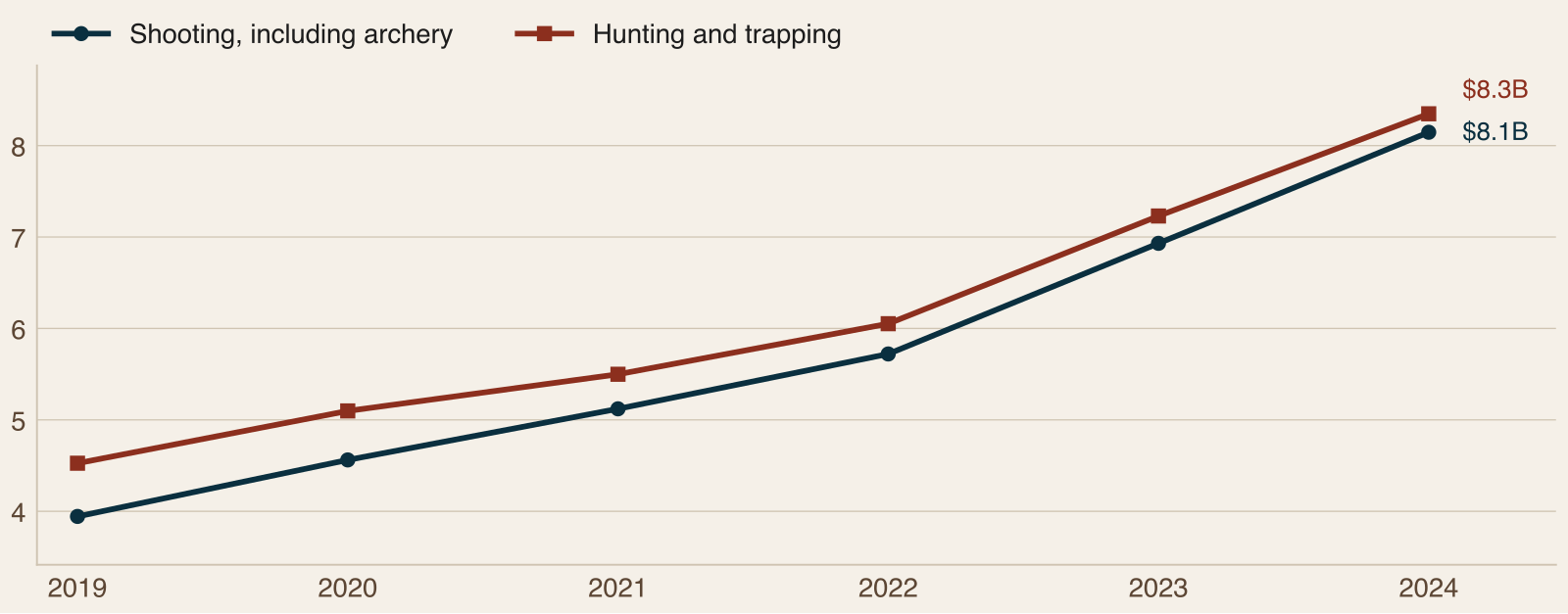
The first is value added. Shooting rose from $3.9 billion in 2019 to $8.1 billion in 2024, a 107% increase. Hunting and trapping, counted separately, went from $4.5 billion to $8.3 billion, up 84%. Together with hunting and trapping the group totaled $16.5 billion in 2024, and shooting made up 49% of it. The series covers every kind of shooting plus archery, so it is not sporting clays alone.
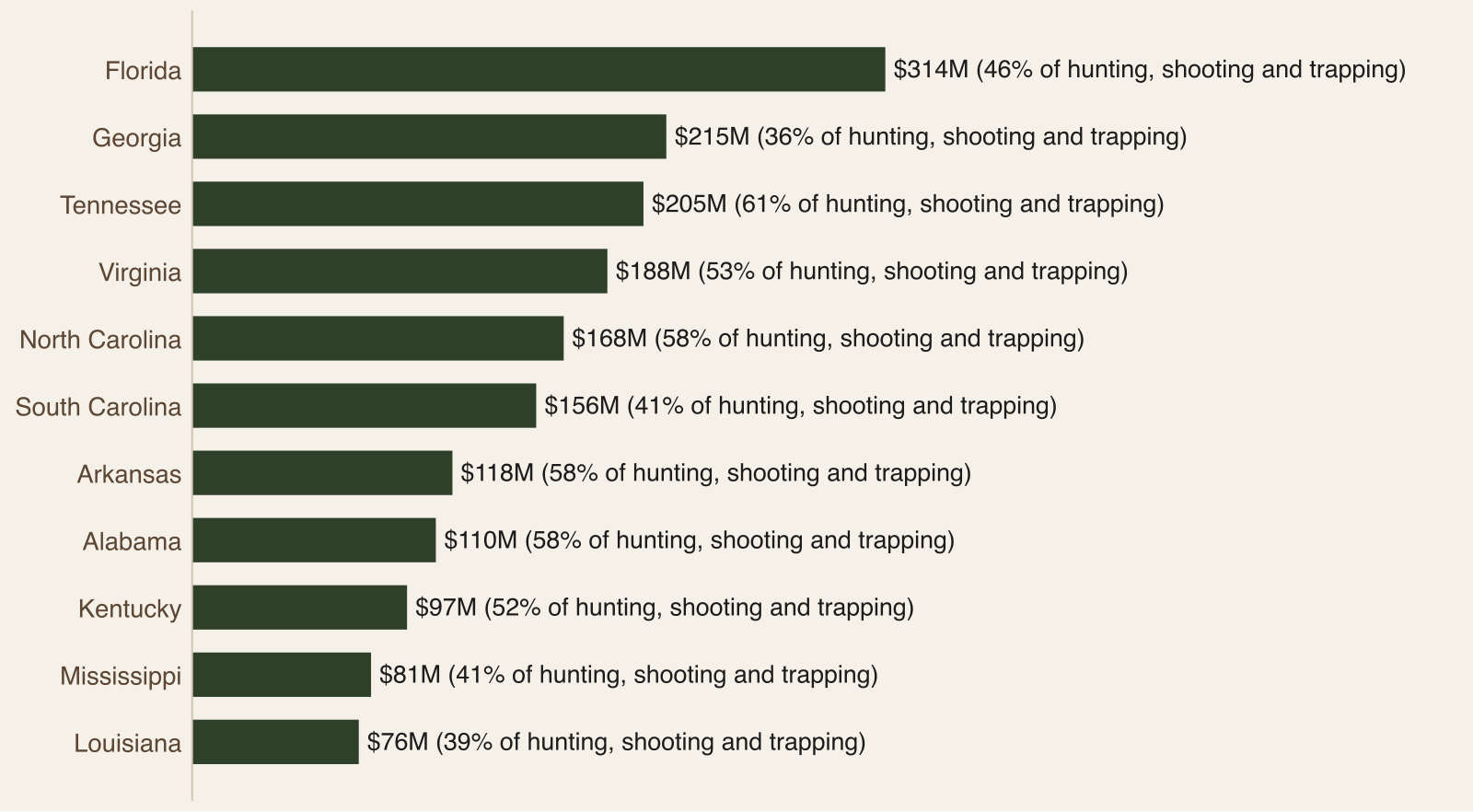
The second is participation. The Sportsmen's Alliance Foundation and Southwick Associates estimated 10,659,260 target shooters and 5,100,710 hunters in the 11 states in 2022, roughly 2.1 to one. Target shooters outnumber hunters in every state, from 1.4 to one in Alabama to 4.3 to one in Florida. Florida also has the largest 2023 state shooting value added at $314 million, followed by Georgia at $215 million and Tennessee at $205 million. The two groups overlap, and the source does not separate shotgun sports from rifle or pistol shooting.
The third is hunting licenses, which are context only. The 11 states had 4,714,399 paid license holders in 2024, up 1.1% from 2020, so the base is steady and not growing. A hunting license is generally not needed to shoot at a clays course.
The BEA state figures are from an earlier release (2023), so the report never combines them with the 2024 national series.
State detail shows where shooting carries the most weight. Across the 11 states, shooting value added was $1,729 million in 2023, 48% of the states' combined hunting, shooting and trapping value added. Florida ($314M), Georgia ($215M) and Tennessee ($205M) were the largest and Louisiana ($76M) the smallest. Shooting is the larger half of the combined activity in Tennessee (61%) and Arkansas (58%), and the smaller in Georgia (36%). The same Sportsmen's Alliance Foundation source puts target shooters' spending at $61.2 billion nationally and $17.2 billion in the 11 states, with 787,510 jobs nationally and 157,280 in the 11 states. Those are output and spending measures from a different method than BEA's value added, so the report warns against comparing them dollar for dollar or adding them together.
Hunting license density varies a great deal. Arkansas has 10.7 paid license holders per 100 residents and Tennessee 10.1, while Florida has 1.1. That matters because Florida also has the most target shooters, 1,981,850, against 460,940 hunters. A reader looking only at license counts would badly understate the shooting pool in Florida, which is why the report treats licenses as context and not as the market.
The Sport: One Target, Many Buyers
This chapter is general description, not data, and it matters because it shapes what a website has to do. Clay-target shooting is a family of shotgun games. Sporting clays imitates the flight of game across a course of stations. Skeet and trap use fixed layouts, and five-stand packs several presentations into one spot.
People come for different reasons: bird hunters staying sharp, beginners, corporate groups and competitive shooters, and one operator may serve all of them from the same homepage.
The report spells out what each of those buyers wants. Beginners come for a lesson or a first round, often with a friend or a group, and they value a course where someone explains safety and equipment without fuss. Casual groups and corporate hosts book an outing, a team event or a celebration, and some of those parties have never held a shotgun. Competitive shooters look for registered shoots and practice rounds, and the more serious ones plan travel around the schedule. Bird hunters use a course to stay sharp between seasons. A visitor has to tell from the homepage which of these the business is built for.
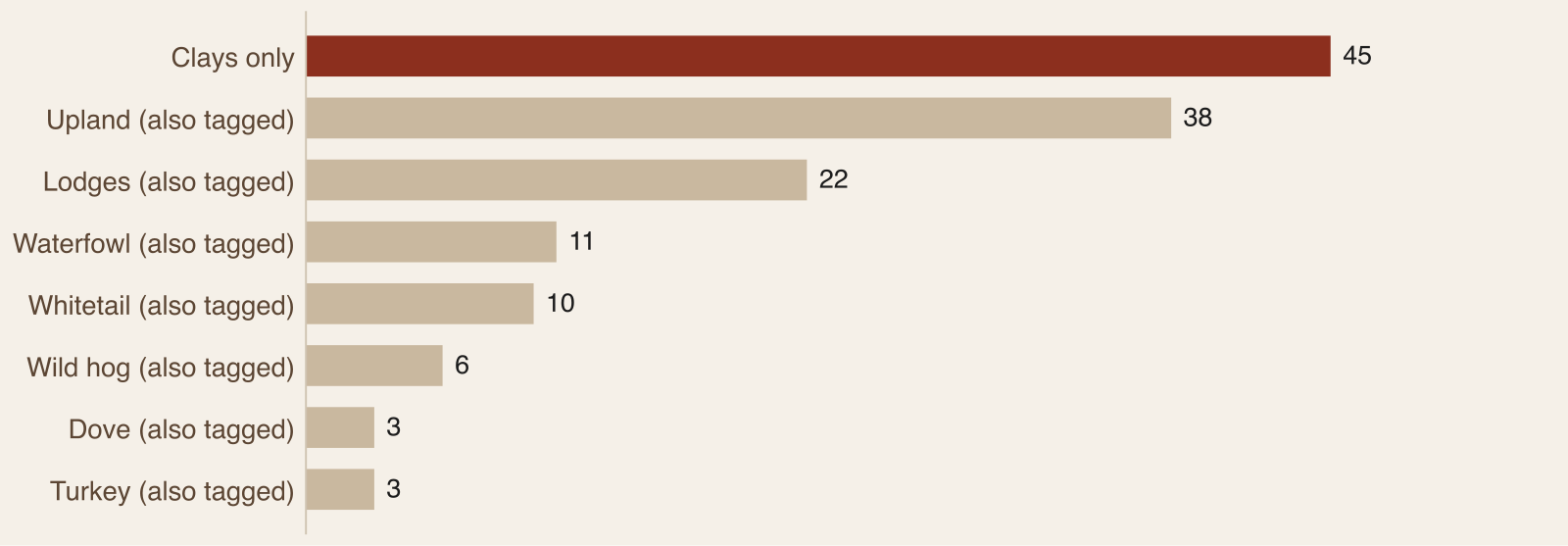
The product is rarely only a round. Of the 92 audited operators, 45 are tagged clays only and 47 also carry another species tag: 38 upland, 22 lodge, 11 waterfowl, 10 whitetail, 6 wild hog, 3 dove and 3 turkey. That points to a set of related offers, such as lessons, groups, leagues, hunter preparation and, on a preserve or lodge property, a hunt or a stay sold beside the shoot.
The business models differ too: private clubs, commercial courses, preserve and lodge programs, resorts and public ranges, and a visitor needs to tell from the homepage which one they are looking at. Range safety, insurance, zoning and preserve licensing sit outside the report. Where a facility is on public land or run by an agency, that agency's rules apply, and commercial instruction there generally needs the managing agency's permission. Confirm current requirements with the state wildlife agency, the local authority and your insurer.
Where It Happens
Clays and shooting is the sixth largest of the eight species groups in the hunting audit: 92 operators, 19% of the 493 audited. Every state has at least 3. North Carolina has the most at 18, then Georgia at 14 and Alabama at 11. Those three hold 43 operators (47%), and the top five, adding Florida and South Carolina with 8 each, hold 59 (64%).
Measured as a share of each state's audited hunting operators, clays is largest in North Carolina (29%), Virginia (28%) and Florida (24%), and smallest in Arkansas (8%).
The report adds three cautions. The audit is a verified sample, so a small count does not mean a state has few places to shoot. The audit counts do not rank states the way public data does: Florida, North Carolina and Tennessee have the most target shooters, while North Carolina, Georgia and Alabama have the most audited operators. And only North Carolina has 15 or more audited clays operators, so the other ten states are pooled later.
The group is a mix. 45 operators (49%) carry the clays tag and nothing else, which marks a course, club or range whose main product is shooting. Public ranges are in there as well: 4 of the 66 records from the new audit are labeled public, agency-run or county-run, and the label is missing from the other 26 records, so 4 is a floor.
The state table in the report sets the audit counts beside the public demand data, and the two do not line up. North Carolina has 18 audited clays operators, 29% of its 62 audited hunting operators, in a state with 1,530,920 target shooters. Georgia has 14 (20% of 69), Alabama 11 (17% of 66), Florida 8 (24% of 33), South Carolina 8 (20% of 40), Louisiana 7 (16% of 44), Virginia 7 (28% of 25), Tennessee 6, Kentucky 5, Mississippi 5 and Arkansas 3. Florida has the most target shooters, 1,981,850, and only 8 audited operators, a reminder that the audit is a verified sample and that researchers stopped rather than pad some states.
For nearly half the group, clays is one product among several. The 47 operators with another species tag lean mostly on upland (38) and lodge (22), with 11 waterfowl, 10 whitetail, 6 wild hog, 3 dove and 3 turkey. That is a preserve, plantation, lodge or resort selling a shoot beside a hunt or a stay, and it changes what the homepage has to explain.
The Business Landscape
Here the report turns to how the audited operators present themselves. 91% have their own website, and 81 of 92 sites returned a page that could be read. Mean digital health, a 1 to 10 score our researchers assign from observed evidence, is 5.87, against 5.23 for all audited hunting operators and 5.09 for the Southeast benchmark. 23% score 4 or below, against 34% for hunting overall. Clays has the highest mean of the eight species tags, with lodges close behind at 5.82, and the spread from first to last is under a point, so read the ranking loosely.
The species-tag table puts the group in context. Sporting clays leads at 5.87, then lodges at 5.82, wild hog at 5.56, waterfowl at 5.32, turkey at 5.30, upland at 5.29 and dove at 5.11, with whitetail between them. The sample sizes behind those tags run from 28 operators for dove to 182 for upland, and one operator can carry several tags, so the rows overlap. On the clays-only versus multi-tag split, the report also shows newsletter signup at 37% against 35% and online booking at 11% against 16%, gaps it calls within the noise at these sample sizes.
The most useful cut is stand-alone shooting against shooting inside a bigger business.
The 45 operators tagged clays only average 5.69, and 45% of their sites carry FAQ content.
The 47 that also carry another tag average 6.04, with 28% scoring 8 or above against 13%, but only 26% carry FAQ content.
So the multi-tag group has the stronger storefront, while the clays-only group does a better job of answering questions.
By state, North Carolina averages 5.78, with 27% showing online booking and 33% carrying FAQ content. The other ten states combined average 5.89 on 74 operators, with 11% booking and 35% FAQ content. The report declines to rank the pooled states, because on 3 to 14 operators each, one site moves a percentage by many points.
A note on fairness: this group blends private and public operators, and a public range has little reason to sell online the way a commercial course does.
How Shooters Search and Book
The audit shows what a visitor finds on a homepage. It does not measure how any one shooter searches. The report's general guidance is that people start with a place and a kind of shooting, often on a phone, then look for practical answers: who can come, whether a first-timer is welcome, hours, equipment, lessons, group booking and parking. Pages that answer those quickly win the visit.
Three signals stand out.
Booking. 14% of the 81 sites read show an online booking engine (11 sites), the highest of the eight tags and still far below the benchmark's 27.0%. Many shops sell walk-up rounds that need no reservation, so a low figure is not always a failing. The gap matters for products that need a date: lessons, groups, corporate events, leagues and registered shoots.
Answers. 35% carry FAQ content, the highest of the eight tags, against 25% across hunting and 36.9% in the benchmark. Yet none of the 81 use FAQ structured data, even though 64% have some structured data, much of it added automatically by website builders.
Email and freshness. 36% offer a newsletter signup, level with the benchmark's 32.7%, which means about two sites in three have none. And 30% of sites with a detectable copyright year show 2023 or earlier, against 25.0% in the benchmark.
All of these rates are lower bounds, because a feature may sit deeper in a site than the homepage.
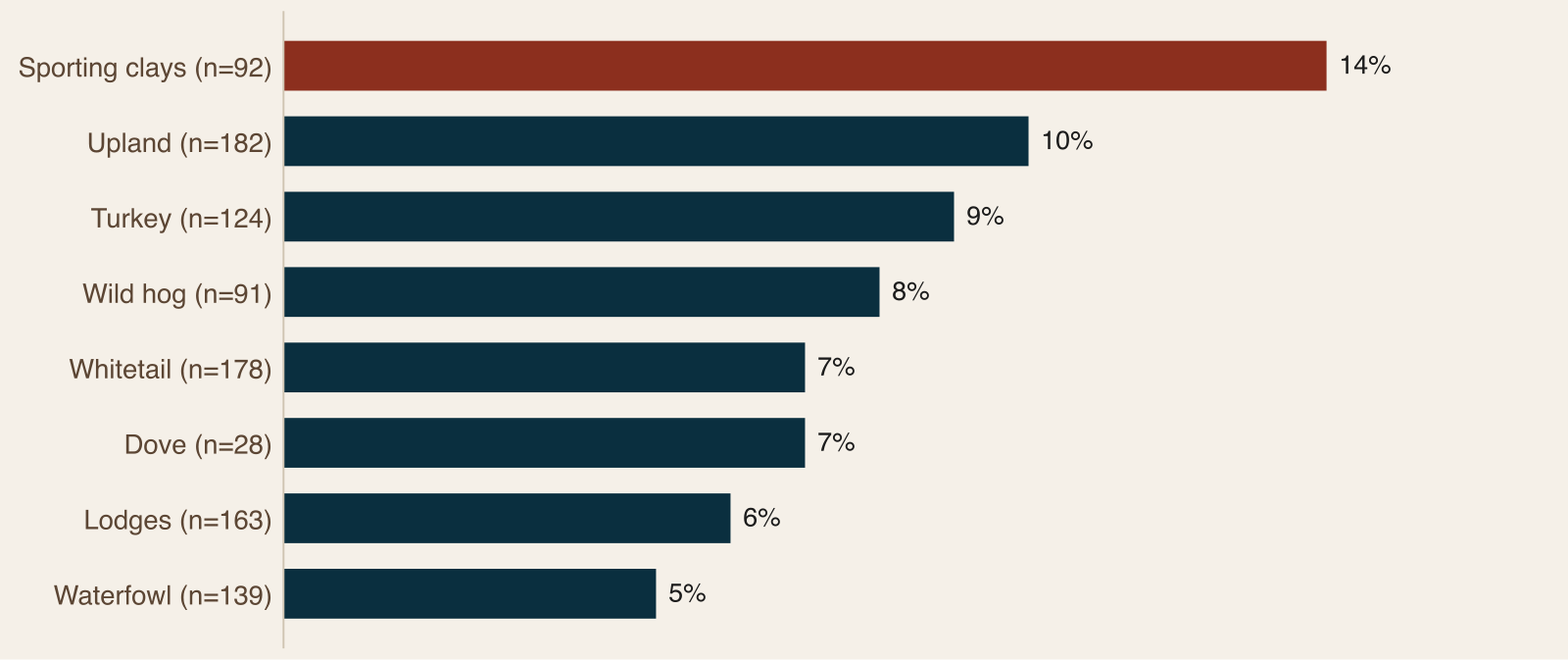
The booking lead is real but small. By species tag, clays is first at 14%, then upland at 10%, turkey at 9%, wild hog at 8%, whitetail and dove at 7%, lodges at 6% and waterfowl at 5%. The report calls the 4-point lead over upland well within the noise at these sample sizes. The more useful comparison is with the benchmark's 27.0%, where many businesses sell by the day or the hour. Across all audited hunting operators, 8% show booking, 25% have FAQ content, 27% have a newsletter signup and 32% show a stale copyright year, so clays operators beat their hunting peers on every signal but still trail the region on booking.
The Shooting Calendar
Clays has a gentler season than hunting. A state sets a hunting season, but a shoot can be held most of the year, so an operator's calendar is mostly its own: leagues, lessons, registered shoots, group days and fundraisers. The calendar chapter is general guidance, not measured data, and it gives no dates for any sanctioning body or state season.
It lays out four phases. Winter and early spring suit long rounds and the planning of registered shoots. Spring brings groups, team events and first-timers. Summer shapes hours around heat and storms, and bird hunters start thinking about the season. Late summer and fall bring hunter preparation and holiday group outings.
The report adds a short guide to how different shooters book. Walk-up and regular shooters decide close to the visit, often the same day from a phone, so they need hours, directions, rules and whether a reservation is needed, visible without scrolling. First-timers and lesson buyers look for a beginner-friendly offer and reassurance, so they need a first-visit page and a way to book a lesson. Groups, teams and corporate hosts plan weeks or months ahead and need a quote, a date and often food, so they need a group page with capacity and a form that gets a quick reply. Competitive shooters need an up-to-date event calendar and entry details, and hunters preparing for the season need preparation sessions and hours that stretch to evenings. This is general guidance, not measured data, and the report tells operators to check their own booking records for their real lead times.
The pattern that holds is that events go to the business that published the date early. For a registered shoot, the event page is the product: date, format, entry steps, squad times and nearby lodging. The chapter also profiles five kinds of shooter, from the same-day walk-up on a phone to the corporate host who needs a quote weeks ahead, and closes with a four-step exercise for building your own booking calendar.
Six Moves for Operators
The final chapter turns the findings into six moves, each tied to a number from the audit: say what kind of place it is and who can come; make a round, lesson or event bookable online, even by a request form; answer first-timers' questions and mark them up; keep an events calendar current; sell the second product beside the first; and keep a list and use it.
Saying what kind of place it is matters because 45 of the 92 operators are tagged clays only and the rest are mixed in with preserves, lodges and resorts. Online booking matters because 14% of the 81 sites read have it against the benchmark's 27.0%. Answering and marking up questions matters because 35% have FAQ content and none of the 81 use FAQ structured data. Keeping a calendar current matters because 30% of sites with a detectable copyright year show 2023 or earlier. Selling the second product matters because 47 of the 92 carry another species tag. And keeping a list matters because 36% have a newsletter signup, so about two in three have none. For operators with a preserve, a lodge or a hunt, the report suggests giving the shoot, the lessons and the hunt preparation their own page, and linking the hunt from the shoot.
If you do one thing this month, put the kind of place it is, who can come, your hours, a way to book and the next three event dates on the homepage, and make it work on a phone.
What the Report Cannot Tell You
The report is open about its limits, and so is this post. It has no count of clay-target shooters, facilities, members or registered shoots. The BEA shooting series includes archery and every kind of shooting, and the participation estimates do not separate shotgun sports from other target shooting. The two BEA releases are different vintages, 2024 nationally and 2023 for states, and are never combined to compute growth. The audit records no facility type and no prices, so there is no discipline breakdown and no pricing in the report.
Small cells matter too. Only North Carolina has 15 or more audited clays operators, so the other ten states are pooled and described together: 74 operators, a mean digital health of 5.89, 92% with their own website, 35% of the 66 sites read with FAQ content and 11% with online booking. North Carolina shows 5.78, 27% booking and 33% FAQ content. The report treats differences smaller than about 10 percentage points as noise.
What It Means for Operators
Three takeaways run through the whole report. First, demand is broad. There are more target shooters than hunters in all 11 states, and shooting value added has more than doubled nationally since 2019, but nobody can count clay-target shooters, so your own bookings are the only real read on your market.
Second, the group is ahead of other hunting operators and behind the region. Clays tops the eight tags on digital health, booking and FAQ content, yet still trails the benchmark on booking and sits just under it on answers.
Third, the easy wins are unglamorous: say who can come, let lessons and groups book, publish answers and dates, and keep the footer current.
Read the Full Sporting Clays and Shooting Report
The full report has every state table, the species-tag comparison, the booking and answer signals, the calendar and the sources and methods behind each chart.
Download the full 2026-27 Sporting Clays and Shooting report (free with your email).
Frequently Asked Questions
Does the report say how many sporting clays courses there are in the Southeast?
No. No source we collected counts clay-target facilities, members, shooters or registered shoots, in the Southeast or nationally. The report uses BEA value added, target shooting participation estimates and hunting license counts as context for the pool a clays operator draws from. The audit describes 92 verified operators, 19% of 493 audited hunting operators, which is a sample and not a census, so a small count in a state does not mean the state has few places to shoot.
Are there really more shooters than hunters in the Southeast?
Yes, by the 2022 Sportsmen's Alliance Foundation estimates: 10,659,260 target shooting participants against 5,100,710 hunters in the 11 states, about 2.1 to one. The ratio runs from 1.4 to one in Alabama to 4.3 to one in Florida. Target shooting there means shooting in general, not shotgun sports alone, and some people are counted in both groups, so the figures describe the pool a clays operator draws from and not the number of clay shooters.
How do clays operators compare online with other hunting operators?
They score higher. Mean digital health is 5.87 for clays operators against 5.23 for all 493 audited hunting operators and 5.09 for the 1,546-operator Southeast benchmark, and 23% of clays operators score 4 or below against 34% for hunting. Online booking is 14% against 8% for hunting, but the benchmark is 27.0%, so the group still trails the region. The report cautions that the spread among the eight species tags is under a point, so the ranking should be read loosely.
Why is online booking low if shooters want convenience?
Part of the answer is the business model. Many courses sell walk-up rounds that need no reservation, and some audited ranges are public facilities that do not take bookings at all. The gap matters most for lessons, groups, corporate events, leagues and registered shoots, which need a date. Only 14% of the 81 sites read show a booking engine. The report's advice is that even a request form that returns a time is a start, because it lets a visitor act at nine in the evening without waiting for business hours.
What is the difference between clays-only operators and the rest of the group?
The 45 operators tagged clays only average 5.69 on digital health and 45% of their sites carry FAQ content. The 47 that also carry another species tag, mostly preserves, plantations, lodges and resorts, average 6.04 and have 28% scoring 8 or above against 13%, but only 26% carry FAQ content. So the multi-tag businesses have the stronger overall storefront, while the stand-alone clays businesses do a better job of answering questions. The records carry no facility-type field, so the species tag is the closest available view.
Why does the report pool ten of the eleven states?
Only North Carolina has 15 or more audited clays operators, with 18 and 15 sites read. The other ten states have between 3 and 14 operators each, so on any one of them a single site moves a percentage by many points. The report pools those 74 operators, which average 5.89 on digital health, and declines to rank them. North Carolina's booking share of 27% is higher than the pool's 11%, while its digital health mean of 5.78 is within noise of the pool.
When should a clays operator publish its event dates?
Early. The calendar chapter is general guidance and not measured data, but its pattern is that events go to the business that published the date first. A registered shoot is typically scheduled well in advance by the host club, and shooters who travel for one decide months ahead, so the date, the format and how to enter belong on the site before the first shooter looks. The report also notes that 30% of sites with a detectable copyright year show 2023 or earlier, which tells visitors the calendar may be out of date.
Can I advertise instruction or guided shooting on public land?
Only with permission. Facilities on public land or run by an agency follow that agency's rules, and commercial instruction or guiding on a public range or other public land generally needs the managing agency's permission. The report lists range safety, insurance, local zoning and noise rules, and any state preserve license among the obligations that sit outside its scope. Confirm with the managing agency, the local authority, your insurer and your state wildlife agency before you advertise a lesson or a guided shoot.
Sources
U.S. Bureau of Economic Analysis, Outdoor Recreation Satellite Account, March 2026 release (2019 to 2024) and the regional series, November 2024 vintage (2023 state data)
Sportsmen's Alliance Foundation, Economic Impact of Hunting and Shooting in America state handouts, research by Southwick Associates, 2024 (2022 data)
U.S. Fish and Wildlife Service, certified hunting license data and Wildlife and Sport Fish Restoration Program, license years 2020 to 2024
U.S. Census Bureau, population estimates, used for license density ratios
Pine & Marsh hunting audit, October 2026 (493 operators), and the Pine & Marsh Southeast audit, October 2026 (1,546 operators), used as the benchmark


Comments