
Inside the 2026-27 Wild Turkey Report: Record Harvests, Weak Hatches and Who Sells the Hunt
Wild Turkey in the Southeast, 2026-27 Edition, is Pine & Marsh's third industry report. It looks at the hunters behind spring turkey, the harvest and recruitment record in 11 states, and the websites of the outfitters that sell turkey hunts. It combines state wildlife agency reports, USFWS license data, the 2022 National Survey and the Bureau of Economic Analysis with a Pine & Marsh audit of hunting businesses.
It is written for turkey guides, deer and multi-species outfitters, lodge owners and anyone who sells a spring hunt. This post walks through the report one chapter at a time, in the report's order. For the marketing playbook, see Marketing a Turkey Hunting Outfitter in the Southeast.
The Industry in Nine Numbers
The headline is a split. Spring 2026 harvests set records in several states, but poult recruitment is below the level agencies call sustainable in most states that measure it. Kentucky's record spring 2026 harvest of 36,439 was the largest single-state count in the data, while 5 of 8 states with a statewide poults-per-hen figure were below 2.0 in their latest survey. The 208K turkeys reported or checked in the latest spring across the 11 states is a floor, not a total, because the years and methods are mixed.
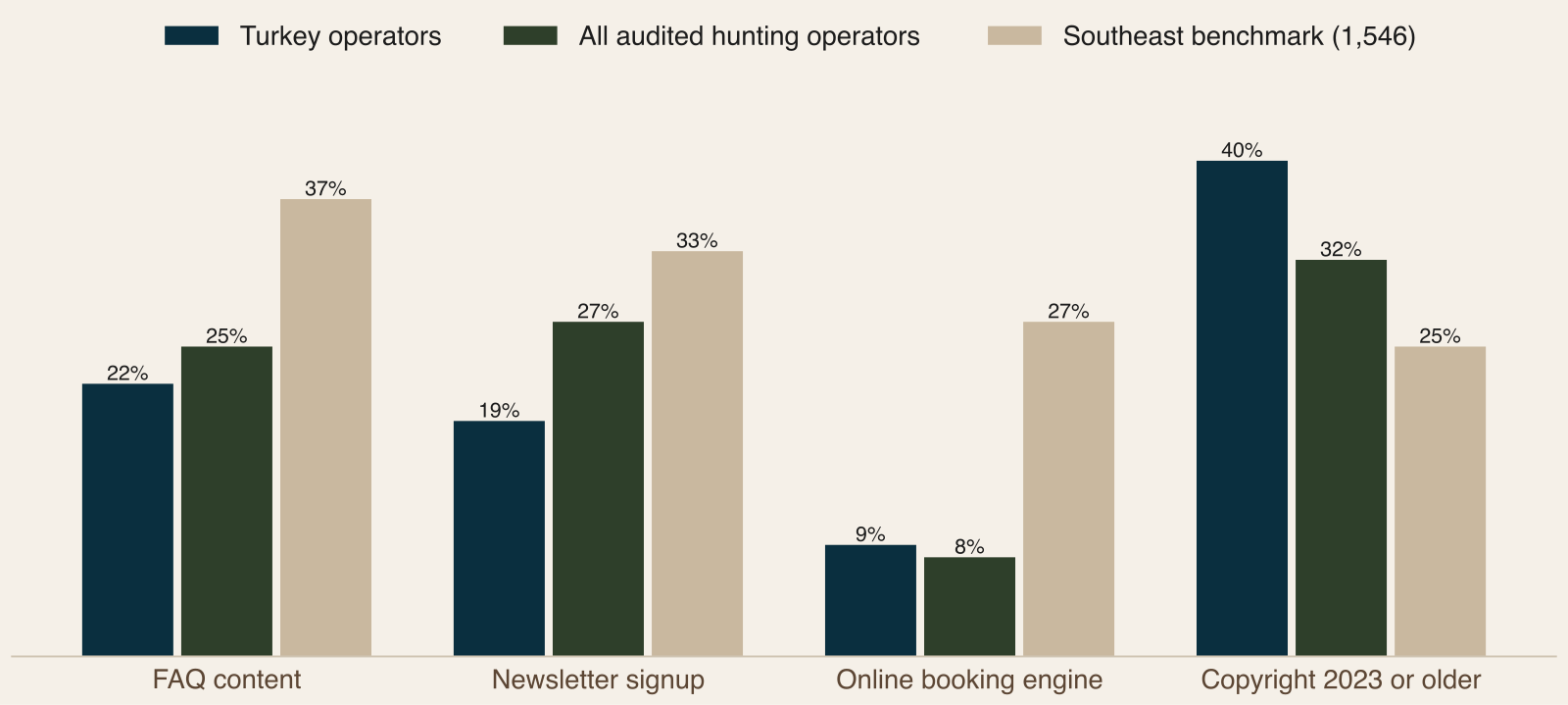
The audit numbers: 124 audited turkey operators, 25% of the 493 audited hunting operators. 90% also carry a whitetail tag, and only 2 sell turkey alone. 9% show an online booking engine on the homepage, against 8% of hunting operators and 27.0% in the Southeast benchmark, and 40% show a copyright year of 2023 or older, against 25.0% in the benchmark.
Demand: Who Hunts Turkey
The first finding is a gap. There is no national count of turkey hunters, and waterfowl has a federal survey where turkey does not. The 2022 National Survey counted 14,374,589 hunters age 16 and older in the U.S., about 11.5 million of whom hunted big game, 5.3 million small game and 2.8 million migratory birds. None of those groups is a turkey count.
License data show the wider pool. The 11 states had 4,714,399 paid hunting license holders in 2024, 29.9% of the U.S. total, up 1.1% against 2020, so the base is steady, not growing. Four states published an estimate of spring turkey hunters: Alabama (70,330 in 2025), Georgia (38,810 in 2024), Florida (28,162 in 2025) and South Carolina (41,805 in 2025). Set against license holders, turkey hunters were roughly 11% to 21% of the base in the three states with a 2025 figure, with Georgia at 5% in 2024. Mississippi reported 31,177 buyers of its turkey stamp in 2026, a different measure. The report calls these an order of magnitude, since the years and methods differ.
BEA value added from hunting, shooting and trapping reached $16.5 billion in 2024, up 95% from $8.5 billion in 2019, and that is all hunting, not turkey. None of these figures says how many hunts are bought from a guide, so they describe the pool a turkey operator draws from, not the size of the guided market.
The National Survey figures put the turkey pool in context. Of the 14,374,589 hunters age 16 and older, big game hunters were about 80%, small game hunters about 37% and migratory bird hunters about 19%, and a hunter can be in more than one group. Density in the license data varies sharply, from 10.7 holders per 100 residents in Arkansas and 10.1 in Tennessee to 1.1 in Florida, and those ratios include nonresident buyers. The state estimates also come from different sources: Alabama, Georgia and South Carolina from post-season hunter surveys reported by their agencies, and Florida from the National Wild Turkey Federation's 2026 Spring Hunt Guide, state-reported.
The Resource: Spring Harvest and Poult Recruitment
Each state counts its spring harvest its own way, so the report lists each state's latest figure with its basis and says not to add them up. Kentucky reported a record 36,439 turkeys in spring 2026, Louisiana a record 4,024, North Carolina 25,034, the highest in its 1977 to 2026 series, and Arkansas 13,591, the highest since 2006. Tennessee's 34,990 was the fourth-highest on record and Virginia reported 24,105. Within those states the 2026 gains over spring 2025 ranged from 10% in North Carolina to 21% in Tennessee.
The latest figures in the report's state table are Alabama 17,049 (2025, Game Check reported), Arkansas 13,591 (2026, checked), Florida 12,066 (2025, reported), Georgia 12,635 (2026, a provisional sum of county records on the agency's dashboard), Kentucky 36,439, Louisiana 4,024, Mississippi 17,907 (Game Check, from a secondary source), North Carolina 25,034, South Carolina 10,419 (2025, corrected for non-reporting), Tennessee 34,990 and Virginia 24,105. For the six states with consistent reported counts, the spring 2025 to spring 2026 changes were Tennessee up 21%, Arkansas up 20%, Kentucky up 19%, Virginia up 17%, Louisiana up 13% and North Carolina up 10%. Those rows are not comparable across states, because counts differ in method.
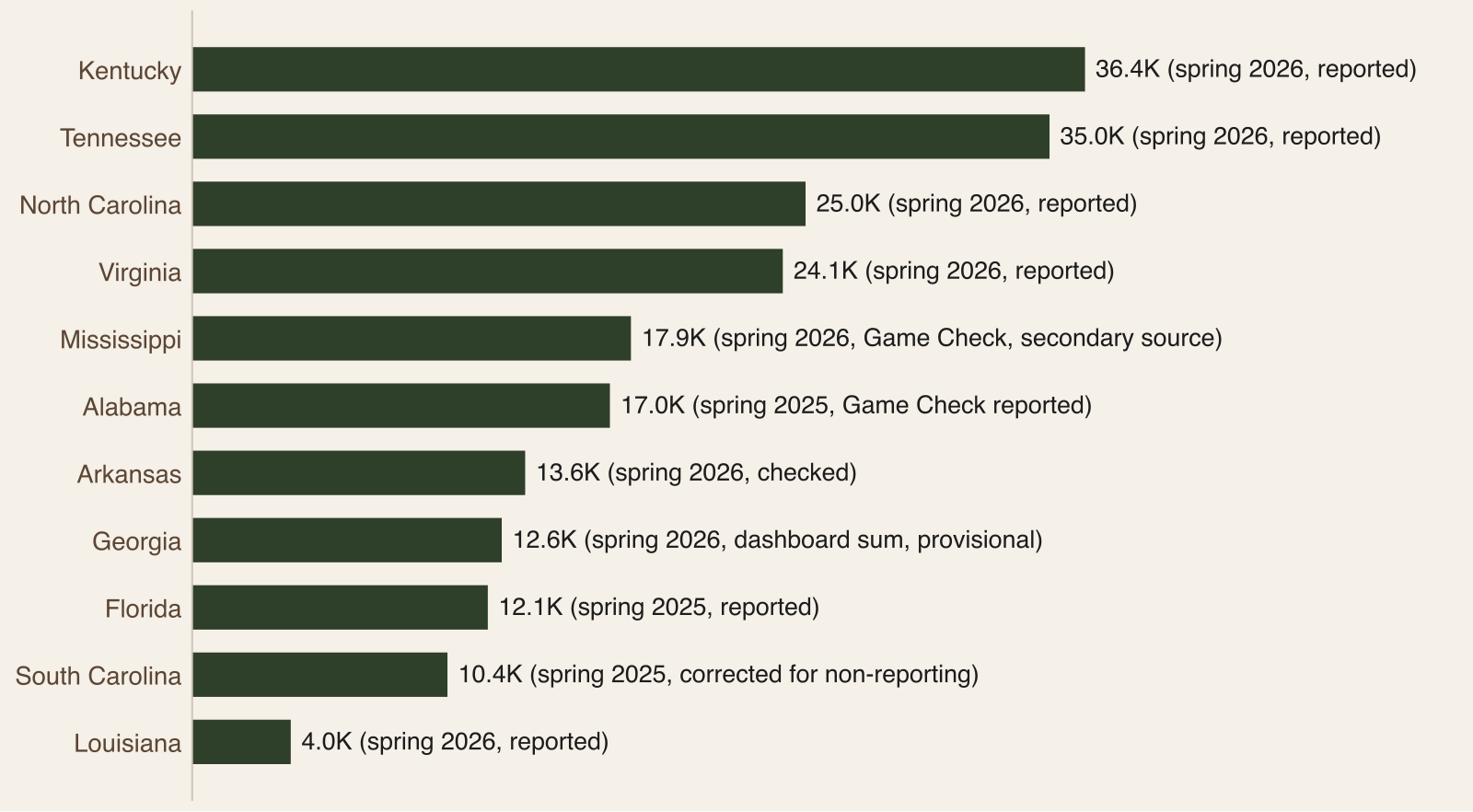
Alabama, South Carolina and Georgia look weaker. Alabama's 2025 Game Check count of 17,049 was down 7% on 2024, and South Carolina's corrected 2025 harvest of 10,419 was down 16%. Georgia's reported harvest fell from 14,412 in 2020 to 11,570 in 2024. Counting methods also matter: Alabama's survey estimate of 2025 harvest (41,869) is 2.5 times its reported count.
The longer view adds nuance. South Carolina's agency says its harvest has fallen about 50% since 2002. Georgia's fall of about 20% from 2020 to 2024 came with the first season under new statewide rules in 2022. Alabama's reported count rose from 14,947 in 2021 to 18,263 in 2024 before easing, and North Carolina's moved from 20,576 in 2022 to 25,034 in 2026. Counting methods keep mattering: South Carolina corrects for about 17.4% non-reporting, Tennessee's 2024 survey estimate (63,856) was 2.0 times its reported count (31,647), Georgia's survey estimate (11,924) was about equal to its reported 11,570, and Alabama's agency noted in 2023 that reporting compliance averaged about 45% over five years.
Recruitment is the core of the story. Alabama's agency treats 2.00 poults per hen as the level needed for a sustainable population. Against that line, 5 of 8 states fell short in their latest survey: Virginia (1.3), North Carolina (1.4), Georgia (1.47), Alabama (1.53) and South Carolina (1.6). Florida reported 2.03, Tennessee 2.2 and Kentucky 3.5, up from 2.7 in 2024.
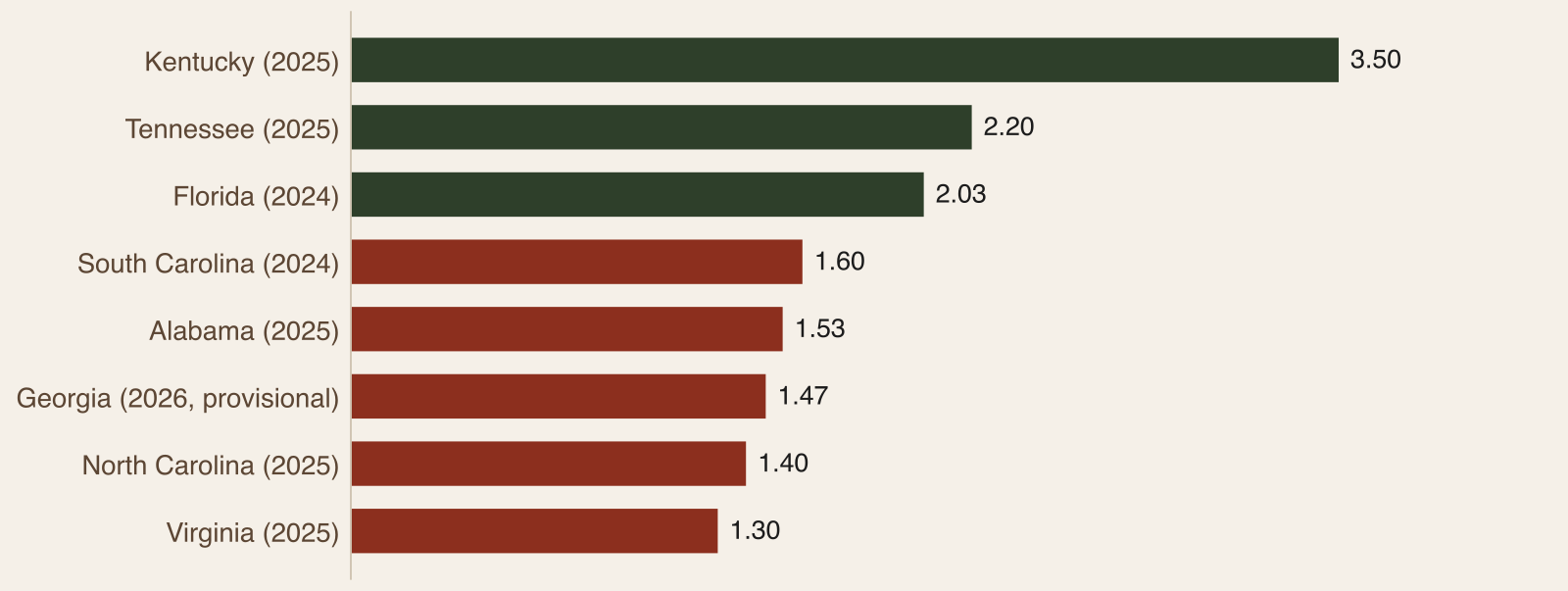
Agencies in Arkansas and Tennessee say a season's harvest depends heavily on reproduction two years earlier. That is why strong 2024 hatches in several states fed the 2026 records, and why weaker 2025 recruitment in Virginia, Alabama and Georgia raises the odds of softer springs ahead. These are agency expectations, not Pine & Marsh forecasts.
Several state statements sharpen the picture. Alabama's agency says brood data since 2010 show a long-term fall in reproduction. Virginia's biologist called the 2025 figure of 1.3, down from 2.1, a significant and concerning drop. Tennessee's 2.2 compares with a five-year average of 2.4, and Kentucky's 3.5 is described as part of an improving trend since a 2017 low. Louisiana publishes regions only, and reports significant 30-year declines in four of its five habitat regions. Arkansas's agency said a slight dip in harvest was possible after weaker 2025 poult surveys.
States have responded. Tennessee cut its season bag from three bearded birds to two from spring 2023 and delayed the season two weeks. South Carolina's 2025 changes cut the season bag from 3 to 2, banned jake harvest and removed nine days. Kentucky allows one spring turkey per hunter per wildlife management area. Rules change often, so confirm current limits with the state agency.
The fuller list of responses, paraphrased from agency statements, shows how varied the rules are. Arkansas reports only youth may take one jake (since 2011), no harvest of bearded hens (since 2021), much shorter seasons than in 2003 and a new split opening structure in 2026. Georgia's 2022 rules were followed by lower harvest and a drop in hunter satisfaction to 63% in 2024. Kentucky cut the fall bag from 4 to 2 and lengthened its no-feeding window. Louisiana adopted a later opener in 2018 and has limited jake harvest to one bird for youth hunters only since 2025. South Carolina also moved to a later opener and a second youth weekend. For 2026-27 Virginia keeps its annual limit at three but allows only one beardless bird, in the fall, to protect more hens. Alabama, Florida, Mississippi and North Carolina cited no decline-driven rule change in the sources reviewed.
On public land, guiding on wildlife management areas, refuges and national forests generally requires a permit or special-use authorization from the managing agency. The report does not describe any operator as guiding on public land. Never advertise a public-land hunt without the permit for that unit, and for a Kentucky WMA confirm with KDFWR.
Where It Happens
The audit finds 124 turkey operators across the 11 states. Alabama has 25 (20%), and Alabama, Kentucky and South Carolina together hold 66 (53%). Louisiana, Mississippi and Arkansas have 1, 2 and 2. That says more about what could be verified online than about hunting, since those three states reported harvests in the thousands.
As a share of each state's own audited hunting operators, turkey is largest in Kentucky (58%), South Carolina (48%) and Florida (42%) and smallest in Louisiana (2%). Harvest, license base and operator count do not rank the states in the same order, and the audit records state only, so it does not show whether hunts are on private, leased or public land.
The rest of the state table fills in the picture. After Alabama (25 operators, 38% of its audited hunting operators), Kentucky has 22 (58%), South Carolina 19 (48%), North Carolina 15 (24%), Florida 14 (42%), Georgia 10 (14%), Virginia 8 (32%) and Tennessee 6 (13%), with Arkansas and Mississippi at 2 (5% and 6%) and Louisiana at 1 (2%). Seven states have fewer than 15 audited turkey operators each, 43 combined, so the report pools them.
The Business Landscape
Turkey is sold by deer and multi-species outfitters. Of the 124 turkey operators, only 2 carry no other species tag. 111 (90%) also carry a whitetail tag, 69 (56%) a lodge tag, 46 wild hog, 29 upland and 20 waterfowl. A turkey buyer lands on a homepage that is mostly about something else, usually deer or a lodge stay, which makes the turkey page and its dates the thing to get right.
Beyond whitetail, lodges, hog, upland and waterfowl, 11 turkey operators also carry a dove tag and 3 a sporting clays tag. Most hold three or more tags, and a few also carry tags outside the eight shown, such as elk, bear or alligator.
99% have their own website, and 122 of 124 sites were read. Mean digital health is 5.30 out of 10, with 31% scoring 4 or below, close to the 5.23 for all audited hunting operators and the 5.09 of the 1,546-operator Southeast benchmark. Turkey ranks fifth of the eight species tags on digital health, with a small spread, and first of eight on stale copyright years.
By state, four have enough operators to show: Alabama (4.40), Kentucky (5.50), South Carolina (5.42) and North Carolina (5.27). The 43 operators in the pooled states average 5.67. The report advises treating differences smaller than about 10 percentage points, or half a point of score, as noise.
The state rows differ in what they show. Alabama's 25 operators have FAQ content on 21% of sites, newsletter signup on 8% and online booking on 8%. Kentucky's 22 show FAQ content at 5%, newsletter at 36% and booking at 5%. South Carolina's 19 show 26%, 32% and 5%, and North Carolina's 15 show 20%, 13% and 20%, the highest booking share of the four. The pooled 43 show 31% FAQ content, 12% newsletter signup and 10% online booking, with 48% showing a copyright year of 2023 or older. Of the 124 operators, 101 came from the new October 2026 audit and 23 from the Southeast audit, and even the largest state rests on 24 sites read.
How Buyers Search and Book
The audit shows what a visitor finds on a homepage, not how a buyer searches, so the buyer description is general guidance. The homepage scan found:
9% of the 122 turkey sites show an online booking engine (11 sites), close to the 8% for all audited hunting operators and far below 27.0% in the benchmark.
22% carry FAQ content against 36.9% in the benchmark, and only 2 of 122 use FAQ structured data, though 58% have some structured data.
19% offer a newsletter signup, below the benchmark's 32.7% and the 27% for hunting overall.
40% of sites with a detectable copyright year show 2023 or earlier.
For turkey the stale footer carries an extra cost. It raises the question of whether the page still reflects the state's current rules, which have changed in several states. A low booking rate is not a surprise for hunts sold by phone and deposit, but a buyer who finds the site late in the evening still has nothing to act on until morning.
The Season and Booking Calendar
The calendar is general guidance, not audit or public data, and it gives no season dates. It runs in five phases: winter, late winter to pre-season, spring season, after the spring season and fall. Late winter to pre-season is the peak planning window, when out-of-state hunters settle on a destination. Fall is for cross-selling next spring's dates to deer guests.
Phase by phase, the report suggests the following. In winter, publish the spring turkey page and packages, update bag limits and license information after the state announces its rules, and offer deer guests first call on spring dates. In late winter to pre-season, open a waiting list, add a deposit or date-hold step, update the FAQ with current license, permit and check-in requirements and show the land type for each hunt. In the spring season, keep availability current, answer messages the same day, share honest hunt reports that say how birds are working, ask every party for a review and remind guests how to report a harvest. After the season, thank guests, collect reviews and photos with permission and add what you saw in the field this summer. In the fall, cross-sell next spring's turkey dates to deer guests and review the site for stale text and the copyright year.
It also sketches four buyers: the local day hunter, the out-of-state hunter, deer and lodge guests who already know you, and first-time and youth hunters booked by a parent or mentor. Its advice is to build your own calendar from your last two springs of bookings.
Each buyer needs something different. A local day hunter decides close to the date, often by phone or text, and needs a text or call link that works on a phone, current availability and a clear weather policy. An out-of-state hunter plans weeks or months ahead and asks what is included and which rules apply, so publish packages, a license and permit checklist and lodging options. Deer and lodge guests already know you and often add a spring hunt when asked, so show a turkey offer on the deer and lodge pages and in your email list. First-time and youth hunters are booked by a parent or mentor who asks about safety, pace and what to expect, so give them a beginner page and explain youth hunt options where the state has them.
Six Moves for Operators
The report closes with six moves: give turkey its own page and sell it from your deer and lodge pages; say what the hunt is and on what land; keep rules and limits current; make it possible to book or hold a date online; answer buyers' questions and mark them up; and be honest about the birds and keep a list. If you can do one thing this month, put a turkey page on your site that names the land, shows the current state limits, lists your spring packages and offers a way to hold a date.
What It Means for Operators
Record harvests are not the whole story. Hunters see declining recruitment, agencies are tightening rules, and agencies themselves say weaker hatches raise the odds of softer springs. A plain hunt report beats a promise, so describe how the birds are working and do not guarantee a bird.
Turkey is a second sale to a guest you already have. With 111 of 124 turkey operators also carrying a whitetail tag, deer guests are the natural spring customers, and a dedicated turkey page linked from the deer and lodge pages reaches them. Name the land, keep the state's rules current, and hold the permit for any public unit.
Read the Full Wild Turkey Report
The full report has every state table, the recruitment data and the methodology.
Download the full 2026-27 Wild Turkey report (free with your email).
Frequently Asked Questions
How many turkey hunters are there in the Southeast?
No source counts them. There is no national or regional count of turkey hunters, only state estimates in four states: Alabama (70,330 in 2025), Georgia (38,810 in 2024), Florida (28,162 in 2025) and South Carolina (41,805 in 2025), plus 31,177 turkey stamp buyers in Mississippi in 2026. The 11 states had 4,714,399 paid hunting license holders in 2024, but the data do not break out turkey, so the figures describe a pool and not the guided market.
Is the turkey population declining in the Southeast?
The signals are mixed. Spring 2026 set records in Kentucky, Louisiana and North Carolina, but 5 of the 8 states with a statewide poults-per-hen figure were below 2.0 in their latest survey, the level Alabama's agency treats as sustainable. Virginia's 1.3 was down from 2.1. Agencies say harvest follows reproduction by about two years, and these are agency expectations, not Pine & Marsh forecasts. Kentucky's 3.5 is the high mark.
Why can't turkey harvest be compared across states?
States count differently: check stations, Game Check, reported counts, counts corrected for non-reporting and survey estimates. Alabama's survey estimate of 2025 harvest (41,869) is 2.5 times its reported count of 17,049, and Tennessee's 2024 estimate is 2.0 times its reported count. Neither is wrong, since they measure different things, but a chart that treats them alike would mislead. Read each state against itself across seasons.
Are most turkey outfitters turkey-only?
No. Of the 124 audited turkey operators, only 2 carry no other species tag. 111 (90%) also carry whitetail, 69 (56%) are lodges, 46 carry wild hog, 29 upland and 20 waterfowl. Turkey is mostly sold by deer and multi-species outfitters, which is why the turkey page and its dates matter, and why deer and lodge guests are the natural spring customers.
How do turkey operators compare online with other hunting operators?
They look much alike. Mean digital health for the 124 audited turkey operators is 5.30 out of 10, against 5.23 for all audited hunting operators and 5.09 for the Southeast benchmark. Turkey ranks fifth of eight species tags on digital health and first on stale copyright years, at 40%. Online booking is 9%, FAQ content 22% and newsletter signup 19%, all from homepage scans and all lower bounds.
How have states changed turkey rules?
Several have tightened rules for hens and jakes. Tennessee cut its bag from three bearded birds to two and delayed its season two weeks from spring 2023. South Carolina's 2025 changes cut the bag from 3 to 2, banned jake harvest and removed nine days. Kentucky cut its fall bag from 4 to 2, Louisiana limits jake harvest to youth hunters only, and Virginia allows only one beardless bird in 2026-27. Rules change often, so confirm current limits with the state agency.
When should I publish my spring turkey page?
Early. The report's calendar says winter is when hunters read state rule changes and ask about dates, and late winter to pre-season is the peak planning window, when out-of-state hunters settle on a destination. Publish the turkey page and packages in winter, update limits after the state announces its rules, and add a deposit or date-hold step. Season dates and zones are set by each state, so check current regulations.
Can I guide turkey hunts on public land?
Only with the managing agency's permit or special-use authorization, and some units do not allow guiding at all. In Arkansas, guiding on Commission WMAs other than for waterfowl requires a Resident Special Guide License, in Louisiana paid hunting guiding is barred on WMAs, and in Mississippi there is no paid guiding on MDWFP WMAs. For a Kentucky WMA, confirm with KDFWR. National forests need a U.S. Forest Service special-use permit, and for refuges and other units, confirm with the managing agency.
Sources
U.S. Fish and Wildlife Service, Wildlife and Sport Fish Restoration Program, certified paid hunting license holders, license years 2020 to 2024
U.S. Bureau of Economic Analysis, Outdoor Recreation Satellite Account, March 2026 release (2024 data)
Kentucky Department of Fish and Wildlife Resources, spring turkey harvest and status reporting
State wildlife agency turkey harvest, post-season survey and brood survey reports for the 11 states (2021 to 2026), as cited in the report
Pine & Marsh hunting audit, October 2026 (493 operators), and the Pine & Marsh Southeast audit, October 2026 (1,546 operators), used as the benchmark


Comments