
Inside the 2026-27 Wild Hog Report: A $3.4 Billion Problem and a Market Sold as an Add-On
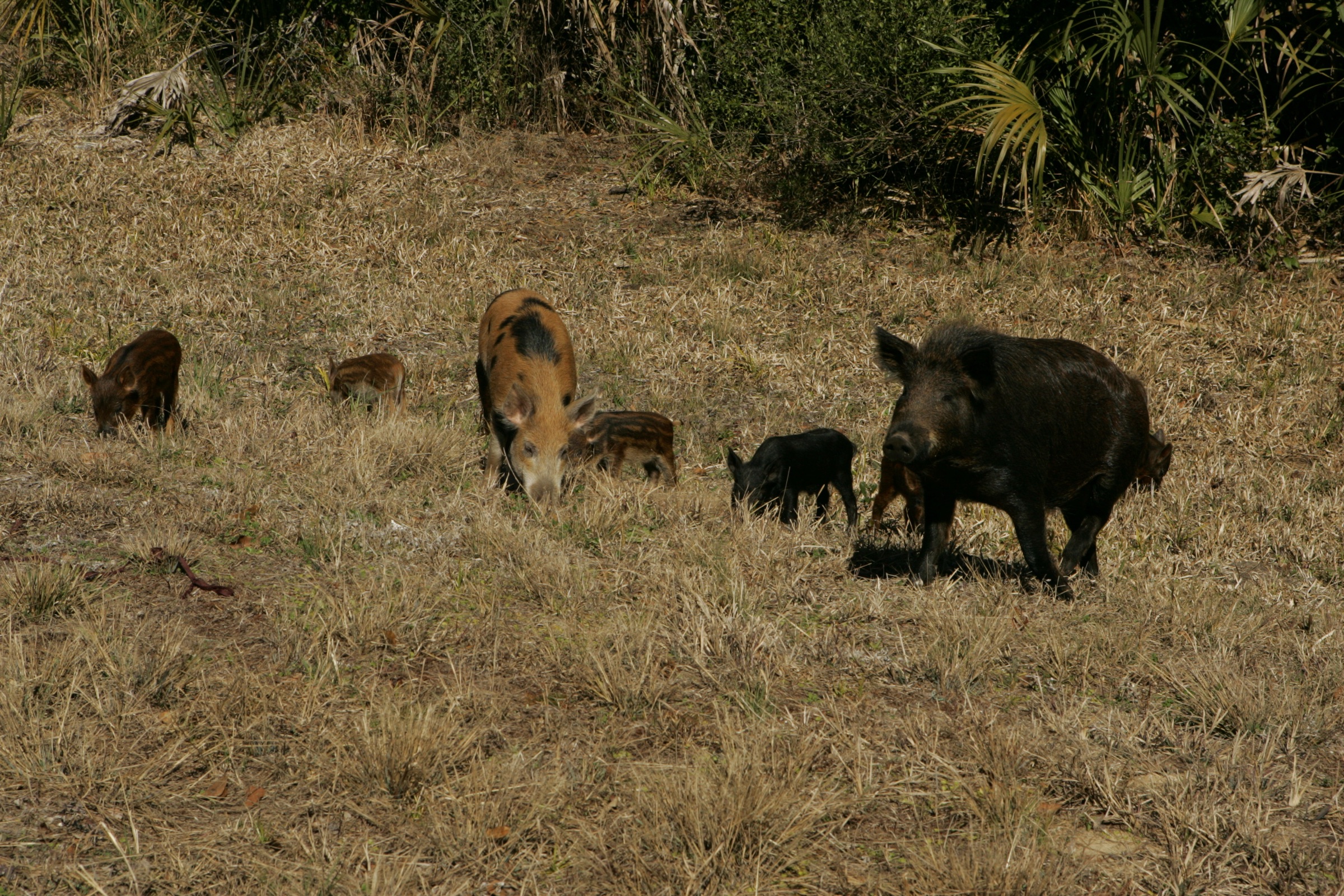
Wild hogs are a damaging invasive animal that governments are spending to control. Guided hog hunting is sold mostly as an add-on, under rules that differ sharply by state, to a buyer who looks for it online. The 2026-27 Wild Hog in the Southeast report, part of the Pine & Marsh Research industry series, sets USDA damage and funding figures, license data and our October 2026 hunting audit side by side.
It is written for lodge owners, outfitters and guides who sell or are considering a hog hunt. This post walks through the report chapter by chapter, in its own order, and says plainly where the data stop. Every figure below comes from the report and the public sources it cites.
At a Glance
The report opens with nine numbers. Six of them frame the market.
91 audited wild hog operators, 18% of the 493 audited hunting operators.
$3.4 billion in minimum annual damage from feral swine in the United States, per USDA APHIS.
9 of the 11 Southeast states eligible for the 2026 federal feral swine eradication and control funding round.
82% of hog operators (75 of 91) also sell another species, so hog is mostly an add-on.
4.71 million paid hunting license holders in the 11 states in 2024, 30% of the U.S.
A mean digital health score of 5.56 for hog operators, against 5.23 for hunting overall and 5.09 for the 1,546-operator Southeast benchmark.
The last three show the storefront: 8% show an online booking engine against 27.0% in the benchmark, and 28% have FAQ content against 36.9%.
The Animal and the Problem
Feral swine are treated by the U.S. Department of Agriculture as a damaging invasive animal. The report uses only what USDA's Animal and Plant Health Inspection Service (APHIS) and the Natural Resources Conservation Service (NRCS) publish, and it does not describe the animal's biology or behavior beyond them.
APHIS gives a minimum annual damage cost of $3.4 billion in the United States and cites an estimated $2.5 billion a year in damage and control costs to agriculture. That second figure is a separate measure, not a part of the first. APHIS also reports that 12 states have eradicated feral swine since 2014. No current state-level damage figure was found.

The population figures are dated. APHIS's five-year report covering fiscal years 2014 to 2018 put the national population at more than 6 million animals, in at least 38 states and about 43% of U.S. counties. The report says to read that as context, not a current count.
Federal money is aimed at control. In July 2026 NRCS announced $35 million for the 2026 round of its Feral Swine Eradication and Control Pilot Program, part of a $105 million total by NRCS and APHIS. From 2020 to 2024 the pilot invested $41 million in 34 projects across 12 states. Nine of the report's 11 states are eligible: Alabama, Arkansas, Florida, Georgia, Louisiana, Mississippi, North Carolina, South Carolina and Tennessee. Kentucky and Virginia are not. Eligibility covers control projects on agricultural land and says nothing about hunting rules.
What it means for a hunting business is the chapter's sharpest point. The data do not say how much recreational or guided hunting contributes to control, so the report does not claim it does. Describe your hunt as a hunt. Do not claim your hunts reduce hog numbers, protect crops or support a government program unless you hold the agreement or permit that says so.
Demand: Hunters as Context
There is no count of hog hunters. No source collected gives a national, regional or state count of hog hunters, a hog harvest figure or a count of guided hog hunts. The National Survey does not report hogs as a group, and state license data carry no hog endorsement. So this chapter describes the pool a hog operator draws from, not the size of the hog market.
That pool is steady. In license year 2024 the 11 states had 4,714,399 paid hunting license holders, 29.9% of the U.S. total of 15,753,516, and the count was +1.1% against 2020. Density varies: Arkansas has 10.7 holders per 100 residents and Tennessee 10.1, while Florida has 1.1. License counts are not unique people and include nonresident buyers.
By state, Georgia has the most paid hunting license holders (815,738, or 7.3 per 100 residents), then Tennessee (734,342, 10.1), North Carolina (581,521, 5.3), Alabama (497,063, 9.6) and Louisiana (451,343, 9.8). Arkansas has 331,401 (10.7), Mississippi 271,751 (9.2), Florida 265,018 (1.1), Virginia 251,350 (2.9) and South Carolina 199,114 (3.6). Because multi-state buyers appear more than once, these describe context only, and the report assigns no share of them to hog hunting.
Nationally, the 2022 National Survey counted 14,374,589 hunters age 16 and older, with 11.5 million hunting big game, 5.3 million small game and 2.8 million migratory birds. Those groups do not identify hog hunters. Value added from hunting, shooting and trapping reached $16.5 billion in 2024, up 95% from $8.5 billion in 2019. That is all hunting and shooting nationally, not hog alone.
The Rules: They Differ by State
The report does not summarize state rules, and neither should an operator rely on a summary. Each state sets its own seasons, license requirements and permitted methods, and each public land manager adds its own. The guidance is short: check your state agency, and check the managing agency of any public land before you hunt or guide there.
It does flag one change. According to audit research notes citing the Kentucky Department of Fish and Wildlife Resources, Kentucky ended its year-round hog season. Confirm the current rule with KDFWR.
The chapter gives operators a checklist of what to verify: whether hogs have a season at all, what license a guest needs on private land, which methods and equipment are allowed and under what permit, what each land type allows, whether guiding for hogs needs a state guide or outfitter license, and the rules on moving or releasing animals. Never imply a hunt depends on stocking unless it is legal where you operate.
On land, the report is direct. Commercial guiding on public land generally needs a permit or special-use authorization. A guide who advertises a method or a piece of public land without the permit for it puts the business and the guest at risk. Confirm with the state wildlife agency and the managing agency before you advertise.
Where It Happens
The audit found hog operators in nine of the 11 states. Georgia has 18, Alabama 16 and South Carolina 16, together 50 of 91 (55%). Florida has 12, North Carolina 9, Tennessee 7, Louisiana 5, and Arkansas and Mississippi 4 each. Kentucky and Virginia have none.
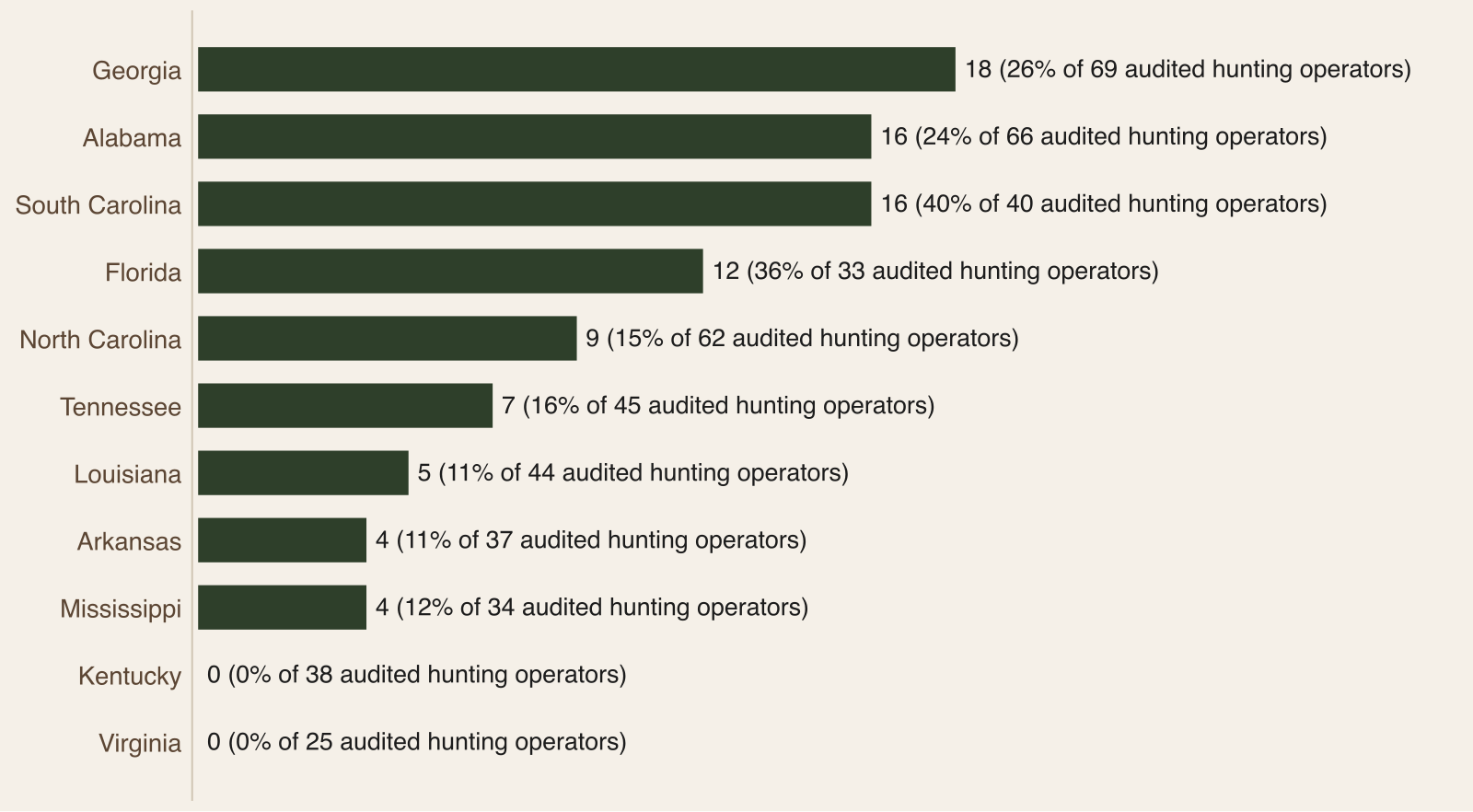
As a share of each state's own audited hunting operators, hog is largest in South Carolina (40%), Florida (36%) and Georgia (26%), and smallest among states that have any in Arkansas (11%). The report is careful with the zeros. The two states with no hog operator are also the two not eligible for the 2026 funding round, but the data cannot say whether the facts are related. The audit counts a sample of operators it could verify, so a small count does not mean a state has few hog hunts.
The full state table pairs each count with the state's audited hunting operators: Georgia 18 of 69, Alabama 16 of 66, South Carolina 16 of 40, Florida 12 of 33, North Carolina 9 of 62, Tennessee 7 of 45, Louisiana 5 of 44, Arkansas 4 of 37 and Mississippi 4 of 34, with Kentucky at 0 of 38 and Virginia at 0 of 25. Three cautions apply. A zero does not mean none are sold. The public license data and the audit counts do not rank the states in the same order. And only Georgia, Alabama and South Carolina have at least 15 audited hog operators, so the other six states are pooled in the business chapter. On Kentucky, the report notes only that its year-round season ended and that no Virginia hog outfitter was found, so confirm the Kentucky rule with KDFWR.
The Business Landscape
The audit sample is 493 hunting businesses in 11 states, 314 newly verified in October 2026 and 179 drawn from the larger Southeast audit. Of those, 91 carry a wild hog tag. It is a verified sample, not a census, and it is kept separate from the 1,546-operator benchmark.
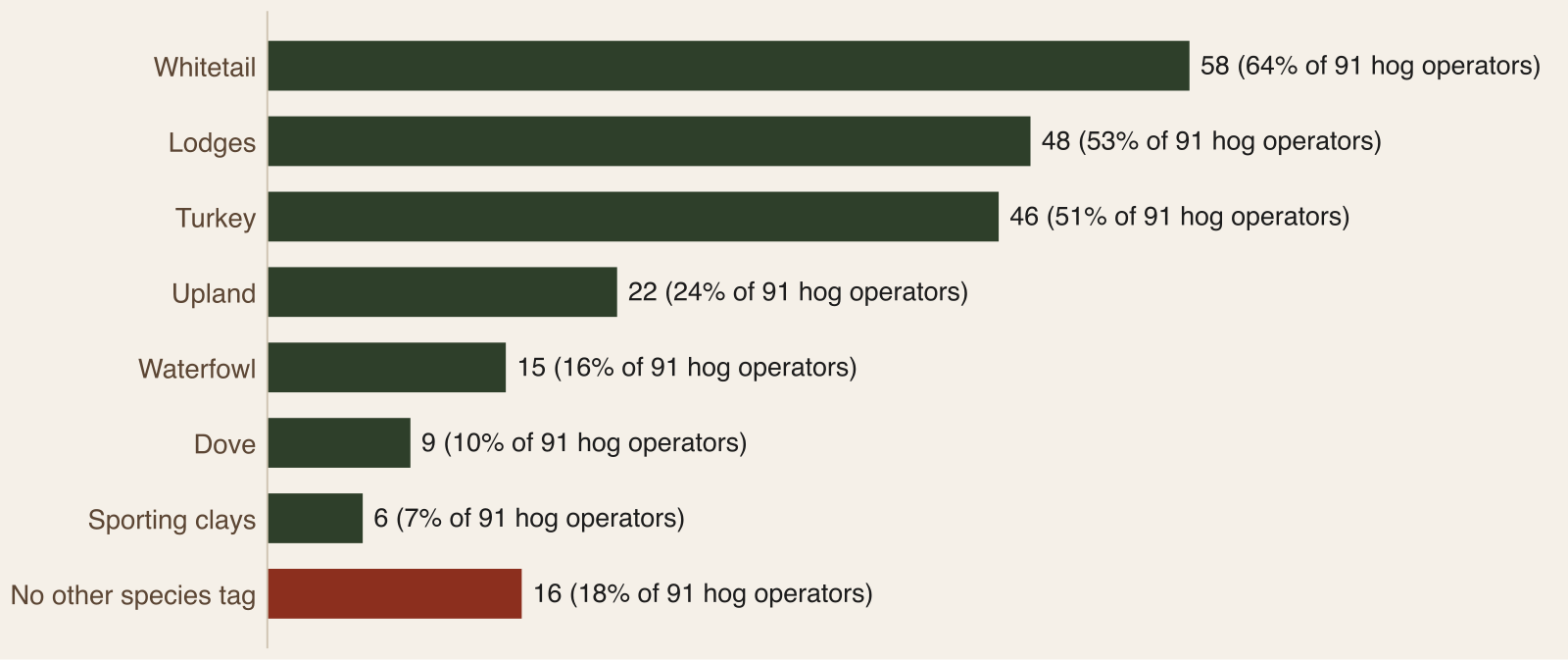
Hog is mostly an add-on. Of the 91, 75 (82%) carry at least one other species tag and only 16 (18%) carry hog alone. 58 are also tagged whitetail, 48 lodges, 46 turkey, 22 upland, 15 waterfowl, 9 dove and 6 sporting clays. A hog buyer lands on a homepage built to sell deer, turkey or rooms and has to find the hog page quickly.
Online, 97% of hog operators have their own website, and 88 of 91 sites were read. Mean digital health, a 1 to 10 score our researchers assign from observed evidence, is 5.56, a little above the 5.23 for hunting and 5.09 for the benchmark. 23% of hog operators score 4 or below, against 34% for hunting and 39.8% for the benchmark. Only sporting clays (5.87) and lodges (5.82) score higher among the species tags in the report's table.
The report's species-tag table puts hog in context. Mean digital health runs from 5.87 for sporting clays (92 operators) and 5.82 for lodges (163) through hog at 5.56 (91), waterfowl 5.32 (139), turkey 5.30 (124), upland 5.29 (182) and whitetail (178), down to dove at 5.11 (28). The spread among the eight is small, and the tags overlap because one operator can guide several species. 11% of hog operators score 8 or above, the same as for all audited hunting operators.
By state, only Georgia, Alabama and South Carolina have enough operators to show separately. Mean digital health runs from 4.56 in Alabama to 6.06 in Georgia, but the report treats state differences smaller than about 10 percentage points, or half a point of score, as noise, since the largest state rests on 18 sites.
The state detail is worth a look if you operate in one of the three. Georgia averages 6.06, with 22% of sites carrying FAQ content, 33% offering a newsletter signup and 17% showing online booking. Alabama averages 4.56, with 13% FAQ, 7% newsletter and 13% online booking. South Carolina averages 5.81, with 25% FAQ, 38% newsletter and 6% online booking, and half of its sites with a detectable copyright year show 2023 or earlier. The other six states combined, 41 operators, average 5.63, with 38% FAQ content and 3% online booking. Even the largest state rests on 18 sites read, so treat these as a description, not a ranking.
How Buyers Search and Book
The audit shows what a visitor finds on a homepage, not how buyers search. As general guidance, buyers tend to start with a place and a kind of hunt, and many arrive through a deer, turkey or lodge page and add the hog hunt once they see it. They want to know what the hunt includes, what land it is on, whether a guide is provided, party size, what license a guest needs and what happens in bad weather. Because rules differ, they also want to see that the operator knows them.
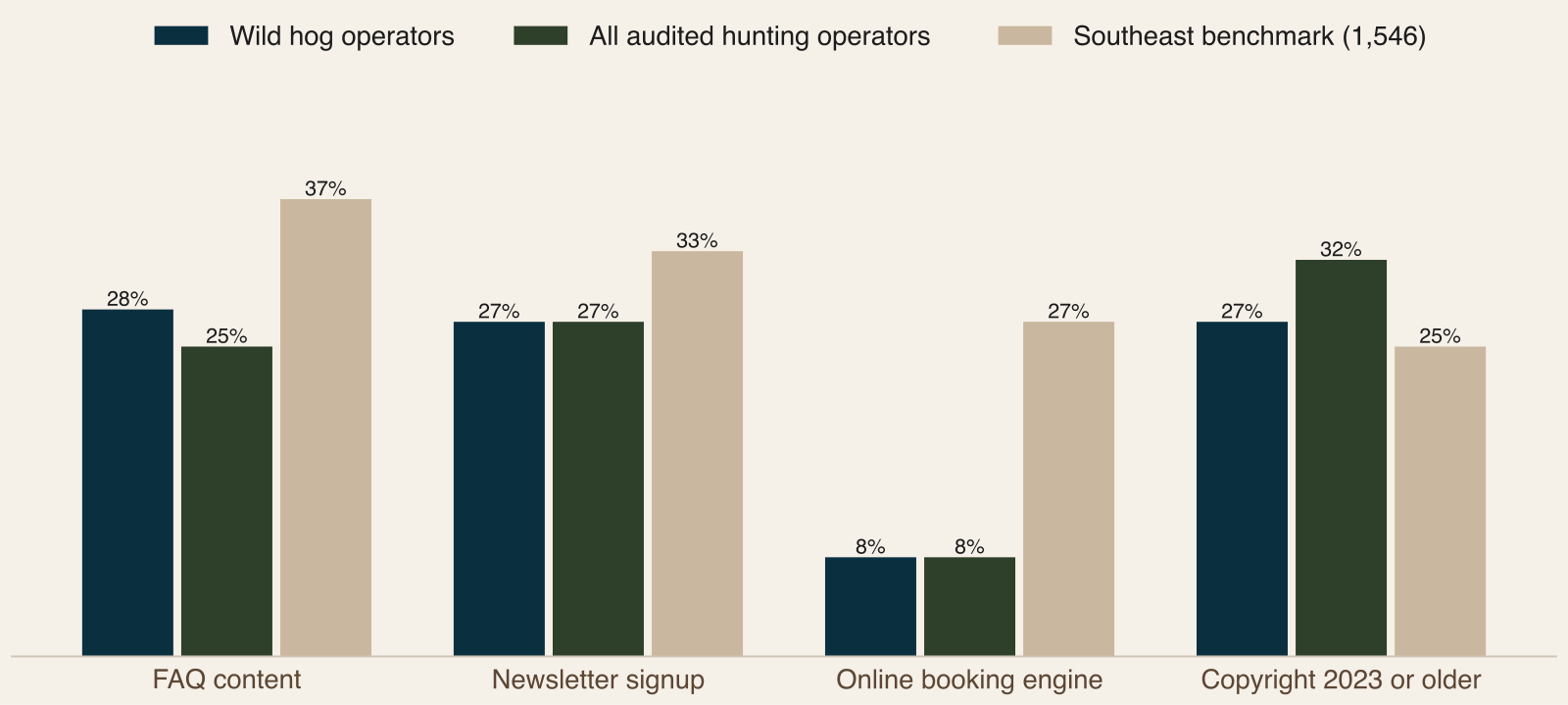
The homepage signals, from the 88 hog sites read:
8% show an online booking engine (7 sites), against 8% for hunting and 27.0% in the benchmark.
28% carry FAQ content, against 25% for hunting and 36.9% in the benchmark. Only 1 of 88 uses FAQ structured data.
27% offer a newsletter signup, against 27% for hunting and 32.7% in the benchmark.
27% of sites with a detectable copyright year show 2023 or earlier, against 32% for hunting and 25.0% in the benchmark.
These are lower bounds. Low online booking is not a surprise for an add-on sold inside a lodge package, but the report calls it a gap: a buyer who finds the site late in the evening has nothing to act on until morning.
Among the eight species tags, hog ranks fourth for online booking share, and the tags run only from 5% to 14%, so the gap is a hunting-wide one. The audit records whether a booking engine is present and not which one, so no platform breakdown is shown. The same goes for FAQ content: the questions buyers ask are specific and repeated, namely what the hunt includes, land type, party size, guides, licenses and permits, lodging, weather and cancellation, and each is a short page section a competitor in the same state may not have. 59% of hog sites have some structured data, much of it added automatically by website builders, but only 1 of 88 marks its answers up. A newsletter signup matters for guests who return to the same lodge season after season, because a list is the cheapest way to fill dates, and a footer from three seasons ago tells a buyer deciding where to send a deposit that the business may have stopped.
The Booking Calendar and Six Moves
The calendar is general guidance, not audit or public data, and it gives no season dates because rules differ by state. Its logic follows the lodge's main species. In spring and summer, buyers who stayed for another species may ask about adding a hog hunt, so publish the hog hunt as its own page with what it includes and the state-specific license note, and review the site for stale text and the copyright year. In late summer and early fall, planners, groups and out-of-state buyers settle on a destination, so post dates and packages, send them to past guests first, and put availability and a deposit step on the booking page. During the main seasons for other species, offer hog as an add-on on the same booking page and answer messages the same day. The rest of the year depends on what the state allows, so check current rules before advertising any date, say so with the rule's source where hunting is allowed, and ask every party for a review.
The report also gives operators a short exercise for building their own calendar. List your dates: what the state allows, your peak weeks, blackout dates and any condition in your permits that affects when you can hunt. Mark your lead times by pulling the last two seasons of bookings and noting how many days ahead each type of party booked, and write your weather and cancellation policy once and show it before the deposit step. Then schedule your content to lead them, posting the next phase's page, email and offer before the first buyers of that phase start looking.
The six moves are below. For the marketing playbook, see Marketing a Hog Hunting Outfitter in the Southeast.
Give hog its own page, and keep it on the main booking path. 75 of 91 audited hog operators sell something else too, so a dedicated page with its own details, photos and dates helps a buyer who arrives from search, and an add-on option helps a lodge guest who arrives for another species.
Say which rules apply and where to check. State what your hunt requires, which permits you hold and the words "check your state agency" for anything that varies. Never imply a method or a piece of public land is open without the permit for it.
Publish packages, dates and availability early. 27% of hog sites with a detectable copyright year show 2023 or earlier, against 25.0% in the benchmark, so post packages and policies by late summer and update dates the day you confirm them.
Make it possible to book, or hold a date, online. 8% of the 88 hog sites read show a booking engine, against 27.0% in the benchmark. Even a deposit link or a date-hold form turns a late-night visit into a booking.
Answer the buyer's questions, and mark them up. Cover inclusions, land type, party size, guides, licenses and permits, lodging, weather and cancellations, then publish them in structured form.
Keep a list and use it. 27% of these sites offer a newsletter or email signup, against 32.7% in the benchmark, and returning guests are the cheapest bookings.
What the Report Cannot Tell You
The data gaps are part of the report, and they shape how to read the chapters above.
No source counts hog hunters, hogs taken or guided hog hunts, and no hog license endorsement data were found. License and National Survey figures are context for all hunting.
The latest population and range figures are from fiscal years 2014 to 2018, and no current state-level damage figures were found.
State rules are not summarized, and the one rule noted, Kentucky's end of its year-round hog season, comes from audit research notes and should be confirmed with KDFWR.
The audit's hog tag is a single category. It does not separate guided hunts from lodge add-ons, dog hunts from thermal hunts, or private land from public land.
The hunting audit came in below its target in some states because researchers stopped rather than pad the sample, and no Kentucky or Virginia hog operator was found.
What It Means for Operators
Three things stand out. The public interest in controlling feral swine is documented and large, but the data do not connect it to your hunts, so sell the hunt honestly. There is no demand count either, so judge your market from your own bookings and the steady license base around you.
Because hog is an add-on at 82% of audited operators, the work is mostly inside a lodge or outfitter site: a clear hog page, a way to add it at booking, and answers to the questions guests ask.
Finally, rules are the business risk. They change at every state line and on every land type, and the report's advice is the same each time: say what your hunt requires, name the permits you hold, and send guests to the state agency for anything that varies.
Get the Report
The full report adds the state tables, the species-tag comparison, the booking calendar and a methodology chapter with data gaps and sources. If you can do one thing this month, the report's advice is to put the hog hunt, what it requires of a guest, the permits you hold and a way to hold a date on the homepage, make it work on a phone, and add a short FAQ with the questions your last ten callers asked.
Download the full 2026-27 Wild Hog report (free with your email).
Frequently Asked Questions
How much damage do feral swine cause?
USDA APHIS gives a minimum annual damage cost of $3.4 billion in the United States, and cites an estimated $2.5 billion a year in damage and control costs to agriculture, a separate measure and not a part of the $3.4 billion. APHIS also reports that 12 states have eradicated feral swine since 2014. The report found no current state-level damage figure, and its population figures, more than 6 million animals in at least 38 states, come from fiscal years 2014 to 2018, so read them as context and not a current count.
How many people hunt wild hogs?
Nobody knows. No source collected counts hog hunters, hogs taken or guided hog hunts, the National Survey does not report hogs as a group, and state license data carry no hog endorsement. The report instead describes the pool: 4,714,399 paid hunting license holders in the 11 states in 2024, 29.9% of the U.S. total and up 1.1% against 2020, a steady base. Licenses are not unique people and include nonresident buyers, so use them as context for all hunting.
Is hog hunting a business on its own?
Mostly not. Of 91 audited hog operators, 75 (82%) also sell another species, most often whitetail (58), lodges (48) and turkey (46), and only 16 carry hog alone. A hog buyer lands on a homepage built to sell deer, turkey or rooms and has to find the hog hunt inside it. The report treats hog as an add-on that deserves its own page, a place on the main booking path and dates that follow the lodge's main season.
What are the rules for hunting hogs?
They differ by state, land type and method, and the report does not summarize them. Check your state wildlife agency and the managing agency of any public land. The checklist covers seasons, licenses, methods and equipment, land type, guide or outfitter licensing, and the rules on moving or releasing animals. Kentucky is reported to have ended its year-round hog season, so confirm with KDFWR. Never advertise a method or public land you lack the permit for.
Can I say my hunts help control hogs?
Only if you hold the agreement or permit that says so. The data do not show how much guided hunting contributes to control, and the federal program, $35 million in the 2026 round, part of a $105 million total, funds control projects on agricultural land in 9 of the 11 states. The report advises describing a hunt as a hunt, not as a control program, because buyers and regulators can both check.
Where are the audited hog operators?
The audit found 91 in nine of the 11 states. Georgia has 18, Alabama 16 and South Carolina 16, together 50 (55%), followed by Florida (12), North Carolina (9), Tennessee (7), Louisiana (5), and Arkansas and Mississippi (4 each). Kentucky and Virginia have none. As a share of each state's audited hunting operators, hog is largest in South Carolina (40%), Florida (36%) and Georgia (26%). The audit is a verified sample, so a small count does not mean a state has few hog hunts.
How do hog operators' websites compare?
Mean digital health is 5.56 out of 10, a little above the 5.23 for hunting overall and 5.09 for the benchmark, and 23% score 4 or below. Of the 88 sites read, 8% show online booking, 28% carry FAQ content, 27% offer a newsletter signup and only 1 uses FAQ structured data. The state spread, from 4.56 in Alabama to 6.06 in Georgia, is within what the sample can support, since differences under about half a point are noise.
Can I guide hog hunts on public land?
Only with the right authorization. Commercial guiding on public land generally needs a permit or special-use authorization from the managing agency, and each manager sets its own rules for wildlife management areas, national wildlife refuges and national forests. A guide who advertises a method or a piece of public land without the permit for it puts the business and the guest at risk. Confirm with the state wildlife agency and the managing agency before you advertise.
Sources
USDA Animal and Plant Health Inspection Service, Feral Swine web page (damage cost figures, accessed October 2026), and National Feral Swine Damage Management Program Five Year Report, FY14-FY18
USDA Natural Resources Conservation Service, news release of July 23, 2026, on the 2026 Feral Swine Eradication and Control Pilot Program
U.S. Fish and Wildlife Service, Wildlife and Sport Fish Restoration Program: certified paid hunting license holders, license years 2020 to 2024
2022 National Survey of Fishing, Hunting, and Wildlife-Associated Recreation, U.S. Fish and Wildlife Service and U.S. Census Bureau
U.S. Bureau of Economic Analysis, Outdoor Recreation Satellite Account, March 2026 release (2024 data)
Pine & Marsh hunting audit, October 2026 (493 operators), and the Pine & Marsh Southeast audit, October 2026 (1,546 operators), used as the benchmark


Comments