
Land Between the Lakes Turkey Ecology: Hardwood Forest and Edge Habitat
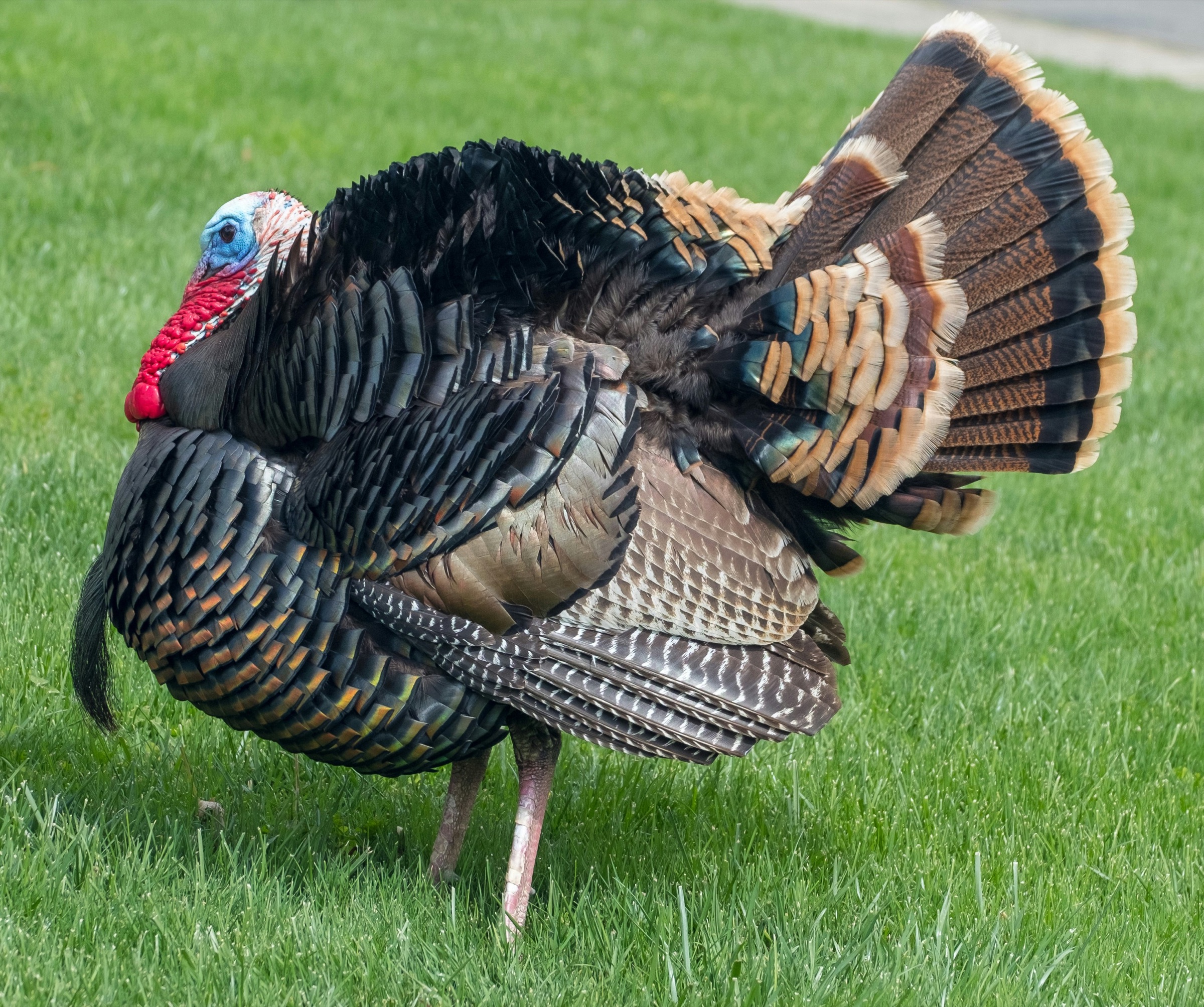
In the second week of November the oaks on the Land Between the Lakes peninsula have dropped most of their leaves, and the woods have gone quiet in the way they do when the acorns are down and the animals are busy. Walk a ridge road north of the Trace and the ground is a drift of brown oak and hickory leaf, with the gray trunks of big trees standing in ranks to the sky. There is very little between the leaf litter and the canopy. A turkey moving through that kind of forest in fall is looking for acorns and hickory nuts on the ground and for a place high in an old tree to roost, and it finds both in the stands the Forest Service describes as mature oak and hickory.
Then the road breaks out into a field. A hayfield, a wildlife planting, or a strip of grassland on a power line right-of-way throws sunlight on the ground, and the picture changes. The turkeys that were invisible in the timber are suddenly walking the edge, working through grass and seed heads in the low light. That sudden contrast, a tall quiet forest broken by small bright openings, is the story of turkey ecology at Land Between the Lakes (LBL). The birds do not live in the forest or in the fields. They live in the seam between the two, and the size and quality of that seam changes with every decade of management.
LBL is also an unusual place to talk about turkeys because of who runs it and how the rules work. It is a National Recreation Area managed by the U.S. Forest Service, it sits across the Kentucky and Tennessee line, and its turkey hunting is governed by a Forest Service fact sheet that overlays two state agencies. This post is the ecology and rules companion to our marketing and field coverage of the peninsula: the habitat, the biology and the agency data, with every number dated.
The Landscape: A Maturing Oak-Hickory Forest Between Two Lakes
What LBL is, in the agency's own numbers
The Forest Service's December 2004 Land and Resource Management Plan (the Area Plan) is the governing planning document the agency still publishes for the peninsula. Its acreage table, Table 1.2, prints a total of 171,280 acres, and it adds a disclaimer that the acres were rounded and that prescription allocations carry a margin of error from the digital map. The LBL home page, in a promotion for the visitor app, uses the rounder phrase 170,000 acres. Both numbers describe the same place, and the plan table is the more precise one for the date it was written.
The plan describes a landscape bounded by water. Kentucky Lake and Lake Barkley make up 96 percent of the boundary, which is a share of the perimeter and not a split of the land. The recreation area sits in Trigg and Lyon counties in Kentucky and Stewart County in Tennessee. The plan's history section explains how it got here: the federal government began acquiring land in 1937, when 65,000 acres were designated the Kentucky Woodlands National Wildlife Refuge, the recreation area itself began in 1963, the Tennessee Valley Authority assumed overall management in 1964, Congress passed the LBL Protection Act in 1998, and management moved to the Forest Service in 1999.
Forest cover, and what the plan says about it
The plan's vegetation section is the best single description of what a turkey sees on the peninsula. It says about 92 percent of the land base is forest cover, primarily mature forest dominated by oak and hickory, with maple, beech, yellow poplar, pine, bottomland hardwood and reverted old fields as other cover types. When TVA took over management in 1964, the plan says, forest occupied about 82 percent of the land base. In other words, the peninsula has been filling in with trees for sixty years. The plan adds that mature forests on LBL generally range from 60 to 90 years old.
Open land is the other half of the turkey story, and the plan measures it precisely: managed open land, meaning cultivated openings and grassland, was about 10,650 acres, and the share of the land base occupied by open land had fallen from about seven percent to about six percent over the decade before the plan, a decline the plan attributes to forest encroachment and reduced active management. Separately, the plan's General Forest prescription lists 5,300 acres of open lands inside a 104,240-acre allocation, which is a different measurement of a different category. The plain summary is that open land on LBL is a small share of the whole, roughly six percent of the land base in the plan's own words, and that it has been shrinking.
The forest is aging, and the oaks are not replacing themselves quickly
The plan reports a 1996 Continuous Forest Inventory that showed a 30-year trend toward bigger trees, with a shift from intermediate-sized trees to an abundance of trees more than 16 inches in diameter. The same inventory showed an increase in maple and poplar and a decrease in oak. Maple is increasing in the understory mainly on moist sites below 460 feet of elevation, and the plan notes that even on drier ridges oak regeneration is often sparse. It also says the age of the oak component and the condition of advanced oak regeneration raise concern about future oak decline from disease and insects. That inventory is nearly thirty years old and is the most recent one the plan cites, so it describes a trend and a worry and not a 2026 measurement.
How a Turkey Uses a Closed Forest
Nesting cover under a high canopy
An Eastern wild turkey (Meleagris gallopavo silvestris) hen nests on the ground, and the nest has to be hidden. A hen needs something to sit under or against, which in a mature hardwood forest means a downed treetop, a thicket of briars, a patch of young saplings where a tree has fallen, or the edge of an opening where grass and brush grow thick. A closed canopy shades the ground and suppresses the dense low cover that makes that concealment. The plan's description of the desired future condition for the peninsula reads accordingly. It calls for patches of young trees and dense regenerating forest that provide food and cover for deer and turkey, and for fire-maintained open forest and grassland where deer and turkey use the open forests and grasslands for feeding.
Brood habitat: the problem with a dark forest floor
A young poult spends its first weeks largely on the ground and depends on insects for protein, which means a brood needs a feeding place where it can walk freely and find invertebrates, with escape cover close by. This is where a shaded, closed-canopy hardwood forest tends to fail. There is little herbaceous growth, so there is little insect habitat at ground level, and little cover for a brood to hide in.
The best peer-reviewed evidence on this question comes from research done nearby, not on LBL itself. McCord, Harper and Greenberg, in a study run between 2000 and 2009 in the Ridge and Valley province of Tennessee and published in 2014, tested silvicultural treatments in mature upland hardwoods. The Forest Service catalog record of the paper describes closed-canopy hardwoods with a thin understory as suboptimal brood habitat and recommends canopy coverage of 60 to 70 percent where turkeys are a focal species, with low-intensity fire every three to five years to maintain brood cover. The authors also reported that invertebrate biomass did not increase after the treatments, though every treatment area still held enough invertebrates to meet the protein needs of a brood of 10.1 poults for 28 days on less than 30 hectares. That is a Tennessee Ridge and Valley result. It is a useful guide to how the biology works, and it is not a measurement taken at LBL.
An Illinois conference abstract by Parker and colleagues (2019), based on 47 hens tracked with micro-GPS tags from 2015 to 2017, reported that during the reproductive period hens selected burns one to two years old over burns two to three years old. The same abstract found that at the seasonal scale hens selected unburned forest over burned forest, and the authors stressed a mix of burn ages, which they call pyrodiversity. That is Illinois, not LBL. Together with the Tennessee paper, it suggests that recently burned stands matter during nesting and brood-rearing as part of a patchwork, not as a replacement for unburned cover.
Roosting, mast and the daily shuttle
Turkeys roost in tall trees, and in a forest of 60 to 90 year old oaks and hickories roost trees are plentiful. A brood moves between feeding grounds by day and a safe roost at night, and the shorter that commute, the safer the brood. On LBL the roosts are abundant and the mast is present. The scarce resource is quality opening habitat close to both.
Open Land and Fire: The Management That Builds Brood Habitat
Why fire is the tool
Fire is how this region kept its open woodlands and grassy barrens before European settlement, and its absence is what closes them. Nowacki and Abrams, in a 2008 review in BioScience, described how fire suppression policies beginning around the 1920s turned fire-maintained open lands across the eastern United States into closed-canopy forest, and how the added shade favors shade-tolerant, fire-sensitive species in a self-reinforcing cycle the authors call mesophication. It is an eastern United States review and not a LBL study, but the maple increase that the plan reports under the LBL canopy is the same pattern at local scale.
The Area Plan sets prescribed fire as an objective. Objective 5j calls for burning an average of about 10,000 acres per year by the end of the first decade of the plan, with a long-term objective of 21,000 acres per year on average. Those are planning targets from 2004, not accomplishment figures. For an actual recent number, the Forest Service's own LBL news release of April 27, 2026 reported that crews treated 14,152 acres with fire in the 2026 season across 20 separate prescribed burns. The release listed the goals as reducing leaf litter and downed limbs, improving wildlife habitat, helping native plants and grasses, keeping fields grassy, and knocking back invasive species such as kudzu. It also reported the first entry of prescribed fire into the area of Stewart County struck by the 2021 tornado. The release does not mention turkeys or measure habitat response, so the turkey benefit is the expected result of well-understood habitat mechanics rather than a published peninsula figure.
Oak-grassland demonstration areas
The Area Plan sets aside 8,630 acres as Oak-Grassland Demonstration Areas, one of its named prescription categories, and describes the goal of restoring open oak woodland and native grassland in those places, sustained by periodic prescribed fire. The Forest Service's 2026 turkey fact sheet from the Forest Service says the agency is partnering with the National Deer Association to improve wildlife habitat on the peninsula and that prescribed burns may occur in any season of the year. For anyone who plans a spring turkey hunt, the practical meaning is that burn status changes, and the LBL alerts page is the place to check it.
The Elk and Bison Prairie
The Elk and Bison Prairie is a 700-acre enclosure of native grassland, a habitat the Forest Service says was common in Kentucky more than a century ago, with a 3.5-mile paved loop road and elk and bison roaming free inside it, according to the Forest Service's visit page. The page says wild turkeys, other birds, small game, butterflies and prairie mammals find sanctuary there. That is a presence statement, not a nest survey, brood count or poult ratio. What can be said with confidence is that 700 acres of native grassland inside an otherwise forested landscape is the kind of structure the Tennessee and Illinois research says broods use, and that turkeys are on the Forest Service's own list of its residents.
The elk in the prairie enclosure are a separate matter from Kentucky's free-ranging eastern elk herd. The Kentucky Department of Fish and Wildlife Resources' 2025-2026 elk report puts that restoration herd at more than 10,000 animals and does not mention LBL.
Population Signals: What the Agencies Publish and What They Do Not
Kentucky's brood survey and the western region
The Kentucky Department of Fish and Wildlife Resources (KDFWR) runs a summer brood survey each July and August, and its 2025 report estimated a statewide poult-per-hen index of about 3.5, up from 2.7 in 2024. The western region, the closest published geography to LBL, did not follow that improvement. It fell to 2.4 in 2025 from 3.1 in 2024, based on 242 observations, with a 95 percent confidence interval of 2.2 to 2.7. The report says production leveled off generally around 2.0 poults per hen, which has been treated as a break-even level for population sustainability, and notes that a change in the calculation method used since 2017 produces estimates about 0.4 higher than the older method.
The report also credits periodical cicadas for part of the swings. It says the 2025 uptick in the eastern two-thirds of the state rivaled 2008, the last emergence of the 17-year Brood XIV, and that the 13-year Brood XIX emerged in several western counties in 2024 and contributed to improved regional production, with a Tennessee Tech researcher documenting better nest success, renesting and brood success that year compared with 2023. None of that is an LBL measurement. The report has no row for LBL, Trigg County or Lyon County, and so the 2.4 figure should be read as a western Kentucky index and not a peninsula number.
Tennessee and the missing peninsula
The Tennessee Wildlife Resources Agency (TWRA) publishes annual spring turkey harvest survey reports on its turkey page, and LBL is not reported there as a separate unit. The Forest Service fact sheet tells hunters to report harvests through the state systems and to name Land Between the Lakes as the location, which is the data trail a future peninsula harvest number would need.
Banding on the Kentucky side
One program touches the peninsula directly. The Forest Service fact sheet says KDFWR has trapped and banded turkeys on the Kentucky portion of LBL to assess gobbler harvest rates and population health, and asks hunters who take a banded bird to report the band number. The KDFWR brood report cites a 2024 Tennessee Tech thesis estimating that hunters take about 30 percent of adult male turkeys but about six percent of one-year-old jakes, a result from banding work in Kentucky and Tennessee rather than an LBL figure. Hunters who want peninsula banding results should ask KDFWR.
Hunting at LBL: Two States, One Federal Card
The 2026 spring dates and rules, as the Forest Service printed them
The Forest Service's 2026 Turkey Hunting Fact Sheet, revised January 2026, states that it is the official document for the hunt dates and that, if other state agencies indicate something different, the fact sheet has precedence. The 2026 spring calendar it printed was as follows. These are last season's dates, shown here to explain how the system works. Confirm the 2027 calendar with the Forest Service before planning.
On the Kentucky side, the 2026 quota hunts ran April 11 to 13 and April 18 to 20, the youth quota hunt ran March 28 to 29, and the non-quota days ran April 21 to 30. On the Tennessee side, the quota hunts ran April 4 to 6 and April 11 to 13, the youth quota hunt ran March 28 to 29, and the non-quota days ran April 17 to 26. Youth hunters on the Kentucky side are 15 and younger, on the Tennessee side 6 to 16, and one adult 21 or older must accompany one youth. Shooting hours on the Kentucky side are one-half hour before sunrise to one-half hour after sunset, and on the Tennessee side one-half hour before sunrise to sunset.
The spring bag on the fact sheet is one turkey with a visible beard in each state portion of LBL, counting toward that state's limit, and youth quota birds count toward the state's spring bag. There is no bonus turkey. Quota hunters apply online in February and are chosen in a computer drawing, and the application is at the Forest Service's LBL hunting page. The Kentucky administrative regulation that covers the area, 301 KAR 2:111, in a version effective November 17, 2021, says LBL may permit spring turkey hunting up to 23 days between the last Saturday in March and the second Saturday in May, and limits a hunter to one turkey with a visible beard during the spring quota hunt.
As of November 2026, the Forest Service had not posted a 2027 LBL turkey fact sheet. KDFWR's spring turkey page still listed 2026 statewide dates, a youth season of April 4 to 5 and a general season of April 18 to May 10. TWRA has published 2027 statewide dates for Tennessee: a Young Sportsman hunt on March 27 to 28, 2027 and a general season of April 3 to May 16, 2027. Neither state's statewide dates are the LBL calendar, which is a separate Forest Service document in both states. Confirm with LBL and with each state agency.
Permits, calling and other rules
Every hunter 16 or older needs an LBL Hunter Use Permit in addition to state licenses, and the Forest Service's LBL hunting page lists the permit at $25 for one year, with a combination hunter and backcountry camping permit at $50 and a $10 quota-hunt application. The fact sheet also lists a hunter safety card as required by state regulations, and notes that licensed motorized vehicles are permitted on numbered roads only.
Calling that imitates a wild turkey is prohibited at LBL from March 1 until turkey season opens, though owl and crow locator calls are allowed. Bait, feed and mineral attractants are prohibited, hog hunting is illegal, and thermal imagery, infrared optics and artificial light to locate wildlife are prohibited. Portable blinds and trail cameras must carry the owner's name, address and phone number, may go out no more than two weeks before the season, and must come out within one week after it, and placement does not reserve a site. The LBL check station requirement has been removed, and harvests are reported through the state systems.
Fall turkey hunting is archery only
Fall turkey hunting at LBL occurs during the area's archery deer season, and the 2026 fact sheet states that firearms are not permitted for fall turkey. The bag is a single turkey of either sex in Kentucky and a single bearded turkey in Tennessee. The fact sheet said the 2026 fall dates were to be announced in summer 2026, and the LBL hunting page directs hunters to the deer hunt fact sheet for those dates. That fall rule is tighter than the Kentucky regulation's general window, which would allow firearm turkey hunting between October 15 and January 31, and so the Forest Service fact sheet, which says it takes precedence, is the document to follow.
Private ground, guided hunts and responsible practice
LBL is public land, and the hunting is do-it-yourself. The Forest Service's LBL hunting page lists no guided or outfitted hunting. Commercial guiding on national forest system land generally requires a Forest Service special use permit, and a Region 8 Forest Service page states that a special use permit is required in advance of operating on national forest system lands. No one should assume that a paid guide may lead a turkey hunt on the peninsula. Anyone who wants to ask about commercial use should contact LBL directly at 800-525-7077 or LBLInfo@usda.gov, and a hunter who wants a guided hunt should look at private land in the region, where a landowner or licensed operator sets the terms.
The fact sheet's safety advice is worth repeating: see the beard before you shoot, wear an orange vest when carrying a turkey out, and check the burn alerts before heading in.
What It Means on the Ground
The practical picture is a forest that is old, rich in mast and roost trees, and short of open habitat. The agency numbers show roughly six percent of the land base in open lands in 2004, a large and active 2026 fire season, and a 700-acre prairie in the middle. There is no peninsula poult ratio, no separate harvest total, and no measured brood response to the prairie or the burns.
For a hunter, that means scouting the seams. Look where mature timber meets a field, a power line, a burn unit or a forest road, and look for where the ground cover stands thick enough to hide a hen. For a landowner on the private ground that surrounds the peninsula in Trigg, Lyon and Stewart counties, the research points to the same ingredients: open woodland, a mix of recently burned and recovering ground, and nearby escape cover. A forest that keeps aging without fire drifts toward the shaded, maple-rich condition the plan describes, and the habitat work that matters most is the cycle of burning, thinning and planting that keeps light on the ground.
Key Takeaways
The Forest Service's December 2004 Area Plan prints 171,280 acres for Land Between the Lakes, and describes about 92 percent forest cover that is mostly mature oak and hickory, up from about 82 percent when TVA assumed management in 1964.
The plan puts managed open land at about 10,650 acres, roughly six percent of the land base and down from about seven percent over the preceding decade.
Prescribed fire is the main habitat tool. The Forest Service reported 14,152 acres treated across 20 burns in the 2026 season, against a 2004 planning target of about 10,000 acres a year.
The state turkey reports do not break out the peninsula. Kentucky's 2025 western region index was 2.4 poults per hen, and that is a regional figure, not an LBL figure.
The January 2026 Forest Service fact sheet governed last season's hunt dates, which differ for the Kentucky and Tennessee sides and include a quota hunt drawn by computer. The 2027 LBL fact sheet had not been posted as of November 2026.
The spring bag on the 2026 fact sheet is one bearded turkey per state portion, fall turkey hunting is archery only, and bait, thermal optics and pre-season calling are prohibited.
Guiding on this national recreation area is not something to assume. Commercial guiding on national forest land generally requires a special use permit, and the LBL staff are the people to ask.
For the Operators
For lodges, outfitters and guides who market in the western Kentucky and Tennessee border country, the peninsula is a gift and a boundary at once. It is a huge block of public hunting land that drives demand, and its rules, not yours, govern what happens on it. The honest approach is to write about the ecology accurately, to send readers to the Forest Service's own fact sheet for dates and permits, and to be clear that your services are on private land and not on the recreation area unless you hold the right Forest Service authorization.
The research also hands you a content angle that most operators miss. Turkeys on and around LBL respond to the same things as turkeys everywhere in the Southeast: nesting cover, brood feeding grounds and mast. A property near the peninsula that explains, with dated agency sources, how it manages openings, fire and edge habitat for those needs is making a more credible argument than one that promises big birds. Pine & Marsh builds that kind of source-backed content for outdoor businesses in the region.
Frequently Asked Questions
How many acres is Land Between the Lakes?
The Forest Service's December 2004 Area Plan prints 171,280 acres in its prescription acreage table, with a note that the figures were rounded. The LBL home page uses the rounder 170,000 acres in a promotion for its visitor app. Both describe the same National Recreation Area, which sits in Trigg and Lyon counties in Kentucky and Stewart County in Tennessee.
Is there a poult-per-hen ratio for Land Between the Lakes?
Not separately. KDFWR's 2025 brood survey reported a western Kentucky index of 2.4 poults per hen, and LBL is not broken out in the state reports. Treat any LBL-specific brood number you see online with caution unless it names a Forest Service or state report.
How much open land does Land Between the Lakes have?
The 2004 Area Plan says about 10,650 acres of open lands, cultivated and grassland combined, which it describes as roughly six percent of the land base, down from about seven percent over the preceding decade. The plan's objective is to maintain approximately 10,600 acres. These are 2004 figures; check with LBL for current open-land acreage.
What were the 2026 spring turkey dates at LBL?
The Forest Service's January 2026 fact sheet printed Kentucky quota hunts of April 11 to 13 and April 18 to 20, Tennessee quota hunts of April 4 to 6 and April 11 to 13, a youth quota hunt on March 28 to 29, and non-quota days of April 21 to 30 in Kentucky and April 17 to 26 in Tennessee. Those were last season's dates. Confirm the 2027 calendar with LBL before planning.
Can I hunt turkeys at LBL in the fall?
Only with archery equipment, during the area's archery deer season. The 2026 fact sheet says fall turkey hunting with firearms is not permitted on LBL, and it allows one turkey of either sex on the Kentucky side and one bearded turkey on the Tennessee side. The sheet said the 2026 fall dates would be announced in summer 2026, so check the LBL deer hunt fact sheet.
Can a guide take me turkey hunting at LBL?
Do not assume so. The Forest Service's LBL hunting page lists no guided hunting, and commercial guiding on national forest system land generally requires a Forest Service special use permit. Contact LBL at 800-525-7077 or LBLInfo@usda.gov to ask. Guided hunts are generally found on private land in the surrounding counties.
Citations and Sources
U.S. Forest Service, Land Between the Lakes National Recreation Area, Land and Resource Management Plan (Area Plan), December 2004, Table 1.2 and vegetation, history and objectives sections, https://www.landbetweenthelakes.us/wp-content/uploads/2025/04/Land-and-Resource-Management-Plan.pdf (accessed November 2026)
U.S. Forest Service, Land Between the Lakes, 2026 Turkey Hunting Fact Sheet, revised January 2026, https://www.landbetweenthelakes.us/wp-content/uploads/2026/01/2026-Turkey-Hunt-Brochure_FINAL.pdf (accessed November 2026)
U.S. Forest Service, Land Between the Lakes, Hunting and Fishing, https://www.landbetweenthelakes.us/outdoors-recreation/hunting-fishing/ (accessed November 2026)
U.S. Forest Service, Land Between the Lakes, LBL wraps up successful 2026 prescribed burn season (April 27, 2026), https://www.landbetweenthelakes.us/?p=6763 (accessed November 2026)
U.S. Forest Service, Land Between the Lakes, Elk and Bison Prairie, https://www.landbetweenthelakes.us/visit/elk-bison-prairie/ (accessed November 2026)
U.S. Forest Service, Land Between the Lakes, home page, https://www.landbetweenthelakes.us/ (accessed November 2026)
U.S. Forest Service, National Forests in North Carolina, outfitting and guiding permits (Region 8 statement that a special use permit is required before operating), https://www.fs.usda.gov/r08/northcarolina/permits/opportunities-new-outfitting-and-guiding-services (accessed November 2026)
Kentucky Department of Fish and Wildlife Resources, 2025 Kentucky Wild Turkey Brood Survey Report, https://fw.ky.gov/Hunt/Documents/ky-turkey-brood-survey-2025.pdf (accessed November 2026)
Kentucky Department of Fish and Wildlife Resources, Spring Turkey Hunting, https://fw.ky.gov/Hunt/Pages/Spring-Turkey-Hunting.aspx (accessed November 2026)
Kentucky Legislative Research Commission, 301 KAR 2:111, Land Between the Lakes, https://apps.legislature.ky.gov/law/kar/titles/301/002/111/ (accessed November 2026)
Kentucky Department of Fish and Wildlife Resources, 2025-2026 Elk Report, https://fw.ky.gov/Hunt/Documents/2025-2026-Elk-Report.pdf (accessed November 2026)
Tennessee Wildlife Resources Agency, Tennessee turkey hunting regulations, https://www.tn.gov/twra/hunting/big-game/turkey.html (accessed November 2026)
McCord, M., C. Harper and K. H. Greenberg, 2014, Brood cover and food resources for wild turkeys following silvicultural treatments in mature upland hardwoods, USDA Forest Service Research and Development catalog record, https://research.fs.usda.gov/treesearch/52369 (accessed November 2026)
Nowacki, G. J. and M. D. Abrams, 2008, The demise of fire and mesophication of forests in the eastern United States, BioScience 58(2):123-138, https://research.fs.usda.gov/treesearch/40238 (accessed November 2026)
Parker, C., J. Hoover, T. Benson, W. Schelsky and L. Garver, 2019, Pyrodiversity matters: wild turkey habitat selection in a fire-managed landscape, conference abstract, https://experts.illinois.edu/en/publications/pyrodiversity-matters-wild-turkey-habitat-selection-in-a-fire-man/ (accessed November 2026)
Explore More
Wild Turkey Biology and Population Ecology: A Southeast Field Synthesis
Turkey Recruitment Decline Across the Southeast: Biology, Causes, and Conservation Responses
Ozark Mountains Turkey Ecology: Arkansas's Boston Mountains and the Ozark National Forest
Marketing a Land Between the Lakes Deer Hunting Lodge: Public-Land Scale, Private-Lodge Comfort
LBL, Kentucky Lake and Lake Barkley: Marketing the Federal Peninsula and Its Two Impoundments
Inside the 2026-27 Wild Turkey Report: Record Harvests, Weak Hatches and Who Sells the Hunt


Comments