
Osceola Turkey: The Ecology of Florida's Endemic Subspecies
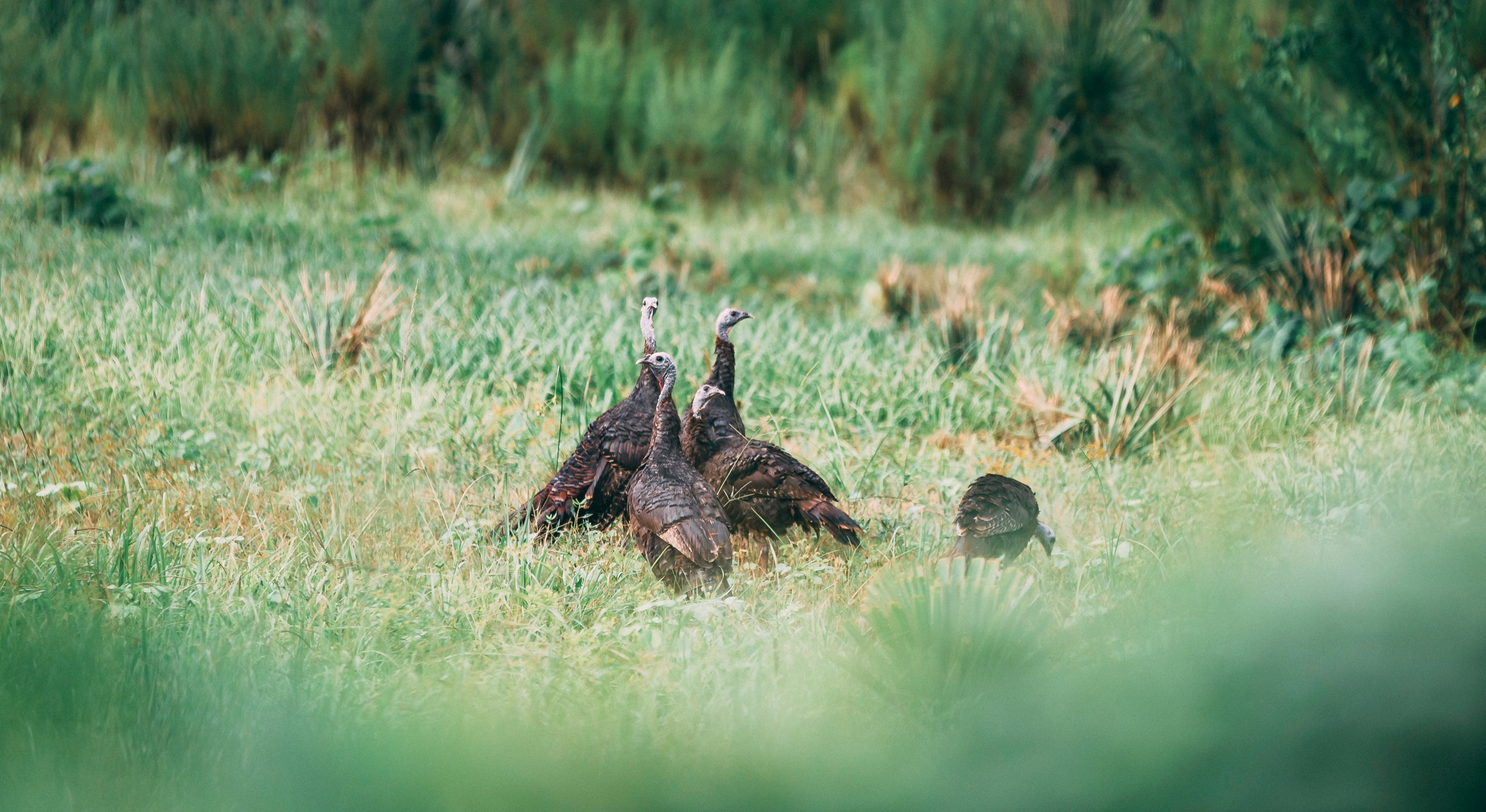
Stand at the edge of a central Florida pasture an hour after sunup in March and the first thing you notice is how open the country feels. The ground is flat and wet-footed, the grass is already green, and the sky is large. A line of cabbage palms and live oaks marks a hammock a quarter mile off. Behind it, slash pines stand wide apart over a floor of saw palmetto, and a dark strip of cypress traces a slough. Nothing about it looks like the hardwood ridges where most of the country's turkey stories begin.
Then a gobbler steps out of the palmettos. In the right light he looks darker than the Eastern birds you may have seen in Tennessee or Alabama, and if he turns his wing toward you, the white bars on the flight feathers are thin and broken rather than bold. This is the Osceola wild turkey, Meleagris gallopavo osceola, the subspecies that lives only in Florida. FWC says it is found nowhere else, which gives it a very small address.
That small address is the reason it deserves its own ecology post. The Osceola lives in a subtropical landscape of flatwoods, dry prairie, pastures and hammocks, shaped by fire, standing water and a growing season that barely pauses. It shares a state with a second subspecies, and the boundary between the two is a gradient rather than a line. And like every turkey in the Southeast, it is being watched closely by biologists because reproduction has been uneven and harvest estimates fell from a peak around 2008.
This is an ecology piece, so it sticks to what Florida's wildlife agency, its state park and natural-areas inventories, and the peer-reviewed literature the agency cites can support. Where a popular claim about the Osceola could not be traced to a primary source this month, the post says so or leaves it out. Everything time-sensitive is dated, and the season rules sit in the last section so you can confirm them with the Florida Fish and Wildlife Conservation Commission (FWC) before you plan anything.
The Landscape: Flatwoods, Dry Prairie and Hammocks
Pine flatwoods and the peninsula's mosaic
FWC's turkey management plan describes the habitat pieces a Florida turkey needs in plain terms: roosting cover, nesting cover, brood-rearing habitat, foraging habitat and escape cover. Those pieces occur, the plan says, in a wide variety of plant communities that are naturally interspersed across the state. In the peninsula that mosaic is made of pine flatwoods interlaced with cypress ponds and strands, hardwood stream bottoms, and cabbage palm and oak hammocks. Lakes ringed by cypress, bayheads or oak hammocks sit beside pine and oak sandhills. Prairie lands are frequently dotted with cabbage palm and oak hammocks. Man-made cover types count too: clearcuts and other forest openings, improved pastures, hayfields and cultivated fields all serve turkeys, according to the plan.
That description matters because it breaks the picture most hunters carry. The Eastern turkey of the Appalachian foothills is a bird of mast-bearing hardwoods. The Osceola's world is a patchwork of grass, palmetto, scattered pine and small islands of oak, and no single patch supplies everything. A hen nests in thick ground cover about three feet tall, according to the plan's description of nesting habitat, walks her poults into grassy openings with abundant insects, and keeps a stand of moderately dense vegetation or trees close enough to run to when something moves. The plan notes that habitat suitability is determined by how close the community types sit to each other and by their three-dimensional structure, which controls a turkey's ability to see and move.
One line in the plan is worth reading twice. In Florida, brood habitat is often the most limited habitat component for wild turkeys. Nesting and escape cover, the plan says, are usually plentiful because of the nearly year-round growing season and the many plant species that supply them. In other words, the bottleneck in Florida is not where a hen nests but whether she can find open, insect-rich ground to raise young once they hatch. That one sentence explains why so much Florida turkey management comes down to fire and openings.
Dry prairie: the open heart of the range
South of Orlando, the landscape opens further into dry prairie. The Florida Natural Areas Inventory (FNAI) describes dry prairie as a community of low shrubs and grasses on vast, level expanses in three major areas north and west of Lake Okeechobee in south-central Florida. The shrub layer is dominated by saw palmetto, often stunted, along with dwarf live oak, gallberry, fetterbush and shiny blueberry. Roughly an equal proportion of herbs mixes in, predominantly wiregrass, with bluestems, indiangrass and numerous forbs. The soils are poorly drained sandy spodosols with an organic hardpan, or soils with a subsurface clay layer that slows drainage.
The inventory gives the pre-settlement extent of the community as roughly 1.2 million acres and ranks it G2/S2, which is its way of saying globally and statewide imperiled. It names Kissimmee Prairie Preserve State Park in Okeechobee County, Three Lakes Wildlife Management Area in Osceola and Polk counties, Myakka River State Park, and Babcock Ranch Preserve as exemplary sites. The account adds that much of the dry prairie has been converted to agriculture and pasture but that examples can still be found throughout its original range. The inventory is a 2010 edition and does not give a current remaining-acreage figure, so this post does not either.
The same inventory lists the rare animals that depend on open habitat here: Florida grasshopper sparrow, Florida burrowing owl, crested caracara, white-tailed kite and Florida sandhill crane. Turkeys are not on that list because they are generalists, not specialists. But a turkey brood walking across a recently burned prairie is using the same open, grassy structure those species need. A habitat that is good for a grasshopper sparrow, which the inventory says prefers areas burned less than 24 months earlier, is a habitat with the open ground that FWC says turkey broods want.
The plan flags one catch about the open country. In certain settings, it says, such as expansive dry prairies and extensive improved pastures, roosting habitat can also be somewhat limiting. A turkey that sleeps in trees needs trees. On a big prairie, those are the hammocks, the cypress edges and the pine stringers, which is why those small islands carry more weight than their acreage suggests.
Fire is the architect
On both flatwoods and prairie, the plan states that many of the plant communities turkeys rely on were historically maintained by frequent natural fire. Today carefully planned prescribed fire has largely replaced those natural events. Applied in a mosaic with frequent return intervals, such as every one to three years, prescribed fire limits woody growth and promotes herbaceous cover, producing the nesting and brood-rearing conditions turkeys need. The FNAI account puts natural fire intervals in dry prairie at roughly one to two years.
Burning during nesting season sounds like a conflict, and the plan addresses it directly. Fires applied during the nesting season, March through July, have minimal negative effects on wild turkey populations, according to several studies the plan cites, including Kilburg and colleagues in the Journal of Wildlife Management in 2014, because few nests are actually destroyed and hens that lose a nest often renest. The long-term habitat benefits of growing-season burns, the plan concludes, generally offset short-term losses. The plan does not say those studies were done on Osceola birds, so treat them as supporting the general principle rather than as an Osceola nest-success measurement.
The Subspecies: How the Osceola Differs from the Eastern Bird
What FWC says to look for
FWC's species profile gives the simplest field mark. The Osceola, which the agency also calls the Florida wild turkey, is best told apart from the Eastern subspecies by its wing feathers. The white bars on the primary feathers are narrower than the black bars and are irregular or broken, which tends to give the wing a darker appearance. On the Eastern bird the white barring on the primaries is more prominent, extends across the vane of the feather, and is nearly as wide as the dark barring, according to the strategic plan.
The plan adds that the Osceola tends to be darker overall, with the darker primaries as the most notable characteristic, and that it tends to weigh less than the Eastern subspecies. It offers possible reasons without picking one: its geographic position relative to Bergmann's rule, which holds that many warm-blooded animals run larger in colder climates, habitat conditions, genetics, or other factors. The plan prints no average weight, so none is given here. Popular accounts also credit the Osceola with stronger iridescence. That is a reasonable observation in the field, but it was not in the agency pages reviewed, so it is not stated here as fact.
A range that fades rather than ends
FWC's profile says that Florida wild turkeys are found in peninsular Florida, and that north of the peninsula and across the panhandle they interbreed with the Eastern subspecies. The 2019 to 2028 strategic plan, dated December 17, 2018, is more detailed. The Osceola is distributed throughout the peninsular part of the state. The Eastern subspecies occurs in north Florida and through the panhandle, but that area, the plan says, is really an intergrade between the two. Because there is no physical barrier, a wide zone exists where the two subspecies meet and intermix and where physical characteristics blend. The plan's map of the ranges is credited to Aldrich and Duvall, 1955.
Two points follow. First, there is no clean river or highway that marks where an Osceola ends. The profile names none, and the plan describes a wide zone, not a thin line. Second, in the hunting world the question gets a practical answer. The National Wild Turkey Federation and FWC's registry programs recognize a turkey harvested within or south of Dixie, Gilchrist, Alachua, Union, Bradford, Clay and Duval counties as an Osceola, according to FWC's 2026 spring hunt guide. That is a registry rule for record-keeping, not a statement of where the genetics change, and the harvest reports do not state that they use the same list.
FWC's 2025 harvest report shows how the split plays out in the take. Of 12,066 turkeys reported harvested in the 2025 spring season, the report says Eastern and Osceola birds were 25.0 percent and 75.0 percent of reported harvests respectively, based on the county where each bird was taken. FWC's 2026 report shows the same split, 25.0 percent Eastern and 75.0 percent Osceola of 13,973 reported birds, and Osceola County, Florida, again had the most reported birds of any county, 1,005. That is a county harvest total, not a subspecies census.
The Turkey's Year in Florida
Gobbling, breeding and the nesting calendar
According to the strategic plan, the breeding season begins in midwinter and is triggered by increasing day length and warmer weather. Males often start gobbling and displaying in January and February and generally continue into May. Hens are apparently not receptive at the first onset of male activity. The plan notes that gobbling may begin earlier in south Florida than elsewhere in the state, but it also cites a study, Williams 1991, reporting that nesting chronology on the peninsula is generally the same as elsewhere and that the nesting season is probably only about a week later in the panhandle and along the Georgia line.
That is a useful correction to a common belief that peninsular hens nest weeks ahead of other states. FWC's species profile says Florida hens typically begin nesting in late March or early April. The plan puts the nesting season more broadly, generally mid-March through June. A hen scratches a slight depression in thick ground cover and lays for about two weeks, then incubates for 26 to 28 days. She does it alone. The plan says hens provide the sole care for nests and for successfully hatched broods.
Clutch size comes with a citation caveat. The profile gives an average of 9 to 12 eggs, and the plan reports 10.3 eggs from an extensive Florida study by Williams and Austin in 1988. The plan's nesting-season graph rests on 91 hens in Alachua, Leon and Madison counties in 2014 to 2016, which is northern Florida. It is the best published Florida timeline in the plan but is not an Osceola-only measurement.
Poults and the first three weeks
The numbers on poult survival are blunt. The strategic plan says approximately 70 percent of poults will not survive beyond two weeks of age, citing Williams and Austin, 1988, and that overall life expectancy is estimated at only about 18 months, though banded turkeys have lived beyond ten years. A hen leaves the nest with her brood within 24 hours of hatching, and insects make up the majority of a young poult's diet. The plan says that in some cases plant material has been the dominant food, which suggests availability matters. Summer brood ranges generally cover 250 to 500 acres, and annual home ranges run from 350 to 1,360 acres, and more than 2,000 acres in poor habitat, according to the studies the plan cites.
The two FWC documents give slightly different timing for poult flight, and it is worth quoting each from its own page. The species profile says poults cannot fly until about two weeks old and roost on the ground under the hen until about four weeks, when they can reach low branches. The plan says poults have limited flight by about eight days and normally begin roosting in trees at about two weeks. Both agree that by about three weeks, as the plan puts it, survival increases considerably.
What they eat, and what Florida does not say
The species profile lists acorns, seeds, fruits, insects, leaves and small vertebrates as foods for wild turkeys in Florida. That is the agency's whole statement of diet, and this post stays inside it. Writers often name saw palmetto berries, chufa tubers and fire ants as key pieces of the Osceola's food web. Those may be so, and they are plausible for the landscape, but none was stated on the FWC pages or the FNAI account reviewed for this post, and no peer-reviewed study was opened to support them. They are left out rather than repeated.
Who eats the turkey
The plan lists a long cast of predators on eggs, poults and adults in Florida: bobcats, raccoons, skunks, opossums, foxes, coyotes, panthers, feral hogs, armadillos, bald eagles, crows, owls, hawks and a variety of snakes. Turkeys cope, the plan says, with a high reproductive capacity, renesting after a lost nest, and the fact that males are polygamous. On a landscape with this many nest predators and this much open ground, a hen with a nest in a palmetto clump is rolling dice every day. The year-round growing season helps the odds by growing the cover she needs.
Population Status: What the Data Do and Do Not Say
The long arc
Florida's turkeys have already been through one collapse. In 1947 and 1948, the state's game commission estimated the statewide population at approximately 26,000, with 15 counties holding 50 or fewer birds and six reporting none, according to the plan. A restocking program from 1949 through 1970 captured, banded and released more than 6,000 turkeys from remaining Florida populations onto suitable habitat. Since then the plan says habitat management and protection have been the main focus. A 2001 FWC distribution survey found 38,880 square miles of occupied turkey habitat statewide, an increase of 7,465 square miles from the mid-1970s, with some loss near urban centers. A repeat in 2011 gave comparable results. Those are statewide figures for all wild turkeys, not for the Osceola alone.
Statewide harvest-based numbers appear to have peaked around 2008. Harvest estimates fell by more than 25 percent between 2008 and 2014, and the plan says recent estimates indicated numbers had stabilized somewhat, though it is still unclear what caused the drop. Similar downward trends have been seen in many southeastern states. The plan says managers are examining habitat change, disease, predation and even hunting regulations as possible influences. For that wider story see Pine & Marsh's Southeast turkey recruitment post, linked below.
The most recent numbers
FWC's 2024 Wild Turkey Summer Survey ran from June 1 to August 31 and logged 6,898 observations totaling 34,356 turkeys, with sightings in 66 of Florida's 67 counties. The statewide ratio was 2.03 poults per hen, 3.47 poults per brood, and 65.0 percent of hens observed with a brood. By FWC's regions, poults per hen were 2.24 in the North Central region, 2.16 in the Northeast, 1.64 in the Northwest, 1.73 in the Southwest and 1.39 in the South. The report does not define the regions by county in the summary reviewed, and does not label any region as Osceola, so no regional figure should be read as an Osceola number. FWC's brood-survey page linked the 2024 report and no later summer report as of this month.
FWC's 2026 spring hunter survey estimated that 33,159 hunters, 17.4 percent of 190,656 eligible hunters, went afield, and that an estimated 14,484 turkeys were harvested, a 29 percent increase from 11,254 in 2025. That rebound followed a 23 percent drop in 2025 from 14,513 in 2024, so one good spring is not yet a trend. Mandatory harvest reporting began in fall 2022. Reported harvest in 2026 was 13,973 birds, 81 percent on private land and 19 percent on public land. By region, the North Central region had the most reported birds, 4,696, and the South region the fewest, 1,522. The survey estimate and the reported count are two different numbers and should not be mixed. Neither is a population count.
Population claims about the Osceola specifically, such as 80,000 to 100,000 birds, circulate widely. This post does not use them. They were not found in the FWC surveys, harvest reports, species profile, strategic plan or May 2026 staff report reviewed for it.
Pressures and active research
The plan names habitat loss to urban growth directly. Florida's human population and development, it says, have increased at an unprecedented rate over four decades, and urbanization, intensive forest management, lack of fire and agricultural development have all contributed to loss and degradation of turkey habitat. Fragmentation compounds it. The plan notes, citing a 1000 Friends of Florida study, that population growth to nearly 34 million could convert about 5.4 million acres from rural and natural to urban uses, and concludes that some reductions in the state's turkey population and distribution are likely.
FWC is also collecting new data. According to the agency's May 2026 Wild Turkey Management Program staff report, fieldwork for a south Florida gobbling and nesting chronology study was recently completed and analysis was underway, and fieldwork continued on a central Florida study of survival and habitat needs. No results had been released in the pages reviewed, so no nest-success or gobbling-peak figure is given here. When FWC publishes them, they will be the first Osceola-focused numbers many readers have seen.
Hunting the Osceola: Seasons and Rules
Spring 2027, as published
FWC's 2026-2027 season-dates page, checked in November 2026, lists the following spring turkey seasons. South of State Road 70, a youth hunt runs February 26 through March 1, 2027, and the general season runs March 6 through April 11, 2027. North of State Road 70, the youth hunt runs March 12 to 15 and the general season runs March 20 through April 25, 2027. The page says these dates and bag limits do not apply to wildlife management areas, whose dates and rules are set in each area's regulations brochure, and many of which require a quota permit.
State Road 70 is a season-dates line, not a subspecies line. A large part of the peninsula lies north of it, and the Osceola's range as FWC describes it is the peninsula. Do not assume early-March dates cover every Osceola bird or that later dates cover only Eastern birds.
Fall dates and bag limits
The same page lists fall 2026 turkey seasons by zone: Zone A October 5 to 18 and November 21 through January 3; Zone B December 5 through January 31; Zone C November 7 through January 3; and Zone D November 26 to 29 and December 12 through January 17. Fall zones are hunting zones, not a map of the subspecies. Only gobblers and bearded turkeys may be taken in any season. Outside WMAs the page lists a daily limit of 2 and a limit of 2 for all spring seasons combined, and 2 for all fall seasons combined.
On WMAs, FWC's 2026 spring hunt guide says the season limit is 2 and hunters may take only one bird per day. Confirm the 2027 version with FWC. The same guide lists the 2026 rules for lands outside the WMA system: a hunting license and turkey permit unless exempt, shooting hours from one-half hour before sunrise to sunset, decoys allowed, and dogs, recorded turkey calls and shooting turkeys on the roost prohibited. Nonresidents cannot use a 10-day license during spring turkey season under the 2026 rules, and several areas, including Big Cypress non-quota units, Herky Huffman/Bull Creek, Jumper Creek, Three Lakes and J.W. Corbett, barred nonresidents during the first nine days of the zonal season. The 2026-2027 page does not restate those nonresident rules, so confirm with FWC whether they continue in 2027.
Public land, private land and the harvest picture
Hunters take most Florida turkeys on private land, 81 percent of reported birds in 2026. Public hunting happens on WMAs under the area's own rules. The 2026 report's top WMAs by reported harvest were Eglin Air Force Base, Apalachicola and Blackwater, and FWC notes that Eglin requires an additional hunting permit. Public-land turkey hunting in Florida is a do-it-yourself pursuit under the area's regulations. Any guided hunt for Osceola turkey takes place on private land with the landowner's permission, not on a WMA.
What It Means on the Ground
The ecology above points to a few plain conclusions. The first is that Osceola country is managed country. Burn rotations, pasture rotations and grazing leases decide whether a hen has open, insect-rich ground when her poults hatch. When a landowner burns on a one-to-three-year cycle in a mosaic, FWC's plan says he is building the conditions turkeys use for nesting and brood rearing.
The second is that the bottleneck is the brood, not the nest. If FWC is right that brood habitat is the most limited component in Florida, the number that matters most each summer is poults per hen, which was 2.03 statewide in 2024.
The third is humility about the subspecies line. Anyone who writes confidently that the Osceola ends at a certain river is reading further into the evidence than FWC does. The honest answer is peninsular Florida, with a wide intergrade zone to the north.
Key Takeaways
The Osceola wild turkey, Meleagris gallopavo osceola, is found only in Florida, and FWC describes its range as peninsular Florida with interbreeding with the Eastern subspecies to the north and across the panhandle.
The clearest field mark FWC gives is the wing: narrow, broken white bars on the primaries that give a darker look. The agency's plan adds that Osceola birds tend to be darker and to weigh less.
FWC's plan names brood habitat as often the most limited habitat component in Florida, and says prescribed fire on a one to three year mosaic creates nesting and brood-rearing conditions.
Nesting runs generally mid-March through June, with an incubation period of 26 to 28 days, and about 70 percent of poults do not survive past two weeks, according to the plan.
FWC's 2026 spring survey estimated 14,484 turkeys harvested, up 29 percent from 11,254 in 2025, and the agency counted 75.0 percent of reported birds as Osceola by county.
Spring 2027 south of State Road 70 runs March 6 through April 11, with a youth hunt February 26 through March 1, per FWC's 2026-2027 page. Confirm with FWC.
No current Osceola population figure, remaining dry prairie acreage or palmetto and fire ant mechanism was verifiable from agency sources, so none is given.
For the Operators
If you run a landowner hunting program, a lodge or a guide business in Osceola country, the biology above is your product's backbone. Clients who come for an Osceola gobbler are often chasing a slam or a subspecies, and the questions they search before they book are ecological: where do Osceola turkeys live, what separates them from Eastern birds, and how are the birds doing. A page on your own site that answers those questions accurately, with dated figures from FWC, is the kind of source that readers and AI assistants cite.
Be careful with the claims that spread fastest. A fixed range line, a precise population number or a food-web story that no agency has published will eventually be checked by a skeptical customer or a competitor. Dated and sourced beats confident and wrong. Your habitat work is also content: a burn rotation, a brood-season pasture practice and a hammock you left standing are the story of why birds are on your ground.
Pine & Marsh writes about the marketing side of this landscape in a separate post, linked below.
Frequently Asked Questions
Is the Osceola wild turkey found only in Florida?
Yes. FWC's strategic plan says the Osceola subspecies is found only in Florida, and the species profile describes the Florida wild turkey as found in peninsular Florida. North of the peninsula and across the panhandle it interbreeds with the Eastern subspecies, so some birds there are intergrades.
Does FWC place the Osceola range on the Suwannee River or on State Road 70?
Neither. The species profile says peninsular Florida, and the plan describes a wide intergrade zone with no physical barrier. State Road 70 is a spring-season dividing line, not a subspecies boundary. The turkey registry programs use a separate county list for recognizing an Osceola. Confirm details with FWC.
How can you tell an Osceola from an Eastern turkey?
FWC says to look at the wing. On the Osceola the white bars on the primary feathers are narrower than the black bars and are irregular or broken, giving the wing a darker look. On the Eastern bird the white barring is more prominent and nearly as wide as the dark barring. The plan also says the Osceola tends to weigh less.
What was Florida's 2024 statewide poults-per-hen ratio, and is it an Osceola figure?
FWC's 2024 summer survey reported 2.03 poults per hen statewide, from 34,356 turkeys in 6,898 observations. It is a statewide ratio. The report gave regional values from 1.39 in the South to 2.24 in the North Central region but did not label any region as Osceola.
What are the spring 2027 turkey season dates south of State Road 70?
FWC's 2026-2027 page lists a youth hunt February 26 through March 1, 2027, and a general season March 6 through April 11, 2027, outside wildlife management areas. WMAs set their own dates. Confirm with FWC before you plan.
What is the turkey bag limit in Florida?
Only gobblers and bearded turkeys may be taken. Outside WMAs FWC lists 2 per day and 2 for all spring seasons combined. On WMAs the 2026 hunt guide says the season limit is 2 and hunters may take one bird per day. Confirm current limits with FWC.
How many turkeys were harvested in Florida in spring 2026?
FWC's survey estimated 14,484 turkeys harvested, a 29 percent increase from 11,254 in 2025. Hunters reported 13,973 birds, 81 percent on private land, and Osceola County had the most reported birds with 1,005. Confirm the latest figures with FWC.
Has FWC published results from its south Florida gobbling and nesting study?
Not in the materials reviewed. The agency's May 2026 staff report said fieldwork was recently completed and analysis was underway. Watch FWC's turkey pages for results.
Citations and Sources
Florida Fish and Wildlife Conservation Commission, Wild Turkey species profile, https://myfwc.com/wildlifehabitats/profiles/birds/game-birds/wild-turkeys/ (accessed November 2026)
Florida Fish and Wildlife Conservation Commission, Strategic Plan for Wild Turkey Management in Florida 2019-2028, December 17, 2018, https://www.myfwc.com/media/1450/turkeystrategicplan.pdf (accessed November 2026)
Florida Fish and Wildlife Conservation Commission, 2024 Wild Turkey Summer Survey Summary, https://myfwc.com/media/vyfbqj11/summer-turkey-survey-2024.pdf (accessed November 2026)
Florida Fish and Wildlife Conservation Commission, 2026 Spring Wild Turkey Hunting Season Status Report, https://myfwc.com/media/nejpwdt4/turkey-harvest-survey-2026.pdf (accessed November 2026)
Florida Fish and Wildlife Conservation Commission, 2025 Spring Wild Turkey Hunting Season Status Report, https://myfwc.com/media/on2nrdyp/turkey-harvest-survey-2025.pdf (accessed November 2026)
Florida Fish and Wildlife Conservation Commission, 2026-2027 Florida Resident Game and Furbearer Hunting Season Dates and Bag Limits, https://myfwc.com/hunting/season-dates/ (accessed November 2026)
Florida Fish and Wildlife Conservation Commission, 2026 Spring Turkey Hunt Guide, https://myfwc.com/hunting/turkey/hunt-without-quota-permit/ (accessed November 2026)
Florida Fish and Wildlife Conservation Commission, Wild Turkey Management Program staff report, May 2026, https://www.myfwc.com/media/buil3pgp/8a-presentation-print.pdf (accessed November 2026)
Florida Natural Areas Inventory, Guide to the Natural Communities of Florida, 2010 edition, Dry Prairie, https://www.fnai.org/PDFs/NC/Dry_Prairie_Final_2010.pdf (accessed November 2026)
Kilburg, E. L., C. E. Moorman, C. S. DePerno, D. Cobb and C. A. Harper, Wild turkey nest survival and nest-site selection in the presence of growing-season prescribed fire, Journal of Wildlife Management 78:1033-1039 (2014), as cited in the FWC strategic plan (accessed November 2026)
Explore More
Marketing an Osceola Turkey Outfitter in Central Florida: The Grand Slam Pilgrimage
Wild Turkey Biology and Population Ecology: A Southeast Field Synthesis
Turkey Recruitment Decline Across the Southeast: Biology, Causes, and Conservation Responses
Alabama Turkey Ecology: Conecuh National Forest and the Gulf Coast
Wild Hog Ecology and Wetland Destruction in Florida's Central Ranch Belt
American Alligator: Apex Predator Ecology and Keystone Role in Southeastern Wetlands
Florida Outdoors: A Deep Dive on Ecology, Sporting Operations, and the Road into 2027 and Beyond


Comments