
Turkey Ecology in Mississippi's Bienville National Forest
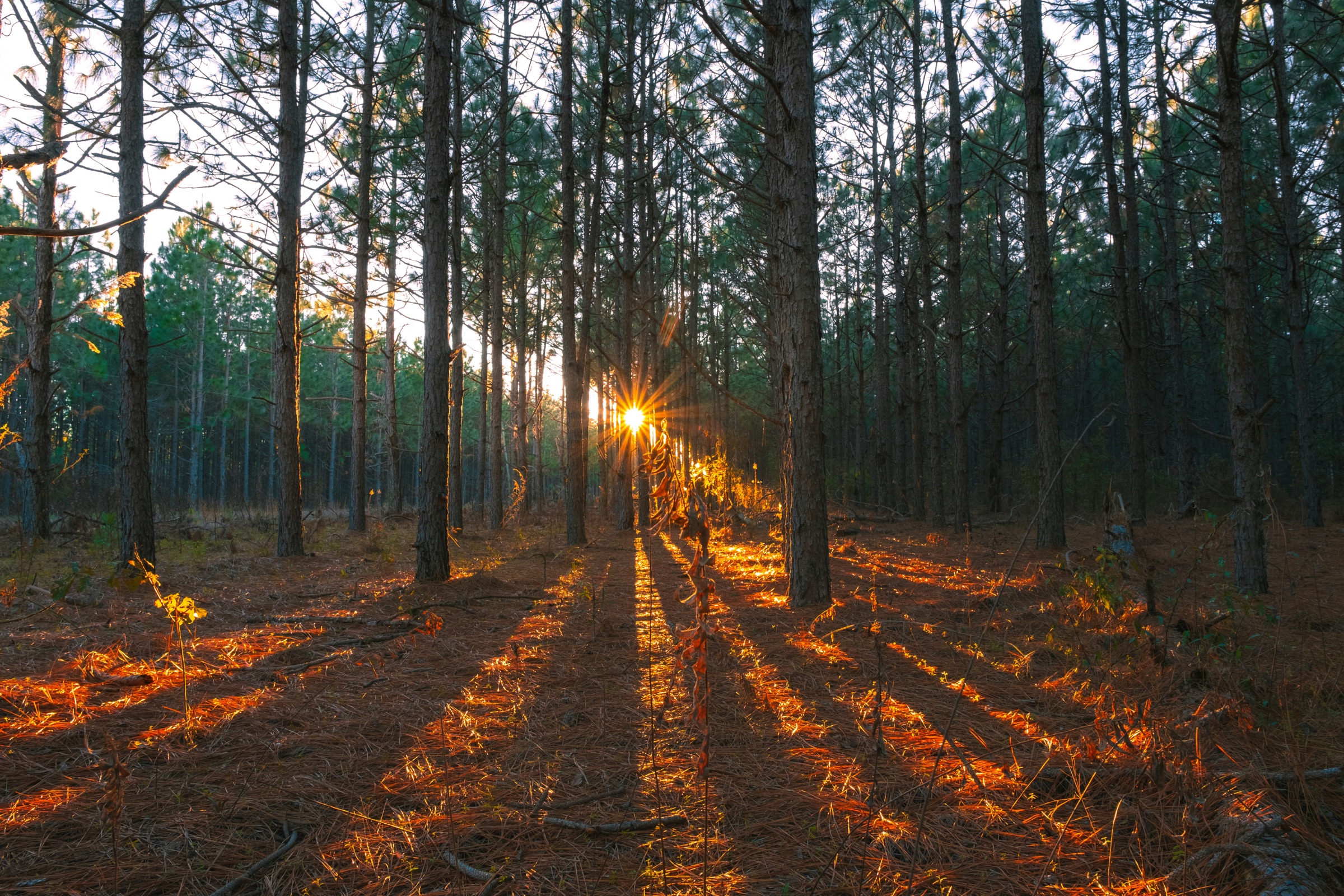
Drive east out of Forest, Mississippi, on a cool morning in late fall and the forest closes in quickly. The pines stand in long straight ranks, loblolly mostly, with water oak leaning in where the ground dips toward a creek. Pine needles carpet the road shoulders. A wildlife opening slides past, a few acres of short grass with a gobbler flock somewhere at its edge, and then the trees take over again. This is Bienville National Forest, the central Mississippi unit of a national forest system that the Forest Service manages as a patchwork of pine, hardwood bottom and prairie opening.
In November the turkeys are not where they were last April. The spring and summer fields have emptied, the broods have broken into winter flocks, and the birds have moved into mature woods to work the acorn crop. Hens travel with their grown young of the year. Gobblers travel apart, in bachelor flocks that drift along pine and hardwood edges. Nothing about the forest looks busy, yet it is the quiet season when the next year's turkey population is quietly settled: how many hens survive winter, how well the oaks mast, and how much open, burned pine they will have to nest in when March comes round.
Bienville is an ecology story worth telling carefully, because the numbers that surround Mississippi turkeys are easy to misuse. A statewide harvest figure is not a forest figure. A regional hatch description is not a ratio for one national forest. Several of the best nest studies on this forest were run in the 1980s and 1990s. This report keeps those lines straight. It walks through the forest type, the biology of a turkey hen working this landscape, what the Mississippi Department of Wildlife, Fisheries, and Parks (MDWFP) says about population status today, how fire and timber management shape the habitat, and what the 2027 spring framework asks of anyone who hunts here. Where a number does not exist for Bienville, the post says so.
The Landscape: Pine Flatwoods, Creek Bottoms and a Transition Zone
Where Bienville sits
Bienville National Forest lies in east-central Mississippi, with ranger district headquarters in Forest. The Forest Service's 2014 Land and Resource Management Plan for the National Forests in Mississippi lists Total National Forest System land for Bienville at 178,541 acres in a timber land classification table that the plan says is based on 2006 data, close to the roughly 178,000 acres often quoted for the forest. The plan describes the forest as transitional: its desired mix of ecological systems is upland longleaf pine, southern loblolly-hardwood flatwoods and floodplain forest, and the plan places it within the transition zone between the northern reach of longleaf pine and the southern reach of the shortleaf pine ecosystem.
That placement matters for turkeys because it means Bienville is not a single habitat. It is a gradient from dry upland pine through gently rolling flatwoods to alluvial creek bottoms, and a hen uses all of it across a year. The same plan notes that the 189-acre Bienville Pines Scenic Area protects the original old-growth loblolly and shortleaf pine that was kept from logging, and that the forest also holds Harrell Prairie, which a Forest Service recreation page calls the largest and least disturbed prairie in Mississippi.
Southern loblolly-hardwood flatwoods
The ecological system that defines much of Bienville is what the Forest Service calls southern loblolly-hardwood flatwoods. The plan describes it as open forest dominated by loblolly pine with patches of hardwoods on gilgai, a tight local mosaic of low mounds and shallow depressions. Overstories are typically loblolly pine and associated hardwoods, especially water oak. The system occurs on the Bienville Ranger District. The plan's stated desired condition is mature and mid-aged forest with a well-distributed network of old growth, open to very open canopies with less than 80 percent closure in mature stands, and fire at an interval of 1 to 3 years with about 40 percent of burns in the growing season.
Those are desired conditions, not a survey of what the ground looks like in 2026. The plan's objectives for the first decade estimated about 79,000 acres of this system on National Forest System land and set a goal of opening roughly 20,000 acres of previously closed-canopy stands. It also set a fire return interval of 1 to 4 years across the 79,000 acres, with 40 to 45 percent of burns in the growing season. It is useful as a statement of what the Forest Service is steering toward. It is not a completed-acreage report,.
Creek bottoms and the hardwood fraction
The pine is only part of what a turkey needs. The Mississippi State University studies on the forest's Tallahala area described its cover this way: mature bottomland hardwood on 30 percent, mature pine on 37 percent, mature mixed pine and hardwood on 17 percent, and 1- to 14-year-old loblolly regeneration on 11 percent, with small openings, old fields and homesites making up the remaining 5 percent. Those percentages describe a 14,410-hectare study area of the Tallahala Wildlife Management Area inside the forest, in Jasper, Newton, Scott and Smith counties, during a research period that ran from the 1980s into the 1990s. They are a snapshot of a management block, not of the whole forest today.
What they show is the mix that makes the forest workable for turkeys: broad alluvial creek drainages in hardwood, mature pine on the ridges and flats, and a smaller fraction of young regeneration stands. The researchers noted that short-term flooding of three to five days occurred periodically along three primary drainages during spring, which is a reminder that even in the pine country, the creek bottoms are not nesting ground in every spring.
The Biology of a Bienville Hen
Nest sites, and what the Mississippi State work found
Nest success is the number that most strongly steers a wild turkey population, and Bienville is one of the few places in Mississippi where it was measured at length. The studies are old, and that is worth saying plainly. Palmer and coauthors published their nine-year telemetry study of hens in the 1993 Proceedings of the Southeastern Association of Fish and Wildlife Agencies. They followed 143 adult hens and found a nesting rate of 72.7 percent, compared with 26.7 percent for 15 juvenile hens. Annual nest success on 104 adult-hen nests averaged 30.8 percent, ranging from zero to 62 percent depending on the year. First clutches averaged 9.1 eggs and second clutches 6.7, with hatchability of 93 percent and 100 percent respectively.
The authors attributed low reproduction mainly to heavy predation of nests and poults and concluded that it appeared to have caused the population decline they were tracking on the area. They also documented how weather and food moved the numbers. Complete oak mast failures occurred in the winters of 1984-85 and 1987-88, and rainfall in Jasper County from July 1987 to June 1988 ran 37 percent below normal. Reproduction was greatest in 1992, after a distemper outbreak that may have reduced nest and poult predators the year before.
Miller and coauthors, in the 1999 proceedings, used 89 nest locations and 89 random locations to ask which habitats hens chose and where they succeeded. Nest success was 36.1 percent in mature pine stands and 11.1 percent in regeneration stands, a difference the authors judged statistically meaningful. Nest success in bottomland hardwood, 18.8 percent, and in upland habitat, 34.8 percent, did not differ in a statistically meaningful way. The authors suggested that higher densities of carnivore prey in regeneration stands may raise the odds of nests meeting predators. Their management line was that providing mature pine stands, burned on a 3-year rotation and set next to riparian areas and bottomland hardwood stands, may increase nest success on their study area.
Two cautions follow. These are single-area studies from a different era of forest management and a different predator community, so their rates are not a 2026 measurement for Bienville. And the two papers describe different samples from the same study area, so their rates should not be merged into one number.
What a hen needs in March, May and August
Put the studies together with the Forest Service's habitat descriptions and a seasonal picture emerges. The Palmer study monitored hens by telemetry at least daily beginning by 14 March each year, ahead of the nesting season. Nesting rate in that paper was defined as the share of hens alive in the April 1 population that were known to nest. A hen that survives to April and finds mature, open pine with enough ground cover is positioned very differently from one that nests beside a freshly cut regeneration block.
After hatching, the problem changes from concealment to raising a brood. The Palmer study measured poult survival to more than 50 days at 22.7 percent across 27 broods with 203 poults, with a range from zero to 41.3 percent depending on the year. That is a long-run average from a declining population on one area. It tells a manager how tightly the whole system can run in a bad year. It does not describe a current brood number for any part of Bienville.
The fall and winter diet
MDWFP's fall turkey life-history page describes how the diet and range shift. Early fall, from September to late October, centers on wild fruits such as wild grape, black cherry, dogwood, persimmon, pawpaw and American beautyberry. By early November turkeys mostly eat acorns and other hard mast. The page says birds move from the open fields and grassy areas of spring and summer into mature forest starting in September, that by early November they spend nearly all their time in mature woods until late February, and that hens favor bottomland hardwoods along major creeks and rivers while gobbler flocks use pine and hardwood transition areas along smaller streams and occasionally burned uplands.
On Bienville that describes the work the creek bottoms and their hardwoods do in winter. The Tallahala studies recorded two complete oak mast failures in a nine-year window, in 1984-85 and 1987-88, and the Palmer paper reports that low reproduction occurred following winters associated with hard mast failure.
Population Status: What MDWFP Actually Reports
The long view
Mississippi's Comprehensive Wild Turkey Management Plan, adopted in 2017 by MDWFP, gives the clearest agency history. It records a first statewide spring harvest estimate of 249 gobblers in 1951, a climb through the 1970s to a peak near 60,000 gobblers in 1987, a fall and stabilization around 1992, and a flat to slightly rising stretch averaging 30 to 35 thousand gobblers a year until the mid-2000s. Beginning in 2005 the plan describes licensed harvest falling by an average of about 4 percent per year, with the 2015 harvest the lowest since 1977.
The plan also reports that statewide summer brood surveys suggested reproduction had been in decline for at least a decade, with regional complexity. East-central Mississippi, the region that contains Bienville, was described as having declining poults-per-hen ratios, although less steeply than the northeast, where the drop was around 4 percent a year. The plan also notes that total turkey observations by hunters in East-central had fallen since the early 2000s. In its habitat section, the plan reports that MDWFP and Mississippi State University mapped statewide habitat suitability and that the East-central management region had the highest average suitability, while the Delta had the lowest.
The 2026 forecast
MDWFP's 2026 spring turkey forecast paints a very different current picture. The page reports that hunters took more than 32,000 gobblers in 2025, 15 percent above the average of the previous decade, and that another strong hatch in summer 2025 put the population at one of its highest levels in a generation. For East-central Mississippi it says solid hatches since 2020 have steadily increased turkey numbers, that hunters should expect an abundance of birds, and that a high share of toms would be two-year-olds.
Read those two sources together, and the careful summary is this. The 2017 plan documents a decline from a 1987 peak and weaker reproduction over the decade before it was adopted, and MDWFP's latest forecast describes a recovery in recent years, at least by harvest and by hatch commentary. Neither document prints a poult-per-hen ratio or a harvest total for Bienville National Forest. The 32,000 figure is statewide. The East-central statements are regional prose. None of them should be assigned to the forest.
Habitat Management: Fire, Timber and Red-Cockaded Woodpeckers
Fire as the common thread
In the Forest Service plan, fire is the thread that ties Bienville's pine habitat together. The plan states that tree age diversity, canopy structure and fire regime are the most important characteristics for the long-term sustainability of loblolly-hardwood flatwoods, and that frequent growing-season burns reduce woody vegetation in the understory and promote the herbaceous component, which is integral to the system. Its fire objectives for the first decade included average annual prescribed burning of approximately 33,000 acres on the Bienville National Forest. That is a planning objective from 2014. The plan does not report how many acres were actually burned in any year,.
For turkeys, the useful point is structural, and the evidence is on the nesting side. The plan's own language is that burning promotes the herbaceous ground layer. The Miller study put a number on the nesting side of the fire idea on the Tallahala area: distance to mature pine burned within 3 years, and distance to mature pine not burned within 3 years, both differed significantly between nest sites and random sites. The paper's authors drew their management suggestion of mature pine on a 3-year burn rotation from those results. They also noted that prescribed burning on the study area ran at a mean frequency of 6.25 years during the research, which is much longer than the 3-year interval they were recommending. This is the kind of detail that gets lost in popular summaries of fire and turkeys.
The red-cockaded woodpecker connection
The Forest Service plan names the red-cockaded woodpecker as a species that depends on the flatwoods system for recovery on Bienville, and a species table in the plan lists Bienville among the districts where the bird is most likely to occur. The plan designates the Bienville population a primary core population, with a delisting goal of 350 potential breeding groups and a habitat management area objective of 500 active clusters. In October 2024 the U.S. Fish and Wildlife Service announced that it was downlisting the species from endangered to threatened, noting that the population had grown from an all-time low of about 1,470 clusters in the late 1970s to an estimated 7,800 clusters across 11 states. The Service also said the bird is not fully recovered and could become endangered again because of habitat loss, storms, wildfires and small population sizes.
What does a woodpecker program have to do with turkeys? The relationship is habitat, not biology. The woodpecker wants mature, open pine with a grassy, low understory kept clear of hardwood midstory by fire. The Mississippi State nest work found hens nesting and succeeding most in mature pine. The plan itself says mature open flatwoods provide a variety of nesting and foraging opportunities for many species and provide the fine fuels that carry fire through the system. This is a plausible and widely shared secondary benefit, but turkey response to red-cockaded woodpecker management on Bienville has not been measured, and the plan's goals are not a current cluster count for the forest. The honest framing is that woodpecker habitat work and turkey nesting habitat overlap in structure, not that one has been proven to drive the other.
Timber, openings and the Shockaloe Trail
Regeneration stands are a necessary part of any managed pine forest, and the Tallahala studies are a reminder of the trade. Young loblolly stands were where nest success was lowest in Miller's data. They were also a small portion of the landscape. Of the 90 nests in Miller's success comparison, 72 were in mature stands and 18 in regeneration stands.
The Forest Service's Shockaloe Trail page gives the easiest place for a visitor to see this in person. The trail runs in the forest between Forest and Morton, just north of U.S. Highway 80, and the page says a trip along it shows more than 60 years of forest management practices, including sound timber and prescribed fire management, superior trees, flatland hardwoods, wildlife openings and watering holes, and endangered species. The page does not say how large the openings are or measure how turkeys use them, so treat it as a place to observe the forest's structure rather than as proof of brood habitat.
Hunting the Forest: 2027 Spring Season and Public Land Rules
What MDWFP has published
MDWFP's hunting seasons and bag limits page for the 2026-2027 license year lists a youth turkey season of March 8 through 14 for hunters 15 and under, and a regular spring season of March 15 through May 2. Those are the 2027 dates, but confirm them with MDWFP before you plan a trip, because agency pages are revised. The same page lists a resident limit of one adult gobbler, or a gobbler with a beard of 6 inches or longer, per day and 3 per spring season. Hunters 15 and under may take one gobbler of any age per day, with the same season limits. Nonresidents have the same daily limit and a season limit of 2, with only 1 allowed before April 1.
The page does not list a fall turkey season for 2026-2027, and it does not give turkey shooting hours, so check the MDWFP regulations for the hours that apply. MDWFP's fall turkey life-history page still describes a limited fall season without giving dates, which is one more reason to rely on the current seasons page.
Hunters 16 and older, residents and nonresidents, need a Mississippi Wild Turkey Stamp beginning with the 2026 spring season unless exempt, whether they hunt public or private land. Exemptions listed by MDWFP are Mississippi Lifetime License holders, hunters under 16, resident hunters 65 and older, and resident hunters rated 100 percent disabled by the Department of Veterans Affairs, the Railroad Retirement Board or the Social Security Administration. Exempt hunters still claim a free Exempt Turkey Game Check privilege. Harvest reporting is through the MDWFP app at the point of harvest before the bird is moved, or with a physical tag notched and attached to the leg, followed by a report by 10:00 p.m. through the website or at 1-800-BE-SMART.
Public land, nonresidents and closures
The 2026-2027 seasons page says nonresidents may not hunt any Mississippi public land before April 1 unless drawn for a Non-resident Public Lands Turkey Permit or a WMA draw hunt, and that during the youth season on public land a nonresident adult accompanying a youth must also be permitted or drawn. Because Bienville is a national forest, that line is the one that touches it directly.
The Forest Service recreation page for Bienville names two MDWFP-managed areas on the forest, Bienville Wildlife Management Area and Caney Creek Wildlife Management Area, and directs permit questions to MDWFP. It does not print turkey rules for either. MDWFP's 2026 WMA turkey draw schedule, posted in December 2025, listed eight Bienville draw hunts between March 14 and March 31, 2026, each with a quota of 36. Those were 2026 dates, and a 2027 schedule was not found on the MDWFP pages checked in early November 2026. The Bienville ranger district office page, updated October 27, 2026, lists current alerts including forest closure orders and a weapons use order. Read those before you go, and confirm WMA permit requirements with MDWFP.
Private land, guiding and what is not allowed
Guiding and outfitting on public land are tightly limited. Under Mississippi's basic regulations for all wildlife management areas, 40 Miss. Code R. 2-1.1, paragraph W, no person or group may act as a guide, outfitter or in any other capacity for which they are paid or promised to be paid by another person for services rendered, so guided or paid activity does not take place on MDWFP WMAs. On national forest land outside those areas, commercial guiding needs a Forest Service special-use permit. For most hunters the practical reading is simple: public land in and around Bienville is where people hunt on their own, and guided hunts are on private land. Hunters who want a guided hunt should use a private-land operation and confirm what it offers.
Responsible Practices on a Public Forest
Public-forest turkey hunting asks for a few specific habits. Scout the forest roads and wildlife openings in winter, when birds are in flocks and sign is easy to read, and learn which creek drainages and pine ridges the flocks use. Respect closure orders and area boundaries. Follow the stamp and Game Check rules every time, including for exempt hunters. In wet springs, remember that the study area's creek drainages flooded for short periods in spring. And respect prescribed burning: expect smoke, and expect to see recently burned pine on any given weekend, because the same fire is part of what makes the habitat.
Key Takeaways
Bienville National Forest is transitional pine country in east-central Mississippi, with a Forest Service plan that lists 178,541 acres of National Forest System land (2006 data), southern loblolly-hardwood flatwoods as a signature system and creek-bottom hardwoods as essential turkey habitat.
The best nest studies on the forest are from Mississippi State University and date from the 1980s and 1990s: adult-hen nest success averaged 30.8 percent in one study, and nest success was 36.1 percent in mature pine versus 11.1 percent in regeneration stands in another. They are not 2026 measurements.
MDWFP's 2017 plan documents a harvest decline from a 1987 peak near 60,000 gobblers, while the 2026 forecast reports over 32,000 gobblers in 2025 and strong recent hatches in East-central Mississippi. Neither prints a Bienville ratio.
Fire is central: the plan stresses frequent growing-season burns to keep flatwoods open, and the Miller study recommended mature pine on a 3-year burn rotation next to bottomland hardwood.
Red-cockaded woodpecker management and turkey nesting habitat overlap in structure, but turkey response on Bienville has not been measured.
MDWFP's 2026-2027 page lists youth season March 8 to 14 and regular season March 15 to May 2 for 2027, with a stamp requirement and special rules for nonresidents on public land before April 1. Confirm with MDWFP.
Guiding and paid activity are barred on MDWFP WMAs, and national forest guiding needs a Forest Service special-use permit. Guided hunts are on private land.
For the Operators
If you run a lodge, a land business or a guide service in east-central Mississippi, this ecology is the content people search for before they book. A page that explains why mature, burned pine matters to a nesting hen, with the agency source named and dated, does more for trust than a photo of a gobbler. It also keeps you on the right side of the rules, because it makes clear what is private-land business and what is public-land self-guided hunting.
Be careful with numbers. A statewide harvest or a regional hatch description is not a Bienville count, and a nest study from the 1990s is not a current ratio. If you cite them, label the geography and the year, and link the agency page. Describe your private-land programs as private land, and do not imply that paid hunting happens on a WMA or in the national forest. If you want help turning this kind of agency-sourced ecology into clear service pages, that is a natural fit for what Pine & Marsh does.
Frequently Asked Questions
How many acres is Bienville National Forest?
The Forest Service's 2014 Land and Resource Management Plan lists Total National Forest System Land for Bienville at 178,541 acres in its timber land classification table, which the plan says is based on 2006 data. The roughly 178,000 figure used elsewhere is close to that number. Acreage figures are approximate, so confirm with the Forest Service.
Is there a Bienville National Forest poult-per-hen ratio?
No such ratio is published. MDWFP's 2026 forecast describes solid hatches in East-central Mississippi since 2020 in words, not as a ratio, and the 2017 state plan reports regional ratios, not forest ratios. Any number attached to Bienville specifically would be a misreading.
Do wild turkeys nest better in pine or in hardwood bottoms on Bienville?
In the Mississippi State study of the Tallahala area, nest success was 36.1 percent in mature pine and 11.1 percent in regeneration stands. Success in bottomland hardwood, 18.8 percent, did not differ in a statistically meaningful way from upland habitat at 34.8 percent. The study is from the 1990s on one area.
When is the 2027 spring turkey season in Mississippi?
MDWFP's 2026-2027 seasons page lists a youth season of March 8 to 14 and a regular season of March 15 to May 2. Residents may take one gobbler per day and 3 per season, and nonresidents 2 per season with only 1 before April 1. Confirm the dates and limits with MDWFP before you hunt.
Do I need a turkey stamp to hunt Bienville National Forest?
Hunters 16 and older, residents and nonresidents, need a Mississippi Wild Turkey Stamp beginning with the 2026 spring season, on public and private land, unless exempt. Lifetime License holders, hunters under 16, residents 65 and older and residents rated 100 percent disabled by the Department of Veterans Affairs, the Railroad Retirement Board or the Social Security Administration are exempt but still claim a free Exempt Turkey Game Check privilege.
Can I hire a turkey guide on Bienville National Forest?
Not on the MDWFP wildlife management areas inside it. 40 Miss. Code R. 2-1.1, paragraph W, bars guides, outfitters and anyone paid for services on WMAs. Elsewhere on a national forest, commercial guiding needs a Forest Service special-use permit. Guided hunts are on private land.
Does red-cockaded woodpecker management help turkeys?
The habitat overlaps: both use mature, open pine with a herbaceous ground layer kept clear by fire. The Forest Service plan says mature open flatwoods provide nesting and foraging opportunities for many species. Turkey response on Bienville has not been measured, so call it a shared habitat benefit rather than a proven effect.
Citations and Sources
U.S. Forest Service, National Forests in Mississippi, Land and Resource Management Plan, 2014, https://www.fs.usda.gov/sites/nfs/files/r08/mississippi/publication/2014-Final-Forest-Plan.pdf (accessed November 2026)
U.S. Forest Service, Bienville National Forest recreation page, last updated July 1, 2025, https://www.fs.usda.gov/r08/mississippi/recreation/bienville (accessed November 2026)
U.S. Forest Service, Bienville National Forest ranger district office page, updated October 27, 2026, https://www.fs.usda.gov/r08/mississippi/offices/bienville-national-forest (accessed November 2026)
U.S. Forest Service, Shockaloe Trail, last updated June 11, 2025, https://www.fs.usda.gov/r08/mississippi/recreation/trails/shockaloe-trail (accessed November 2026)
Mississippi Department of Wildlife, Fisheries, and Parks, Hunting Seasons and Bag Limits (2026-2027 seasons), https://www.mdwfp.com/wildlife-hunting/hunting-seasons-and-bag-limits (accessed November 2026)
Mississippi Department of Wildlife, Fisheries, and Parks, 2026 Spring Turkey Season Forecast, https://www.mdwfp.com/wildlife-hunting/wildlife-species-program/wild-turkey-program/2024-spring-turkey-season-forecast (accessed November 2026)
Mississippi Department of Wildlife, Fisheries, and Parks, WMA Turkey Draw Hunts (2026), https://www.mdwfp.com/sites/default/files/2025-12/WMA%20Turkey%20Draws%20(2026).pdf (accessed November 2026)
Mississippi Department of Wildlife, Fisheries, and Parks, Wild Turkey Stamp FAQ, https://www.mdwfp.com/wildlife-hunting/wildlife-species-program/wild-turkey-program/Mississippi-Wild-Turkey-Stamp/wild-turkey-stamp-faq (accessed November 2026)
Mississippi Department of Wildlife, Fisheries, and Parks, The Life and Times of Fall Turkeys, https://www.mdwfp.com/wildlife-hunting/wildlife-species-program/wild-turkey-program/all-about-wild-turkeys/life-and-times-fall-turkeys (accessed November 2026)
Mississippi Department of Wildlife, Fisheries, and Parks, Comprehensive Wild Turkey Management Plan, adopted March 2017, https://www.mdwfp.com/sites/default/files/2024-02/mdwfp-wild-turkey-management-plan-low-res.pdf (accessed November 2026)
40 Miss. Code R. 2-1.1, Basic Regulations for All Wildlife Management Areas, paragraph W (effective 6/30/2025), https://www.law.cornell.edu/regulations/mississippi/40-Miss-Code-R-2-1.1 (accessed November 2026)
U.S. Fish and Wildlife Service, Red-cockaded woodpecker downlisting announcement, October 24, 2024, https://www.fws.gov/press-release/2024-10/downlisting-red-cockaded-woodpecker-endangered-threatened (accessed November 2026)
Palmer, W. E., S. R. Priest, R. S. Seiss, P. S. Phalen and G. A. Hurst, Reproductive effort and success in a declining wild turkey population, Proceedings of the Annual Conference of the Southeastern Association of Fish and Wildlife Agencies 47:138-147, 1993, https://seafwa.org/sites/default/files/journal-articles/PALMER-138-147.pdf (accessed November 2026)
Miller, D. A., B. D. Leopold, G. A. Hurst and P. D. Gerard, Habitat characteristics of wild turkey nest sites in central Mississippi, Proceedings of the Annual Conference of the Southeastern Association of Fish and Wildlife Agencies 53:434-443, 1999, https://seafwa.org/sites/default/files/journal-articles/MILLER-434-443.pdf (accessed November 2026)
Explore More
Two Metros, One National Forest: Bienville NF and the 178,000-Acre Gap Between Jackson and Meridian
Wild Turkey Biology and Population Ecology: A Southeast Field Synthesis
Turkey Recruitment Decline Across the Southeast: Biology, Causes, and Conservation Responses
Bobwhite Quail: Ecology, Habitat Decline, and the Longleaf Pine Connection
Alabama Turkey Ecology: Conecuh National Forest and the Gulf Coast
Inside the 2026-27 Wild Turkey Report: Record Harvests, Weak Hatches and Who Sells the Hunt
The Mississippi Outdoor Field Report: The Delta, the Gulf Coast Marsh, and the Soil Belts In Between


Comments