
The Southeast Saltwater Inshore Field Report: Spartina to Mangrove, Redfish, Speckled Trout and the Tidal Coast
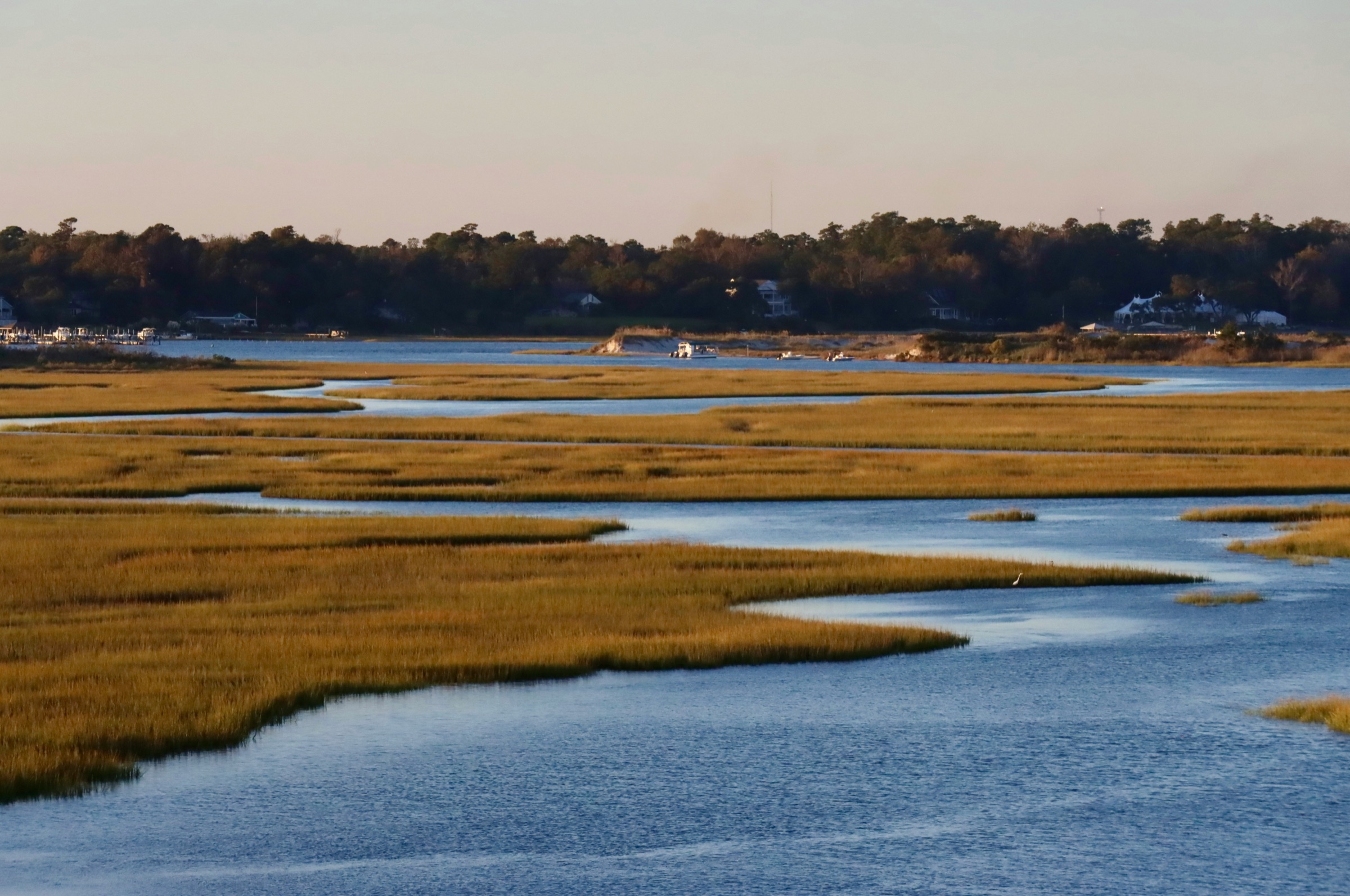
Stand on a dock in coastal South Carolina in late November at dead low tide and the marsh looks like a different place. The creeks have shrunk to ribbons of dark water between mud banks, the cordgrass has gone the color of old rope, and oyster shell shows white along the edges. Six hours later the same ground will be underwater to the stems. That daily pulse, the water coming and going over a plain of grass, is the engine of everything that follows in this report.
Travel south and west and the grass changes company. On the Gulf side, a barrier island off Mississippi holds a handful of small black mangroves at the northern edge of their range, and farther south the mangrove coast begins. Through all of it, two fish follow the water: the red drum that anglers call redfish, and the spotted seatrout that Southern anglers call speckled trout.
This is a cross-state field report on that coast. It is not a state-by-state essay, since the state field reports already exist and are linked at the end. It does three things instead. It describes the shared ecology, from cordgrass marsh to mangrove edge. It lays out the calendar that cold, spawning and tide impose on both fish. And it gathers, in one place, what each state's own agency publishes about redfish and seatrout rules as of early November 2026, because the rules differ in ways that surprise people who fish across state lines. One correction to a common phrase is worth making up front. The Southeast states covered by this series number eleven, but Tennessee, Kentucky and Arkansas have no tidal coast, so this report covers the tidal coast of the eight that do: Virginia, North Carolina, South Carolina, Georgia, Florida, Alabama, Mississippi and Louisiana.
An Ecology Snapshot: Cordgrass, Creeks and the Mangrove Edge
Smooth cordgrass and the shape of a Southeast marsh
The South Carolina Department of Natural Resources (SCDNR) describes smooth cordgrass (Spartina alterniflora) as a species found from Newfoundland south to Florida and west to Texas, which covers essentially the whole range of this report. In South Carolina it grows along all major estuarine waterways. The same SCDNR species account describes the marsh in two zones. The low marsh is regularly flooded by tides, and smooth cordgrass dominates it. The high marsh is irregularly flooded, and cordgrass is common there but not dominant.
SCDNR also describes how the plant changes with distance from the water. Along creek and river banks, where soil salinity is lowest, the tall form can reach about 3 meters by that source's measure. Height falls with distance from the bank, and plants in the upper marsh, where salinity is highest, are under 20 inches. Growth is fastest in soils at 20 parts per thousand salinity or less and slows as salinity rises. The practical meaning for anglers is simple. The tall grass is the creek edge, and the creek edge is where the water goes first and the fish arrive first.
SCDNR notes that smooth cordgrass provides nursery and protective cover for many aquatic species, especially juvenile crustaceans and fishes. The Lowcountry tidal rivers field report on this site walks through that marsh in detail.
Where the mangrove takes over
Mangroves are the tropical counterpart, and they are limited by cold. A U.S. Geological Survey page on freeze-damaged black mangrove states that freezing temperatures control the northern distribution of mangrove forests in the southeastern United States, and shows freeze damage to black mangrove near Port Fourchon, Louisiana. A 2019 PLoS One study by Macy and coauthors, working on Horn Island, Mississippi, reports that the island marks the northern limit of black mangrove in the Gulf of Mexico, with a known population of three trees first found in 2012, and describes warming as moving the marsh and mangrove boundary northward into marshes historically dominated by smooth cordgrass. The authors note that fewer severe freezes would let mangroves expand more permanently rather than in the expansion and contraction cycles seen in the past.
That is a useful way to read the coast. Cordgrass reaches from Newfoundland to Texas, mangrove is held back by freezes, and the line between them moves with winter.
Redfish life history
SCDNR describes red drum as a long-lived fish that matures at 3 to 5 years, at about 28 inches for males and 33 inches for females, with spawning in late summer and fall near estuary inlets and passes along barrier island beaches, where males drum to attract females. Adults use nearshore and inshore bottoms including tidal creeks, oyster reefs and beaches, usually over sand or sandy mud. Juveniles live in estuaries near shallow tidal creeks and marsh edges and move to deeper river channels in winter. SCDNR lists the state record at 75 pounds, set in 1965, and states that no commercial red drum fishery currently exists in South Carolina.
The Atlantic States Marine Fisheries Commission (ASMFC) adds that spawning occurs at night in nearshore waters during summer and fall, that males mature between ages one and four, and that females mature between ages three and six. This is the reason redfish are managed with a slot. The slot protects the juveniles below it and the large, highly fecund spawners above it.
Speckled trout life history
SCDNR describes spotted seatrout very differently. They mature at one year, at about 9 inches for males and 10 inches for females, and spawn from April through September in moderate salinity in the deeper parts of estuaries, with night aggregations often near piers, pilings, bridges, points of land and holes. Adults live near salt marsh edges, over grass beds, around tidal creek mouths and channels and over oyster reefs. Juveniles use shallow tidal creeks and marsh. In winter they move to deeper channels, rivers or the main estuary. SCDNR's page states plainly that excessive cold can result in mass mortalities, and lists the maximum age at roughly 8 to 10 years.
Those two life histories explain most of what follows. A redfish takes years to mature and can live for decades, so its population responds slowly to regulation. A speckled trout matures in a year, lives a few years and can be knocked down hard by a single cold winter, which is exactly what North Carolina's managers recorded in early 2026.
What the Habitat Creates
Edges, creek mouths and structure
Both fish are tied to edges. The SCDNR species pages place adult seatrout at salt marsh edges, grass beds, creek mouths, channels and oyster reefs, and adult red drum at tidal creeks, oyster reefs and beaches. The structure that holds them is built from the same few things in every state: cordgrass banks, oyster shell, seagrass where it exists, and the channels that connect them. What changes from state to state is the proportion. The Big Bend field report on this site covers Florida's seagrass flats, and the Louisiana coastal marsh field report covers a very different marsh.
Diet follows the marsh
SCDNR lists the large adult seatrout diet as menhaden, spot, mullet, croaker and mud minnows, with occasional grass shrimp and penaeid shrimp, and the smaller adults as taking more crustaceans. Adult red drum eat menhaden, spot, anchovies and crabs, and juveniles eat shrimp, small fish and crabs. The marsh therefore supplies both nursery cover for the prey and the prey itself.
The role of cold
Cold is the one habitat factor that can reorder the whole system in a week. Winter pushes both species to deeper water. When temperatures drop fast enough, seatrout in shallow water are stunned and die. In February 2026, North Carolina's Division of Marine Fisheries confirmed significant cold stun events in 10 waterbodies from Hyde County to Pender County and closed all coastal and joint waters to commercial and recreational spotted seatrout harvest at 4 p.m. on February 6, 2026. The Division's press release said the season would remain closed through June 30, 2026 and reopen by proclamation, and said peak spawning is May through July. Proclamation FF-31-2026 then reopened commercial and recreational harvest at 12:01 a.m. on July 1, 2026. Under the state's seatrout fishery management plan, a significant cold stun event requires closing harvest through the spring so surviving fish can spawn first.
Timing Signals: The Calendar of Cold, Spawn and Tide
Winter and the closures that follow it
Several state rules are built directly around this cold calendar. Florida's Fish and Wildlife Conservation Commission (FWC) lists a seatrout closure in the Panhandle in February, with the season open March 1 through January 31, and a closure in the Indian River Lagoon region from November 1 through December 31. The FWC red drum page lists the Indian River Lagoon region as catch and release only. Virginia's Marine Resources Commission lists a speckled trout closure of April 1 through June 30, 2026.
Spring and summer: seatrout spawn
SCDNR's April through September seatrout spawn and North Carolina's May through July spawning peak describe the period when trout concentrate. Those are the windows in which several states close or restrict harvest, so watch agency announcements as closely as a bite report.
Late summer and fall: redfish spawn
For red drum, ASMFC and SCDNR both place spawning in the summer and fall. SCDNR puts it near inlets and passes. By SCDNR's account, that puts spawning adults near inlets and passes in late summer and fall, while juveniles stay in estuaries near shallow tidal creeks and marsh edges. Agency pages describe seasons, not dates for any particular inlet run.
Tide windows
Smooth cordgrass dominates the regularly flooded low marsh by SCDNR's description, which means the grass banks are available to fish only when the tide is high enough to cover them. It is a sound reason to learn a creek's tide cycle before fishing it. This report leaves the hour-by-hour tide math to local guides and tide tables, because no agency page opened for it gives time windows.
On the Ground: A Coast in Regional Pieces
The Carolinas and Georgia
On the South Atlantic coast, the Lowcountry tidal rivers around Charleston and Beaufort are the textbook spartina marsh, and the Lowcountry tidal rivers field report on this site covers them, along with the ACE Basin field report for the tidal rice impoundments and the South Carolina state report. North Carolina's sounds and capes are a different kind of inshore. The National Park Service says Cape Lookout National Seashore is reached by boat, three miles offshore, that an Off-Road Vehicle Beach Driving Permit is required before driving on the barrier islands, and that visitors should bring all the food, water and supplies they need and carry trash out. Cape Hatteras National Seashore's page mentions the calm of the salt marshes and recreation on the sound side of the barrier islands, off-road vehicle use allowed in certain areas, and four campgrounds. For the Albemarle and Pamlico side, see the North Carolina state field report and the marketing post on Albemarle and Core Sounds.
Florida: from the Panhandle to the Keys
Florida has the widest range of inshore habitat on this coast. FWC divides the state into nine regions for red drum and for seatrout, and the regions are the best way to read the state. The Panhandle runs from the Florida and Alabama line east to near Alligator Point. The Big Bend runs east and south from there to near Fred Howard Park. Tampa Bay, Sarasota Bay, Charlotte Harbor and the Southwest and Southeast regions run down the Gulf and Atlantic coasts, and the Indian River Lagoon and Northeast regions cover the Atlantic side north to the Georgia line. The Florida state field report and the Big Bend field report on this site cover the habitat, and the marketing posts on Tampa Bay and the Indian River and Mosquito Lagoon cover those fisheries.
The northern Gulf: Alabama, Mississippi and Louisiana
Mobile Bay and the Mobile-Tensaw Delta have their own field report, as do the Mississippi Gulf Coast and Biloxi Marsh and the Louisiana coastal marsh. These are the places on the coast where the marsh is the story and the mangrove edge is just barely in view. Horn Island, Mississippi, is the Gulf's northern mangrove outpost in the Macy study, and the Louisiana freeze photo from USGS comes from near Port Fourchon.
Virginia and the northern edge
At the northern end of the range, Virginia's Eastern Shore and Chesapeake tributaries are covered in the state field report and in the Chesapeake Bay tributaries and Mobjack Bay speckled trout post. Virginia is also where ASMFC's Addendum II on red drum, approved in October 2025, aligns recreational rules for Virginia, Maryland and the Potomac River Fisheries Commission, according to ASMFC's species page.
Planning Your Trip: Rules by State, as of Early November 2026
Rules change by proclamation, and several of the ones below changed this year. Each figure below comes from the named state agency's own page or regulations guide, or, for South Carolina's red drum change, from the act itself as well. All of it is dated to early November 2026, and every angler should confirm with the agency before fishing.
Stock status first
ASMFC's 2024 benchmark assessment found the Atlantic southern stock of red drum, from South Carolina through the east coast of Florida, overfished with overfishing occurring, and the northern stock, from New Jersey through North Carolina, not overfished with overfishing not occurring. The Gulf stocks are not part of that split. The Georgia and South Carolina rule changes described below sit against that background. ASMFC also states that federal waters are closed to red drum harvest and sale under a 2007 executive order and moratorium.
Florida (FWC)
FWC's red drum page lists a slot of 18 to 27 inches total length, with open year-round harvest in all regions except the Indian River Lagoon, which is catch and release. The bag is 1 fish per person per day, with a vessel limit of 4 in the Panhandle, Big Bend and Northeast regions and 2 in Tampa Bay, Sarasota Bay, Charlotte Harbor, the Southwest and the Southeast. The page says stocks are exceeding FWC's 40 percent escapement goal in most parts of Florida and that the state adopted a regional management approach in 2022.
For spotted seatrout, FWC's page says new regional regulations are now in effect and describes the regional management approach as adopted in 2026, without giving a specific day. The slot is 15 to 19 inches total length in every region. The Big Bend bag is 5 per person with one fish over 19 inches allowed per vessel. The Panhandle, Tampa Bay, Sarasota Bay, Charlotte Harbor, Southwest and Southeast bags are 3 per person with the same one-over-19 allowance. The Indian River Lagoon bag is 2 per person and the Northeast bag is 3, and in both of those regions no fish larger than 19 inches may be possessed. Seasons are described above. Confirm the region boundaries on the FWC pages, because the red drum and seatrout region lines are not interchangeable.
Georgia (Georgia DNR Coastal Resources Division)
Georgia's limits page lists red drum at 5 fish per day within a 14 to 23 inch total length slot, and spotted seatrout at 15 per day with a 14 inch minimum, year-round. The page also states that effective January 1, 2027, the red drum daily limit decreases from 5 to 3 and the slot becomes 15 to 24 inches. A separate Georgia page on the proposal describes a public comment period that closed June 30, 2026 and a Board of Natural Resources consideration scheduled for August 25, 2026, and does not report a vote outcome, so confirm the final rule with the agency.
South Carolina (SCDNR and Act 231 of 2026)
SCDNR's regulations page carries a notice of new information about red drum regulations. South Carolina Act 231, which the General Assembly's page lists as approved by the Governor May 19, 2026, makes it unlawful to take or possess more than one red drum in any one day, not to exceed two on any boat, with a slot of 18 to 25 inches total length, and requires a nonoffset, nonstainless steel circle hook when taking saltwater gamefish with hand-held hook and line and natural bait on a hook size of 4/0 or larger. The act sets an effective date of July 1, 2026. SCDNR's 2026-2027 regulations guide, published on eRegulations and last updated August 11, 2026, lists the same red drum change, says red drum may not be taken from federal waters, and lists spotted seatrout at a 14 inch total length minimum and 10 per person per day, with no harvest by gig from December 1 through February 28.
North Carolina (Division of Marine Fisheries)
The Division's recreational size and bag table, which it states takes effect November 1, 2026 and is for general information only, lists red drum at 18 to 27 inches total length, 1 per day, with possession of red drum over 27 inches unlawful and gigging, spearing and gaffing prohibited. For spotted seatrout it lists 14 to 20 inches total length and 3 per day. Seatrout harvest was closed by Proclamation FF-12-2026 on February 6, 2026, and reopened at 12:01 a.m. on July 1, 2026 under Proclamation FF-31-2026, which sets the recreational rule at 14 to 20 inches total length, except that one fish over 26 inches may be kept, and 3 per person per day. Cold stun closures can come again in any winter, so check the Division's current proclamations list before keeping fish.
Alabama (Outdoor Alabama)
Outdoor Alabama's saltwater size and creel page lists spotted seatrout at 15 to 22 inches total length with a creel limit of 6 per person, and red drum at 16 to 26 inches total length, 3 per person. Alabama's administrative rule for these limits, Ala. Admin. Code r. 220-3-.30, adds that of the 6 spotted seatrout, one may exceed the maximum size, that no red drum may exceed the maximum length, and that no one under Alabama's jurisdiction may possess a red drum in federal waters. The page names no seasons for either species.
Mississippi (Department of Marine Resources)
The Mississippi Department of Marine Resources' recreational limits page lists spotted seatrout at a 15 inch minimum with a daily bag of 15, and red drum at 18 to 30 inches with a bag of 3, and says recreational anglers may retain only one red drum over 30 inches. The page does not show a revision date, so confirm with the department.
Louisiana (LDWF)
The Louisiana Department of Wildlife and Fisheries' recreational saltwater finfish page lists red drum at 18 inches minimum and 27 inches maximum total length, 4 per person per day with none over 27 inches, open year-round in state waters, and spotted seatrout at 13 inches minimum and 20 inches maximum total length, 15 per person per day with no more than 2 over 20 inches, open year-round in state waters. Take or possession of red drum in federal waters is prohibited. Captain and crew may not retain red drum on charter or headboats during a for-hire trip, and their spotted seatrout bag on a vessel under charter is zero. Confirm these figures on the LDWF site before fishing.
Virginia (VMRC)
Virginia's Marine Resources Commission recreational regulations list red drum at an 18 to 26 inch slot with a possession limit of 3 per person, and speckled trout at a 14 inch minimum with 5 per person and only 1 greater than 24 inches, with the closure noted above. The VMRC regulations sheet is labeled updated April 2026.
Seasons, Access and Guided Options
Month by month
Late fall and winter belong to the deeper creeks and holes, and to cold watch. Spring brings the seatrout spawn, and several states handle that with seasons or closures. Summer and early fall bring the redfish spawn near inlets. This report gives windows from agency pages and leaves local tides and hot spots to local guides.
Public access and rules to know
Most of the coast fished here is public tidal water, but some of the best of it is inside federal or state lands with their own rules. At Cape Lookout National Seashore, a beach driving permit is required, and supplies must be self-carried. At Cape Hatteras, off-road vehicle use is allowed in certain areas only. Check the National Park Service pages and each state's wildlife management or refuge rules, because no commercial activity or paid guiding should be assumed on a refuge, a national seashore or a state park without that agency's own permit. The Florida FWC red drum page prohibits a captain and crew bag on a for-hire trip, Outdoor Alabama says captain and crew of Alabama commercial party boats may not retain bag limits of fish harvested in state waters, and Louisiana's regulations bar captain and crew from keeping red drum or seatrout on a charter trip. Licensed charter and guide services operate on public tidal waters under state licensing, and anglers should confirm what a captain's license covers.
Responsible practices
Handle fish gently when releasing, especially in cold water. Follow circle hook rules where they exist, including South Carolina's natural bait rule. Measure fish in total length unless the rule says fork length. Watch for state proclamations in winter, when cold stun can close a fishery on two days' notice, as it did in North Carolina in February 2026.
Key Takeaways
The Southeast inshore coast runs from smooth cordgrass marsh in the Atlantic states to a thin mangrove edge on the northern Gulf, and cold sets that boundary.
Red drum mature slowly and are managed with slots. Spotted seatrout mature at one year and can be knocked down by cold, as North Carolina's February 2026 closure showed.
The Atlantic southern red drum stock, South Carolina through east Florida, was assessed overfished in 2024, and Georgia and South Carolina have tightened their rules.
State rules differ widely: Florida's red drum slot is 18 to 27 inches with a bag of 1, South Carolina's is 18 to 25 inches with a bag of 1 under Act 231, Alabama's is 16 to 26 inches with 3, Mississippi's is 18 to 30 inches with 3, and Louisiana's is 18 to 27 inches with 4, per each agency as dated above.
Georgia's page states a 2027 change to 3 red drum in a 15 to 24 inch slot. North Carolina's seatrout harvest was closed by cold stun in February 2026 and reopened July 1, 2026 by proclamation.
Confirm every figure with the state agency before fishing, because proclamations change rules mid-year.
For the Operators
For a guide, lodge or charter business on this coast, the rules are the content. Anglers search for what the slot is, whether a fishery is open and what a captain can keep, and every state answers differently. A page that states a limit, names the agency, gives the date and says confirm before fishing is more useful and more defensible than a general claim about how good the fishing is. Because the seatrout and red drum rules changed in several states in 2026, clear, dated pages are also what a returning client or an AI search answer will lean on.
Be exact about geography. Florida's region lines differ for red drum and seatrout, North Carolina's table is informational only, and Georgia's red drum change takes effect in 2027. Do not copy a bag from one state onto another. If you want that kind of source-checked ecology and rules content on your own pages, it is a natural fit for what Pine & Marsh does.
Frequently Asked Questions
What is the redfish limit in South Carolina in 2026?
South Carolina Act 231, approved May 19, 2026, makes the limit one red drum per person per day, not to exceed two per boat, in an 18 to 25 inch total length slot, with a circle hook rule for natural bait on hooks 4/0 or larger, effective July 1, 2026. SCDNR's regulations page carries a notice of the change. Confirm with SCDNR.
Is spotted seatrout harvest open in North Carolina?
Yes, as of early November 2026. North Carolina closed commercial and recreational harvest on February 6, 2026 after cold stun events, and Proclamation FF-31-2026 reopened it on July 1, 2026 with a recreational limit of 3 fish from 14 to 20 inches, plus one allowed over 26 inches. A new cold stun can close it again, so check the Division of Marine Fisheries proclamations list before keeping any fish.
What changes for Georgia red drum in 2027?
Georgia's limits page says that effective January 1, 2027, the daily limit drops from 5 to 3 red drum and the slot changes from 14 to 23 inches to 15 to 24 inches. A separate page on the proposal does not report the Board's vote, so confirm with the Coastal Resources Division.
Why does Florida have different redfish and trout rules by region?
FWC adopted a regional management approach, in 2022 for red drum and in 2026 for spotted seatrout. Each region has its own bag and, for seatrout, season. The Big Bend seatrout bag is 5, for example, while most other regions are 3, and the Indian River Lagoon redfish fishery is catch and release only.
Where do mangroves stop on the Gulf coast?
A 2019 study on Horn Island, Mississippi, calls it the northern limit of black mangrove in the Gulf of Mexico, with three trees first found in 2012. USGS says freezing temperatures limit how far north mangroves extend in the southeastern United States, and shows freeze damage near Port Fourchon, Louisiana.
Why is the Atlantic red drum stock listed as overfished?
ASMFC's 2024 benchmark assessment found the southern stock, South Carolina through the east coast of Florida, overfished with overfishing occurring: the three-year average spawning potential ratio fell below its 30 percent threshold, and female spawning stock biomass fell below its threshold. The northern stock, New Jersey through North Carolina, was not overfished. The Gulf states are outside that split.
When do redfish and speckled trout spawn?
SCDNR places spotted seatrout spawning from April through September, and North Carolina's Division of Marine Fisheries says peak spawning is May through July. ASMFC and SCDNR place red drum spawning in summer and fall, near inlets and passes. Confirm local timing with the state agency.
Can I keep a charter bag on a for-hire trip?
Not in several states. FWC prohibits a captain and crew bag on a for-hire trip for red drum, Outdoor Alabama bars captain and crew of commercial party boats from retaining bag limits of fish taken in state waters, and Louisiana bars captain and crew from keeping red drum or seatrout on a charter. Rules vary, so confirm with the state agency.
Citations and Sources
South Carolina Department of Natural Resources, Red Drum species page, https://www.dnr.sc.gov/marine/species/reddrum.html (accessed November 2026)
South Carolina Department of Natural Resources, Spotted Seatrout species page, https://www.dnr.sc.gov/marine/species/spottedseatrout.html (accessed November 2026)
South Carolina Department of Natural Resources, Smooth Cordgrass species account, ACE Basin Species Gallery, https://www.dnr.sc.gov/marine/mrri/acechar/speciesgallery/Plants/SmoothCordgrass/index.html (accessed November 2026)
South Carolina Department of Natural Resources, Hunting and Fishing Laws and Regulations, https://www.dnr.sc.gov/regulations.html (accessed November 2026)
South Carolina Department of Natural Resources, 2026-2027 regulations guide, Finfish Size and Catch Limits (eRegulations, updated August 11, 2026), https://www.eregulations.com/southcarolina/fishing/finfish-size-catch-limits (accessed November 2026)
South Carolina General Assembly, Act No. 231 of 2026 (bill 961), https://www.scstatehouse.gov/sess126_2025-2026/bills/961.htm (accessed November 2026)
Florida Fish and Wildlife Conservation Commission, Red Drum regional regulations, https://myfwc.com/fishing/saltwater/recreational/red-drum/ (accessed November 2026)
Florida Fish and Wildlife Conservation Commission, Spotted Seatrout regional regulations, https://myfwc.com/fishing/saltwater/recreational/spotted-seatrout/ (accessed November 2026)
Georgia Department of Natural Resources, Coastal Resources Division, Recreational finfish season, limits and sizes, https://coastalgadnr.org/limits (accessed November 2026)
Georgia Department of Natural Resources, Coastal Resources Division, Red Drum Regulation Changes 2026, https://coastalgadnr.org/RedDrum (accessed November 2026)
North Carolina Division of Marine Fisheries, Recreational Size and Bag Limits (effective November 1, 2026), https://deq.nc.gov/about/divisions/marine-fisheries/rules-proclamations-and-size-and-bag-limits/recreational-size-and-bag-limits (accessed November 2026)
North Carolina Division of Marine Fisheries, Waters to close to commercial and recreational Spotted Seatrout harvest, press release, February 4, 2026, https://www.deq.nc.gov/news/press-releases/2026/02/04/waters-close-commercial-and-recreational-spotted-seatrout-harvest (accessed November 2026)
North Carolina Division of Marine Fisheries, Proclamation FF-31-2026, Spotted Seatrout opening and harvest restrictions, June 25, 2026, https://files.nc.gov/deq/documents/2026-06/FF-31-2026_SpottedSeatrout_open%20harvest_final.pdf (accessed November 2026)
North Carolina Division of Marine Fisheries, Proclamation FF-12-2026, Spotted Seatrout, https://www.deq.nc.gov/marine-fisheries/fisheries-management-proclamations/2026/spotted-seatrout-coastal-and-joint-fishing-waters-including-atlantic-ocean-commercial-and/open (accessed November 2026)
Outdoor Alabama, Saltwater Recreational Size and Creel Limits, https://outdooralabama.com/fishing/saltwater-recreational-size-creel-limits (accessed November 2026)
Alabama Administrative Code, Rule 220-3-.30, Saltwater fish creel, bag, possession and size limits (amended effective June 17, 2025), https://admincode.legislature.state.al.us/api/rule/220-3-.30 (accessed November 2026)
Mississippi Department of Marine Resources, Recreational Catch Limits, https://dmr.ms.gov/recreational-catch-limits/ (accessed November 2026)
Louisiana Department of Wildlife and Fisheries, Recreational Saltwater Finfish, https://www.wlf.louisiana.gov/page/recreational-saltwater-finfish (accessed November 2026)
Virginia Marine Resources Commission, Recreational Saltwater Fishing Regulations, https://webapps.mrc.virginia.gov/public/reports/swrecfishingrules.php (accessed November 2026)
Atlantic States Marine Fisheries Commission, Red Drum species page, https://asmfc.org/species/red-drum (accessed November 2026)
National Park Service, Cape Lookout National Seashore, last updated March 13, 2026, https://www.nps.gov/calo/index.htm (accessed November 2026)
National Park Service, Cape Hatteras National Seashore, last updated August 21, 2024, https://www.nps.gov/caha/index.htm (accessed November 2026)
U.S. Geological Survey, Freeze damaged black mangrove, https://www.usgs.gov/media/images/freeze-damaged-black-mangrove (accessed November 2026)
Macy, A., S. Sharma, E. Sparks, J. Goff, K. L. Heck, M. W. Johnson, P. Harper and J. Cebrian, Tropicalization of the barrier islands of the northern Gulf of Mexico: A comparison of herbivory and decomposition rates between smooth cordgrass (Spartina alterniflora) and black mangrove (Avicennia germinans), PLoS One 14(1):e0210144, 2019, https://pmc.ncbi.nlm.nih.gov/articles/PMC6322730/ (accessed November 2026)


Comments