
Sporting Lodges and Multi-Program Destinations: Nonresident Demand and How Groups Book
A sporting lodge does not sell a hunt. It sells a trip: a place to sleep, a set of programs on the same land, meals, and a gathering place at the end of the day. The buyer is often a group, often from out of state, and often not the person who will carry the gun. That makes a lodge a different marketing problem from a single-species outfitter, and it is why our 2026-27 industry series gives lodges and multi-program destinations their own report.
This post walks through what that report found, what it means for lodge owners, and what to fix first. Every figure below comes from the report and the public sources it cites.
What the Sporting Lodges Report Found
Start with an honest limit. No source we collected counts lodge guests, rooms, revenue or package prices. So the report does not size the lodge market. It describes the demand around lodges and then looks at how lodge websites perform.
On demand, the traveling pool is large. The 11 Southeastern states sold 993,081 nonresident hunting licenses, tags, permits and stamps in 2024, which is 22% of the 4,581,316 sold to nonresidents nationally. Those are products sold, not people, and a single hunter can show up several times. They are also not lodge guests. They are the best public measure of how many hunters cross state lines.
Dependence on out-of-state hunters varies widely. Nonresident products were 34% of hunting products sold in Arkansas in 2024, 24% in Kentucky and 22% in Mississippi, against 7% in Virginia and 7% in North Carolina. Tennessee's and North Carolina's series swing sharply between years for reasons the source does not give, so read those two states with care.
The hunting economy around the lodge has grown quickly too. The Bureau of Economic Analysis put value added from hunting, shooting and trapping at $16.5 billion in 2024, up 95% from 2019 in current dollars. That covers all hunting and shooting nationally, not lodges. Hunting spending, accommodation and food value added, and state visitor spending describe the same trips from different angles, so the report shows them side by side and never adds them together.
Reading the Nonresident Table as a Lodge Owner
The state table is where an owner can find their own situation. In 2024 nonresident products were 34% of hunting products sold in Arkansas (163,321, up 14% from 2020), 24% in Kentucky (135,518, up 20%) and 22% in Mississippi (90,336, up 4%). Georgia sold the most in absolute terms, 195,292, but that was 12% of its sales, up 24%. South Carolina sold 109,583 (12%, up 5%), Alabama 72,628 (8%, up 16%), Louisiana 45,875 (11%, down 11%) and Florida 35,961 (10%, up 98% from a small base). Across the 11 states the sum was up 16% against 2020, against 11% for the U.S.
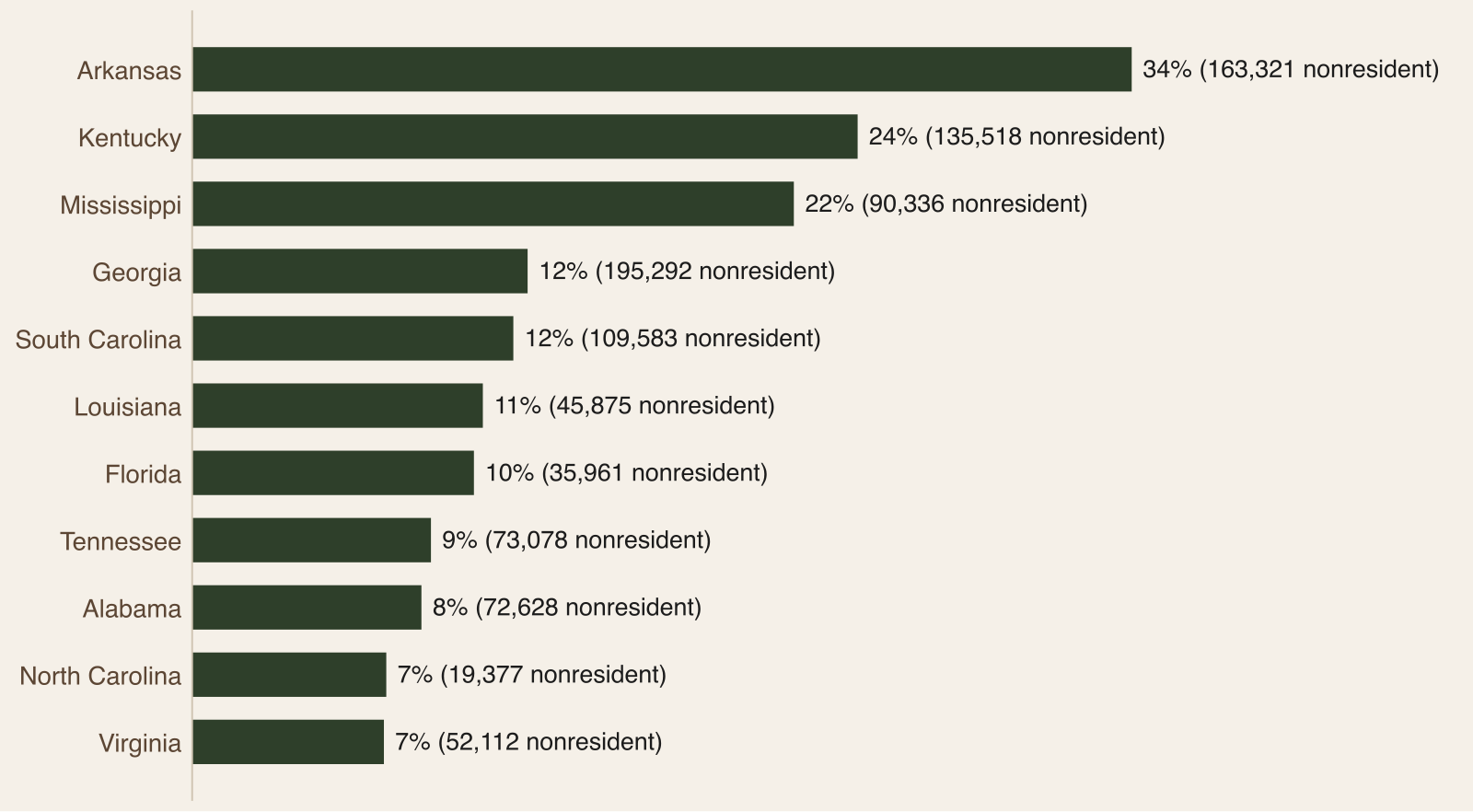
What does that mean for the pitch? A lodge in Kentucky or Arkansas is in a state where roughly a quarter to a third of the products sold go to travelers, so travel details such as lodging, arrival and what a visiting hunter needs belong high on the page. A lodge in Alabama, Virginia or North Carolina, at 8% or 7%, sells into a market that is mostly resident hunters, so a returning-guest list and local word of mouth matter more. Arkansas is the only state with a count of people, about 127,000 nonresident hunters against about 270,000 residents in 2022, roughly 32% of those hunting.
The economy around the lodge has grown as well. BEA value added from hunting, shooting and trapping rose from $8.5 billion in 2019 to $16.5 billion in 2024, with hunting and trapping alone at $8.3 billion and shooting, including archery, at $8.1 billion. That is 2.4% of the $697 billion BEA measures for all outdoor recreation. U.S. hunting spending was $45.2 billion in 2022, of which $12.3 billion (27%) was trip-related. These measures overlap and are never added together.
The Audit: 199 Lodge and Multi-Species Operators
Our October 2026 hunting audit verified 493 hunting businesses in the 11 states. Of those, 199 (40%) fall in a lodge group: 163 tagged as lodges, plus 36 multi-species operators with three or more game tags and no lodge tag. It is our own grouping of audit records, not an official category, and it is a sample of operators we could verify, not a census. Alabama, Kentucky and South Carolina hold 86 of the 199.
The bundle shows up in the tags. Of the 199, 146 (73%) carry two or more game programs and 95 carry three or more. Whitetail is the most common program (129 operators), then turkey (96), upland (70) and wild hog (67). Those tags show what an operator lists, not how much revenue each program brings in.
Lodges score above other hunting operators online. Mean digital health, a 1 to 10 score our researchers assign from observed evidence, is 5.67 for the lodge group, against 5.23 for all 493 audited hunting operators and 5.09 for our 1,546-operator Southeast benchmark. The lodge-tagged operators average 5.82, while the 36 multi-species operators without a lodge tag average 5.00, so businesses that sell several hunts without calling themselves a lodge are the weaker of the two.
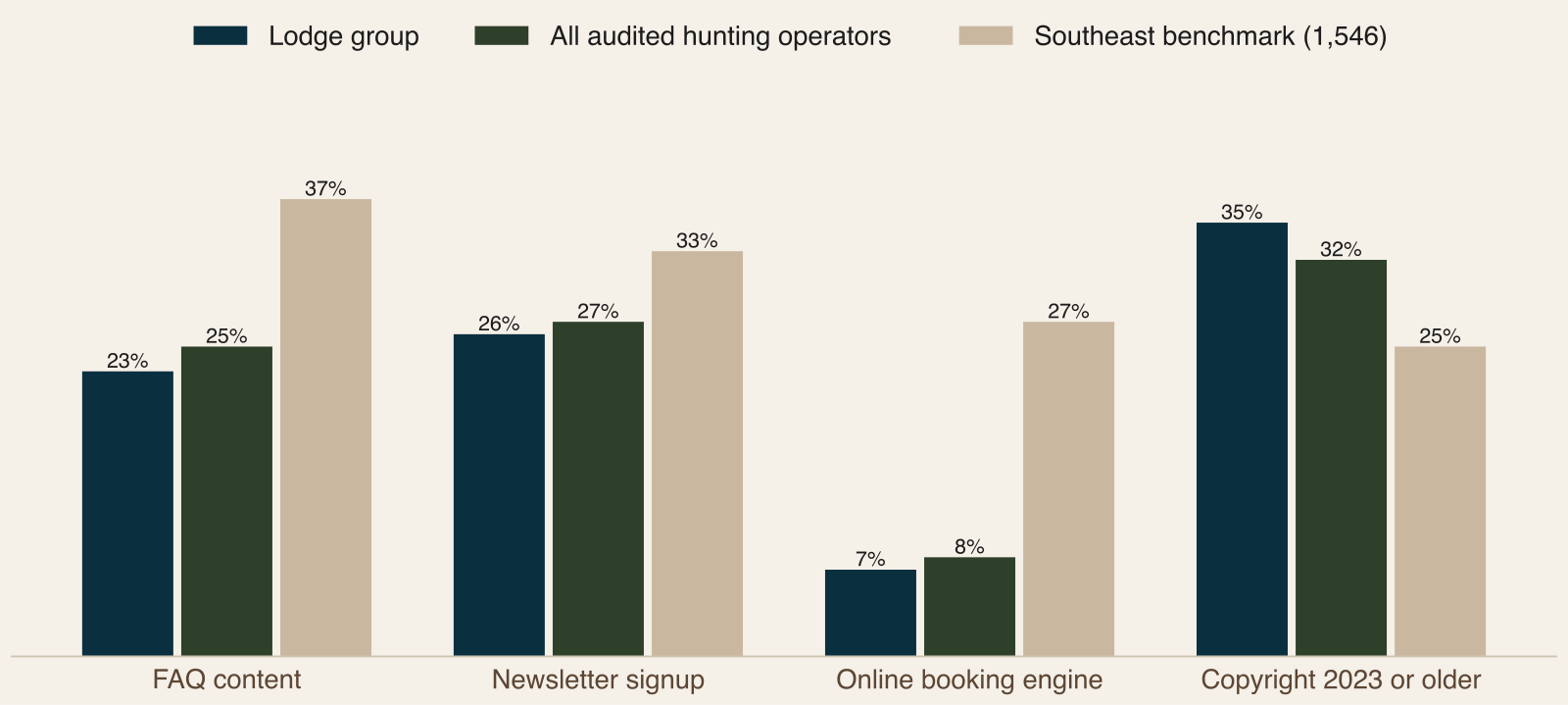
Then the gaps. Of the 192 lodge sites we could read:
7% show an online booking engine on the homepage, against 27.0% in the benchmark.
23% carry FAQ content, against 36.9%.
3 of 192 use FAQ structured data.
26% offer a newsletter signup, against 32.7%.
35% of sites with a detectable copyright year show 2023 or earlier, against 25.0%.
These are lower bounds. The scanner reads only the homepage and records whether a booking engine is present, not which one, and it does not record inquiry forms or group pages.
Lodges by State
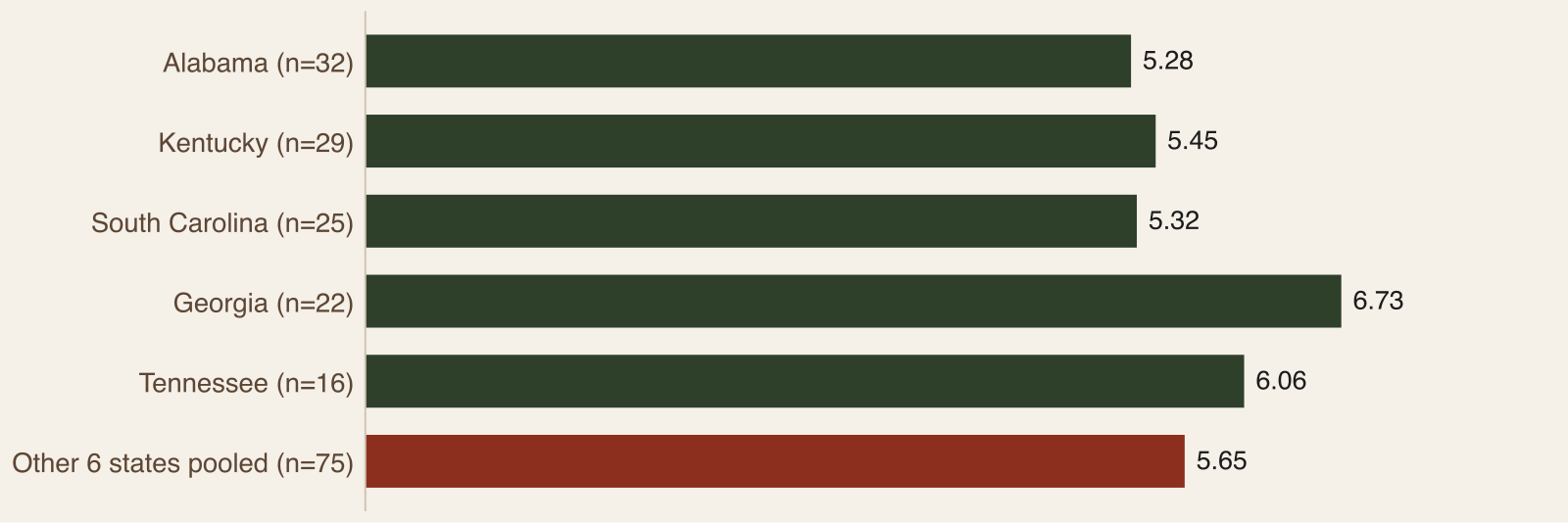
Alabama has 32 lodge group operators (48% of its audited hunting operators), Kentucky 29 (76%), South Carolina 25 (62%), Georgia 22 (32%) and Tennessee 16 (36%). The other six states are pooled because each has fewer than 15: those 75 operators average 5.65, 99% have their own website, 30% of sites read carry FAQ content and 6% show online booking.
Among the five states shown separately, mean digital health runs from 5.28 in Alabama to 6.73 in Georgia, with Tennessee at 6.06, Kentucky at 5.45 and South Carolina at 5.32. Georgia also has the highest booking rate at 14%, while South Carolina has the stalest sites, with 50% of those with a detectable year showing 2023 or earlier. Treat state differences smaller than about 10 percentage points, or half a point of score, as noise, since even the largest state rests on 32 sites read.
Two Kinds of Lodge Site
The 163 lodge-tagged operators average 5.82, with 25% carrying FAQ content, 29% offering a newsletter signup, 6% showing online booking and 36% showing a copyright year of 2023 or older. The 36 multi-species operators with no lodge tag average 5.00, with 44% scoring 4 or below, 17% carrying FAQ content and 11% offering a newsletter signup. The second part is small, so only the larger gaps matter: score (5.82 against 5.00) and newsletter signup (29% against 11%).
For comparison, the 294 hunting operators outside the lodge group average 4.93 and 93% have their own website, against 98% in the group. In the lodge group 25% score 4 or below and 15% score 8 or above. Of the 192 lodge sites read, 62% carry some structured data, usually added by website builders, but only 3 mark answers up as FAQ structured data.
What This Means for Lodge Operators
The nonresident number is context, not a forecast. It tells you the traveling pool is real and growing in most of the region. It does not tell you how many of those hunters will sleep in your beds. Some stay with relatives, hunt leased land or rent a house, and the data collected do not show where nonresident hunters sleep. Use your own booking records to judge your demand.
You are selling to more than one kind of buyer. A hunting party wants seasons, guns, dogs and a license checklist. A corporate host, usually a non-hunter arranging an outing, wants capacity, minimums, a quote and a named contact. A family or reunion organizer wants to know whether there is something for every age, and whether children can take part. All three can land on the same homepage. If the site cannot give each one a path, the visitor goes to a competitor that can. That is our general guidance on how these buyers decide, not measured data.
Booking is a gap, but it is not always an online checkout. For a group trip arranged by quote, a low online booking rate is not a surprise. The problem is the late-evening visitor who finds the site and has nothing to act on until morning. An inquiry form, a date-hold request or a deposit link serves the same purpose where full online booking does not fit.
Answers are cheap to write and rarely marked up. Corporate planners and families ask the same questions: capacity, what is included, ages, dates, programs, license requirements, meals, weather and cancellation. Each one is a short section on a page, and a competitor in your state may not have it. Only 3 of 192 lodge sites publish them in the structured format search engines read most easily.
Freshness is a trust signal. A footer from three seasons ago tells a planner deciding where to send a deposit that the business may have stopped.
How Each Buyer Decides
The audit does not measure how buyers search, so this is our general guidance, not data. Four buyers tend to land on the same homepage.
A corporate host is usually not the hunter. They are working out whether the property can take a group and handle meals, rooms and logistics, so the site should answer capacity and minimums, sample itineraries, what is included, who to contact, and how a quote and a deposit work.
A family or reunion organizer is working out whether there is something for every age and whether children can take part, so the site should give age rules and supervision, non-hunting activities, room types and meals.
A hunting party is working out which seasons and programs fit the dates, how many guns, and what license a guest needs, so each program needs a page with dates, party size and a license checklist.
A planner or assistant wants a shortlist compared quickly, so put clear facts in plain text, a short FAQ, and a phone number and form that work on a phone.
Their timing differs too. A corporate group plans well ahead and needs a quote, a minimum and a deposit, and often decides with a committee. A family chooses dates around school and holidays, often months ahead. An out-of-state hunting party plans around travel and lodging, weeks or months ahead. A returning guest rebooks the same dates when reminded, often at the end of a season.
Build Your Own Booking Calendar
The report's calendar is general guidance and gives no season dates. In spring and summer, planners for corporate outings, reunions and club trips choose destinations for the fall and winter. In late summer and early fall, hunting parties settle dates and out-of-state buyers choose. In the main seasons buyers book near the date and the calendar fills in layers. In late season and winter, guests look back and some rebook, and shooting and other days on the property can keep the calendar moving.
Then build your own in four steps. List your dates, including season open and close for each program, peak weeks and blackout dates. Mark your lead times from the last two seasons of bookings. Schedule your content to lead them, posting the next phase's page and offer before its first buyers start looking. And write your cancellation, weather and group-change policy once and show it before the deposit step.
What the Data Cannot Tell You
No source collected gives lodge revenue, room count, guest count, occupancy, package content or price, or anything on corporate or family bookings. Nonresident licenses are products sold, not people, and they cannot be tied to lodge stays; only Arkansas has a count of hunters. The spending measures overlap and are never converted into a lodge figure. The audit scanner reads the homepage, so it does not see inquiry forms, group pages or reservation systems, and every rate is a lower bound. The hunting audit and the 1,546-operator benchmark overlap by 179 operators, and the benchmark covers all outdoor business types, so comparisons with it are indicative.
Practical Moves for the Next 30 Days
Show the whole trip on the homepage. Put the stay, each program, the season dates and a way to ask about a group or hold a date above the fold, and make sure it works on a phone.
Give each program its own page. A buyer searching for a turkey hunt should land on turkey, with seasons, party size, what a day looks like and a license checklist.
Build a group page. Capacity, minimums, sample itineraries, what is included, a named contact and a short inquiry form.
Add a date-hold or deposit step. Even a simple form turns a late-night visit into an inquiry.
Write a short FAQ from your last ten callers' questions, then mark it up with FAQ structured data.
Refresh dates, photos and the footer every season, and publish next season's offer early. Planners for corporate outings and reunions choose destinations in spring and summer.
Keep a list and use it. Returning guests and past group hosts are the cheapest bookings. Offer them first choice of next year's dates.
Be careful about what you advertise on public land. Programs on a lodge's own land follow state seasons and license rules, and shooting preserves operate under state preserve licenses. Hunts on wildlife management areas, national wildlife refuges and national forests follow each managing agency's rules. National forests require a special-use permit for commercial guiding, some Southeastern states bar paid hunting guiding on their wildlife management areas, and some refuges prohibit commercial guiding outright. Never advertise a guided public-land hunt unless the managing agency allows it and you hold any permit it requires, and confirm the rules with the state wildlife agency and the managing agency.
For more on the lodge side of the business, see our posts on marketing a sporting lodge at the top tier, what a great sporting lodge website looks like, marketing to the corporate and executive retreat market and email and CRM for sporting lodges.
Read the Full Sporting Lodges Report
The full report covers the state-by-state nonresident table, the lodge group by state, the booking and answer signals, a general booking calendar and six moves for operators, with sources and methods on every chart.
Download the full 2026-27 Sporting Lodges and Multi-Program Destinations report (free with your email).
Sources
U.S. Fish and Wildlife Service, certified hunting license data and Wildlife and Sport Fish Restoration Program, license years 2020 to 2024
U.S. Bureau of Economic Analysis, Outdoor Recreation Satellite Account, March 2026 release (2019 to 2024)
Sportsmen's Alliance Foundation, Economic Impact of Hunting and Shooting in America (research by Southwick Associates, 2022 data, published 2024), and state tourism office reports for the 11 states (2024 and 2025), as cited in the report
Pine & Marsh hunting audit, October 2026 (493 operators), and the Pine & Marsh Southeast audit, October 2026 (1,546 operators), used as the benchmark
Frequently Asked Questions
How many nonresident hunters visit the Southeast each year?
The report does not count people. The 11 states sold 993,081 nonresident hunting licenses, tags, permits and stamps in 2024, 22% of the U.S. total of 4,581,316, and that was up 16% from 2020. Because one hunter can buy several products, the number of individual hunters is lower. Arkansas is the only state in the data collected with a count of nonresident hunters, at about 127,000 in 2022, against about 270,000 residents. The other ten states have no equivalent figure.
Does the report say how big the sporting lodge market is?
No. No source we collected gives lodge revenue, room counts, guest counts or package prices, so the report does not size the market. It uses nonresident license sales, BEA value added and state visitor spending as context for the pool of travelers a lodge draws from, and it keeps those measures separate because they overlap. If you see a lodge market figure attributed to this report, it did not come from here. Your own booking records are the only measure of your share.
Which states depend most on nonresident hunters?
By share of hunting products sold in 2024, Arkansas (34%), Kentucky (24%) and Mississippi (22%) lean hardest on travelers, against 7% in Virginia and North Carolina. By volume, Georgia sold the most nonresident products at 195,292. Florida's count was up 98% from 2020 from a small base of 35,961. Tennessee and North Carolina swing sharply between years for reasons the source does not give, so read those two with care and attribute no cause to either.
Why do lodge websites score higher than other hunting operators?
Lodges average 5.67 on our 10-point digital health scale, against 5.23 for all 493 audited hunting operators and 4.93 for hunting operators outside the lodge group. The audit cannot say why. The pattern fits a business with more to show and a longer sales conversation putting more into its site, but that is an interpretation, not a finding. The lodge-tagged operators average 5.82, while the 36 multi-species operators without a lodge tag average 5.00.
Should a lodge take bookings online?
It depends on how you sell. Only 7% of the 192 lodge sites read show a booking engine, against 27% in the benchmark, and for group trips arranged by phone or quote that is not unusual. At a minimum, give the visitor something to act on at night: an inquiry form, a date-hold request or a deposit link. The audit does not record inquiry forms, so the 7% is a floor. Georgia has the highest rate among the states shown, at 14%.
How should a lodge answer corporate and family buyers differently?
A corporate host needs capacity, minimums, sample itineraries, what is included, a named contact and a quote and deposit process. A family or reunion organizer needs age rules, supervision, non-hunting activities, room types and meals. A hunting party needs a page per program with dates, party size and a license checklist. All three can land on the same homepage, so give each a path. This is general guidance, not measured data, and your own booking records will show your real lead times.
Can a lodge advertise guided hunts on public land?
Only where the managing agency allows it. National forests require a special-use permit for commercial guiding. Some Southeastern states bar paid hunting guiding on their wildlife management areas, and some national wildlife refuges prohibit commercial guiding. Programs on a lodge's own land follow state seasons and license rules, and shooting preserves operate under state preserve licenses. Confirm the rules for each unit with the state wildlife agency and the managing agency, and do not advertise a guided public-land hunt you are not authorized to run.
How fresh does a lodge website need to be?
Freshness is a trust signal. Of the lodge sites with a detectable copyright year, 35% show 2023 or earlier, against 25.0% in the benchmark, and South Carolina's lodge sites were the stalest at 50%. A footer from three seasons ago tells a corporate planner deciding where to send a deposit that the business may have stopped. Update dates, photos and the footer each season, and publish next season's offer early, since planners for corporate outings and reunions choose destinations in spring and summer.


Comments