
Inside the 2026-27 Arkansas Outdoors Report: The State With the Most Hunters and Anglers per Resident
The 2026-27 Arkansas Outdoors report is a state-level look at the business of hunting, fishing and paddling in Arkansas. It puts public, primary-source data next to Pine & Marsh's October 2026 audit of private, for-profit outdoor businesses, 139 of them in Arkansas. The public data comes from the U.S. Bureau of Economic Analysis (BEA), the U.S. Fish and Wildlife Service, the Arkansas Game and Fish Commission (AGFC), the Army Corps of Engineers, the National Park Service and other agencies.
It is written for guides, lodge owners, outfitters, float operators and marina owners who sell trips in Arkansas, and for anyone deciding where to put marketing effort before the 2026-27 seasons. This post walks through the report chapter by chapter, in the report's own order. For the marketing playbook, see Marketing a Sporting Operation in Arkansas: The Full State Guide.
At a Glance: Arkansas in Nine Numbers
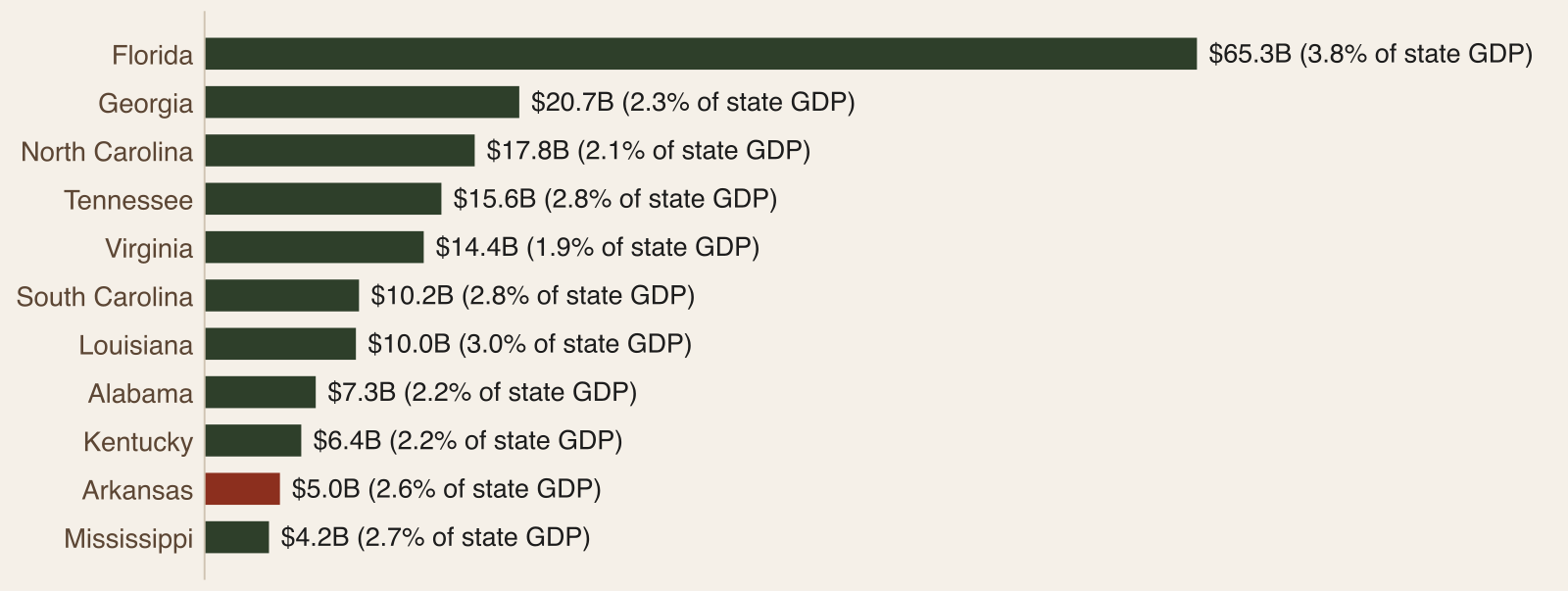
The opening chapter boils the state down to nine figures. Outdoor recreation added $5.0 billion of value added in 2024, which was 2.6% of state GDP, the sixth-highest share of the eleven states in the series. The state counted 43.4K outdoor recreation jobs and 54.3 million visitors in 2025, who spent $10.2 billion.
The people numbers stand out. Arkansas had 10.7 hunting license holders and 17.2 fishing license holders per 100 residents in 2024, the highest of the eleven states for both. Nonresidents paid 66% of hunting license revenue. Five Corps of Engineers lakes drew 9.4 million visits in fiscal 2024.
The 139 audited Arkansas businesses have a mean digital health score of 4.91 out of 10, against 5.09 region-wide, and 16% of the sites the audit read show an online booking engine, against 27% across the region. The report's summary is "small in dollars, heavier in weight," and the rest of the chapters back that up.
The Outdoor Economy: Small in Dollars, Heavy in Weight
Arkansas's $4.96 billion of outdoor recreation value added in 2024 was the second-lowest total of the eleven states. Florida, the largest, produced $65.3 billion. Outdoor recreation employed 43,384 people in Arkansas, 3.2% of wage and salary jobs.
Weight is a different question from size. The 2.6% share of state GDP is above the U.S. figure of 2.4%. The report is careful about what BEA counts: the outdoor share of many industries, from retail and boat manufacturing to lodging, food service and transportation, as well as the activities themselves.
The activity breakdown uses BEA's older 2023 vintage, so it is compared only with other 2023 figures. Arkansas did not rank first in any of the nine activity lines, and its best rank was seventh of eleven, in shooting (including archery) and equestrian. Water-based guided tours and charters were $43M, 1% of the regional total and the lowest of the eleven states. The report explains that this BEA line is weighted to coastal charter and boat-tour economies, which an inland state does not have.
The rest of the 2023 activity table shows an inland, hunting-and-paddling economy. Boating and fishing produced $399 million (4% of the regional total, ninth of eleven), fishing excluding boating $69 million (4%, ninth), and guided tours and outfitted travel of all kinds $98 million (2%, eleventh). Hunting and trapping added $84 million, tenth of eleven, while shooting including archery produced $118 million and equestrian $106 million, each 7% of the regional total and seventh of eleven. Within that same vintage, Arkansas's outdoor value added moved from $3.4 billion in 2019 to $2.9 billion in 2020 and $4.5 billion in 2023, up 33% in current dollars, and the report does not join those figures to the 2024 number.
Tourism is measured separately. The 2025 state study counted 54.3 million visitors, $10.2 billion in visitor spending and a $17.4 billion total economic impact. Southwick Associates' estimates put angler spending at $2.1 billion and hunter spending at $1.20 billion in 2022. The report never adds these measures together, because they count different things in different years. Every first-time guest of an Arkansas guide, lodge or marina arrives as one of these visitors first.
The tourism study also reports 71,860 direct jobs, which the report notes is a direct-only figure with no total-jobs count, along with $2.3 billion of labor income and $529 million in state and $204 million in local tax revenue. On the spending side, Southwick Associates' estimates count 549,770 resident and nonresident anglers in 2022, supporting about 18,010 jobs, and 347,420 hunters. Target shooting added $1.0 billion from 536,110 participants, a separate and overlapping group.
Hunters and Anglers: Dense, Slipping and Out-of-State Funded
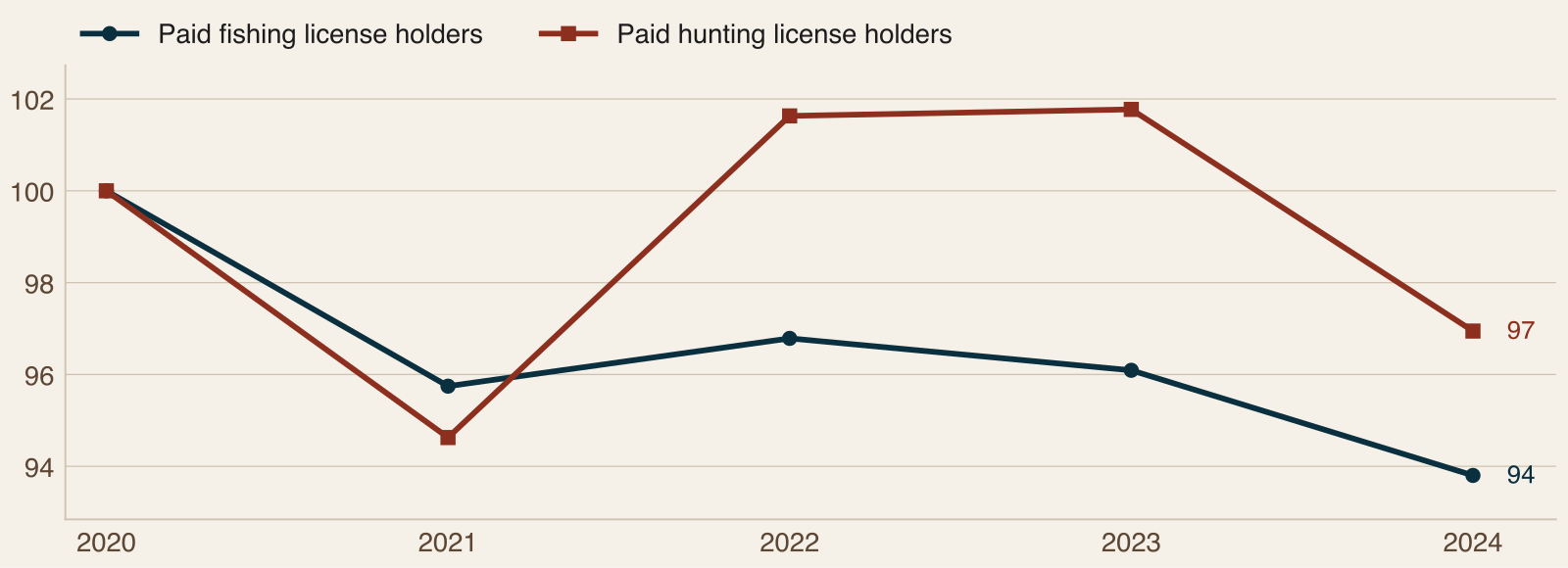
In license year 2024, Arkansas counted 532,819 paid fishing license holders and 331,401 paid hunting license holders. Against 3.1 million residents, that is the highest density in the region for both.
The counts have slipped. From 2020 to 2024, fishing license holders fell 6.2% and hunting license holders fell 3.1%, with most of the hunting drop in the last year (4.7% from 2023). The report treats the counts as estimated ranges: roughly 323,000 to 348,000 hunting license holders and roughly 533,000 to 568,000 fishing license holders across the five license years.
The resident and nonresident split is where the money is:
Nonresidents bought 34% of hunting items and paid 66% of hunting license revenue, the second-highest share in the region.
Nonresidents bought 31% of fishing items, the second-highest share, and paid 56% of fishing license revenue, the highest share.
A nonresident hunting item brought in $89 on average against $24 for a resident item.
The report adds two other windows. The 2022 National Survey counted about 907,000 anglers aged 16 and older fishing in Arkansas, 43% of them nonresidents, and about 398,000 hunters. Items are not people, and survey estimates are not license counts, so the report keeps them apart.
The National Survey adds trips and days: about 7.3 million trips and 13.6 million days for anglers, with about $3.8 billion in spending in Arkansas, $727 million of it trip-related. Its hunters, about 398,000, spent about $1.7 billion. Federal harvest surveys add a third window on bird hunters. USFWS estimated about 75,100 active duck hunters in 2024-25 (a preliminary figure, with a margin of 5% at 95% confidence), 32,900 goose hunters and about 18,500 active dove hunters in 2025-26. AGFC says more than 100,000 waterfowl hunters hunt the state each year, and the report notes that the survey and the agency figure are different measures.
The Resource and the 2026-27 Seasons
Arkansas divides into twenty deer zones. Every zone shares a long archery window from September 26 to the end of February and opens modern gun on November 14, but closing dates, antler rules and dog rules vary by zone. For a guide or hunting property, the report's point is that dates must be stated by zone, never for the state as a whole.
Hunters checked 185,922 deer in 2025-26, down 7.2% from 200,285 in 2024-25. Turkey is the bright spot: hunters checked 13,591 turkeys in spring 2026, up from 11,332 in 2025, which AGFC calls the highest since 2006. USFWS estimated an Arkansas duck harvest of about 1,415,000 birds in 2024-25 (preliminary), against 1,127,900 in 2023-24.
The harvest mix is worth knowing for deer content: antlered bucks were 50% of the 2025-26 harvest, does 44% and button bucks 6%. Early buck-only archery runs August 29 to 31, 2026. Modern gun opens November 14 everywhere but closes on different dates, for example December 6 in Zones 1 to 3, 6 to 8, 10 and 11, but December 28 in Zones 16, 16A and 17. Alternative firearms runs October 17 to 25 in every zone except 4 and 5, where it is closed. The bag limit is four deer, no more than two antlered bucks, in every zone, while antlerless allowances, antler rules and dog rules differ by zone.
The report's calendar table also covers turkey, ducks, geese, dove and feral hogs. Feral hogs may be hunted year-round on private land with the landowner's permission, but on public land only by hunters taking bear, deer or elk in an open season.
Spring turkey 2027 runs April 5 to 25 in Zone 3, April 12 to May 2 in Zone 2 and April 19 to May 9 in Zone 1, with a youth hunt April 10 and 11 in Zones 1, 1A, 2 and 2A, and a statewide limit of two legal turkeys. For ducks, the special early teal season runs September 19 to 27, the regular season runs November 21 to 29, December 10 to 23 and December 26 to January 31, and the daily bag is six ducks with species limits, including no more than four mallards, two of them hens. Canada goose runs September 1 to October 15 at five a day and again from November 21 to January 31 at two a day. Dove runs September 5 to October 25 and December 8 to January 15, with a daily bag of 15 and a possession limit of 45. The report also notes that the mourning dove trend for the Central Management Unit, which includes Arkansas, was down 4.43% a year over 2016 to 2025, and that the goose harvest estimate of about 256,400 carries a wide margin of 35%.
The chapter also covers trout. Trout are not native to Arkansas, and the fisheries exist because of cold water released from Corps dams. Since February 1, 2026, AGFC has run reduced limits on four tailwaters because of hatchery shortages, and anglers 16 and older need a trout permit to keep trout. The limits respond to hatchery conditions and change, so the report says a guide's website should link to AGFC's current regulations rather than copy them.
The Water: Lakes, Rivers and Trout
Arkansas has no coastline, so the federal saltwater survey used in the coastal state reports does not apply. Fishing here is on Corps reservoirs, free-flowing rivers such as the Buffalo, and cold tailwaters. BEA put boating and fishing at $399 million of value added in 2024, the third-lowest of the eleven states.
The five Corps projects drew 9.4 million visits in fiscal 2024. Beaver Lake was the most visited at 2.71 million, and Lake Ouachita had the most fishing visits at 287,775. Fishing was between 7% and 14% of visits at each project, so these are broad recreation lakes first and fishing lakes second. A business that sells a day on the water is selling into a crowd that came for many reasons.
The project-by-project table fills in the rest. Greers Ferry Lake drew 2,340,522 visits, 261,056 of them for fishing (11%), Lake Ouachita 2,322,138 with 287,775 fishing (12%), Dardanelle Lake 1,068,198 with 145,766 fishing (14%) and DeGray Lake 993,726 with 105,433 fishing (11%). Motorized boating accounted for 1,537,999 visits across the five projects. Visits are visits, not people, and activity counts overlap, since one visit can include more than one activity. The U.S. Coast Guard also counted 217,397 registered recreational vessels in Arkansas in 2024, down 5.3% from 2023, but registration rules differ by state, so the report reads that count as Arkansas against Arkansas over time.
The audit counts 31 fly-fishing and trout operators, the largest category in the Arkansas sample, and their supply depends on hatcheries. The practical lesson in the report is to publish the current limit from AGFC, with a date, and to update it.
Arkansas also requires a guide license to guide for pay in the taking of fish, along with a fishing license and at least $100,000 in general liability insurance (AGFC Codes 03.14 and 03.15). The report did not verify the Corps' own rules for commercial guiding on Corps land, so the answer there is to confirm with the project office.
Public Land and the Rules for Guides
This chapter matters most to anyone selling guided trips, because the land is layered and each layer has its own rule. The report covers AGFC wildlife management areas, the Buffalo National River, national wildlife refuges, two national forests, Corps lakes and state parks.
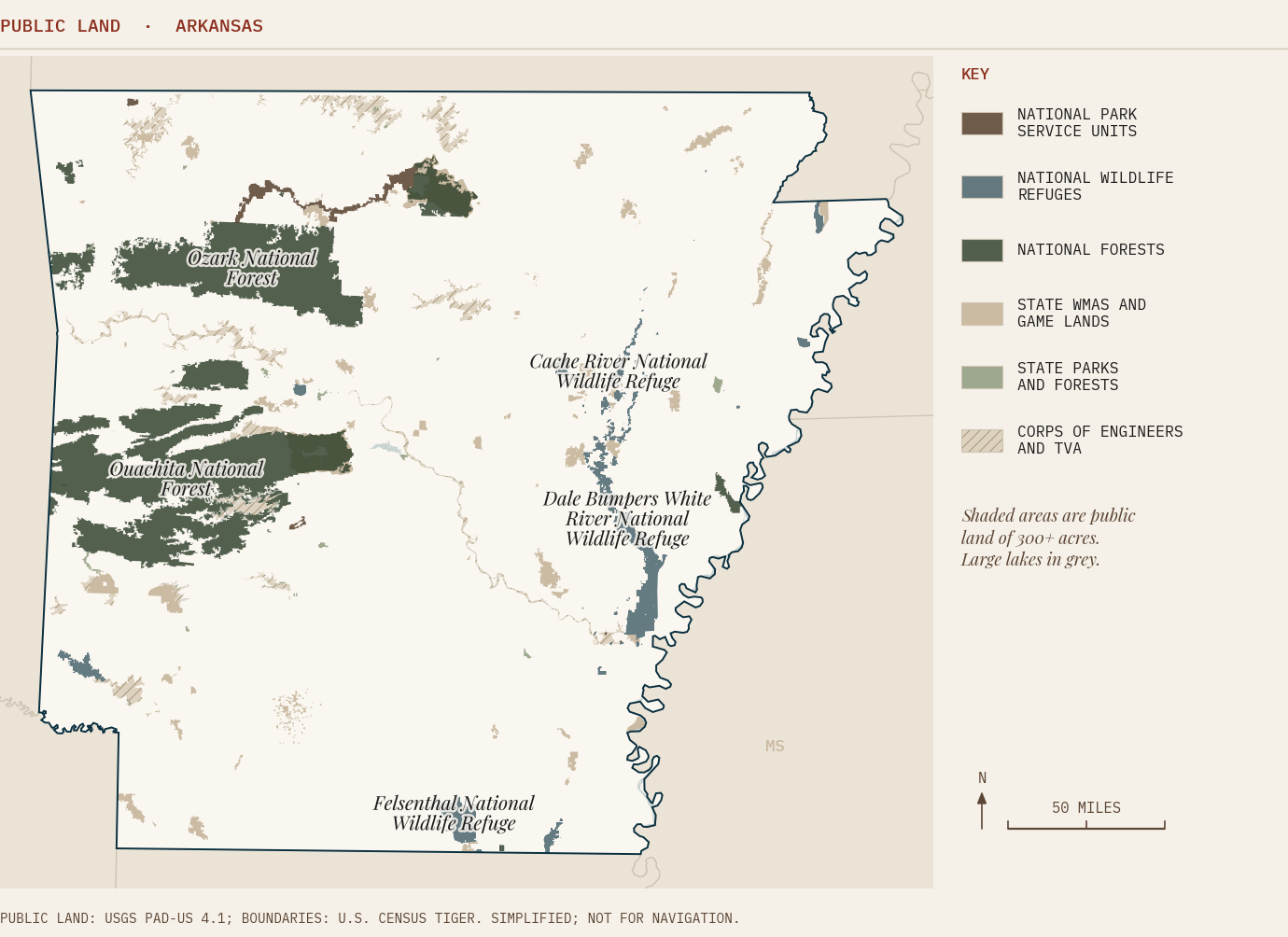
What the report finds, agency by agency:
AGFC wildlife management areas: Waterfowl guiding is illegal on Commission-owned or controlled WMAs and national wildlife refuges, for both hunter and guide (AGFC Code 24.08, effective July 1, 2024). A resident guiding another hunt on a WMA needs a Resident Special Guide License, and a nonresident may not exercise it. For fishing trips on a WMA, confirm with AGFC.
Buffalo National River: No commercial activity without a Commercial Use Authorization. The National Park Service needs at least 30 days to process a complete application and charges a $350 first application fee and a $50 annual management fee.
National wildlife refuges: The Dale Bumpers White River refuge prohibits commercial guiding for the take of wildlife or fish, and a Special Use Permit is required for all commercial activities. Check each refuge.
National forests: Selling goods or services, including guiding, requires a special-use authorization.
Corps lakes and state parks: The report did not verify the rules. Confirm with the Corps project office or the park.
An AGFC guide license is the state-level requirement, and it does not by itself authorize a paid trip inside a national park, refuge or forest. The report summarizes published rules and is not legal advice.
The Regions: Ten Sub-Regions, Wide Spread
The audit groups Arkansas into ten sub-regions, from the Ozark trout rivers to the duck marshes of the Delta. They hold 3 to 23 operators each, and six of the ten fall under the report's small-sample rule (15 operators and 10 sites read), so they are described in words, without percentages or means.
Among the four sub-regions large enough to compare, scores range from 4.05 in Greers Ferry Lake and the Little Red River to 5.81 in the Buffalo National River. The White River and Norfork tailwaters score 5.09 with 23 operators, and Lake Ouachita and DeGray Lake score 4.18. In the Buffalo sub-region, 86% of operators have their own website. The Delta and Grand Prairie sub-region is mostly waterfowl hunting outfits, which the report ties back to the WMA and refuge rule above.
The profiles add detail. The White River and Norfork tailwaters sub-region has 23 operators, 18 of them fly fishing and trout, and 65% have their own website, 15% of the sites read show online booking and 46% carry FAQ content. The Buffalo National River has 21 operators, 12 of them paddle, kayak and canoe, with 25% showing online booking and 25% carrying FAQ content. Greers Ferry Lake and the Little Red River has 20 operators, 12 of them trout and fly fishing and 6 marinas and boat rental, and only 70% have their own website. Lake Ouachita and DeGray Lake has 17, mostly marinas and boat rental (9). The smaller sub-regions are Ozarks and Beaver Lake (14 operators), Ouachita National Forest and Hot Springs (13), the Delta, Stuttgart and Grand Prairie (13, nine of them waterfowl hunting), Southwest Arkansas (8), the Arkansas River and Little Rock (7) and Crowleys Ridge and the northeast (3). Rule notes follow each profile, and the Delta's note repeats that paid waterfowl guiding is illegal on WMAs and refuges. Guiding on private land is a separate matter that needs the licenses and insurance in AGFC Code 03.14 or 03.15.
The Operator Landscape: Level With the Region, Behind on Booking
The 139 audited Arkansas operators have a mean digital health of 4.91, the fifth-lowest of the eleven states, against 5.09 region-wide. The report notes that the gap is within the margin of noise, and that the audit is a structured sample, not a census.
The detail:
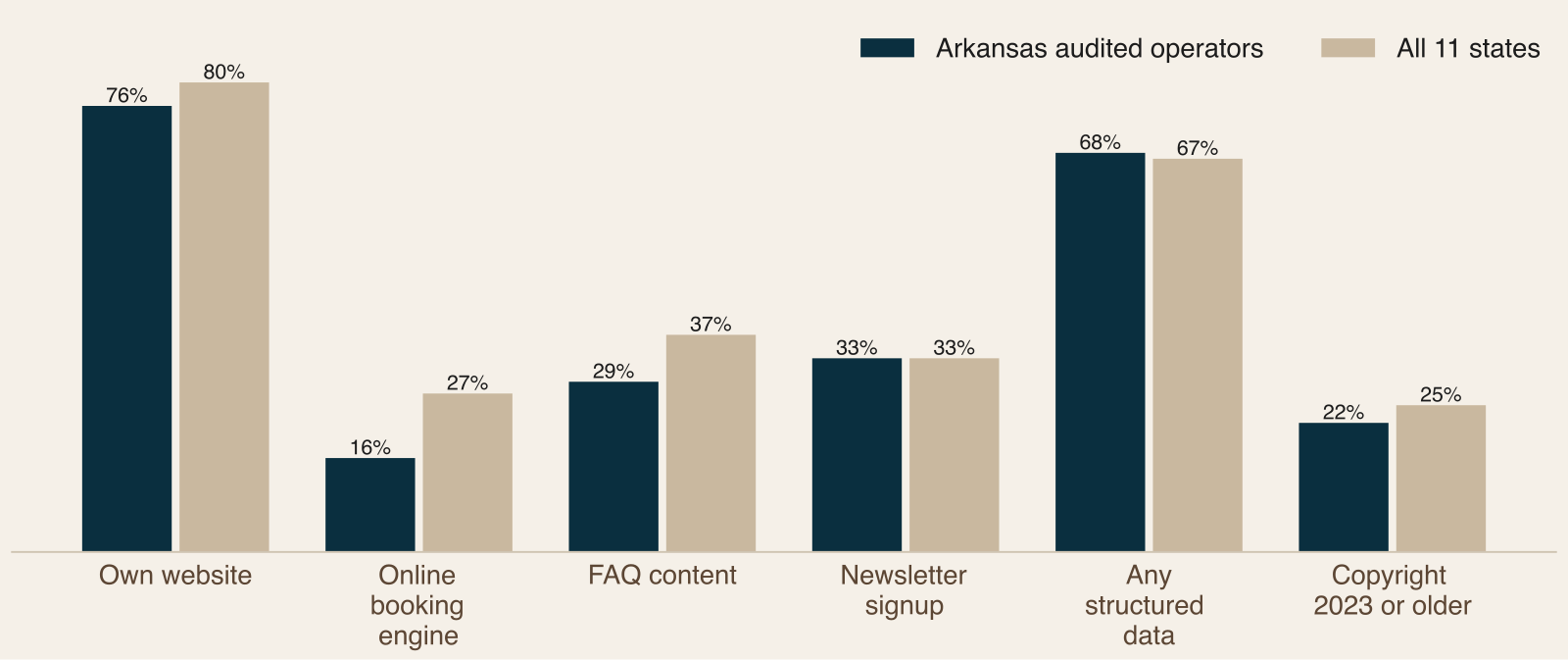
76% have their own website, against 80% across the region.
16% of the 90 sites read show an online booking engine, against 27%. Where an engine shows, FareHarbor is the most common, on 7 of the 14 sites with one.
29% carry FAQ content, but only one marks its answers up as FAQ structured data.
Arkansas's sample leans toward the lower tier, with 32% of operators lower-tier against 26% region-wide. Within tiers the state is close to the region: top-tier 7.19 against 7.06, middle-tier 5.06 against 4.95, and lower-tier 2.56 against 2.84. The largest categories are fly fishing and trout (31), marinas and boat rental (24) and paddle, kayak and canoe (22).
Re-weighted to the regional tier mix, Arkansas's mean would be 5.10 rather than 4.91, which is why the report calls the ranking directional. By category, fly fishing and trout averages 5.06 across 31 Arkansas operators against 5.53 across 126 in the eleven states, marinas and boat rental 4.42 against 4.78, and paddle, kayak and canoe 5.45 against 5.36. Of the 139 audited operators, 90 had a homepage that could be read, and every rate in the chapter is a lower bound because a feature may sit deeper in a site.
The separate hunting audit (493 hunting operators, October 2026) counts 37 in Arkansas. Their mean digital health is 5.49 and 92% have their own website, but only one of 34 sites read shows online booking. By tag, waterfowl leads with 27.
What It Means for Operators
Taken together, the chapters tell a consistent story. Arkansas has the densest base of license holders in the region and a nonresident hunter who pays most of the license revenue, yet the audited operators sit slightly below the region online and well behind on booking. The buyer is often coming from somewhere else, and the gap is in the part of the website that lets that buyer act.
The report closes with six moves, from publishing the license stack you work under to showing open dates for hunts. Its single piece of advice for this month is to make sure a visitor on a phone can find your homepage, see what a trip includes and which permits you hold, and hold a date in under a minute.
Get the Arkansas Report
The full report adds the audit tables, every chart with its source and year, the 2026-27 season calendar, the sub-region notes and the full source list.
Download the full 2026-27 Arkansas Outdoors report (free with your email).
Frequently Asked Questions
How big is the outdoor economy in Arkansas?
Outdoor recreation added $5.0 billion of value added in 2024, per BEA, which was 2.6% of state GDP and the sixth-highest share of the eleven states. It employed 43,384 people, 3.2% of wage and salary jobs. The state tourism study separately counted 54.3 million visitors spending $10.2 billion in 2025, for a $17.4 billion total economic impact. The report does not add the two measures together, because they count different things in different years by different methods.
Who pays for hunting licenses in Arkansas?
Nonresidents pay most of the money. In license year 2024 they bought 34% of hunting items but paid 66% of hunting license revenue, the second-highest share in the region, and a nonresident hunting item brought in $89 on average against $24 for a resident item. They also paid 56% of fishing license revenue, the highest share, while buying 31% of fishing items. Items are not people, since one person can buy several, but the revenue pattern is clear.
Can I guide duck hunts on public land in Arkansas?
No, not on Commission-owned or controlled WMAs or national wildlife refuges. AGFC Code 24.08 makes paid waterfowl guiding there illegal for both hunter and guide, effective July 1, 2024. The Dale Bumpers White River refuge also prohibits commercial guiding for wildlife or fish. A resident guiding another hunt on a WMA needs a Resident Special Guide License. For any other public-land trip, confirm with the managing agency, and remember that guiding on private land still needs the guide license and liability insurance.
What does an Arkansas guide license require?
Arkansas requires a guide license to guide, aid or assist another person for pay in the taking of fish, along with a fishing license and at least $100,000 in general liability insurance, under AGFC Codes 03.14 for residents and 03.15 for nonresidents. Hunting guides need the matching hunting license. The report is clear that the state license is a floor: it does not by itself authorize a paid trip inside a national park, refuge or forest, and the report did not verify the Corps' rules for commercial guiding on Corps land.
How do Arkansas operators compare online?
The 139 audited Arkansas operators have a mean digital health of 4.91 against 5.09 region-wide, the fifth-lowest of the eleven states, a gap the report calls within the margin of noise. The clearer gap is booking: 16% of the 90 sites read show an online booking engine, against 27% across the region, and 29% carry FAQ content against 37%. Re-weighted to the regional tier mix, the Arkansas mean would be 5.10.
Do the trout limits change?
Yes. Since February 1, 2026, AGFC has run reduced limits on four tailwaters because of continued shortages at federal and state hatcheries: the White River and North Fork, the lower White River reach with its own mixed limit, and the Beaver and Greers Ferry tailwaters. The limits can change again, and anglers 16 and older need a trout permit to keep trout. The report advises linking to AGFC's current regulations and showing the date you last checked them.
Why are Corps lakes called recreation lakes first?
Because fishing is a minority of the visits. The five Arkansas Corps projects drew 9.4 million visits in fiscal 2024, and fishing was between 7% and 14% of the visits at each one. Beaver Lake was the most visited at 2.71 million, and Lake Ouachita had the most fishing visits at 287,775. A marina or guide selling a day on the water is selling into a crowd that came for many reasons, so the offer has to explain itself quickly to someone who may not be an angler.
What does a guide need to run trips on the Buffalo National River?
A Commercial Use Authorization from the National Park Service. The Park Service lists guided paddling, motorized boat tours and guided hiking among the services covered, needs at least 30 days to process a complete application, and charges a $350 first application fee and a $50 annual management fee. Business operations in a park unit also need NPS permission under 36 CFR 5.3. AGFC also lists a Buffalo National River WMA, so a hunting guide has to check with both agencies.
Sources
U.S. Fish and Wildlife Service, certified hunting and fishing license data, license years 2020 to 2024
AGFC Codes 03.14 and 03.15, guide license requirements, with Arkansas Game and Fish Commission season, trout and WMA pages read October 21, 2026
USGS Gap Analysis Project, PAD-US 4.1, for the public-land map
Pine & Marsh Southeast audit, October 2026 (1,546 operators), and the Pine & Marsh hunting audit, October 2026 (493 operators)
Related Reading
Marketing a Sporting Operation in Arkansas: The Full State Guide
Inside the 2026-27 Waterfowl Report: Hunters, Breeding Numbers and the Duck Guide Storefront
Inside the 2026-27 Whitetail Report: Why You Cannot Rank Deer Harvest by State
Inside the 2026-27 Mississippi Outdoors Report: A Small Economy and Room to Grow Online


Comments