
Inside the 2026-27 North Carolina Outdoors Report: Big Water, Big Visitors and Permits by Agency
The North Carolina Outdoors report is our 2026-27 state edition for North Carolina. It sets public data from the Bureau of Economic Analysis, Visit North Carolina, the U.S. Fish and Wildlife Service, NOAA Fisheries and the state wildlife and marine agencies beside our October 2026 audit of 243 North Carolina outfitters, guides, charters, tour companies and lodges. It is written for the people who run those businesses.
This post walks through the report chapter by chapter, with the numbers that matter and what they mean for operators. For the marketing playbook, see Marketing a Sporting Operation in North Carolina: The Full State Guide.
The Outdoor Economy
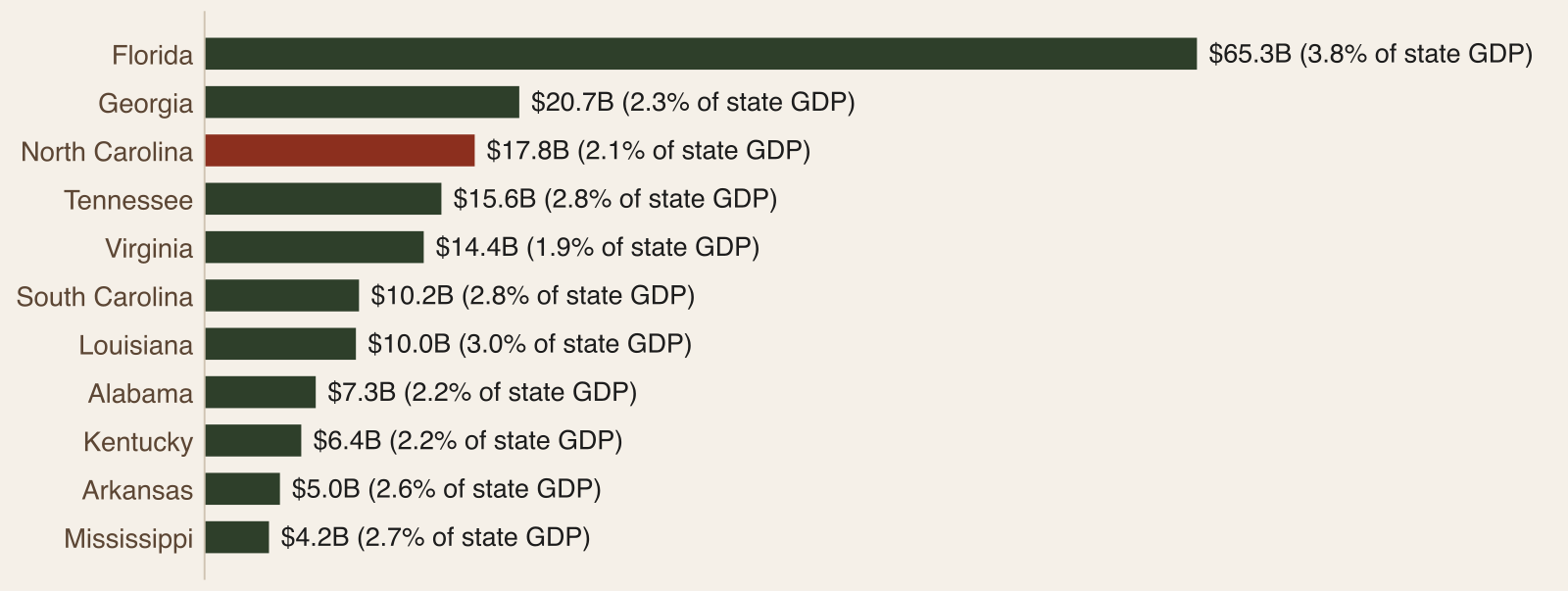
Outdoor recreation added $17.8 billion of value added to North Carolina's economy in 2024, according to the Bureau of Economic Analysis (BEA). That is 10% of the eleven-state Southeast total, 2.6% of the national figure and the third-highest total of the eleven states, behind Florida and Georgia. It employed 155,462 people, 3.0% of wage and salary jobs.
Size and weight differ. Outdoor recreation was 2.1% of state GDP, below the U.S. figure of 2.4% and the second-lowest share of the eleven states. North Carolina is a large state with a large economy, so the outdoors is a smaller slice of it.
The activity breakdown, for 2023 from an earlier BEA release, shows where the state is strong:
North Carolina ranked second of eleven in six of the nine activity lines.
Its largest share of the regional total was in fishing, excluding boating, at 13%.
Water-based guided tours and charters, the line closest to the guide and charter trade, produced $403M, 13% of the regional total, second of eleven.
Hunting and trapping was a relative weak spot at $122M, 6% of the region and sixth of eleven.
Visitors add a separate picture. Preliminary 2025 findings from Visit North Carolina put visitor spending at $37.2 billion, a record and 1.3% above 2024, with 230,997 direct tourism jobs. Yet the state ranked seventh in domestic visitation, down from fifth in 2024, in the context of Hurricane Helene recovery in the west.
Southwick Associates' estimates, built on the 2022 national survey, put angler spending at $5.1 billion in 2022 and hunter spending at $2.10 billion. The report never adds BEA value added, tourism spending and survey-based spending together, since they measure different things.
The full 2023 table fills in the picture. North Carolina ranked second of eleven in boating and fishing ($1,336M, 12% of the regional total), fishing excluding boating ($226M), RVing ($499M, 10%), climbing, hiking and tent camping ($216M, 13%) and equestrian ($179M, 12%), and third in guided tours and outfitted travel of all kinds ($576M, 12%). It ranked fifth in shooting including archery ($168M, 10%). Within that older vintage, outdoor value added moved from $12.8 billion in 2019 to $9.5 billion in 2020 and $16.2 billion in 2023, up 26% in current dollars, but BEA revised the series in March 2026, so the report does not join it to the 2024 figure.
The tourism study counted $36.1 billion of domestic and $1.1 billion of international visitor spending, and $9.8 billion in payroll. Southwick Associates counted 1,404,130 anglers supporting about 46,140 jobs and 650,360 hunters, and target shooting added $2.4 billion from 1,530,920 participants, a separate and overlapping group.
Hunters and Anglers
Fishing is the big market. Using the U.S. Fish and Wildlife Service's certified license data, North Carolina's paid fishing license holders ran roughly 1,318,000 to 1,488,000 across license years 2020 to 2024, and paid hunting license holders roughly 582,000 to 654,000. The report presents these as estimated ranges, not exact counts. Holder counts run above the licenses sold in the same data, which may reflect lifetime license holders, so for exact figures contact the North Carolina Wildlife Resources Commission (NCWRC). The direction is down: fishing holders peaked in 2021 and fell by 2024, and hunting holders fell most in the last year.
Per 100 residents, the state has 11.9 fishing and 5.3 hunting license holders, the fifth-highest and fourth-lowest densities in the region.
Items sold tell a cleaner story about who buys:
In 2024, 30% of fishing licenses, tags, permits and stamps went to nonresidents, the third-highest share in the region. Yet nonresidents paid only 21% of fishing license revenue, the second-lowest share.
Hunting is a resident market. Nonresidents bought 7% of hunting items and paid 16% of hunting license revenue.
Items are not people, and one person can buy several. Federal surveys estimate about 45,000 active duck hunters in 2024-25 (preliminary) and about 47,700 active dove hunters in 2025-26. These are survey estimates and are not added to license counts.
For an operator, the nonresident angler is a real part of demand in this state, but they spend less on licenses than their numbers suggest. Hunting parties are mostly local, so a lodge or guide serving out-of-state hunters is selling into a thinner pool than in neighboring states.
The exact counts show a trend the ranges hide. Fishing license holders were 1,450,542 in 2020, peaked at 1,487,575 in 2021 and fell to 1,317,891 in 2024, down 9.1%. Hunting license holders fell from 633,506 to 581,521, down 8.2%, with most of the drop, 4.4%, in the last year. In 2024 North Carolina sold 607,250 resident and 256,411 nonresident fishing items for $23.1 million and $6.2 million, and 254,626 resident and 19,377 nonresident hunting items for $11.1 million and $2.1 million.
Holders and sales do not tie. The state reports 1,317,891 fishing license holders against 863,661 items sold, and 581,521 hunting holders against 274,003 items. One possible reason is lifetime licenses counted as holders without a sale that year, but the data do not say, which is why the report calls the holder figures an estimated range and sends readers to NCWRC for exact counts.
The Resource and the 2026-27 Seasons
Hunters registered 199,770 deer in 2025-26, of them 103,737 antlered, the highest of the five seasons shown and up 19% from 168,427 in 2021-22. Because North Carolina counts deer through mandatory registration, these are reported harvest, a floor on the true kill.
Deer seasons run by zone. Gun season opens from October 17 in the east to November 28 in the western counties, and every zone closes January 1, 2027. Archery opens statewide on September 12, 2026. Each zone's dates have to be stated precisely on any page that quotes them.
Other findings:
Hunters reported 25,034 turkeys in the spring 2026 season, the highest in NCWRC's series, which begins in 1977. Spring turkey 2027 runs April 17 to May 15.
USFWS estimated a duck harvest of about 479,900 birds in 2024-25 (preliminary) and a dove harvest of about 557,200 in 2025-26.
Quail season runs November 21, 2026 to February 28, 2027. Migratory game bird hunting is closed on Sundays.
On the water, rules are specific. As read in October 2026, red drum must be 18 to 27 inches, one fish per person per day. Spotted seatrout are 14 to 20 inches, three per day. Flounder was open for two weeks only in 2026, September 1 to 14. In the mountains NCWRC classifies public trout waters five ways, from Hatchery Supported to Delayed Harvest, where no trout may be kept from October 1 to early June and only single-hook artificial lures are allowed. NCWRC's Setzer hatchery begins a major renovation in 2026, so stockings will be reduced in 2026, 2027 and possibly 2028. Because rules change, link to the agency's current pages rather than copying them.
The zone calendar has more detail than a summary can carry. Archery closes October 2 in the Northeastern and Southeastern zones, October 30 in the Central zone and five Northwestern CWD counties, November 6 in the rest of the Northwest and November 13 in the Western zone. Gun season opens October 17, November 14, November 21 and November 28 in the corresponding zones. The Bear Mountain bear management unit runs October 3 to November 21 and December 12 to January 1.
Small game and birds run on their own clocks. Gray squirrel runs October 12 to February 28 and again May 17 to 31, 2027, and pheasant from September 5. The inland duck zone runs October 15 to 17, November 7 to 28 and December 18 to January 30, and the coastal zone October 23 to 24, November 7 to 28 and December 17 to January 30, with September teal on September 10 to 19 east of U.S. 17. Woodcock runs December 10 to January 30. Spring turkey 2027 has a youth season April 10 to 11. The 2025 summer survey counted 1.4 poults per hen statewide. On trout waters, Hatchery Supported streams allow seven trout a day, and NCWRC's Setzer hatchery, which produces over 75% of its stocking trout, begins a major renovation in 2026, so stockings will be reduced in 2026, 2027 and possibly 2028.
The Water
NOAA's recalibrated estimates count 14.4 million marine angler trips in North Carolina in 2025, down 1% from 14.5 million in 2021, and 13% of all trips in the seven Southeast states it covers. This is a state of shore anglers: 74% of trips were from shore and 24% from private and rental boats. NOAA recalibrated every estimate in August 2026, so do not compare these figures with anything published earlier.
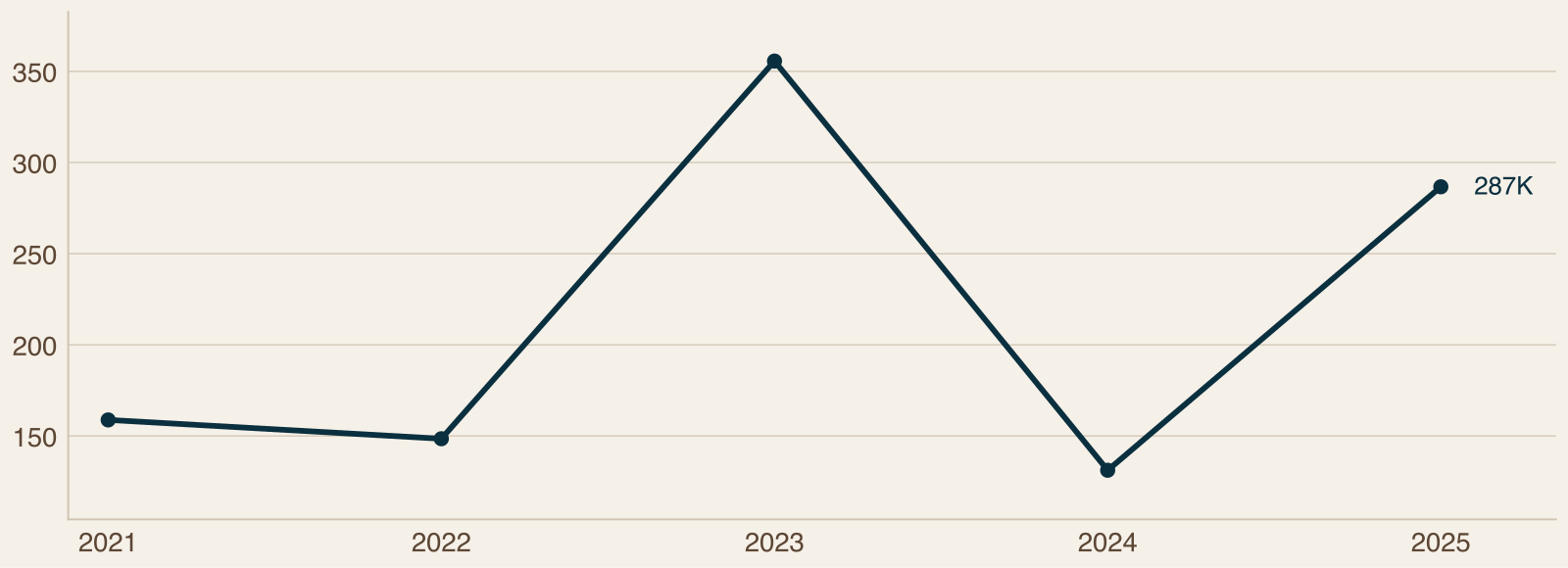
Charter-boat trips numbered 286,673 in 2025, 14% of the seven-state charter total but only 2% of North Carolina's own trips. The series is unsteady, from a low of 131,199 in 2024 to a high of 355,612 in 2023, so charter counts move with weather, storms and sampling as much as with demand. The charter mode includes offshore trips, and no mode isolates inshore guiding.
What the trips are worth:
Trip spending supported $1.45 billion in sales impact in 2023 and about 10,928 jobs, 14% of the Southeast's nine coastal areas.
Charter customers spend the most per day: $405 per angler-day, 5.7 times the shore angler's $71.
The U.S. Coast Guard counted 345,699 registered recreational vessels in 2024, third among the eleven states.
The Corps of Engineers counted 2,922,546 visits at B. Everett Jordan Dam and Lake and 1,984,240 at Falls Lake in fiscal 2024.
To carry paying anglers in coastal waters, the N.C. Division of Marine Fisheries requires a for-hire license, and the captain's license needs a U.S. Coast Guard license suitable for a passenger rating. Separately, anyone who serves for hire as a hunting or fishing guide needs a Wildlife Resources Commission guide license. Which applies depends on the water, so confirm with both agencies.
Two numbers add context to the coastal data. The 2025 trip estimate carries a percent standard error of 8.1, against 4.9 to 5.8 in the four earlier years, so moves of a few percent are within noise. Shore trips were 10.6 million and private and rental boat trips 3.5 million. Inland, Falls Lake logged 233,273 fishing visits and Jordan Lake 368,845, and W. Kerr Scott Dam and Reservoir had 615,242 visits, 73,122 for fishing. A Blanket For-Hire Captain's or Vessel license costs $250 for residents with six or fewer passengers and $350 for more than six, or $312.50 and $437.50 for nonresidents. The state guide license under G.S. 113-270.4 is $15 for residents and $150 for nonresidents.
Public Land and the Rules for Guides
This is the chapter that keeps operators out of trouble. Public land is large and guiding on it is permit-bound, and the permit depends on who manages the land.
What the report found:
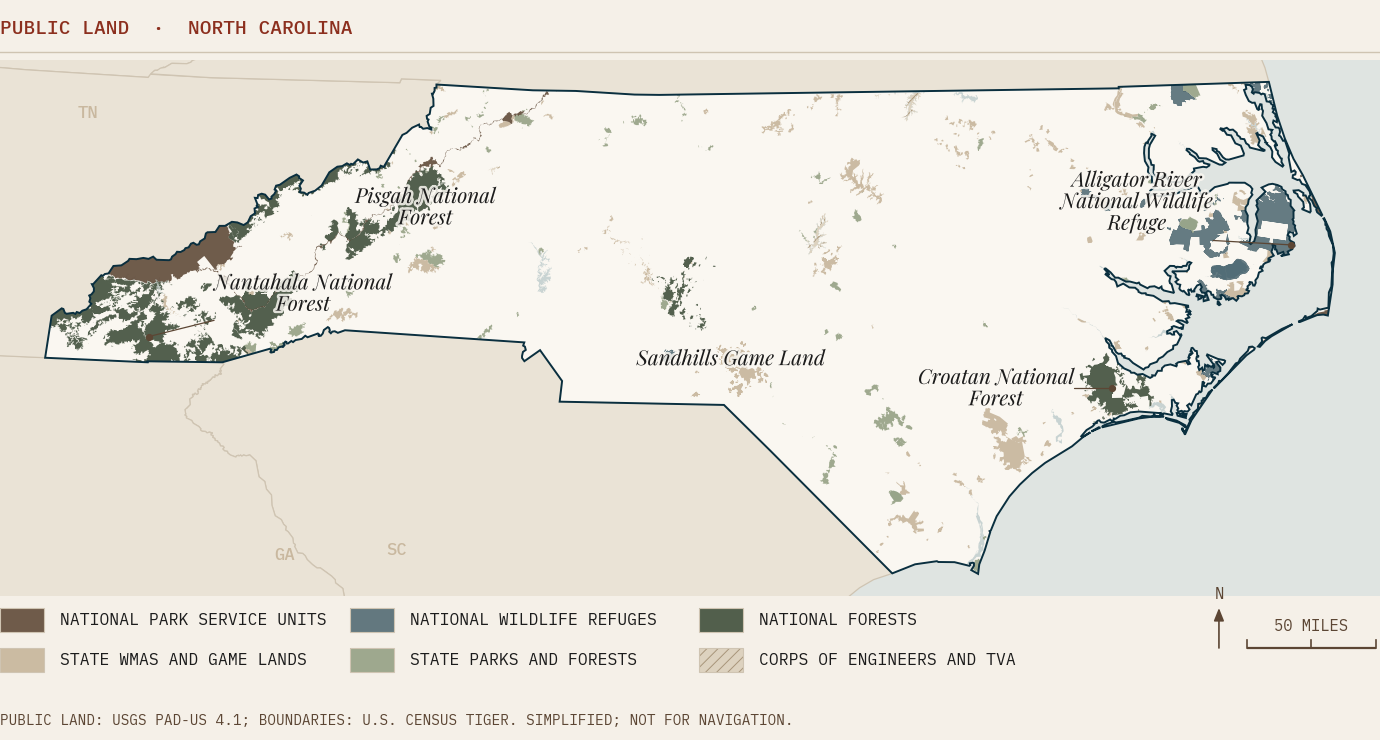
NCWRC game lands: over 2 million acres. NCWRC requires an annual Commercial Use Permit of businesses using game lands for financial gain by conducting unlicensed activities such as guided tours and rentals. The report found no NCWRC page that authorizes paid hunting guides on game lands, so confirm with NCWRC before selling a guided hunt on one.
National parks and seashores: business operations require an NPS permit, contract or written agreement. Great Smoky Mountains runs commercial services through concession contracts or Commercial Use Authorizations, and Cape Hatteras issues authorizations for guided fishing.
National wildlife refuges: commercial enterprise is prohibited except as authorized by special permit.
National forests: selling goods or services, including guiding, requires a special-use authorization.
State parks: conducting commercial business is prohibited except when authorized by a Special Activity Permit.
A national park authorization does not cover a refuge, a refuge permit does not cover a state park, and a coastal for-hire license or a state guide license covers the anglers or hunters on the trip, not the right to run a business inside a park, refuge or forest. Check with the agency that manages the exact place you plan to guide. The report summarizes published rules and is not legal advice.
The scale of the land helps explain the permit list. Great Smoky Mountains National Park covers 522,427 acres, divided almost evenly between North Carolina and Tennessee, with more than 12 million recreational visits in 2024. The state's four national forests are Nantahala, over half a million acres and the largest, Pisgah, over 500,000 acres, Croatan, 160,000 acres, and Uwharrie, 51,546 acres. State Parks manage over 250,000 acres with more than 19 million visitors a year. The NCWRC Commercial Use Permit is $102 plus $3 per participant, and a Cape Hatteras Commercial Use Authorization for guided fishing is a $350 application fee plus a $100 management fee, valid until December 31 of the year issued.
The Regions
The audit groups North Carolina's operators into ten sub-regions, from the Outer Banks to the Smokies, and every one has enough operators and readable sites to be scored. Scores range from 4.57 in the Pamlico, Albemarle and Inner Banks to 6.14 in the Outer Banks. Differences under half a point are noise.
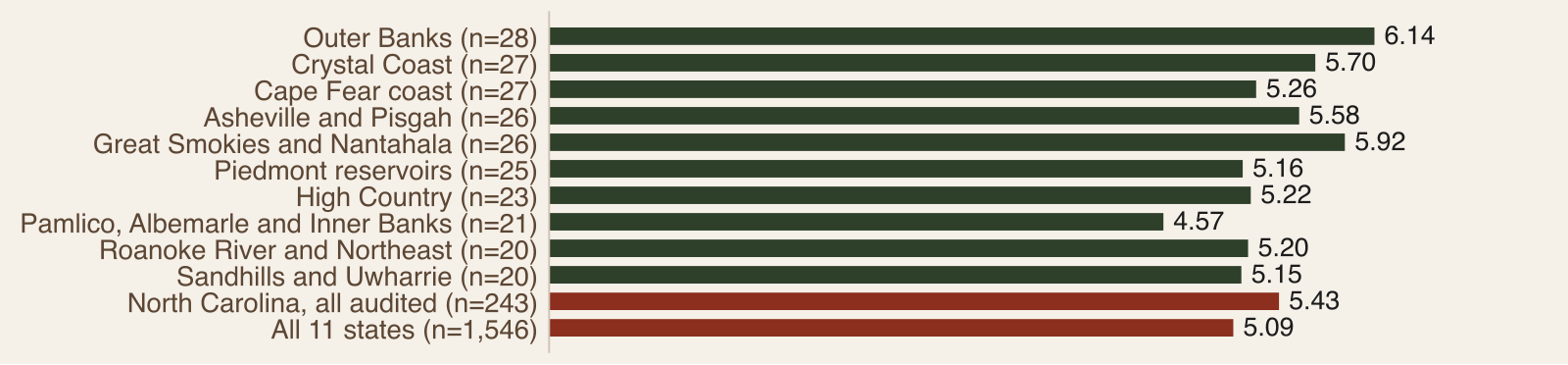
Outer Banks: 28 operators, mean digital health 6.14, the fifth-highest of 43 comparable sub-regions across the eleven states. 40% of sites read show a booking engine. Offshore charters lead.
Great Smokies and Nantahala: 26 operators, 5.92, led by whitewater rafting and fly fishing.
Crystal Coast: 27 operators, 5.70, mostly inshore fishing.
Asheville and Pisgah: 26 operators, 5.58, with all of them having their own website and fly fishing leading.
Cape Fear coast: 27 operators, 5.26. Piedmont reservoirs: 25 operators, 5.16, led by striper and lake fishing. High Country: 23 operators, led by fly fishing and trout.
Roanoke River and Northeast: 20 operators, led by multi-species hunting guides. Sandhills and Uwharrie: 20 operators, 5.15, led by upland and plantation operations.
Pamlico, Albemarle and Inner Banks: 21 operators, 4.57, the lowest-scoring North Carolina sub-region, with 67% on a site of their own.
Each region carries its own rule notes. Cape Hatteras National Seashore issues Commercial Use Authorizations for guided fishing, Pisgah and Nantahala need a Forest Service special-use authorization, and mountain trout streams follow five classifications.
The sub-region figures show how much the booking path varies. The Cape Fear coast has 27 operators, 63% with their own website and 56% of the 16 sites read showing online booking. The Crystal Coast has 85% on their own website and 23% showing booking, and Asheville and Pisgah has 100% on their own website and 28% showing booking. The Piedmont reservoirs have 47% showing booking, the High Country 39% with 61% carrying FAQ content, the highest in the state, and the Sandhills and Uwharrie 17% showing booking and 22% carrying FAQ content. The Roanoke River and Northeast has 80% on their own website and 20% showing booking.
The Operator Landscape
North Carolina's 243 audited operators are part of 1,546 across the eleven states. Their mean digital health, a 1 to 10 score assigned by researchers from observed evidence, is 5.43, the second-highest of the eleven states against 5.09 for the region. The lead is within the margin of noise.
How North Carolina compares with the eleven-state benchmark:
Own website: 81%, against 80%.
Score 4 or below: 33%, against 40%.
Online booking engine (193 sites read): 32%, against 27%.
FAQ content: 41%, against 37%, but only six of the 193 mark answers up as FAQ structured data.
Newsletter signup: 29%, against 33%.
Where a booking engine shows, FareHarbor is the most common: 35 of the 62 sites with one use it, followed by Wix Bookings (15) and Xola (4). And 27% of sites with a detectable copyright year still show 2023 or earlier.
The sample is not tilted. 30% of operators are top-tier against 32% regionally. Top-tier operators average 7.61 in North Carolina against 7.06 across the region, and re-weighted to the region's tier mix, the state's mean would be 5.53.
By category, paddle, kayak and canoe operators average 6.23, eco-tours 6.38 and fly fishing and trout 5.90. Inshore and flats fishing, the largest category with 37 operators, averages 4.78.
The separate October 2026 hunting audit counts 62 North Carolina hunting operators with a mean of 5.27, about level with the 5.23 for all 493 audited hunting operators. 92% have their own website, but only 14% of the 56 sites read show online booking.
The category table has the clearest comparisons. Inshore and flats fishing has 37 operators at 4.78 against 4.69 across 196 in the eleven states. Paddle, kayak and canoe has 30 at 6.23 against 5.36 across 231, fly fishing and trout 29 at 5.90 against 5.53 across 126, striper and lake fishing 23 at 4.65 against 4.49 across 51, offshore charter fishing 20 at 5.75 against 5.15 across 67, upland, plantation and sporting clays 17 at 5.71 against 5.21 across 82 and eco-tours and wildlife viewing 16 at 6.38 against 6.00 across 101. By tier, middle-tier operators average 5.41 against 4.95 and lower-tier 3.10 against 2.84. In the hunting audit, tags overlap: whitetail (24), upland and quail (21), sporting clays (18), turkey (15), waterfowl (12), wild hog (9), lodge or multi-program (8), bear (2) and dove (2).
What It Means for Operators
North Carolina is a big, varied outdoor market with a large fishing public and record visitor spending. Its operators already rank near the top of the region online, so the gains are in the details: booking that works on a phone, plain answers marked up for search, and a clear statement of which permits you hold.
The report closes with seven moves:
Write for the visitor and the season.
Make booking work on a phone.
Answer the questions, then mark them up.
Publish the rules you work under.
Write a page for each water, region and season.
Close the gap in the Pamlico, Albemarle and Inner Banks.
For hunting operators, close the booking gap.
Above all, do not assume one permit travels. Match the authorization to the agency that manages the place you guide, and confirm with NCWRC before selling a guided hunt on a game land.
Get the Full Report
The full report adds the complete 2026-27 hunting calendar, the activity and category tables, ten sub-region profiles, the public land map and sources for every chart.
Download the full 2026-27 North Carolina Outdoors report (free with your email).
Frequently Asked Questions
How big is North Carolina's outdoor economy?
Outdoor recreation produced $17.8 billion of value added in 2024, third-highest of the eleven Southeast states, but only 2.1% of state GDP against 2.4% nationally, the second-lowest share. It employed 155,462 people. Visit North Carolina separately reported a record $37.2 billion of visitor spending in 2025, 1.3% above 2024, though the state fell to seventh in domestic visitation from fifth. The report never adds these measures together because they count different things.
How many fishing and hunting license holders does North Carolina have?
In license year 2024 the state counted 1,317,891 paid fishing license holders, the second-highest count in the region, and 581,521 paid hunting license holders, the third-highest. Fishing holders fell 9.1% since 2020 and hunting holders 8.2%. The report gives the five-year spans as estimated ranges, roughly 1,318,000 to 1,488,000 for fishing, because holders run above licenses sold, possibly reflecting lifetime licenses. Contact NCWRC for exact counts.
Can I sell guided hunts on North Carolina game lands?
Confirm with NCWRC first. NCWRC requires an annual Commercial Use Permit, at $102 plus $3 per participant, of businesses using game lands for financial gain through unlicensed activities such as guided tours and rentals. The report found no NCWRC page that authorizes paid hunting guides on game lands. Because that is not the same as permission, ask NCWRC about the exact game land and get the answer in writing before you publish a guided hunt.
What licenses does a North Carolina guide or charter need?
In coastal waters, the Division of Marine Fisheries requires a for-hire license, and the captain's license needs a Coast Guard license suitable for a passenger rating. Anyone serving for hire as a hunting or fishing guide also needs a Wildlife Resources Commission guide license, $15 for residents and $150 for nonresidents. Which applies depends on the water, so confirm with both agencies. Federal and state land add their own authorizations.
Where are North Carolina operators weakest online?
The lowest-scoring sub-region is the Pamlico, Albemarle and Inner Banks, at 4.57 against 5.43 for the state, with 67% of its 21 operators on a site of their own and 21% of sites read showing online booking. By category, inshore and flats fishing, the largest at 37 operators, averages 4.78. Across the state, only six of 193 sites read mark answers up as FAQ structured data, though 41% carry FAQ content.
What does the coast look like for guides and charters?
NOAA's recalibrated estimates count 14.4 million marine angler trips in 2025, down 1% from 2021, and 74% were from shore. Charter boats made 286,673 trips, about 2% of the total, and the count swings from 131,199 in 2024 to 355,612 in 2023, so no trend is drawn. Charter customers spend the most per day, $405 against $71 for a shore angler. NOAA recalibrated its estimates in August 2026, so do not compare them with older figures.
When do the main North Carolina seasons open?
Deer archery opens statewide September 12, 2026, and gun season opens by zone from October 17 in the Northeastern and Southeastern zones to November 28 in the Western zone, closing January 1, 2027. Spring turkey 2027 runs April 17 to May 15 with a youth season April 10 to 11. Quail runs November 21 to February 28. Flounder was open only September 1 to 14 in 2026, so always link to current agency pages.
Do nonresident anglers matter in North Carolina?
They are numerous but lower value per license. Nonresidents bought 30% of fishing licenses, tags, permits and stamps in 2024, the third-highest share in the region, but paid only 21% of fishing license revenue, $6.2 million against $23.1 million from residents. Hunting is a resident market, with nonresidents buying 7% of items and paying 16% of revenue. A lodge or guide serving out-of-state hunters is selling into a thinner pool than in neighboring states.
Sources
Pine & Marsh outfitter audit (1,546 operators) and hunting supplement (493 operators), October 2026
Related Reading
Marketing a Sporting Operation in North Carolina: The Full State Guide
Inside the 2026-27 Virginia Outdoors Report: From the Chesapeake to the Blue Ridge
Inside the 2026-27 South Carolina Outdoors Report: A Coast and Lake State with Room to Grow Online
Inside the 2026-27 Fly Fishing and Trout Report: A Strong Email List and a Booking Gap


Comments