
Inside the 2026-27 Virginia Outdoors Report: From the Chesapeake to the Blue Ridge

The Virginia Outdoors report is our 2026-27 state edition for Virginia. It sets public data from the Bureau of Economic Analysis, the Virginia Tourism Corporation, the U.S. Fish and Wildlife Service, NOAA Fisheries and the Virginia wildlife, marine and parks agencies beside our October 2026 audit of 146 Virginia guides, charters, outfitters and tour companies. It is written for the people who run those businesses.
This post walks through the report chapter by chapter, with the numbers that matter and what they mean for operators. For the marketing playbook, see Marketing a Sporting Operation in Virginia: The Full State Guide.
The Outdoor Economy
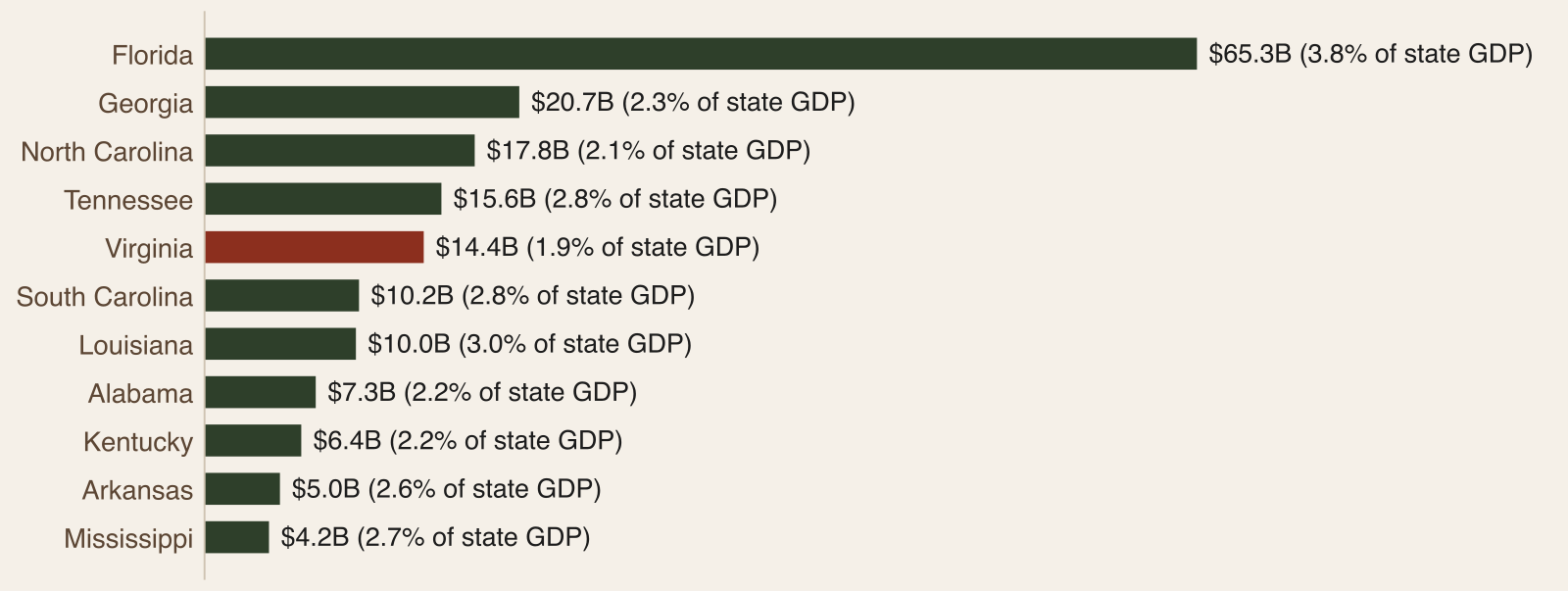
Outdoor recreation added $14.4 billion of value added to Virginia's economy in 2024, according to the Bureau of Economic Analysis (BEA). That is 8% of the eleven-state Southeast total, 2.1% of the national figure and the fifth-highest total of the eleven states. It employed 126,038 people, 2.9% of wage and salary jobs, the fourth-highest count.
Virginia's economy is large and diverse, so the outdoors is a small slice. Outdoor recreation was 1.9% of state GDP, below the U.S. figure of 2.4% and the lowest share of the eleven states.
The activity breakdown, for 2023 from an earlier BEA release, shows a middling profile:
Virginia's best rank in any of the nine activity lines was fourth of eleven, in three lines, including climbing, hiking and tent camping and hunting and trapping.
Its largest share of the regional total was in shooting, including archery, at 11%, or $188M.
Water-based guided tours and charters, the line closest to the guide and charter trade, produced $259M, 8% of the regional total and fifth of eleven.
Visitors are a separate measure. The Virginia Tourism Corporation's 2025 study counted 117.1 million visitors who spent $36.2 billion, up from $25.2 billion in 2021. It puts the total economic impact of visitors at $54.8 billion, supporting 332,302 jobs. This is on a different basis from BEA and is never added to it.
Southwick Associates' estimates, built on the 2022 national survey, put angler spending at $2.7 billion in 2022 and hunter spending at $1.20 billion.
The 2023 activity table shows where Virginia's outdoor money sits. Boating and fishing was $827M, sixth of eleven, and RVing was $357M, seventh. Climbing, hiking and tent camping was $172M, 11% of the regional total and fourth of eleven. Hunting and trapping was $170M, fourth of eleven, and equestrian was $137M, fifth. Guided tours and outfitted travel of all kinds was $417M, fifth of eleven. For a guide, the useful reading is that Virginia's strengths are on land, in the mountains and on the shooting range, more than on the water.
In the same earlier BEA vintage, Virginia's outdoor value added moved from $10.5 billion in 2019 to $7.8 billion in 2020 and $13.4 billion in 2023, up 28% over four years in current dollars. BEA revised 2020 to 2023 in March 2026, so the report does not join those figures to the 2024 number and computes no growth rate across the two releases. The tourism study adds $3.4 billion in state and local tax revenue.
On spending, Southwick's estimates count 1,397,130 resident and nonresident anglers supporting about 19,860 jobs, 248,950 hunters, and target shooting that added $1.2 billion from 902,940 participants, a separate and overlapping group.
Hunters and Anglers
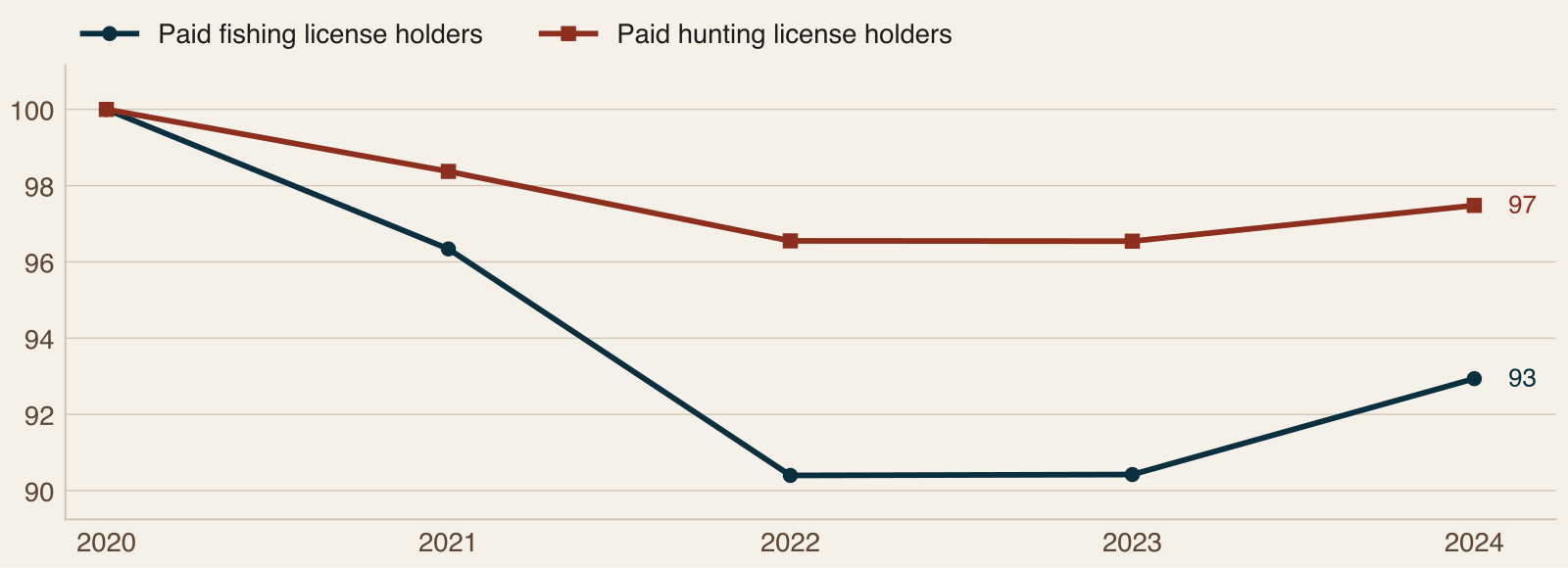
Virginia has fewer licensed anglers per resident than anywhere else in the region. In license year 2024 the state counted 574,708 paid fishing license holders and 251,350 paid hunting license holders, per the U.S. Fish and Wildlife Service's certified data. That is 6.5 fishing and 2.9 hunting license holders per 100 residents, the lowest and second-lowest densities in the region.
Both series have drifted down. Fishing license holders were 618,383 in 2020, the high of the period, fell to a low of 559,013 in 2022 and stood at 574,708 in 2024, down 7.1% over the period. Hunting license holders fell from 257,844 to 251,350, down 2.5%.
Items sold show who buys:
In 2024, nonresidents bought 10% of fishing licenses, tags, permits and stamps and paid 10% of fishing license revenue, both the lowest shares in the region.
Hunting is a resident market. Nonresidents bought 7% of hunting items but paid 21% of hunting license revenue.
Items are not people, and one person can buy several. Federal surveys estimate about 17,000 active duck hunters in 2024-25 (preliminary) and about 20,600 active dove hunters in 2025-26. These are survey estimates and are not added to license counts.
For operators, the point is that the local licensed base is thin, so the customer who has to search is more often a visitor. The next chapters show how large the visitor pool is.
The resident and nonresident split is clearest in the item counts for license year 2024. Fishing: 926,990 resident items and 102,420 nonresident items, with residents paying $28.5M and nonresidents $3.1M. Hunting: 693,930 resident items and 52,112 nonresident items, with residents paying $19.0M and nonresidents $5.1M. Fishing licenses in these figures combine freshwater and saltwater, and anglers fishing under a licensed charter vessel are not counted, which matters for anyone who sells for-hire trips.
A worked example for a Virginia guide: the nonresident hunter is 7% of hunting items but 21% of revenue. A lodge that sells to out-of-state hunters is serving a small group that pays a premium, and the page that serves them needs travel, lodging and license information, not only dates.
The Resource and the 2026-27 Seasons
Virginia hunters checked in 227,302 deer in 2025-26 (preliminary), up 10% from 205,759 in 2024-25 and up 19% from 190,582 in 2021-22, the highest of the five seasons shown. Of those, 108,163 were antlered bucks and 103,535 were does. The count is mandatory reported kill, so it is a census of check-ins rather than a survey, though it excludes late special seasons and kill permits.
Other findings:
Spring turkey hunters reported 24,105 birds in 2026, up from 20,565 in 2025. Brood survey results are weaker: a statewide average of 1.3 poults per hen in summer 2025 against 2.1 in 2024. For 2026-27, only one of a hunter's three annual turkeys may be beardless, and that applies in fall only.
USFWS estimated a duck harvest of about 178,600 in 2024-25 (preliminary) and a dove harvest of about 241,200 in 2025-26.
Deer bag limits differ east and west of the Blue Ridge: two a day and six a license year in the east, two a day and five a license year in the west. Early archery runs October 3 to November 13 statewide.
The report includes the full 2026-27 calendar. The dates are shown as published and should be confirmed before any trip is sold, since many public lands and localities set their own dates.
On the water, the Virginia Marine Resources Commission's 2026 sheet lists red drum at 18 to 26 inches, three per person, summer flounder at four per person, and Chesapeake Bay striped bass at 19 to 24 inches, one per person, in a spring and a fall season. Link to the commission's current sheet rather than copying the numbers.
The deer check-in series runs 190,582 in 2021-22, 184,968 in 2022-23, 206,586 in 2023-24, 205,759 in 2024-25 and 227,302 in 2025-26 (preliminary). Late special antlerless seasons and kill permits are excluded, so later seasons may be revised upward.
The 2026-27 calendar has more to work with. Early muzzleloader runs Oct. 31 to Nov. 13 statewide, and general firearms east of the Blue Ridge runs Nov. 14 to Jan. 2 in most counties, with Chesapeake, Suffolk east of the Dismal Swamp line and Virginia Beach on Oct. 1 to Nov. 30. The deer limit is one a day on National Forest and DWR lands. Bear is one per license year, at least 100 pounds live weight. Ducks run Oct. 9-12 (black duck closed), Nov. 18-29 and Dec. 19 to Jan. 31, with six a day. Atlantic Population Canada geese run Nov. 24-29 and Dec. 24 to Jan. 31, doves Sept. 5 to Oct. 24, Nov. 21-29 and Dec. 19 to Jan. 18 with 15 a day, and woodcock Nov. 11 to Dec. 1 and Dec. 26 to Jan. 18 with three a day.
On turkey, DWR's long-term brood average is 2.4 poults per hen, so the 1.3 in summer 2025 and 2.1 in 2024 sit below it. That is why the beardless-turkey rule matters to anyone who sells a fall hunt. Spring hunters reported 24,105 birds in 2026 against 24,447 in 2023.
The commission's April 2026 sheet adds the Bay's spring striped bass season (May 16 to June 15) and fall season (October 4 to December 31), summer flounder with a 16 inch minimum through May and 17.5 inches from June 1, and its warning that all regulations are subject to change.
The Water
NOAA's recalibrated estimates count 6.84 million marine angler trips in Virginia in 2025, up 18% from 5.81 million in 2021, and 6% of all trips in the seven Southeast states it covers. Shore fishing was 65% of trips and private and rental boats 34%. NOAA recalibrated every estimate in August 2026, so do not compare these figures with anything published earlier.
The charter fleet is small and volatile. Charter-boat trips numbered 41,556 in 2025, 0.6% of Virginia's own trips, after 19,096 in 2022. Party boats, a separate Virginia mode, ran from 15,866 to 19,953 trips a year. Small counts carry wide error, so no trend is drawn.
What the trips are worth:
Trip spending supported $336 million in sales impact in 2023 and about 2,164 jobs, 3% of the Southeast's nine coastal areas.
Charter customers spend the most per day: $291 per angler-day, 6.8 times the shore angler's $43.
The U.S. Coast Guard counted 216,494 registered recreational vessels in 2024, the third-lowest count of the eleven states.
In tidal waters, a captain carrying paying anglers needs a U.S. Coast Guard captain's license, a Virginia charter or head boat license and a Class A or Class B Virginia fishing guide license, and federal waters need their own permits. The report did not find a state license rule for freshwater guides on a source it could read, so confirm that with the relevant agency.
The MRIP table gives the five-year picture: 5.81 million trips in 2021, 5.46 million in 2022, 6.31 million in 2023, 6.01 million in 2024 and 6.84 million in 2025. Single-year estimates carry percent standard errors of about 5% to 8%, so moves of a few percent between years are within noise. In 2025 the 6.84 million split into 4.46 million shore trips and 2.32 million private and rental boat trips.
Charter-boat trips are 2.1% of the seven-state charter total, and MRIP's charter mode includes offshore as well as inshore trips, so no mode isolates inshore guiding. The 41,556 trips in 2025 follow 44,986 in 2021, 34,074 in 2023 and 20,316 in 2024, a series too volatile to read as a trend. For-hire spending of $291 per angler-day compares with $53 on a private boat and $43 on shore.
On the freshwater side, the Corps counted 240,404 visits to Philpott Lake in fiscal 2024, 32,570 of them for fishing and 53,155 for motorized boating.
Public Land and the Rules for Guides
Much of the water and woods a Virginia guide sells is public, and each manager has its own rules.
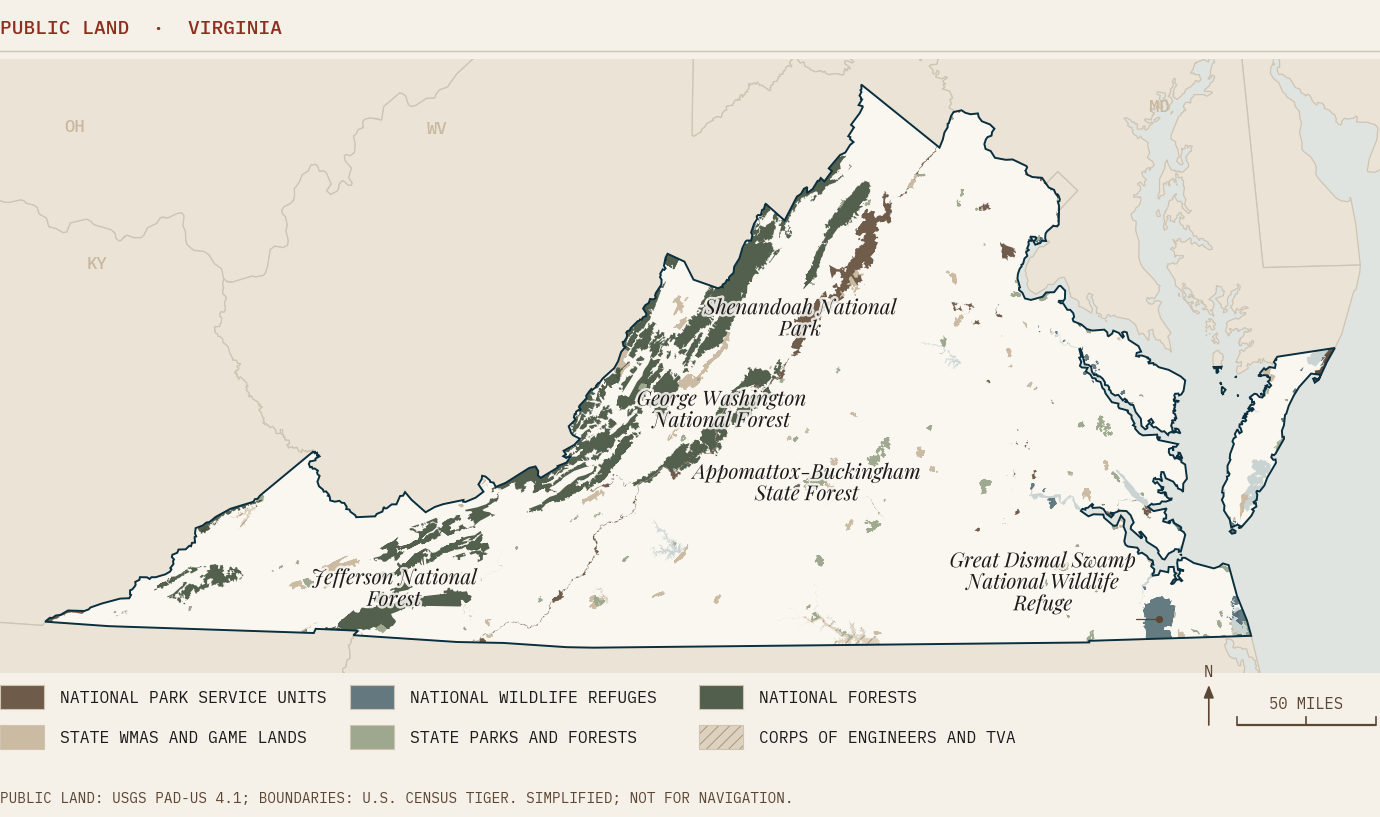
What the report found:
DWR wildlife management areas: DWR lists 50. Any commercial use of DWR lands and facilities requires a Special Use Authorization. The report found no source that authorizes paid guiding on a WMA without that authorization.
National parks: Shenandoah National Park covers 198,754 acres, and a Commercial Use Authorization is required for any paid activity that takes place at least in part in the park. Approved service types include backcountry hiking and camping, spin or fly fishing and bicycle tours.
National wildlife refuges: commercial enterprise is prohibited except as authorized by special permit.
National forests: the George Washington and Jefferson National Forests cover about 1.8 million acres. Selling services, including guiding, requires a special-use authorization.
State parks: a commercial use permit is required for activities such as guided hikes and equipment rentals. Individual parks add their own requirements.
An NPS authorization does not cover a refuge, a refuge permit does not cover a state park, and a state charter or guide license covers the boat and captain, not the right to run a business on public land. Check with the agency that manages the exact place you plan to guide. The report summarizes published rules and is not legal advice.
The report's scale figures put the rules in context. Shenandoah National Park is 198,754 acres, 79,579 of them designated wilderness. DWR visitors 17 and older need an Access Permit (DWR charges $4 for a day or $28 for the year) unless they hold a Virginia hunting, freshwater fishing or trapping license or a current boat registration, and the Special Use Authorization for commercial use is DWR form PERM-005 under 4VAC15-40-280. Other cited rules are 36 CFR 5.3 for national park business, 50 CFR 27.97 for refuges and 36 CFR 261.10 for the national forests. The refuges include Chincoteague, Back Bay and Great Dismal Swamp.
Two examples show how layered it gets. In far southwest Virginia, DCR's Grayson Highlands page says commercial groups need a Special Use Permit from both the park and the U.S. Forest Service for paid guided hikes, so confirm for the specific trail. On the Potomac, state parks such as Leesylvania need a DCR commercial use permit, and the river is shared with Maryland and the District of Columbia.
The Regions
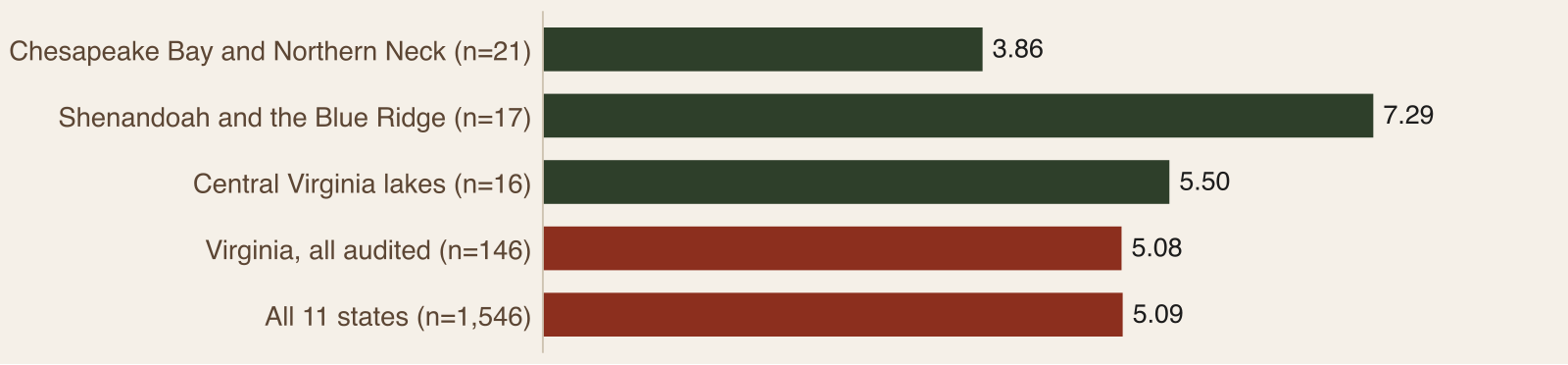
The audit groups Virginia's operators into ten sub-regions, but only three have at least 15 operators and 10 readable sites, so only those carry figures. Their scores range from 3.86 to 7.29. Differences under half a point are noise.
Shenandoah and the Blue Ridge: 17 operators, mean digital health 7.29, the highest of the 43 comparable sub-regions across the eleven states. All have their own website, 41% carry FAQ content and 24% of sites read show a booking engine.
Central Virginia lakes: 16 operators, mean 5.50, with 46% of sites read showing a booking engine. Paddle outfitters lead the sample.
Chesapeake Bay and the Northern Neck: 21 operators, mean 3.86, the second-lowest of the 43. Only 52% have their own website, and general fishing guides lead the sample.
The other seven sub-regions are described in words. Tidewater and Hampton Roads has 19 operators, led by offshore charters (6). The Eastern Shore, the James River corridor, the New River and Claytor Lake and Smith Mountain Lake each hold 12 to 14 operators, and far southwest Virginia and Northern Virginia hold 11 and 10.
Each region carries its own rule notes. Class A guide licenses covering Virginia and Maryland tidal waters are limited entry, and the Potomac is shared with Maryland and the District of Columbia, so confirm which agency's rules apply to the water you guide on.
The profiles add detail the three scored sub-regions cannot. In the Chesapeake Bay and the Northern Neck, only 11 of the 21 operators had a homepage we could read, and 36% of those sites show a booking engine. A Class A guide license covers Virginia and Maryland state waters but is limited entry, with 240 resident and 38 nonresident licenses a year and waiting lists, while a Class B covers Virginia waters only, and a holder of a qualifying Maryland license can get a no-cost reciprocity permit.
Among the unscored sub-regions, Tidewater and Hampton Roads has 19 operators but only eight readable homepages, so it is described in words, with offshore charters (6), paddle (5) and eco-tours (3) the largest groups. The Eastern Shore has fourteen operators, led by paddle (5), eco-tours (4) and inshore fishing (4), and commercial enterprise on Chincoteague National Wildlife Refuge requires a special permit. The James River corridor has thirteen, led by fly fishing and trout (4). The New River and Claytor Lake has thirteen, the Smith Mountain Lake and Roanoke group twelve, led by striper and lake fishing (4) and marinas (4), far southwest Virginia eleven, led by cycling (5), and Northern Virginia and the Potomac ten.
In the Shenandoah and the Blue Ridge, the largest groups are paddle (4), adventure and attractions (4) and fly fishing and trout (4), and Shenandoah's approved service types for the Commercial Use Authorization include spin or fly fishing and bicycle tours. In the Central Virginia lakes, DWR has a regulation specific to the tailwaters of Kerr Dam, so check the current text before guiding there.
The Operator Landscape
Virginia's 146 audited operators are part of 1,546 across the eleven states. Their mean digital health, a 1 to 10 score assigned by researchers from observed evidence, is 5.08, the fifth-highest of the eleven states against 5.09 for the region. The gap is within the margin of noise, so Virginia is about level with the region.
How Virginia compares with the eleven-state benchmark:
Own website: 77%, against 80%.
Score 4 or below: 38%, against 40%.
Online booking engine (104 sites read): 32%, against 27%.
FAQ content: 38%, against 37%, but only three sites mark answers up as FAQ structured data.
Newsletter signup: 35%, against 33%.
Where a booking engine shows, FareHarbor is the most common: 20 of the 33 sites with one use it, followed by Wix Bookings (8) and Peek (6). And 19% of sites with a detectable copyright year still show 2023 or earlier.
The sample leans toward the top tier: 38% of operators are top-tier against 32% regionally, and 20% are lower-tier against 26%. Re-weighted to the region's tier mix, Virginia's mean would be 4.81 rather than 5.08.
By category, paddle, kayak and canoe is the largest with 38 operators and averages 5.39. Fly fishing and trout averages 6.00 across 18 operators, against 5.53 for the eleven states.
The separate October 2026 hunting audit counts 25 Virginia hunting operators with a mean of 5.12, about level with the 5.23 for all 493 audited hunting operators. 92% have their own website, but only 14% of the 22 sites read show online booking.
The tier figures explain the caution. Top-tier operators average 6.84 in Virginia against 7.06 across the region (n=56), middle-tier operators 4.74 against 4.95 (n=61), and lower-tier operators 2.38 against 2.84 (n=29). Virginia's tiers each sit slightly below the region's, yet the state mean matches the region's, because the sample leans toward the top tier.
The category counts show what Virginia's operators sell. Beyond paddle (38), fly fishing and trout (18) and general fishing guides (12), the smaller groups are eco-tours and wildlife viewing (11), cycling and bike tours (9), inshore fishing (7), offshore charter fishing (6), striper and lake fishing (6), marinas and boat rental (5) and lodging and campgrounds (4). The hunting tags, which overlap, are upland and quail (11), whitetail (8), turkey (8), lodge or multi-program (7), sporting clays (7), waterfowl (5) and dove (4).
What It Means for Operators
Virginia is a mid-sized outdoor economy with a huge visitor trade and a thin local license base. Operators are about level with the region online on average, but that average hides sub-regions as far apart as 3.86 and 7.29. Where you sit in the state matters more than the state mean.
The report closes with six moves:
Write for the visitor and the weekend traveler.
Make booking work on a phone.
Answer the questions, then mark them up.
Publish the rules you work under.
Write a page for each water, region and season.
For hunting operators, close the booking gap.
On public land, get the specific authorization before you sell. A DWR Special Use Authorization, an NPS Commercial Use Authorization, a Forest Service special-use authorization and a state parks commercial use permit are four different permits from four different managers.
Each move has a number behind it. Virginia counted 117.1 million visitors in 2025 while only 10% of fishing license items went to nonresidents. The other 68% of sites show no booking engine on the homepage. Three of the 104 sites read use FAQ structured data. If you can do one thing this month, make sure a visitor on a phone can find your homepage, see what a trip includes and which permits you hold, and hold a date in under a minute.
Get the Full Report
The full report adds the complete 2026-27 hunting calendar, the saltwater rules, the activity and category tables, ten sub-region profiles, the public land map and sources for every chart.
Download the full 2026-27 Virginia Outdoors report (free with your email).
Frequently Asked Questions
How big is Virginia's outdoor economy?
Outdoor recreation produced $14.4 billion of value added in 2024, fifth-highest of the eleven Southeast states, but only 1.9% of state GDP, the lowest share in the region, against 2.4% nationally. It employed 126,038 people, the fourth-highest count. The Virginia Tourism Corporation separately counted 117.1 million visitors who spent $36.2 billion in 2025, measured on a different basis and never added to the BEA figure. Both are useful, but they answer different questions: the first is the industry's weight, the second is the size of the visitor market.
Do Virginia guides need a license?
In tidal waters, a captain carrying paying anglers needs a U.S. Coast Guard captain's license, a Virginia charter or head boat license and a Class A or Class B Virginia fishing guide license, plus federal permits in federal waters. Class A covers Virginia and Maryland state waters but is limited entry, with 240 resident and 38 nonresident licenses a year. The report found no state license rule for freshwater guides on a source it could read, so confirm with DWR or the relevant agency before you advertise.
Can I guide paid trips on Virginia WMAs and in Shenandoah National Park?
Only with authorization. Any commercial use of DWR lands requires a DWR Special Use Authorization, and the report found no source that authorizes paid guiding on a WMA without it, so confirm with DWR before selling a trip. Shenandoah National Park requires a Commercial Use Authorization for any paid activity that takes place at least in part in the park, and approved service types include spin or fly fishing and bicycle tours. A permit from one manager never covers land managed by another.
Why do Virginia sub-regions score so differently online?
Among the three sub-regions with enough data, means range from 3.86 in the Chesapeake Bay and Northern Neck to 7.29 in the Shenandoah and the Blue Ridge. In the Bay sub-region only 52% of operators have their own website, while in the Shenandoah all do, and the Central Virginia lakes sit between at 5.50. Differences under half a point are noise, but this gap is far larger. Seven of the ten sub-regions are too small to score, so we describe them in words.
How many people fish Virginia's coast?
NOAA estimates 6.84 million marine angler trips in 2025, up 18% from 5.81 million in 2021, with shore fishing making up 65% and private and rental boats 34%. Charter boats carried 41,556 trips, a small and volatile slice that was 44,986 in 2021 and 19,096 in 2022. Trips are not people, and NOAA recalibrated every estimate in August 2026, so do not compare these figures with anything published before then.
How much do charter customers spend compared with other anglers?
NOAA's 2022 expenditure survey put for-hire spending in Virginia at $291 per angler-day, against $53 for a private boat and $43 for the shore angler. That is 6.8 times the shore angler's spending. NOAA's 2023 economics report put the sales impact of marine angler trip spending in Virginia at $336 million, supporting about 2,164 jobs. The two figures are built on different years and are never divided by the MRIP trip counts, so use them as direction, not as a revenue forecast.
How does online booking look among Virginia operators?
Of the 104 Virginia sites we read on October 17, 2026, 32% showed an online booking engine, against 27% across the eleven states. FareHarbor was the most common, on 20 of the 33 sites with one, followed by Wix Bookings (8) and Peek (6). Hunting is behind: only 14% of the 22 hunting sites read show online booking. These are lower bounds, because a feature may sit deeper in a site, and the 5-point gap to the region is inside the noise band.
What should a Virginia operator do first?
Follow the report's six moves: write for the visitor and the weekend traveler, make booking work on a phone, answer the questions and mark them up, publish the rules you work under, write a page for each water, region and season, and, for hunting operators, close the booking gap. If you can do one thing this month, make sure a visitor on a phone can find your homepage, see what a trip includes and which permits you hold, and hold a date in under a minute.
Sources
Pine & Marsh outfitter audit (1,546 operators) and hunting supplement (493 operators), October 2026


Comments