
Inside the 2026-27 Tennessee Outdoors Report: Tailwaters, Hunters and 150 Million Visits
The Tennessee Outdoors report is our 2026-27 state edition for Tennessee. It sets public data from the Bureau of Economic Analysis, the Tennessee Department of Tourist Development, the U.S. Fish and Wildlife Service, the Tennessee Wildlife Resources Agency (TWRA) and federal and state land agencies beside our October 2026 audit of 160 Tennessee guides, outfitters, rafting companies, marinas and lodges. It is written for the people who run those businesses.
This post walks through the report chapter by chapter, with the numbers that matter and what they mean for operators. For the marketing playbook, see Marketing a Sporting Operation in Tennessee: The Full State Guide.
The Outdoor Economy
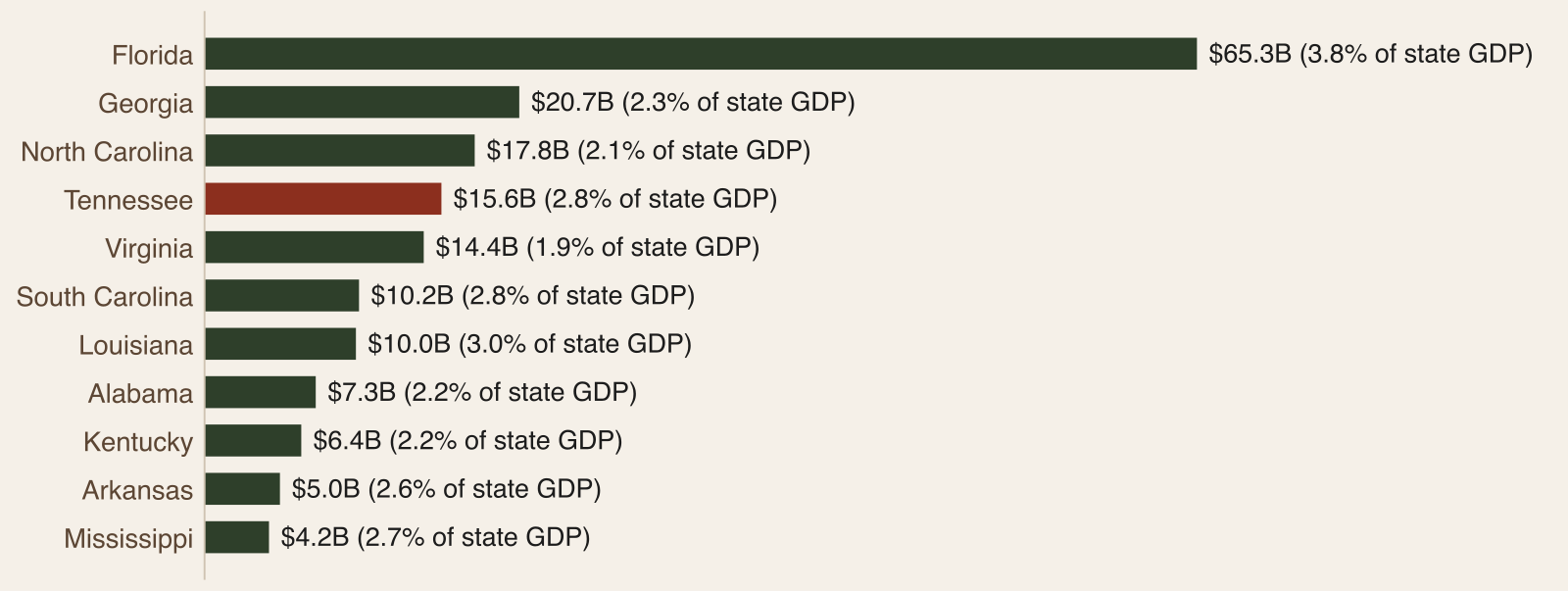
Outdoor recreation added $15.6 billion of value added to Tennessee's economy in 2024, according to the Bureau of Economic Analysis (BEA). That is 9% of the eleven-state Southeast total, 2.2% of the national figure and the fourth-highest total of the eleven states. It employed 114,070 people, 3.3% of wage and salary jobs, the fifth-highest count.
Outdoor recreation was 2.8% of state GDP, above the U.S. figure of 2.4% and tied with South Carolina for the third-highest share.
The activity breakdown, for 2023 from an earlier BEA release, shows an inland pattern:
Tennessee's best rank in any of the nine activity lines was third of eleven, in two lines.
Its largest share of the regional total was in shooting, including archery, at 12%, or $205M.
Water-based guided tours and charters produced $283M, 9% of the regional total and fourth of eleven. That line is weighted toward coastal charter and boat-tour economies, which an inland state does not have.
The visitor trade is huge. The Tennessee Department of Tourist Development counted 150 million visits in 2025 and $32.5 billion of direct visitor spending, 2.7% more than in 2024 and 40% more than in 2018, against 22% for the U.S. These are visits, not unique visitors, and the release names Great Smoky Mountains National Park, the most visited national park in the country, as a cornerstone.
Southwick Associates' estimates, built on the 2022 national survey, put angler spending at $2.8 billion in 2022 and hunter spending at $2.00 billion. BEA value added, tourism and spending studies measure different things and are never added together.
The 2023 activity table puts numbers on that inland pattern. Boating and fishing was $938M, fourth of eleven. Guided tours and outfitted travel of all kinds was $458M, 9% of the regional total and fourth of eleven. RVing was $467M, third of eleven, and hunting and trapping was $131M, fifth. Climbing, hiking and tent camping was $126M, sixth, and equestrian was $136M, also sixth. Tennessee's outdoor money is spread across many mid-sized lines rather than concentrated in one headline activity, so a guide is competing for a share of a visitor's trip budget that also goes to lodging, food and attractions.
Within that same earlier BEA vintage, Tennessee's outdoor value added moved from $9.9 billion in 2019 to $7.4 billion in 2020 and $13.0 billion in 2023, up 32% over four years in current dollars. BEA revised 2020 to 2023 in March 2026, so the report does not join those figures to the 2024 number and computes no growth rate across the two releases.
The tourism release adds that visitors generated $2.0 billion in state and $1.3 billion in local tax revenue, $3.3 billion together. On the spending side, Southwick's estimates count 982,700 resident and nonresident anglers supporting about 22,900 jobs, 844,170 hunters, and target shooting that added $2.9 billion from 1,345,490 participants, a separate and overlapping group.
Hunters and Anglers
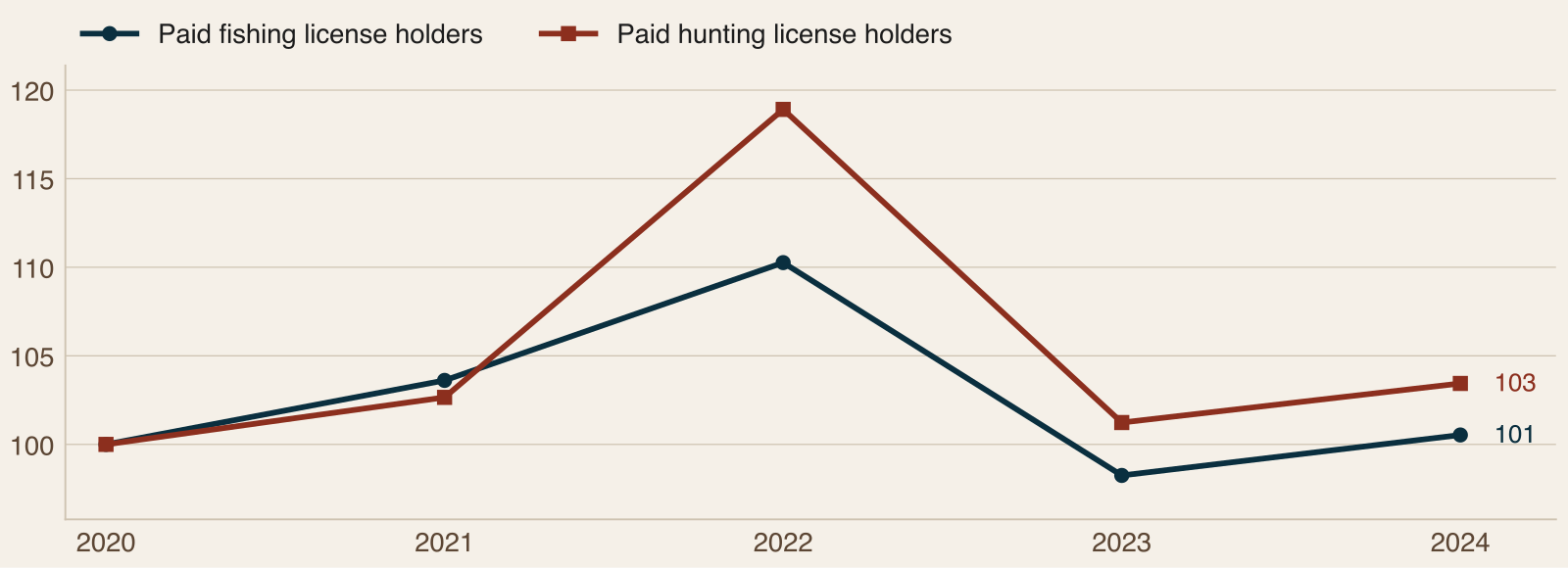
Tennessee is a hunting state. Using the U.S. Fish and Wildlife Service's certified license data, paid hunting license holders ran roughly 710,000 to 844,000 across license years 2020 to 2024, and paid fishing license holders roughly 876,000 to 983,000. The report presents these as estimated ranges. Hunting holders rose by about 16% in 2022 and fell by about 15% in 2023, a single swing the data do not explain and the report does not treat as a trend. For exact counts, contact TWRA.
Per 100 residents, Tennessee has 12.4 fishing and 10.1 hunting license holders, the third-highest and second-highest densities in the region.
Items sold show who buys:
In 2024, nonresidents bought 20% of fishing licenses, tags, permits and stamps, the fifth-lowest share, and paid 24% of fishing license revenue.
Hunting is a resident market. Nonresidents bought 9% of hunting items and paid 19% of hunting license revenue.
Items are not people, and one person can buy several. Federal surveys estimate about 32,500 active duck hunters in 2024-25 (preliminary), and active dove hunters at 24,000 in 2025-26, against 32,100 the season before.
For operators, the lesson is that the core customer is a Tennessean, and the traveling customer is far more likely to be a visitor in the Smokies than an out-of-state hunter.
Over the five license years, fishing holders peaked in 2022 and ended 2024 about level with 2020 (+0.5%), while hunting holders ended 3.4% higher, with most of that gain in the last year (+2.2% from 2023). The 2022 and 2023 hunting swing is not treated as a trend.
In items, the resident and nonresident split looks like this for license year 2024. Fishing: 748,529 resident items and 192,503 nonresident items, with residents paying $21.9M and nonresidents $7.0M. Hunting: 767,031 resident items and 73,078 nonresident items, with residents paying $23.4M and nonresidents $5.5M. Nonresidents bought 20% of fishing items but paid 24% of fishing revenue, and they bought 9% of hunting items but paid 19% of hunting revenue.
The federal surveys also estimate about 33,500 active waterfowl hunters in all in 2024-25, of whom about 32,500 hunted ducks. These are survey estimates of people who hunted, not license counts, and they should not be added to the license figures.
A worked example: a Middle Tennessee guide selling deer hunts should write for the resident hunter, who knows the management unit and wants dates and deposit terms. A Smokies rafting company should write for the visitor, who knows nothing and needs meeting points, inclusions and weather plans.
The Resource and the 2026-27 Seasons
TWRA sorts Tennessee's counties into six deer management units, with the same antlered limit statewide and antlerless limits that differ by unit. The season runs from an archery-only window on private land that opens August 28, 2026 through January 3, 2027. West of the Tennessee River, the counties form a CWD Management Zone with rules on moving carcasses, which matters to any guide or lodge hosting out-of-state hunters.
On harvest:
TWRA's mandatory check-in counted 167,986 deer in 2024-25, against 163,174 in 2022-23. The 2025-26 count was 153,294, down 9% from the season before, from a query TWRA calls unproofed.
The spring 2026 turkey harvest was 34,990, up 13% against the five-year average of 31,038 and the fourth-highest on record. Starting in spring 2023, TWRA cut the bag from three to two and delayed the opener by two weeks.
USFWS estimated a duck harvest of about 538,700 in 2024-25 (preliminary) and a dove harvest of about 392,600 in 2025-26, against 436,100 the year before.
Bobwhite quail have fallen by more than 90% since the 1960s.
Elk are quota-only: 19 permits for 2026, hunted on North Cumberland WMA, with all other public land closed to elk hunting. Wild hogs are classified as a species deemed destructive, and it is illegal to possess, transport or release live wild hogs. Statewide seasons do not apply on every WMA, since each sets its own rules.
The 2026-27 calendar gives a guide specific dates to build pages around. Deer: archery only Aug. 28-30, 2026, archery Sept. 26 to Oct. 30 and Nov. 2-6, muzzleloader and archery Nov. 7-20, and gun, muzzleloader and archery Nov. 21 to Jan. 3, 2027, with young sportsman days Oct. 31 to Nov. 1 and Jan. 9-10, 2027. The statewide bag is two antlered deer, one per day. Spring turkey 2027 has young sportsman days Mar. 27-28 and a general season Apr. 3 to May 16, two male turkeys, only one a jake. Doves run Sept. 1 to Sept. 28, Oct. 10 to Nov. 1 and Dec. 8 to Jan. 15, 2027, with a daily bag of 15 and a Tennessee Migratory Bird Permit required.
For waterfowl, the general duck season runs Nov. 28-29 and Dec. 5 to Jan. 31, 2027, with six ducks a day and species limits. Canada goose runs Sept. 1-20, Oct. 10-22, Nov. 28-29 and Dec. 5 to Feb. 14, 2027. WMA waterfowl hunts run on application dates, and statewide seasons do not apply on every WMA.
Elk applications for 2027 run Feb. 3-27, 2027, for the quota hunt on North Cumberland WMA. Black bear is one bear of either sex per year, with an archery-only still hunt Sept. 26 to Oct. 23, 2026 in all zones. Quail runs Nov. 7 to Feb. 28 with a bag of 6.
On the deer harvest, the check-in table shows 163,174 in 2022-23, 152,563 in 2023-24, 167,986 in 2024-25 and 153,294 in 2025-26, with the antlered share holding between 53% and 55%. The 2025 summer survey counted 2.2 poults per hen against a five-year average of 2.4, which feeds the agency's adaptive harvest management.
The Water
Tennessee has no saltwater fishery, so there is no coastal charter story here. Its water is reservoirs, tailwaters and rivers.
BEA put boating and fishing value added at $0.97 billion in 2024, the fourth-highest of the eleven states.
The U.S. Coast Guard counted 244,031 registered recreational vessels in 2024.
Five Corps of Engineers projects in Middle Tennessee and the Upper Cumberland logged 15.3 million visits in fiscal 2024, 1,885,058 of them for fishing, or 12%. Old Hickory Lock and Dam had the most fishing visits, at 724,786.
The tailwaters are the specialty. TWRA's list names fourteen dams where it stocks trout, and seven of them carry a special trout regulation. The rest follow statewide rules of seven trout a day with no minimum length. Special regulations change fast between rivers. On the South Fork Holston below South Holston Dam, all trout are under a 16 to 22 inch protected length range, with some reaches closed to all fishing November 1 through January 31. The Watauga quality trout area allows two trout of at least 14 inches and no bait. The Hiwassee is catch and release from October 1 through February 28.
Dam releases decide whether a tailwater can be fished or floated at all. TWRA advises anglers to call TVA at 1-800-238-2264 to check discharge and generation schedules. A guide's site that publishes the day's release and a backup plan answers the first question a visiting angler has.
On licensing, customers need a Tennessee fishing license from age 13. The report did not find a TWRA page establishing a separate state fishing guide license, but it did not exhaustively search state law, so confirm with TWRA before you advertise. The Coast Guard has its own rules for carrying passengers for hire.
The Corps lake table is a useful map of where fishing demand sits. Old Hickory Lock and Dam logged 6,583,948 total visits and 724,786 for fishing (11%). J. Percy Priest logged 5,111,116 visits and 664,880 for fishing (13%), with 887,277 motorized boating visits. Center Hill Lake logged 1,738,771 visits and 278,743 for fishing, the largest fishing share at 16%. Cheatham logged 126,578 fishing visits and Cordell Hull 90,071. A visit is not a person, since one angler can log several.
TWRA stocks trout on a schedule that varies by dam. It stocks the Clinch below Norris Dam from March through August and the Caney Fork below Center Hill Dam from March through December. The Hiwassee below Appalachia Dam is stocked from October through July, and the South Fork Holston below South Holston Dam from March through September. The Dale Hollow, Normandy, Percy Priest, Cherokee, Fort Patrick Henry, Ocoee No. 1 and Watauga dams follow statewide rules. Stocking months are variable within the months shown.
Other special rules to know: the Clinch below Norris Dam is a 14 to 20 inch protected length range, the Elk River from Tims Ford Dam to the I-65 bridge has a 20 inch brown trout minimum with one per day, and on the Caney Fork brown trout need to be 24 inches and only one may be kept. Link to TWRA's current trout regulations rather than restating them.
Public Land and the Rules for Guides
Much of the water and woods a Tennessee guide sells is public. TWRA, the National Park Service, the Fish and Wildlife Service, the Forest Service, the state park system, the Corps of Engineers and TVA each decide whether, and on what terms, a paid trip may operate.
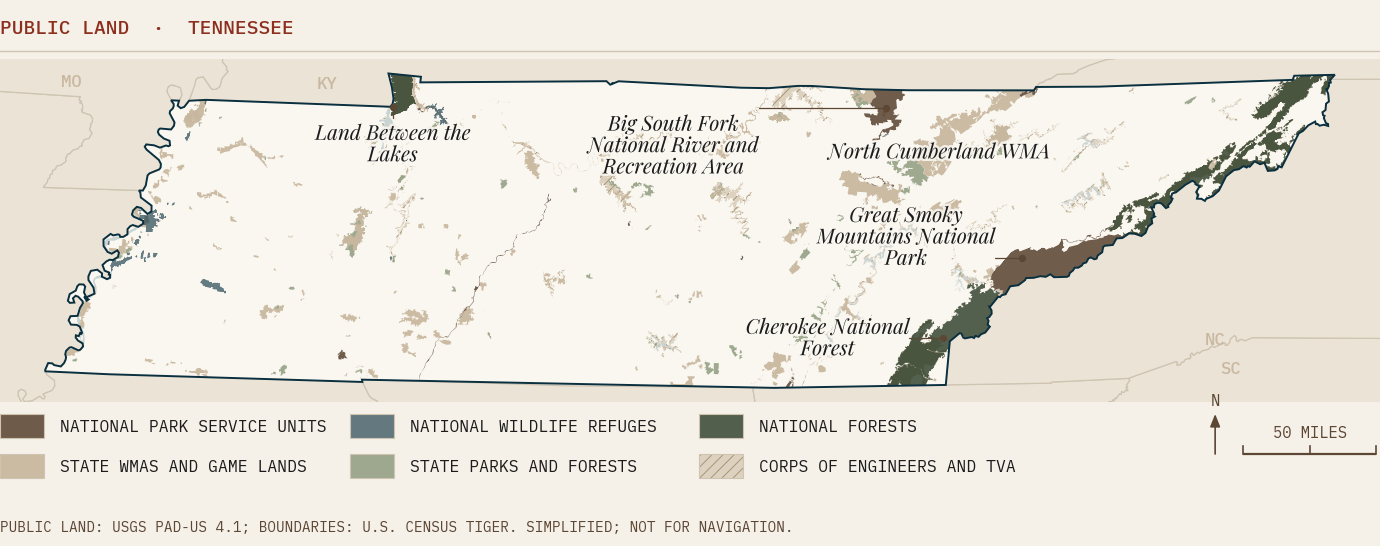
What the report found:
TWRA wildlife management areas: more than 100 WMAs and refuges. Each has its own rules in the TWRA hunting guide. The report found no TWRA page that authorizes commercial guiding on WMAs, so confirm with TWRA and the area manager before selling any guided trip on one.
Great Smoky Mountains National Park: business operations require an NPS permit, contract or written agreement. Ask the park which authorization fits your service before you advertise a trip inside the boundary.
National wildlife refuges: commercial enterprise is prohibited except as authorized by special permit.
Cherokee National Forest: more than 660,000 acres. Outfitters and guides need a permit arranged through the Ranger District office.
Tennessee State Parks: no commercial park activity without a commercial use authorization. Applicants show $1 million of liability insurance naming the State, operating plans and staff training.
TVA and Corps of Engineers reservoirs: not reviewed for this edition. Ask the project office before selling a trip that launches from or crosses its land.
A national park authorization does not cover a refuge, and a Forest Service permit does not cover a TWRA WMA. Check with the agency that manages the exact place you plan to guide. The report summarizes published rules and is not legal advice.
The scale of the land explains why the rules matter. TWRA's WMAs and refuges run from 53 to 625,000 acres. Great Smoky Mountains National Park covers 522,427 acres, almost evenly split with North Carolina, and drew more than 12 million recreational visits in 2024. Tennessee National Wildlife Refuge covers more than 51,000 acres and Hatchie 11,556. The rules cited are 36 CFR 5.3 for national park business operations, 50 CFR 27.97 for refuges and 36 CFR 261.10 for the national forest. State park commercial whitewater outfitters fall under a separate chapter of the Tennessee rules.
A worked example: a rafting or fishing company that launches from a state park, guides inside the national forest and shuttles through a refuge holds three different authorizations, and none substitutes for another. Say on your site which ones you hold.
The Regions
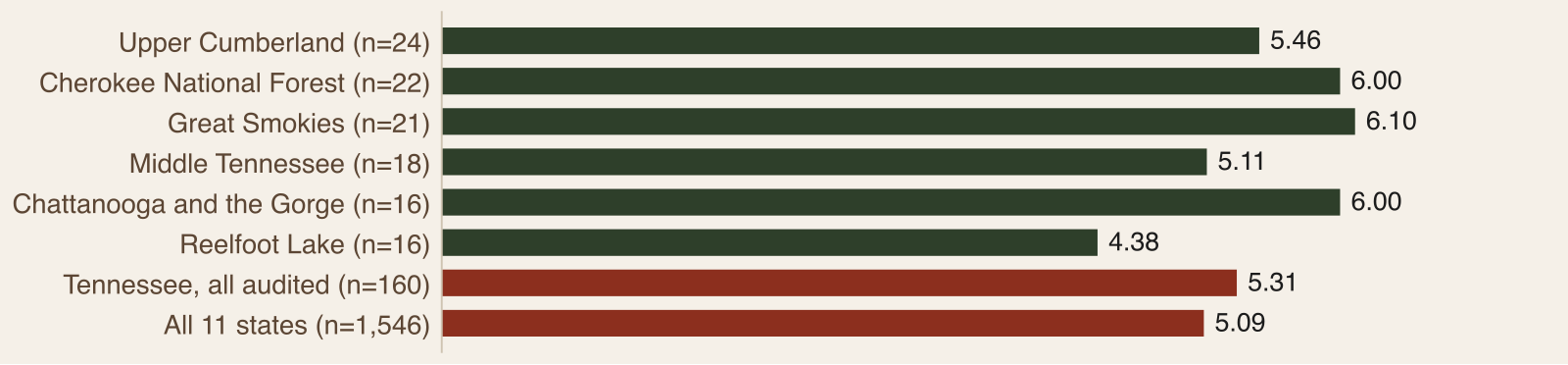
The audit groups Tennessee's operators into ten sub-regions. Six have enough operators and readable sites to be scored, and the other four are described in words. Among the six, scores range from 4.38 in Reelfoot Lake to 6.10 in the Great Smokies. Differences under half a point are noise.
Great Smokies: 21 operators, mean digital health 6.10, with 100% on their own website and 63% carrying FAQ content. The sixth-highest of 43 comparable sub-regions.
Cherokee National Forest country: 22 operators, 6.00, led by whitewater rafting (12).
Chattanooga and the Tennessee River Gorge: 16 operators, 6.00.
Upper Cumberland: 24 operators, 5.46, dominated by marinas and boat rental (16), with only 10% of sites read showing a booking engine.
Middle Tennessee: 18 operators, 5.11, led by paddle and kayak operators (7).
Reelfoot Lake: 16 operators, 4.38, led by waterfowl hunting operators (8). None of the 12 sites read show an online booking engine. Reelfoot National Wildlife Refuge requires a special permit for commercial enterprise, so confirm with the refuge before selling any guided hunt or tour that touches refuge land or water.
The other four sub-regions, the Duck River and Tims Ford, the Tri-Cities and northeast tailwaters, Kentucky Lake and Memphis and West Tennessee, hold between 7 and 13 operators each. The northeast tailwaters are the home of the South Fork Holston and Watauga, where fly fishing operators lead the sample.
Reelfoot Lake was created by a series of New Madrid fault zone earthquakes in the winter of 1811-1812, and Reelfoot National Wildlife Refuge manages the upper third of the lake as a refuge for migratory birds and a wintering ground for waterfowl and bald eagles. Counties west of the Tennessee River, including Lake and Obion, are in the CWD Management Zone, and only approved parts of deer may be moved out of it.
In the Great Smokies, anglers 16 and older need a Tennessee or North Carolina fishing license and no trout stamp is required, but special permits are required for fishing in Gatlinburg and Cherokee, North Carolina. In Middle Tennessee, 38% of sites read show an online booking engine and 31% carry FAQ content. In the Cherokee National Forest country, 32% show booking and 47% carry FAQ content, and the Hiwassee is catch and release from October 1 through February 28.
The four unscored sub-regions still carry rules. In the Tri-Cities group, the South Fork Holston below South Holston Dam has a 16 to 22 inch protected length range and some stretches are closed to all fishing November 1 through January 31, and the Watauga quality trout area is a 14 inch minimum with two trout and no bait. On the Elk River below Tims Ford Dam, brown trout have a 20 inch minimum. Paris Landing is a Tennessee State Park, so a business that sells a recreation service there needs a commercial use authorization. Hatchie National Wildlife Refuge covers 11,556 acres, and Shelby County is in the CWD Management Zone and in TWRA Deer Management Unit 1.
The Operator Landscape
Tennessee's 160 audited operators are part of 1,546 across the eleven states. Their mean digital health, a 1 to 10 score assigned by researchers from observed evidence, is 5.31, the fourth-highest of the eleven states against 5.09 for the region. The lead is within the margin of noise.
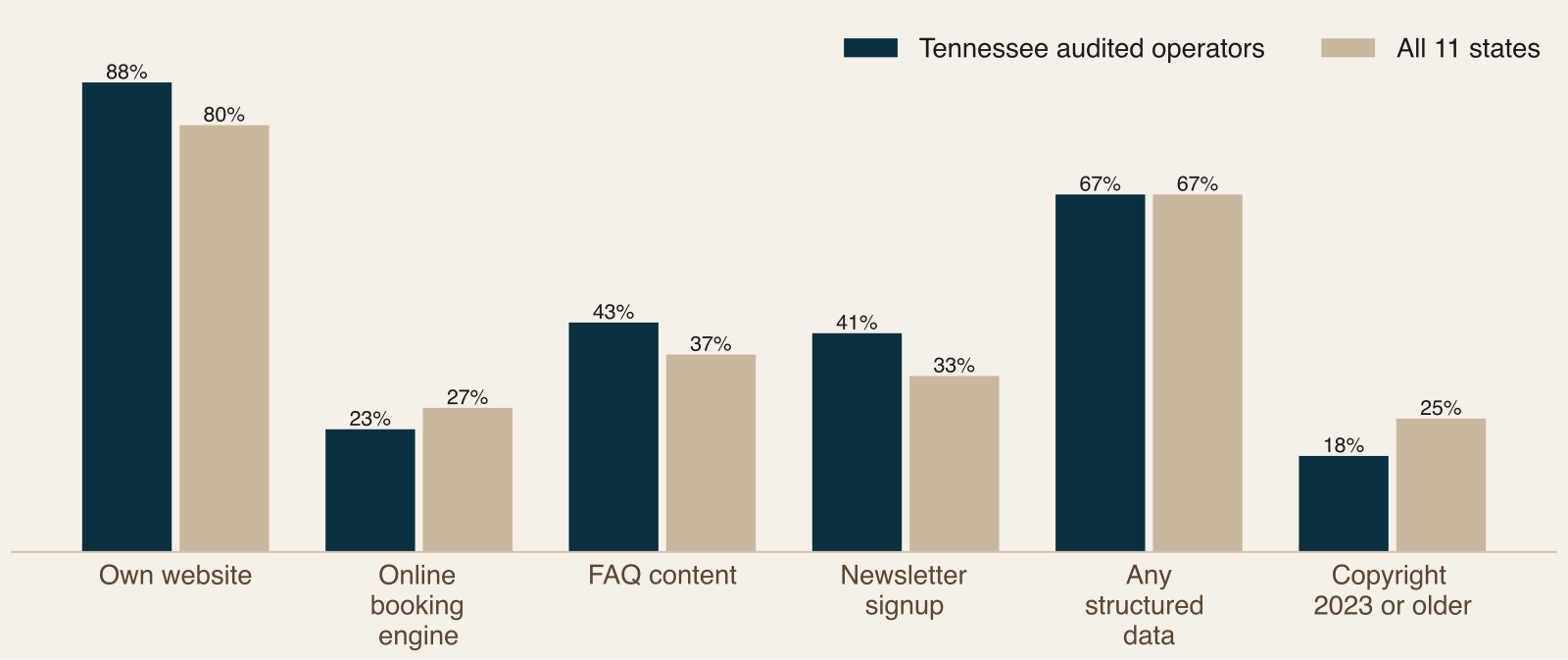
How Tennessee compares with the eleven-state benchmark:
Own website: 88%, against 80%.
Score 4 or below: 34%, against 40%.
Online booking engine (125 sites read): 23%, against 27%.
FAQ content: 43%, against 37%, but only one site marks answers up as FAQ structured data.
Newsletter signup: 41%, against 33%.
Where a booking engine shows, FareHarbor is the most common: 20 of the 29 sites with one use it, followed by Peek (4) and Xola (2). And 18% of sites with a detectable copyright year still show 2023 or earlier.
The sample leans toward the top tier: 37% of operators are top-tier against 32% regionally. Re-weighted to the region's tier mix, Tennessee's mean would be 5.16 rather than 5.31, so the ranking is best read as directional.
By category, whitewater rafting averages 7.18 across 17 operators, against 6.55 for the eleven states. Marinas and boat rental, the largest category with 26 operators, average 5.31. Paddle, kayak and canoe operators average 4.62, against 5.36 region-wide.
The separate October 2026 hunting audit counts 45 Tennessee hunting operators with a mean of 5.40, about level with the 5.23 for all 493 audited hunting operators. 96% have their own website, but only 9% of the 43 sites read show online booking.
The tiers explain why the ranking is directional. Top-tier operators average 7.15 in Tennessee against 7.06 across the region (n=59), middle-tier operators 5.17 against 4.95 (n=63), and lower-tier operators 2.66 against 2.84 (n=38). Tennessee's sample is 37% top-tier and 24% lower-tier, against 32% and 26% across the eleven states.
Among the categories with at least 15 Tennessee operators, marinas and boat rental number 26, paddle, kayak and canoe 21, whitewater rafting 17 and fly fishing and trout 15, the last averaging 5.47 against 5.53 region-wide. Smaller groups, described in counts only, include lodging and campgrounds (11), waterfowl hunting (9) and bass, crappie and lake fishing (8).
On the hunting side, the 45 Tennessee hunting operators split by tag as lodge or multi-program (16), waterfowl (15), upland and quail (12), whitetail (9), wild hog (7), turkey (6) and sporting clays (6). The tags overlap, because one operator can sell several hunts. Their 33% FAQ content and 23% newsletter signup suggest the same pattern as the main audit: the sites answer little and capture little.
What It Means for Operators
Tennessee is an inland outdoor economy of mountains, reservoirs and tailwaters with a large visitor trade and a resident hunting base. Its operators are about level with the region online, which means the openings are specific: booking on the page, plain answers marked up for search, and a page for each tailwater, lake and season.
The report closes with six moves:
Write for the visitor.
Put booking on the page.
Answer the questions, then mark them up.
Publish the rules you work under.
Write a page for each water and season, with the release schedule link for tailwaters.
For hunting operators, close the booking gap.
On public land, never assume. On WMAs, confirm with TWRA and the area manager. In the national park, a refuge, a national forest or a state park, get the specific authorization before you advertise the trip.
Each of the six moves has a number behind it. Booking: 77% of audited sites show no engine on the homepage. Answers: 43% carry FAQ content but one of the 125 uses the structured format. Rules: 18% of sites with a detectable copyright year still show 2023 or earlier. If you can do one thing this month, make sure a visitor on a phone can find your homepage, see what a trip includes and which permits you hold, and hold a date in under a minute.
Get the Full Report
The full report adds the complete 2026-27 hunting calendar, the tailwater table, the Corps lake table, ten sub-region profiles, the public land map and sources for every chart.
Download the full 2026-27 Tennessee Outdoors report (free with your email).
Frequently Asked Questions
How big is Tennessee's outdoor economy?
Outdoor recreation produced $15.6 billion of value added in 2024, fourth-highest of the eleven Southeast states, and 2.8% of state GDP against 2.4% nationally. It employed 114,070 people, 3.3% of wage and salary jobs. The Tennessee Department of Tourist Development separately counted 150 million visits and $32.5 billion of direct visitor spending in 2025, 40% above 2018. The two measures use different methods and are never added together, so treat the first as the industry's weight and the second as the size of the visitor market.
How many hunters and anglers does Tennessee have?
The report gives estimated ranges: roughly 710,000 to 844,000 paid hunting license holders and roughly 876,000 to 983,000 paid fishing license holders across license years 2020 to 2024. Tennessee has the second-highest density of hunting license holders in the region, at 10.1 per 100 residents, and 12.4 fishing license holders per 100. Only 9% of hunting items and 20% of fishing items went to nonresidents. License holders are not unique people, so contact TWRA for exact counts.
Can I guide paid trips on Tennessee WMAs?
Confirm first. The report found no TWRA page that authorizes commercial guiding on WMAs, and each WMA has its own rules in the TWRA hunting guide. TWRA manages more than 100 WMAs and refuges, from 53 to 625,000 acres, and statewide seasons do not apply on every one. Confirm with TWRA and the area manager before selling any guided trip on a WMA, and do not assume that a permit from another agency covers it.
What permits does guiding in Tennessee's parks and forests require?
It depends on the land. Great Smoky Mountains National Park requires an NPS permit, contract or written agreement under 36 CFR 5.3. Refuges require a special permit for any commercial enterprise under 50 CFR 27.97. Cherokee National Forest outfitters need a permit through the Ranger District office. State parks require a commercial use authorization with $1 million of liability insurance naming the State, operating plans and staff training. A permit from one agency never covers land managed by another.
Which Tennessee tailwaters have special trout rules?
TWRA's list names fourteen dams where it stocks trout, and seven carry special regulations: the Clinch, Caney Fork, Hiwassee, Elk and Watauga, plus the South Fork Holston below both South Holston and Boone dams. The rest follow statewide rules of seven trout a day with no minimum length. Regulations change fast between rivers, and generation schedules can change the water without warning, so call TVA at 1-800-238-2264 before going on a tailwater and link to TWRA's current regulations.
What do Tennessee's audit scores say about the sub-regions?
Six of the ten sub-regions had enough operators to compare. Scores ranged from 4.38 at Reelfoot Lake to 6.10 in the Great Smokies, with the Cherokee National Forest country and Chattanooga at 6.00, the Upper Cumberland at 5.46 and Middle Tennessee at 5.11. The state mean was 5.31 against 5.09 for the region. Differences under half a point are noise, so the useful reading is the gap between the top and the bottom, not the rank order in the middle.
Where do Tennessee operators fall short online?
The answer layer is thin. Of the 125 sites read, 43% carry FAQ content but only one marks answers up as FAQ structured data, and 23% show an online booking engine against 27% region-wide. Among 43 hunting sites read, only 9% show booking. On the plus side, 88% of audited operators have their own website, against 80% across the region. These website figures come from a homepage scan on October 17, 2026, and are lower bounds because a feature may sit deeper in a site.
What should a Tennessee guide or outfitter do first?
Use the report's six moves as a checklist. Write for the visitor, put booking on the page, answer the questions and mark them up, publish the rules you work under, write a page for each water and season, and, for hunting operators, close the booking gap. If you can do one thing this month, make sure a visitor on a phone can find your homepage, see what a trip includes and which permits you hold, and hold a date in under a minute.
Sources
Tennessee Wildlife Resources Agency, hunting seasons, wildlife management area and tailwater trout pages, and the Tennessee Department of Tourist Development 2025 economic impact release, as cited in the report
Pine & Marsh outfitter audit (1,546 operators) and hunting supplement (493 operators), October 2026


Comments