
Wild Turkey Ecology of Arkansas's Ouachita National Forest
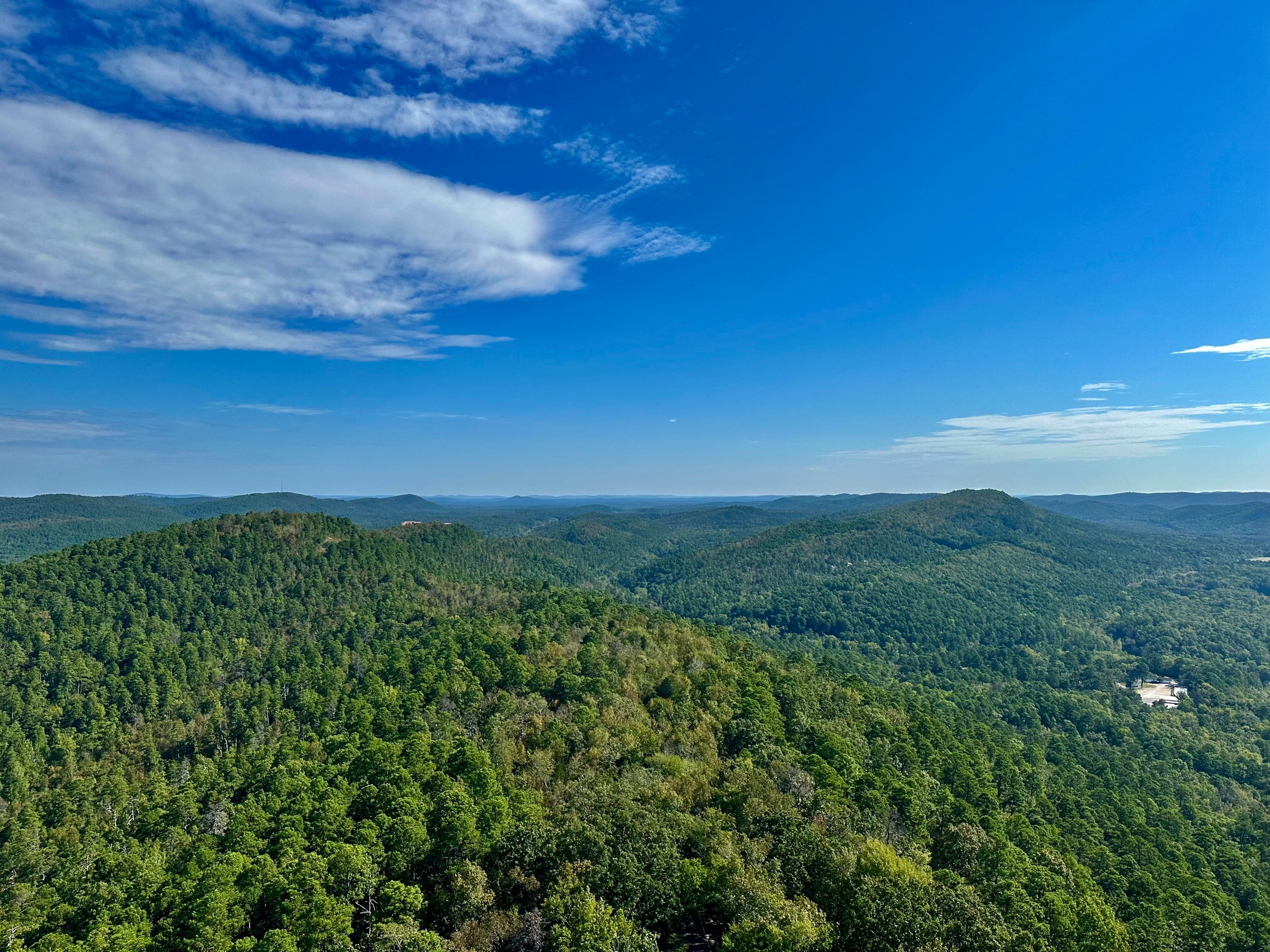
Drive west out of Hot Springs on a clear November morning and the land starts to fold. The ridges here do not wander the way most mountains do. They run in long, straight lines from east to west, one behind the next, with a valley tucked between each pair. From a high point you can see the pattern for miles: dark green pine on the crests and south-facing slopes, a mixed, rust-colored hardwood canopy on the faces turned toward the north, and the pale thread of a gravel forest road following a creek in the bottom.
This is the Ouachita National Forest, nearly 1.8 million acres across central Arkansas and southeast Oklahoma. It is a mountain forest that most people drive through on the way to somewhere else, and it is a turkey forest that very few people describe well. It is not the oak-hickory plateau of the Ozarks, and it is not the longleaf pine of the Coastal Plain. It is shortleaf pine and hardwood on narrow ridges, a forest that was cut hard a century ago, then shut in by decades of fire suppression, and then, beginning in the 1990s, deliberately opened up again.
That last part is what makes the Ouachitas worth a closer look. The Forest Service has spent three decades thinning pine, felling brushy midstory and putting fire back on the ground across the mountains, on the stated goal of rebuilding the open pine woodland that early travelers described. Turkeys are a small part of that story on paper, and a large part of it in the minds of the hunters who walk these ridges every April. This report separates what the research says from what people hope it says.
It is written in early November, with the 2026 spring season behind us and the 2027 season about five months out. It covers the landscape, the biology of a turkey in this forest, what the restoration program has and has not shown, what the Arkansas Game and Fish Commission (AGFC) numbers say, and how the spring season is structured. It stays in the Ouachitas. For the oak-hickory story one range to the north, see our report on the Boston Mountains and the Ozark National Forest.
The Landscape: East-West Ridges, Pine and Hardwood
What the Ouachita Mountains are
A 2007 Forest Service paper on restoration in the Ouachitas gives the plain outline. The Ouachita Mountains of west-central Arkansas and southeastern Oklahoma cover about 6.6 million acres and, together with the Boston Mountains and Ozark Plateaus to the north and east, form the Interior Highlands. Unlike the Ozarks, which are an uplifted plateau cut by rivers, the Ouachitas are an eroded mountain system, folded and faulted from ocean sediments some 280 million years ago. The result, in the paper's words, is an unusual east-west orientation with broad, long slopes that face south and north. Elevations run from 500 to 2,700 feet.
That orientation is the key to everything that follows. A ridge that runs east and west has one face that takes the full afternoon sun and one that sits in shade. The south-facing side takes more sun, and the north-facing side sits in shade. A 2004 Forest Service paper on pine-bluestem restoration describes the same pattern: south-facing and west-facing slopes once held fire-maintained shortleaf pine with a grassy, herbaceous understory, while north-facing slopes tend to be dominated by oaks, hickories and other hardwoods.
The forest by the numbers
The Forest Service describes the Ouachita as nearly 1.8 million acres in central Arkansas and southeast Oklahoma, and calls it the oldest and largest national forest in the Southern Region. The 2007 paper uses 1.78 million acres. President Theodore Roosevelt established it in 1907 as the Arkansas National Forest, and President Calvin Coolidge renamed it the Ouachita in 1926. The Forest Service lists five district clusters: Caddo Womble, Jessieville Winona Fourche, Mena Oden, Oklahoma, and Poteau Cold Springs. Its page describes the forest as primarily a pine-hickory mix.
One caution about acreage. The Forest Service page does not split the acres between Arkansas and Oklahoma, and older figures for the Arkansas side vary, so check current numbers with the Forest Service. What matters for turkeys is simpler: the hunting rules depend on which side of the state line a ridge falls on.
Forest Service history in two sentences
Large-scale cutting of the original forest began in the early 1910s and was largely finished by about 1940. What followed, under Forest Service stewardship, was a strict fire-suppression policy that, the 2007 paper says, continued well into the 1980s. Those two facts, a cut forest and decades without fire, explain nearly everything about the habitat a turkey finds today.
The Open Woodland That Fire Built
What early travelers described
The 2007 paper cites travelers, settlers and scientists in the 1800s and early 1900s who described open pine and hardwood forests with a floristically rich understory of grasses and forbs. The Forest Service authors note that elk and bison once found suitable habitat in these open woodland communities, and the name of Buffalo Creek is a reminder. Fire was common. In a typical Ouachita Mountain area in Oklahoma, the paper reports, fires occurred at an average return interval of less than 10 years for most sites, and tree densities then averaged about 170 trees per acre at an average diameter of 11.4 inches.
Put that in turkey terms. A pine woodland with 170 big trees to the acre and a grass-and-forb floor is a bright, open place. Seed-eating birds and insect-eating poults do well on that kind of floor. Hens can find clumps of grass to nest in. Light reaches the ground, so the insects that young turkeys eat in their first weeks can live there. That is an inference from how turkeys use cover, not a measurement from the Ouachitas, but it is the same reasoning the managers use.
What fire suppression did
By about 1970, the paper says, the shortleaf pine-bluestem woodland community had all but disappeared from the Ouachita landscape. The stands that replaced it are younger, thicker and shadier. Today's typical shortleaf pine-hardwood stand is 70 to 90 years old and carries 90 to 100 square feet of basal area in pine and about 30 square feet in hardwoods per acre. In the Oklahoma study area the average number of trees ran 200 to 250 per acre at about 9 inches across, and average fire return intervals now ranged from 40 to more than 1,200 years. Understory vegetation across the region is now dominated by woody species, and the once-common grasses and forbs are scarce.
On industry lands, meanwhile, shortleaf pine uplands were often converted to loblolly pine plantations after the late 1960s. Some of those lands were later acquired by the national forest, which is why each restoration area still contains some loblolly plantation acreage. Bachman's sparrow, brown-headed nuthatch and northern bobwhite, the paper notes, were negatively affected by the loss of habitat, and the red-cockaded woodpecker became endangered.
A turkey's view of a closed forest
A dense stand that is poor for bobwhite is not necessarily empty of turkeys. Mature hardwoods on the north-facing slopes produce acorns, and a closed forest still holds roost trees and travel corridors. The problem is the brood stage. A hen with a clutch of poults needs ground that is open enough to walk and rich enough in insects and tender plants to feed them, and a shaded, woody understory is a poor supply of both. That is the logic behind pairing restoration with turkey management, and the next section takes up what the research actually found.
The Biology of a Turkey in the Ouachitas
Nesting, hatching and the weather
Hens nest on the ground, and the timing is tied to spring. The AGFC has described April 18 as the average peak nest-initiation date in Arkansas. Poults cannot regulate their own body temperature in the first weeks after hatching, which makes them very vulnerable to cold and wet weather. This is why the biologists who track the flock talk about spring rain as much as habitat. In its report on the 2022 brood survey, the AGFC attributed much of the improvement in that year's numbers to dry weather during peak hatching.
The calendar produces a quiet fact that matters to hunters. Statewide peak nest initiation falls around April 18, the day before the Zone 1 opener on April 19, 2027, so by opening day many hens are likely laying or beginning to incubate. The AGFC's own stated reason for its recent zone changes was to stay conservative so turkeys can start nesting before hunting pressure disturbs them.
Mast, roosts and the daily shuttle
The ridge-and-valley structure means a turkey can find several kinds of habitat within a short walk. In winter, hardwood slopes with oak and hickory supply mast. In spring, the south-facing pine woodlands and the open grassy places warm earlier and green up sooner. Credible as that sequence is, we want to be careful: none of the Forest Service or AGFC papers we opened measured how far turkeys move between slope and valley or how they use particular tree species. It is a reading of the habitat, not a measured daily route, and local biologists should be the final word on it.
What the older research says
Published turkey research specific to these mountains is thin, and the older habitat studies predate the 1994 restoration program, so they describe birds in a suppressed forest, not a restored one. The most useful Ouachita-specific turkey evidence is the 1990s breeding-bird study covered in the next section, and a habitat reading like the one above should be checked against what local AGFC and Forest Service biologists see.
Restoration: What the Forest Service Is Doing and What It Has Shown
The shortleaf pine-bluestem program
The Ouachita National Forest began large-scale restoration in 1994 with a forest plan amendment that set aside some 54,000 acres to restore old-growth shortleaf pine. In 1996 another amendment added 120,000 acres in west-central Arkansas to aid recovery of the red-cockaded woodpecker. A 2002 amendment allocated 30,000 acres in McCurtain County, Oklahoma, for the same bird. The 2005 revised forest plan designated another 50,000 acres for restoration unrelated to either old-growth or woodpecker recovery. Together that is 254,000 acres, about 25 percent of the pine-dominated acreage on the forest and about 14 percent of the whole forest.
The prescription is specific. For typical second-growth shortleaf stands, foresters thin to a residual basal area of about 60 square feet per acre, fell most of the woody midstory stems, and then burn at 3- to 4-year intervals. Overstory oaks and hickories are kept as individuals or clumps within pine stands. Flowering trees and fruiting shrubs such as dogwood, serviceberry and wild plum are retained during midstory reduction. Reaching the open, grassy condition normally takes a thinning, a midstory treatment and three prescribed fires over about 10 years. For loblolly plantations, the paper describes thinning to about 60 square feet, burning on the same interval, and eventually clearcutting and replanting with native shortleaf pine.
How it gets paid for
The paper is candid about the economics. Timber purchasers are willing to pay for the privilege of cutting and removing trees under the restoration prescription, and under federal law portions of the proceeds are retained to pay for the follow-up midstory work and prescribed burning. In the authors' words, timber sales are a means to an end, not an end in themselves. That arrangement explains how the program covered so many acres with limited appropriated dollars.
The numbers, and how old they are
The treatment totals in the 2007 paper are the most detailed we found, and they are old. Since 1994, as of that paper, some 52,992 acres had been thinned, 42,948 acres had received midstory reduction, and 143,233 acres had received one or more prescribed burns. Managers estimated that 18,653 acres were in a substantially restored condition. The 254,000-acre allocation is therefore a target, not an accomplishment, and it would be wrong to say that 250,000 acres have been restored. We did not find a current Forest Service restored-acre total, so we do not print one.
What it did for turkeys: a careful reading
This is where the popular story and the research part ways. The 2007 paper summarizes a study of breeding birds by Wilson, Masters and Bukenhofer (1995) in the Journal of Wildlife Management. Ten species were significantly more numerous in treated stands than in untreated controls. Some 27 species showed higher but non-significant numbers in the treatments, and wild turkey was named in that group, along with the red-cockaded woodpecker, Bachman's sparrow, northern bobwhite and red-headed woodpecker. In plain terms: turkeys were counted at higher numbers in treated stands, but the difference was not statistically significant.
The big, significant responses were elsewhere. A study of northern bobwhite in the restoration area found population increases of 5-fold to 19-fold in treated stands compared with untreated controls. Preferred white-tailed deer forage in treated stands was 6 to 7 times greater than in controls. Small mammal populations increased in abundance and diversity, herbaceous species richness and total forb and legume abundance increased, and adult butterflies were more numerous where nectar sources were richer.
So the honest statement is this. Restoration is producing the kind of ground cover, with grasses, forbs and insects, that broods use, and the research shows clear gains for several other species. The Ouachita-specific evidence for a turkey population response is a non-significant increase in a bird survey from the 1990s. We did not find a later turkey study on restored Ouachita stands, so claims that restoration has measurably grown the turkey flock deserve a hedge.
The red-cockaded woodpecker connection
Red-cockaded woodpeckers are the reason much of the program exists. The 2007 paper reports that, in response to restoration and a translocation program, the forest's population rose from about 32 adults and 13 active territories in 1990 to some 88 adults and 37 active territories in 2006. Those are 2006 counts, not current ones. In October 2024 the U.S. Fish and Wildlife Service announced that the species had been reclassified from endangered to threatened, estimating about 7,800 clusters across 11 states, and noting that it remains at risk of becoming endangered again. The release gives no Ouachita total, so we do not offer one.
For turkey hunters, the connection is practical. A federally listed bird underwrites a program of thinning and burning that also opens ground for game, which is why the woodpecker is sometimes described as a flagship for the whole pine woodland. That is a reasonable way to frame it, as long as the framing does not slide into claiming a turkey result the studies did not report.
Population Signals: AGFC Brood and Harvest Data
The brood survey
The AGFC runs an annual brood survey and reports poults per hen. In its March 2023 report on the 2022 survey, the statewide average was 1.79 poults per hen. By region, the Delta came in at 2.21, the Gulf Coastal Plain at 2.19, the Ozarks at 1.64 and the Ouachitas at 1.46, the lowest region reported. The agency's own target band for a stable to slightly increasing population is 1.8 to 2.0, so the Ouachitas sat well below it that year.
It is easy to misuse these numbers. The 1.79 is the statewide figure, not the Ouachita figure, and the 1.46 is a single year. We did not find Ouachita-specific ratios for 2023 through 2025 in the sources we opened. What the agency did say in March 2026 is that the 2024 and 2025 brood surveys were the highest observed since 2013, statewide.
The harvest
Hunters checked 11,332 turkeys in spring 2025, up 22 percent from 9,296 in 2024, according to the AGFC's March 2026 report on its 2025 annual turkey program report. It was the first season above 10,000 birds since 2017. The harvest of the Ouachita ecoregion rose 34 percent from 2024, and the Ozark ecoregion rose 37 percent. The agency noted that harvest is strongly influenced by reproduction two years earlier, and credited increased reproduction from 2021 to 2023. The story did not give a bird count for the Ouachita ecoregion, so we report only the percentage. The 2026 season went higher still: in May 2026 the AGFC reported 13,591 turkeys checked statewide, the highest spring harvest since 2006, and credited good weather two years earlier and during most of the season. That release gave no ecoregion figures.
Harvest is also shaped by rules. The AGFC says only 440 jakes, or 4 percent of the harvest, were checked in 2025, compared with 4,610 jakes in 2003, which was nearly a quarter of that year's harvest. The AGFC says it established the no-jakes rule in 2011, and the agency credits it with improved gobbler carryover. In 2026, just over 300 jakes were checked, less than 3 percent of the harvest. Youth hunters may take one jake within their two-bird seasonal limit. Confirm the current legal-turkey definition in the AGFC hunting guidebook before you hunt.
What the numbers do and do not say
Put together, the picture is of a recovering statewide flock with one mountain region that has lagged in reproduction at least in the year we can see. Higher harvest in the Ouachita ecoregion in 2025 is encouraging, but it reflects hatches two years earlier and favorable season weather, not a verified effect of restoration. The AGFC's May 2025 report cites very few rainy or cold days in the season as a factor. Treat harvest and brood surveys as weather-sensitive indicators, and keep a hedge on any single-year claim.
On the Ground: Access, Rules and the 2027 Season
Public access in the forest
State wildlife regulations apply on national forest land in Arkansas, and national forests do not issue hunting licenses. The Forest Service's Ouachita hunting rules include that tree stands may stay in place for 14 days before they must be moved more than 200 yards away, that stands must carry the owner's name and address and be removed at the end of the season, that baiting is prohibited, and that off-highway vehicles are limited to designated routes. Check the Forest Service's motor vehicle use map, because routes not shown on it are closed to public motor vehicle travel.
Two walk-in turkey hunting areas show how the forest manages access. The Fourche Mountain Walk-In Turkey Hunting Area covers 3,162 acres about 3.5 miles south of Rover, in Yell County. The Sharptop Mountain Walk-In Turkey Hunting Area covers 11,275 acres in the Caddo-Womble Ranger District, with Glenwood listed as the nearest town, about seven miles away. Off-road vehicle use is prohibited in both, and the Forest Service closes certain roads to motor vehicles, with Sharptop's closures running from February 1 to September 1 each year. Both pages were updated in March 2025, so confirm current closures with the ranger district.
The 2027 spring season
The AGFC's turkey dates page, opened in November 2026, lists the 2027 regular spring season by zone: Zone 1, April 19 to May 9; Zone 1A, April 19 to 27; Zone 2, April 12 to May 2; Zone 2A, April 12 to 20; and Zone 3, April 5 to 25. The youth hunt for hunters ages 6 to 15 is April 10 to 11, 2027, in Zones 1, 1A, 2 and 2A, with a one-turkey limit. The statewide limit is two legal turkeys, no more than one per zone during the first seven days of the regular season, and no more than one per day. Hens, including bearded hens, are not legal. Each wildlife management area has a limit of one legal turkey, and nonresidents may take only one turkey within their seasonal bag.
Zones follow county lines, so work out which zone your county sits in using the AGFC's guidebook. One easy mistake to avoid is mixing up Ouachita County, which is a separate county, with the national forest that shares the name. Methods are set by the AGFC: shotguns of 10 gauge or smaller or archery equipment including crossbows, no shot larger than No. 2, no hunting over bait, no electronic or mechanical callers, and no hunting from 30 minutes after sunset until 30 minutes before sunrise. The dates page we opened did not list a fall turkey season, and the forest's Oklahoma district clusters fall under Oklahoma rules, so confirm Oklahoma dates with the Oklahoma Department of Wildlife Conservation. All dates are as of November 2026, so confirm with the AGFC.
Private ground, guided hunts and responsible practice
The forest is public ground, and the people who hunt it do so on their own. Commercial guiding on a national forest requires a Forest Service special-use permit, so anyone considering a paid service should ask whether it holds one, and should not assume it. Guided turkey hunts in Arkansas are on private land, and the quality of those hunts reflects the habitat on that land. A private landowner who wants to mirror the forest approach, with thinned pine, grass and regular fire, is working from the same biology, though prescribed burning on private ground has its own legal and safety requirements. Check the legal and safety requirements for burning before you plan any fire.
Responsible practice is straightforward. Hunt only legal turkeys, leave the roosts alone in the dark, report your harvest through the AGFC's system, and take part in the agency's hunter survey that asks about hunting days, gobbles heard, and gobblers and hens seen. That survey data guides the habitat work the agency describes.
Key Takeaways
The Ouachita National Forest covers nearly 1.8 million acres in Arkansas and Oklahoma, on east-west ridges that split the landscape into south-facing pine slopes and north-facing hardwood slopes.
Cutting from about the 1910s to 1940 and fire suppression into the 1980s led the shortleaf pine-bluestem woodland to all but disappear by about 1970.
The Forest Service has allocated 254,000 acres to restoration. As of its 2007 paper, 18,653 acres were judged substantially restored, so the allocation is a target, not a result.
The prescription is thinning to about 60 square feet of basal area, felling midstory stems, and burning every 3 to 4 years.
In the 1990s breeding-bird study, wild turkey showed higher but non-significant numbers in treated stands. The large gains were for bobwhite and deer forage.
The AGFC's 2022 brood survey put the Ouachitas at 1.46 poults per hen, below the statewide 1.79. Ouachita-ecoregion harvest rose 34 percent in 2025, and the 2026 statewide harvest of 13,591 was the highest since 2006.
The 2027 spring season opens April 19 in Zone 1 and April 12 in Zone 2, with a youth hunt on April 10 and 11. Confirm with the AGFC.
For the Operators
For lodges, outfitters and landowners marketing around the Ouachitas, the useful thing about this landscape is that its story is honest and specific. The restoration program, the woodpecker, the ridge-and-valley structure and the walk-in turkey areas are all documented, and visitors who care about ecology respond to a place described accurately. Avoid promising a bird count, and do not say the forest is full of turkeys because it has been restored. The research does not say that.
Public land and private land play different roles. National forest hunters hunt on their own, so a business serving them offers lodging, meals and local knowledge about access, not a guided hunt on the forest. Guided hunts belong on private land you control or lease. If you want a deeper look at how operators in these mountains talk about hunts, see our guide to marketing an Ozark and Ouachita deer-and-bear operation.
Frequently Asked Questions
How big is the Ouachita National Forest?
The Forest Service describes it as nearly 1.8 million acres in central Arkansas and southeast Oklahoma, and the oldest and largest national forest in the Southern Region. The agency's page does not split the acreage between the two states.
How many acres of shortleaf pine restoration are planned, and how many are done?
A 2007 Forest Service paper counts 254,000 acres allocated to restoration across four decisions from 1994 to 2005. As of that paper, about 18,653 acres were judged substantially restored. We did not find a more recent total, so confirm current figures with the Forest Service.
What does the restoration prescription involve?
Foresters thin pine stands to about 60 square feet of basal area per acre, fell most of the woody midstory stems, and burn at 3- to 4-year intervals. Reaching an open, grassy condition normally takes a thinning, a midstory treatment and three burns over about 10 years.
Did restoration increase wild turkey numbers?
The one study we found that named turkeys, a 1990s breeding-bird study summarized in the 2007 paper, counted more turkeys in treated stands, but the difference was not statistically significant. Clear, significant gains were shown for northern bobwhite and for deer forage. We did not find a newer Ouachita turkey study.
What was the Ouachita brood ratio, and is there a newer number?
The AGFC's 2022 brood survey put the Ouachitas at 1.46 poults per hen, the lowest region, against 1.79 statewide. The agency said statewide brood surveys for 2024 and 2025 were the highest since 2013, but we did not find Ouachita-specific ratios for those years.
When is the 2027 spring turkey season in Arkansas?
The AGFC lists Zone 1 as April 19 to May 9, 2027, Zone 2 as April 12 to May 2, and Zone 3 as April 5 to 25, with a youth hunt April 10 to 11 in Zones 1, 1A, 2 and 2A. Zones follow county lines. Confirm current dates and your zone with the AGFC before you hunt.
Can I hire a guide to hunt turkeys on the national forest?
Not without a permit. Guiding on a national forest requires a Forest Service special-use permit, and many hunters on the forest hunt on their own. Guided hunts in Arkansas are usually on private land. Contact the Forest Service and the AGFC to confirm.
Are there special rules for hunting turkeys on the Ouachita National Forest?
State rules apply, and the Forest Service adds its own: tree stands may stay up 14 days before moving more than 200 yards, stands must carry the owner's name and address, baiting is prohibited, and off-highway vehicles are limited to designated routes. Check the forest's motor vehicle use map and your ranger district.
Citations and Sources
U.S. Forest Service, Ouachita National Forest, About the Area, https://www.fs.usda.gov/r08/ouachita/about-area (accessed November 2026)
Hedrick, L. D., G. A. Bukenhofer, W. G. Montague, W. F. Pell, and J. M. Guldin. 2007. Shortleaf pine-bluestem restoration in the Ouachita National Forest, U.S. Forest Service Treesearch, https://research.fs.usda.gov/treesearch/31513 (accessed November 2026)
Thill, R. E., D. C. Rudolph, and N. E. Koerth. 2004. Shortleaf pine-bluestem restoration for red-cockaded woodpeckers in the Ouachita Mountains: implications for other taxa, https://research.fs.usda.gov/download/treesearch/20528.pdf (accessed November 2026)
Wilson, C. W., R. E. Masters, and G. A. Bukenhofer. 1995. Breeding bird response to pine-grassland community restoration for red-cockaded woodpeckers. Journal of Wildlife Management 59:56-67 (as summarized in Hedrick et al. 2007)
Arkansas Game and Fish Commission, Turkey Dates, Rules and Regulations, https://www.agfc.com/hunting/turkey/turkey-dates-rules-regulations/ (accessed November 2026)
Arkansas Game and Fish Commission, Annual turkey report offers insight into 2026 hunting season, https://www.agfc.com/news/annual-turkey-report-offers-insight-into-2026-hunting-season/ (accessed November 2026)
Arkansas Game and Fish Commission, Arkansas turkey hunters post highest harvest in 20 years (May 14, 2026), https://www.agfc.com/?p=20504 (accessed November 2026)
Arkansas Game and Fish Commission, Turkey Guidebook available online (March 23, 2022), https://agfc.com/?p=9518 (accessed November 2026)
Arkansas Game and Fish Commission, Arkansas hunters post nine-year high in turkey harvest, https://www.agfc.com/news/arkansas-hunters-post-nine-year-high-in-turkey-harvest/ (accessed November 2026)
Arkansas Game and Fish Commission, Turkey trending up in recent survey results, https://www.agfc.com/news/turkey-trending-up-in-recent-survey-results/ (accessed November 2026)
Arkansas Game and Fish Commission, Commission approves 2026 turkey season changes, https://www.agfc.com/news/commission-approves-2026-turkey-season-changes-neeley-celebrated-in-final-commission-meeting/ (accessed November 2026)
U.S. Forest Service, Ouachita National Forest, Forest Service reminds hunters about regulations on public lands (October 29, 2024), https://www.fs.usda.gov/r08/ouachita/newsroom/releases/forest-service-reminds-hunters-about-regulations-public-lands (accessed November 2026)
U.S. Forest Service, Ouachita National Forest, Permits, https://www.fs.usda.gov/r08/ouachita/permits (accessed November 2026)
U.S. Forest Service, Ouachita National Forest, Fourche Mountain Walk-In Turkey Hunting Area, https://www.fs.usda.gov/r08/ouachita/recreation/fourche-mountain-walk-turkey-hunting-area (accessed November 2026)
U.S. Forest Service, Ouachita National Forest, Sharptop Mountain Walk-In Turkey Hunting Area, https://www.fs.usda.gov/r08/ouachita/recreation/sharptop-mountain-walk-turkey-hunting-area (accessed November 2026)
U.S. Fish and Wildlife Service, Red-cockaded woodpecker downlisting release (October 2024), https://www.fws.gov/press-release/2024-10/downlisting-red-cockaded-woodpecker-endangered-threatened (accessed November 2026)
Explore More
Ozark Mountains Turkey Ecology: Arkansas's Boston Mountains and the Ozark National Forest
Wild Turkey Biology and Population Ecology: A Southeast Field Synthesis
Turkey Recruitment Decline Across the Southeast: Biology, Causes, and Conservation Responses
Black Bear Natural History and Habitat Ecology Across the Southeast
The Ouachita Mountains: Clear-Water Bass, Freshwater Scuba, and the Bear Range Nobody Markets
Marketing an Ozark and Ouachita Mountain Deer-and-Bear Operation in Arkansas
Inside the 2026-27 Wild Turkey Report: Record Harvests, Weak Hatches and Who Sells the Hunt


Comments