
Wild Turkey Ecology in Kentucky's Daniel Boone National Forest
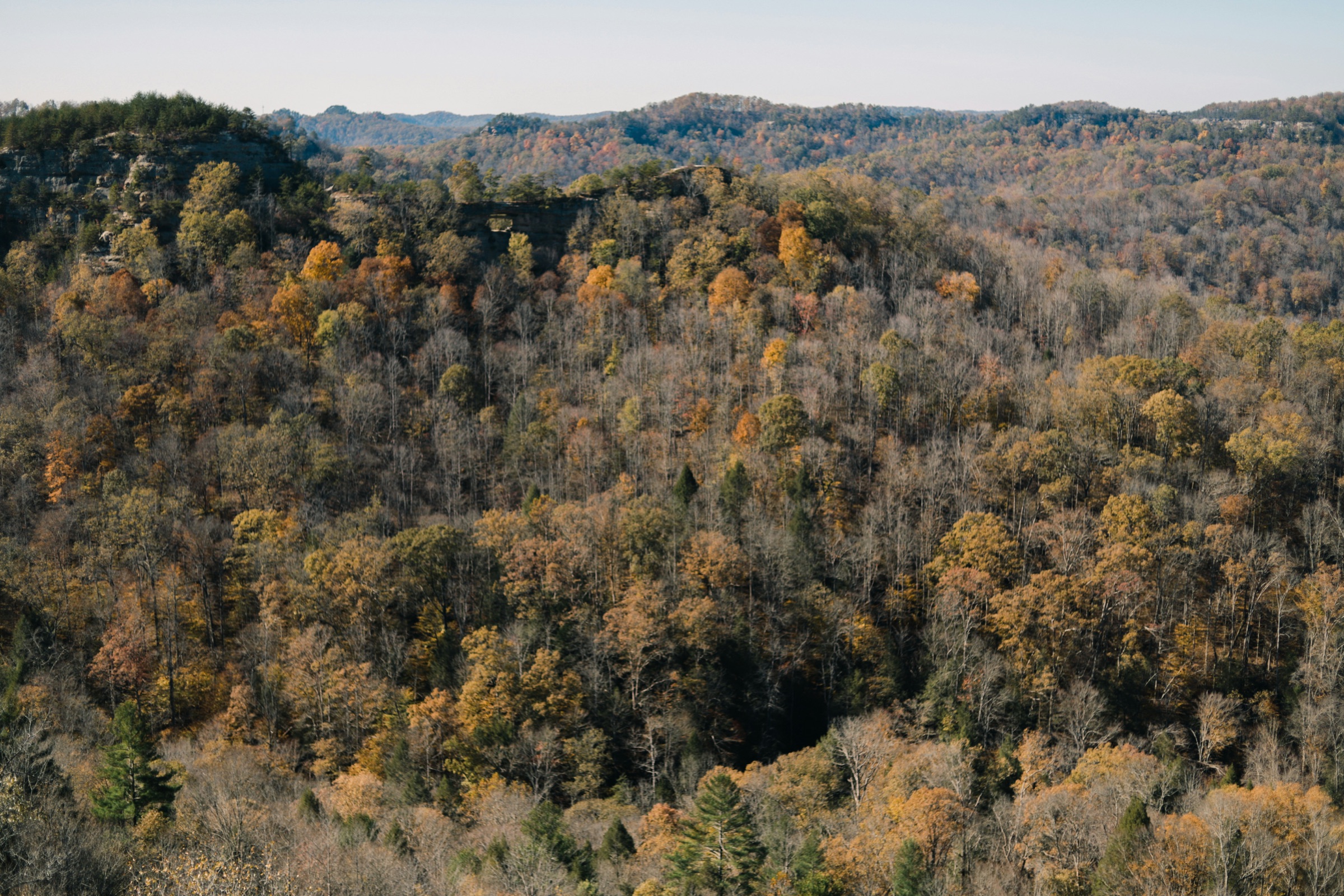
Climb out of a hollow on the Cumberland District in late autumn and the forest changes around you in a few hundred feet. Down low the ground is dark and damp, with hemlock and rhododendron shading a creek. Higher up the slope the leaf litter turns dry and pale, and the canopy is mostly oak, with sandstone ledges breaking through at the top. On a ridge like that, an eastern wild turkey does not wander an open meadow. It scratches through the leaves under the oaks, moving in a loose group, turning over acorns and listening.
This is the Daniel Boone National Forest, a landscape of the Cumberland Plateau in the Appalachian foothills of southern and eastern Kentucky, and it is as different from a Black Belt pasture or a Red Hills pine savanna as turkey country gets. The bird that lives here has to make a living in forest that is closed over almost everywhere, where the open ground that a hen and her poults need in early summer is scarce, and where the acorn crop in October can matter as much as anything that happens in April.
That makes it a good place to ask hard questions about turkey ecology, and also a place where plenty of confident claims have no numbers behind them. Kentucky publishes good statewide and regional turkey data, and none of it breaks out the national forest. This report follows the turkey through the forest's habitats and seasons, reads what the Kentucky Department of Fish and Wildlife Resources (KDFWR) has actually measured, and says plainly where the evidence ends.
The Landscape: A Forested Plateau
Forest by the numbers
The U.S. Forest Service's about page for the Daniel Boone, last updated March 25, 2025, describes national forest lands of 708,879 acres across 21 counties of southern and eastern Kentucky, set along the Cumberland Plateau in the Appalachian foothills. Those lands are intermixed with state, private and other federal lands inside a 2.1-million-acre proclamation boundary, so a map of the forest is a patchwork, not a block. The forest is run through four ranger districts, and each district's page gives its own figures: Cumberland in the north, with 182,694 acres in eight counties including Red River Gorge and Cave Run Lake; London, with 208,044 acres between the Kentucky and Cumberland rivers; Stearns, with more than 171,000 acres in southeastern Kentucky; and Redbird, with 145,850 acres in six counties. Some counties appear in more than one district, so those district acreages cannot be added together.
The same page counts 2,516 miles of streams, nearly 3,500 miles of cliff lines and 3,800 species of plants and animals, 26 of them federally listed. Two federally designated wildernesses, which the Forest Service's wilderness page names as Beaver Creek and Clifty, sit inside it. Clifty, set aside by Congress in 1985, covers 12,371 acres within the Red River Gorge Geological Area, and motorized or mechanized equipment is prohibited there. The forest's page says hunting is available for nine state-regulated game species, including wild turkey, deer, elk and squirrels, and that five wildlife management areas on the forest are managed with KDFWR.
How closed is the canopy?
For a turkey, the question that matters is how much of that forest is open. Two of the cooperative wildlife management areas give a hint. KDFWR's public-lands records list Redbird WMA, in Clay and Leslie counties, at 24,033 acres, about 98.80 percent forest and 1.22 percent open land. The Forest Service describes roughly 100 acres of openings there. Beaver Creek WMA, in McCreary and Pulaski counties, is listed at 17,753 acres, 96.21 percent forest and 3.51 percent open land, with about 150 acres of open fields. Both are owned by the Forest Service and lie within the forest.
Those are two areas, not the whole forest, but they show the pattern. Open ground is a tiny part of the landscape, and for a bird that raises young on ground-level insects, that matters. The relationship is discussed below.
Mixed mesophytic hardwoods and the oaks
The Forest Service's wilderness page describes the Red River Gorge Geological Area, where Clifty lies, as a place where cliffs tower 200 feet above mature hemlocks, hardwoods and rhododendron thickets. Another example from the Forest Service's research natural area program is Tight Hollow, a proposed 469-acre tract inside the Red River Gorge Geological Area that the agency calls predominantly old-growth hemlock and mixed mesophytic forest, including 72 acres of one of the few remaining uncut stands of yellow-poplar and eastern hemlock. That description is of one tract, not of the forest as a whole. What can be said is that the forest is diverse, mostly hardwood, and mostly closed.
Turkey Biology in Closed-Canopy Forest
The food base: mast and what comes after
A turkey's winter depends on what the forest drops. The Forest Service's species review, written in 1992 and updated in 2025, says mast and fruits are important during the fall and winter and lists oak among the plant foods in the bird's diet. In Kentucky, the 2024 population status report cites KDFWR survey data showing oak and beech mast crops above average to bumper across most of the state in fall 2023.
That is as far as the published record goes on mast and turkeys in Kentucky. A claim you will often hear, that mast failure years produce a measurable drop in poult-per-hen ratios on this forest, is not supported by anything KDFWR publishes. The 2025 brood report does not attribute its ratios to mast, and the status report ties the heavy 2023 mast crop to a lower fall harvest, not to poor production. Mast most plausibly matters, but a forest-specific number has not been published.
Nesting and incubation
Kentucky does not publish nest-site data from the national forest. The state's turkey reproductive studies are elsewhere: a 3-year Tennessee Tech study in Muhlenberg County, in western Kentucky, is measuring nesting success and first-month poult survival, and a second project begun in 2023 is assessing nesting chronology, habitat selection and brood survival of hens in western Kentucky. KDFWR cautions that such studies are a snapshot of one corner of the state.
The general biology comes from the Forest Service's species review. It gives a clutch of 10 to 13 eggs and an incubation period of 28 days, with precocial young. The review is a species-level synthesis written decades ago, not a Daniel Boone measurement. KDFWR's brood survey adds a useful point: its estimate of hatch timing, based on the size of poults that observers report, was consistent with past years and with field data from the state's research projects.
Poults, insects and openings
Young turkeys eat insects. The species review says poults rely on insects for protein, and that in the Southeast the best poult cover is a grass and forb mix roughly 16 to 28 inches tall. It says openings should make up 10 to 25 percent of a turkey's range, spaced so a hen with a brood does not have to travel more than 1 to 2 miles. Compare that guidance with the roughly 1 to 4 percent open land on the two wildlife management areas above, and the problem is clear. On large parts of this forest, the open ground a hen needs in June is limited to old fields, roadsides, utility corridors, a few wildlife openings and the edges of private land.
That is an inference from a general review and from acreage tables, not a measurement. No one has published how Daniel Boone hens actually use openings, and the single best summary is that scarce openings very likely concentrate brood activity, though that has not been measured here.
What Kentucky's Numbers Show
The statewide picture
KDFWR's 2024 population status report, prepared for the Southeast Wild Turkey Working Group, estimates the statewide population at approximately 400,000 turkeys before the 2024 spring season. Over 2014 through 2023, spring harvest averaged 30,466, while the mean poults per hen was 1.98, and the report notes that reproductive success was about twice as variable as harvest. Hunters took 33,460 turkeys in the 2024 spring season, 9 percent above the 2019 to 2023 average, with eastern region harvest up 10 percent. Public land harvest was 2,131 and wildlife management area harvest was 986. Those are statewide totals, not Daniel Boone totals.
The report also notes that notably better reproductive success in 2021 preceded the second and third highest statewide spring harvests in 2023 and 2024, and that hunters nevertheless continue to perceive a declining turkey population. Both can be true. KDFWR's 2025 brood survey says the effect of a good or bad hatch shows up in the spring harvest two years later, because two-year-old gobblers are harvested at much higher rates than one-year-old jakes. Citing banding data, the report puts the annual harvest rate at about 30 percent of adult males in the population, compared with about 6 percent of jakes.
The 2025 brood survey
KDFWR has run the brood survey each summer since 1984, with volunteers and staff reporting turkeys seen in July and August. The 2025 report estimates a statewide poults-per-hen index of approximately 3.5, up from 2.7 in 2024. By region, the Eastern Region rose from 2.3 in 2024 to 3.8 in 2025, with a 95 percent interval of 3.6 to 4.1 based on 424 observations. The Central Region rose from 2.6 to 3.6, and the Western Region fell from 3.1 to 2.4. In the Eastern Region, 84 percent of hens were seen with at least one poult, up from 60 percent in 2024, and the average brood was 4.5 poults. The report ties upticks like this to periodical cicada emergences and says 2025 production in the eastern two-thirds of the state rivaled 2008, the previous emergence of the Brood XIV cicadas, so the year likely reflects an unusual insect pulse as well as habitat.
Three cautions apply before anyone uses those numbers. First, the Eastern Region is a survey grouping of counties, not the national forest, and the report has no row for Daniel Boone, any ranger district or any wildlife management area. Second, the report says production has generally been judged against a break-even level of about 2.0 poults per hen, but the calculation method adopted in 2017 yields values about 0.4 higher than the older single-ratio method, so recent numbers should not be compared with that old benchmark point for point. Third, the survey is volunteer-reported, with quality filters applied before analysis. The report calls the long-term trend since 2017, the lowest production level on record, positive.
The practical meaning is that the 2025 eastern hatch looks like a strong year. If the two-year lag the report describes holds, it would be expected to show up in the spring 2027 harvest as a larger class of two-year-old gobblers. That is an inference from KDFWR's general explanation, not a forecast KDFWR has published, and weather, predators and hunter numbers can all change the outcome.
The fall harvest decline
Fall turkey harvest in Kentucky has dropped sharply. The status report says the 2023 fall harvest was 1,012 birds statewide, down 51 percent from 2022 and 49 percent from the 5-year average. The drop was largest in eastern Kentucky, where 220 birds were taken, 64 percent below the 5-year eastern average of 615. The department attributes it to lower hunter participation, which it ties to concern for the population, conflicts with deer season and recent bag limit reductions, and to good hard mast production. It does not present the fall decline as a measured drop in the turkey population.
Management: Fire, Mesophication and the Elk Zone
The mesophication story
For decades, the dominant story among forest ecologists in the East has been the loss of fire. Nowacki and Abrams, in a 2008 review in BioScience, argued that fire suppression since about the 1920s has turned fire-maintained open lands into closed-canopy forests and favored shade-tolerant, fire-sensitive plants over sun-loving, fire-tolerant ones, a self-reinforcing process they call mesophication. A 2021 BioScience paper by Alexander and colleagues treats it as a hypothesis with considerable support for its role in declining oak dominance, though several later phases lack direct evidence. Their Kentucky example, Bernheim Arboretum and Research Forest, shows abundant overstory oaks and oak seedlings but few oak saplings or midstory trees, the regeneration bottleneck the hypothesis predicts. Bernheim is not the Daniel Boone.
Those papers are the best peer-reviewed context for what may be happening to oak ridges across the plateau. They are not studies of turkeys on this forest. The effect of mesophication on Daniel Boone turkey habitat has not been measured, so treat the connection as plausible reasoning, not a finding. What is established is that oaks need light to regenerate, and that turkeys use oak mast.
Mine land, elk and the open-ground question
A second story in eastern Kentucky concerns open ground. KDFWR's 2025-2026 elk report says the elk herd, restored from 1,543 animals released between December 1997 and March 2002, is now estimated at over 10,000, the highest of any state east of the Mississippi River. The restoration zone covers 16 counties and about 4.1 million acres. The report says that declining surface-mine activity has meant a loss of early successional habitat and an increase in non-native autumn olive, and that elk program staff are using prescribed fire in response, with 12,054 acres burned since 2018 and a goal of 2,000 acres a year under the Eastern Kentucky Habitat Initiative.
It is tempting to say the same reclaimed grassland that feeds elk also raises turkey broods. The idea is reasonable, but the elk report never mentions turkeys, and the state's public-lands page for Boone Forestlands WMA, a 27,997-acre area of reclaimed surface-mined and forested land in Bell, Harlan, Clay and Leslie counties with 11.26 percent open land, does not mention them either. Boone Forestlands is also not a national forest unit; KDFWR lists it as owned by Boone Forestlands, LLC under a cooperative agreement with the department. Treat the turkey benefit of mine reclamation as unmeasured.
What the evidence supports for managers
For landowners and managers around the forest, a short list holds up. Keep any openings you have in tall native grass and forbs instead of mowed turf or dense fescue, since the species review ties poult cover to a grass and forb mix of about 16 to 28 inches. Keep oaks, one of the mast sources in the turkey's diet, in the system by letting light reach the forest floor where it can. Keep fire in the management toolbox where it fits, following the example of KDFWR's elk program. And do not credit or blame any single factor for a year's production, since KDFWR itself notes that reproductive success varies with weather, food and cover, land management, predators and disease.
Seasons, Rules and the Ground
What the 2026-27 fall and 2027 spring rules say
KDFWR's fall turkey page lists 2026-27 seasons as follows. Shotgun is Oct. 24-30 and Dec. 5-11, 2026. Archery runs Sept. 5, 2026 through Jan. 18, 2027. Crossbow runs Oct. 1-18 and Nov. 14 through Dec. 31, 2026. The fall limit is two turkeys, one a day, and only one may have a beard 3 inches or longer. Dogs may be used in the fall to locate and flush turkeys, and electronic calling devices are prohibited. The 2024 status report says the fall bag was reduced from four turkeys to two as of the 2023-2024 seasons.
Spring is set by formula. The youth-only season is two consecutive days starting the first Saturday in April, and the general season is 23 consecutive days starting the Saturday closest to April 15. The page prints the 2026 dates, youth April 4-5 and general April 18 to May 10, but does not print 2027 dates, so confirm them with KDFWR once published. The spring limit is two bearded turkeys, one a day, and one bearded turkey per wildlife management area. Electronic calls and dogs are prohibited, imitating turkey sounds where turkeys are likely to be is restricted from March 1 until the youth season and again between the youth season and the general opener, and feeding wildlife outside the curtilage of a home is illegal from March 1 through July 31. The spring bag was not cut from four to two. That cut applied only to the fall bag.
Public land, wildlife management areas and guiding
Turkey hunting on the national forest follows Kentucky's regulations, and the forest's cooperative wildlife management areas follow the same statewide rules unless an area page says otherwise. The state pages for Redbird, Beaver Creek and Boone Forestlands print no separate turkey dates, but the one-bearded-turkey-per-WMA rule applies on wildlife management areas. Confirm the rules for any specific area with KDFWR before you go.
Public land is where people hunt on their own. Guiding on a national forest requires a Forest Service special-use permit, and Kentucky wildlife management areas have their own rules, so confirm with the Forest Service and KDFWR before assuming that a paid guide can operate on any public area. Guided turkey hunts in this region are normally on private ground, and a hunter booking one should ask where the hunt takes place.
Basing out
The forest's best-known gateway is Red River Gorge on the Cumberland District, where the Forest Service notes a visitor-use monitoring alert from October 2026 through September 2027. It is not a turkey closure, but it is a reminder to check current Forest Service notices before you travel. The Redbird WMA is about 7 miles west of Hyden, per the Forest Service page. London, Morehead and the towns around Cave Run Lake and Laurel River Lake sit near the other districts.
Key Takeaways
Daniel Boone National Forest covers 708,879 acres of national forest land across 21 counties on the Cumberland Plateau, inside a 2.1-million-acre proclamation boundary of mixed ownership.
The forest is overwhelmingly closed canopy: Redbird WMA is about 98.80 percent forest and Beaver Creek WMA about 96.21 percent, so open brood habitat is scarce.
Kentucky's 2025 brood survey found about 3.5 poults per hen statewide and 3.8 in the Eastern Region, up from 2.7 and 2.3 in 2024, but it has no row for the national forest.
By KDFWR's two-year-lag explanation, the strong 2025 hatch, boosted by a periodical cicada emergence, would be expected to show up in the spring 2027 harvest as two-year-old gobblers; KDFWR has not published a forecast.
The mast-failure and mine-grassland benefit claims are unmeasured on this forest; the 2023 fall harvest drop in the east was tied to participation, bag limits and good mast, not to poor production.
The 2026-27 fall seasons include shotgun Dec. 5-11, crossbow through Dec. 31 and archery through Jan. 18, 2027, with a two-bird limit. Spring 2027 dates are not yet printed, so confirm with KDFWR.
Public land is for hunters on their own; guiding on national forest needs a Forest Service special-use permit, so guided hunts are normally on private ground.
For the Operators
If you run a lodge, a camp or a guide service near Daniel Boone National Forest, you are working in a landscape that outdoor travelers know for climbing, hiking and the elk herd far more than for turkeys. The person who types a question about eastern Kentucky turkey hunting is probably planning a trip around a mix of public land, private land and uncertainty about the seasons, and the first places they land are KDFWR pages and a handful of national outlets.
What nobody writes down is how the place works. Why a forest this large holds fewer birds than its size suggests, why a hatch in July shows up in a gobbler count two springs later, why an open field matters so much in a closed forest: operators who live here already know this, and publishing it with dates and a careful note about what is not measured is the kind of content that other writers and search tools cite. You do not need to claim a forest turkey density, because none exists. The honest version of your knowledge, with state figures labeled as state figures, is stronger than a number nobody can source. Pine & Marsh helps outdoor operators publish that kind of knowledge on their own sites.
Frequently Asked Questions
How many acres is Daniel Boone National Forest?
The Forest Service's about page, updated March 25, 2025, lists 708,879 acres of national forest lands across 21 counties, within a 2.1-million-acre proclamation boundary that includes state, private and other federal land. The Forest Service's home page rounds the figure to more than 708,000.
Is there a poults-per-hen number for Daniel Boone National Forest?
No. KDFWR's 2025 brood survey reports statewide and regional values only. It estimates about 3.5 poults per hen statewide and 3.8 in the Eastern Region, but it has no row for the forest or any ranger district. The Eastern Region is a grouping of counties, not the national forest.
Did Kentucky cut the spring turkey bag from four birds to two?
No. The spring limit on the current state page is two bearded turkeys per season, one a day, and one bearded turkey per wildlife management area. The cut from four to two applied to the fall bag, as of the 2023-2024 seasons, according to KDFWR's 2024 status report.
What are Kentucky's fall turkey seasons for 2026-27?
Per KDFWR's fall turkey page, shotgun is Oct. 24-30 and Dec. 5-11, 2026, archery runs Sept. 5, 2026 through Jan. 18, 2027, and crossbow runs Oct. 1-18 and Nov. 14 through Dec. 31, 2026. The limit is two turkeys, one a day. Confirm dates with KDFWR before you hunt.
When is spring turkey season in 2027?
KDFWR's page gives a formula, not dates: a two-day youth season starting the first Saturday in April and a 23-day general season starting the Saturday closest to April 15. It prints only the 2026 dates, so confirm the 2027 dates with KDFWR once they are published.
Do mast crops and mine reclamation measurably affect turkeys on this forest?
Not in published data. KDFWR's reports link a heavy 2023 oak and beech crop to lower fall harvest, not to poor production, and the elk report's habitat work for elk does not mention turkeys. Both ideas are plausible, but neither has been measured on the forest.
How many elk are in eastern Kentucky?
KDFWR's 2025-2026 elk report estimates over 10,000 elk and calls Kentucky's herd the largest of any state east of the Mississippi River. The restoration zone covers 16 counties and about 4.1 million acres. Elk and turkeys share some country, but the report does not discuss turkeys.
Can I hire a guide for turkeys on the national forest?
Guiding on a national forest requires a Forest Service special-use permit, and state wildlife management areas have their own rules, so confirm with the Forest Service and KDFWR before assuming it is allowed. Guided hunts in the region are normally on private land.
Citations and Sources
U.S. Forest Service, Daniel Boone National Forest, About the Area (last updated March 25, 2025), https://www.fs.usda.gov/r08/danielboone/about-area (accessed November 2026)
U.S. Forest Service, Daniel Boone National Forest ranger district pages (Cumberland, London, Stearns, Redbird), https://www.fs.usda.gov/r08/danielboone/offices/cumberland-ranger-district-office and the matching london-, stearns- and redbird-ranger-district-office pages (accessed November 2026)
U.S. Forest Service, Daniel Boone National Forest wilderness page, https://www.fs.usda.gov/r08/danielboone/wilderness (accessed November 2026)
U.S. Forest Service, Clifty Wilderness, https://www.fs.usda.gov/r08/danielboone/recreation/clifty-wilderness (accessed November 2026)
U.S. Forest Service, Red River Gorge, https://www.fs.usda.gov/r08/danielboone/recreation/red-river-gorge (accessed November 2026)
U.S. Forest Service, Redbird Wildlife Management Area, https://www.fs.usda.gov/r08/danielboone/recreation/redbird-wildlife-management-area (accessed November 2026)
U.S. Forest Service Research and Development, Tight Hollow Research Natural Area, https://research.fs.usda.gov/srs/rnas/locations/tight-hollow (accessed November 2026)
U.S. Forest Service, Fire Effects Information System, Meleagris gallopavo species review (written April 1992), https://research.fs.usda.gov/feis/species-reviews/mega (accessed November 2026)
U.S. Forest Service, Daniel Boone National Forest, Special Use Permits, https://www.fs.usda.gov/r08/danielboone/permits/special-use-permits (accessed November 2026)
Kentucky Department of Fish and Wildlife Resources, 2025 Kentucky Wild Turkey Brood Survey Report, https://fw.ky.gov/Hunt/Documents/ky-turkey-brood-survey-2025.pdf (accessed November 2026)
Kentucky Department of Fish and Wildlife Resources, Kentucky Wild Turkey Population Status Report 2024, https://fw.ky.gov/Hunt/Documents/2024-KY-Turkey-Status-Report.pdf (accessed November 2026)
Kentucky Department of Fish and Wildlife Resources, Fall Turkey Hunting, https://fw.ky.gov/Hunt/Pages/Fall-Turkey-Regs.aspx (accessed November 2026)
Kentucky Department of Fish and Wildlife Resources, Spring Turkey Hunting, https://fw.ky.gov/Hunt/pages/spring-turkey-hunting.aspx (accessed November 2026)
Kentucky Department of Fish and Wildlife Resources, 2025-2026 Elk Report, https://fw.ky.gov/Hunt/Documents/2025-2026-Elk-Report.pdf (accessed November 2026)
Kentucky Department of Fish and Wildlife Resources, Redbird WMA public-lands record, https://app.fw.ky.gov/Public_Lands_Search/detail.aspx?Kdfwr_id=35 (accessed November 2026)
Kentucky Department of Fish and Wildlife Resources, Beaver Creek WMA public-lands record, https://app.fw.ky.gov/Public_Lands_Search/detail.aspx?Kdfwr_id=39 (accessed November 2026)
Kentucky Department of Fish and Wildlife Resources, Boone Forestlands WMA public-lands record, https://app.fw.ky.gov/Public_Lands_Search/detail.aspx?Kdfwr_id=9003 (accessed November 2026)
Nowacki, G. J., and M. D. Abrams, The demise of fire and mesophication of forests in the eastern United States, BioScience 58(2):123-138 (2008), https://research.fs.usda.gov/treesearch/40238 (accessed November 2026)
Alexander, H. D., and others, Mesophication of oak landscapes: evidence, knowledge gaps, and future research, BioScience 71(5) (2021), https://academic.oup.com/bioscience/article/71/5/531/6117972 (accessed November 2026)
Explore More
Wild Turkey Biology and Population Ecology: A Southeast Field Synthesis
Turkey Recruitment Decline Across the Southeast: Biology, Causes, and Conservation Responses
Black Bear Natural History and Habitat Ecology Across the Southeast
Ozark Mountains Turkey Ecology: Arkansas's Boston Mountains and the Ozark National Forest
Wild Turkey of Alabama's Talladega and Bankhead National Forests
Inside the 2026-27 Wild Turkey Report: Record Harvests, Weak Hatches and Who Sells the Hunt
Coal Mines Became Elk Country: Marketing Kentucky's 16-County Elk Restoration Zone


Comments